

Finding Quality Property Leads: The Foundation of Real Estate Success
Property leads are the lifeblood of any successful real estate business. These are not simply people looking for infotainment or potential buyers; they are people with a current property. They represent potential sellers and buyers at various stages of the transaction process.
Quick Answer: What Are Property Leads?
- Definition: Contacts of property owners or buyers who have shown interest or have potential motivation to transact
- Types: Motivated seller leads, buyer leads, probate leads, distressed property leads, off-market leads
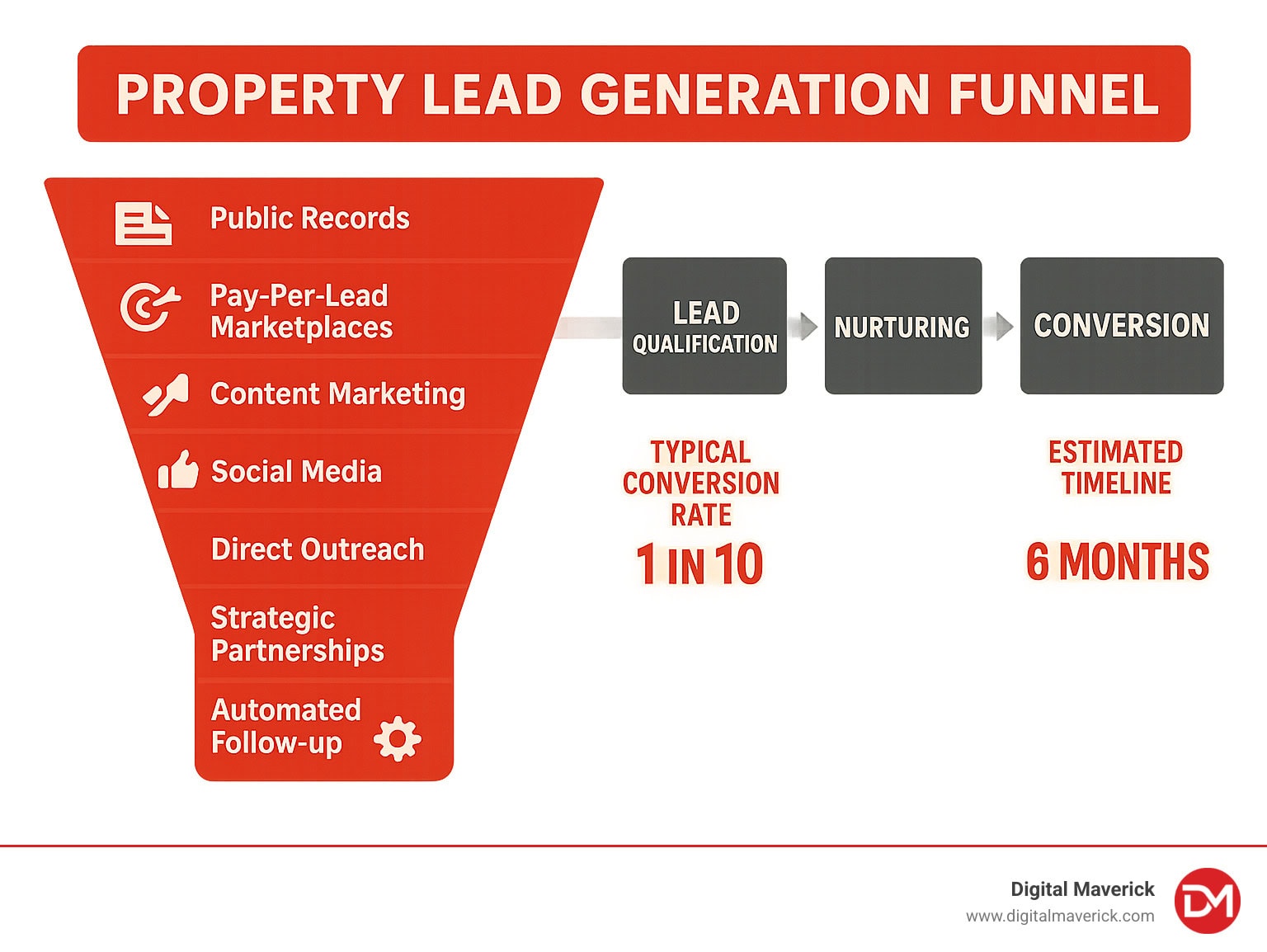
- Sources: Public records, online marketplaces, content marketing, social media, direct outreach, referral networks
- Conversion: Typically 1 in 8 to 1 in 15 motivated seller leads close, depending on market and follow-up process
- Cost: Ranges from $125-$350 per exclusive lead, depending on location and lead quality
Finding reliable property lead sources can feel overwhelming. With 96% of homebuyers using the internet in their home search, digital channels have become essential – but they’re just one piece of the puzzle.
The challenge isn’t just finding leads; it’s finding quality leads that convert into closed deals. Whether you’re pursuing motivated sellers, probate opportunities, or first-time buyers, your success depends on targeting the right prospects and implementing effective follow-up systems.
I’m Preston Guyton, founder of Digital Maverick, where I’ve spent over 20 years helping real estate teams generate and convert property leads through proven systems and coaching, specializing in empowering teams to close more deals through effective lead management strategies.
What Are Property Leads & Why They Matter
Ever wonder what separates the top 1% of real estate professionals from everyone else? From my experience coaching agents to unlocking success, it often comes down to how they source and nurture their property leads.
So what exactly are property leads? They’re potential real estate opportunities represented by contacts who have either raised their hand with interest or match specific criteria suggesting they may soon buy or sell. Unlike generic real estate inquiries, property leads connect directly to a physical asset and typically include valuable information about both the owner and the property itself.
Think of property leads as existing on a motivation spectrum:
When you connect with highly motivated sellers—those actively searching “sell my house fast” or similar terms—you’re at the top of the motivation scale. In the middle are moderately motivated folks who might be requesting property valuations or exploring their options without urgency. At the lower end are latently motivated individuals whose life circumstances (like probate situations or pre-foreclosure status) suggest they might need real estate services soon, even if they don’t know it yet.
“Property leads are considered the premier source of potential deals because they combine both a motivated party and a specific asset,” explains veteran investor Mark Johnson, who has closed over 700 transactions in his career. “When you know both who to contact and what property they’re connected to, your conversation becomes immediately relevant.”
The quality of your leads matters far more than quantity—something I’ve seen proven time and again with our clients. The conversion math tells the story: average motivated seller leads typically close at rates between 1 in 8 to 1 in 15. However, when you focus on high-quality, exclusive leads, those numbers can improve dramatically to around 1 in 3 within just 90 days.
This is why exclusivity and data accuracy are so crucial. One premium lead that closes is worth more than dozens of low-quality leads that go nowhere. That single transaction can cover your marketing costs for months while building your reputation in the community.
With this foundation in mind, let’s explore the seven proven methods for finding quality property leads that actually convert into closings.
Leverage Public Records & Hyperlocal Data
Public records represent a goldmine of property lead information, giving you access to ownership details, transaction history, and property characteristics that can help identify motivated sellers before they ever list.
Platforms like PropertyRadar provide access to over 150 million properties and more than 1 billion recorded documents nationwide. Then, there is ez Home Search that offers agents and consumers information on every residential property in the United States. This wealth of information allows for hyperlocal targeting—focusing on specific neighborhoods or even individual streets where you want to build your business.
“It’s about being first to connect,” says Sarah, a user who consistently sources off-market deals. “When you can identify potential sellers before they’ve made a public decision to sell, you’re not competing with every other agent in town.”
Key benefits of public records for property lead generation include:
- Identifying pre-distressed properties before foreclosure listings appear
- Finding high-equity owners who could sell without financing contingencies
- Targeting absentee owners who may be tired of property management
- Finding recent inheritance situations that often lead to sales
Modern platforms improve these records with skip tracing capabilities, allowing you to find current contact information for property owners even if they don’t live at the address.
Using County Courthouse & Probate Filings
“Probate leads are the low-hanging fruit,” according to US Probate Leads, which has been sourcing these opportunities for over 20 years. Why? Because executors almost always want to sell inherited properties, as heirs typically prefer cash over managing real estate.
Probate filings are available in over 3,000 markets nationwide and represent a significant opportunity as trillions of dollars transfer between generations in the coming years. These property leads offer several advantages:
- Highly motivated executors with fiduciary responsibilities to liquidate assets
- Less competition compared to on-market properties
- Potential for below-market acquisitions due to condition or timeline pressures
The pandemic created an additional opportunity in this space. Pre-pandemic, probate properties typically sold within 2-6 months of filing. Today, backlogs have extended that timeline to 12-36 months, creating a larger pool of aged leads available at bulk pricing—sometimes as low as $0.45 per lead for volume purchases.
Stacking Multiple Data Filters to Pre-Qualify Property Leads
The true power of public records comes from combining multiple filters to pinpoint precisely the type of property leads you want to pursue.
For example, you might create a list that includes:
- Single-family homes
- Owned for 10+ years
- 70%+ equity
- Absentee owner
- No mortgage refinance in last 5 years
- Property tax delinquency
“When you stack filters like this, you’re essentially pre-qualifying leads based on data,” explains Tom Wilson, who uses BatchLeads to find off-market opportunities. “Instead of sifting through hundreds of contacts, you’re focusing on the 10-20% most likely to convert.”
Most platforms offer 300+ data filters, allowing you to create highly targeted lists based on your investment strategy or buyer needs. This precision targeting dramatically improves ROI by ensuring your outreach efforts focus on the most promising prospects.
Tap Into Online Pay-Per-Lead Marketplaces
Finding quality property leads has never been easier thanks to pay-per-lead marketplaces. These platforms have transformed how real estate professionals connect with motivated sellers and buyers, offering a straightforward approach: you only pay for the leads you receive.
Think of these marketplaces as your on-demand lead generation team. They handle all the marketing heavy lifting—creating ads, building landing pages, and qualifying prospects—then deliver ready-to-contact leads straight to your inbox.
“I was spinning my wheels trying to build my own lead generation system,” shares Michael, a real estate agent in Denver. “Switching to a pay-per-lead model gave me immediate results without the headache of managing marketing campaigns.”
When comparing your options, consider this helpful breakdown of the three main lead generation models:
| Model | Pros | Cons | Best For |
|---|---|---|---|
| Pay-Per-Lead | • Pay only for what you get • No upfront investment • Immediate results | • Higher per-lead cost • Quality varies by provider • Limited control over volume | Teams needing predictable lead flow without setup costs |
| Subscription | • Lower per-lead cost at volume • Consistent monthly expense • Often includes tools/CRM | • Pay regardless of lead volume • Requires longer commitment • Setup and learning curve | Established teams with consistent marketing budgets |
| DIY Generation | • Complete control over process • Brand building opportunity • Lowest long-term cost | • High upfront investment • Technical skills required • Delayed results | Teams with marketing expertise and patience for ROI |
The beauty of pay-per-lead platforms is that the leads come to you already seeking solutions. As Property Leads explains, “These sellers are raising their hands asking for help, not being interrupted by cold calls or mailers.” This inbound approach typically creates warmer conversations and higher conversion rates.
Evaluating Lead Cost & Close Rates for Property Leads
When it comes to property leads, the old saying rings true: you get what you pay for. Costs typically range from $125-$350 per exclusive lead, with prices varying based on several factors.
Location plays a huge role—leads in competitive markets like Miami or San Francisco command premium prices compared to smaller markets. The type of lead matters too, with motivated seller leads generally costing more than buyer leads due to their higher potential value.
Smart real estate professionals focus on ROI rather than just the upfront cost. As Elizabeth Avery, who sources leads through multiple channels, puts it: “I’d rather pay $300 for a lead with a 1-in-8 close rate than $30 each for leads with a 1-in-100 chance.”
When evaluating a marketplace, look beyond the sticker price and ask these essential questions:
What are the actual close rates? (A 1-in-8 ratio is solid, while 1-in-3 is exceptional)
How do they verify lead quality? (Phone verification is better than just email)
What’s the average time-to-close? (Faster closes mean quicker ROI)
Do they offer quality guarantees or refunds?
The best platforms are transparent about these metrics, giving you confidence that your investment will pay off.
Protecting Your Budget With Refund & Off-Market Clauses
Nobody wants to pay for property leads that don’t deliver. Quality marketplaces understand this and offer protection through clear refund policies.
Some platforms will refund or replace leads that don’t meet their standards.
Look for marketplaces that offer refunds when:
- The property type doesn’t match your specifications (like getting mobile homes when you asked for single-family)
- The property is already listed on the MLS when marketed as off-market
- Contact information proves invalid or unreachable
- The lead is actually another investor or wholesaler
- The submission is clearly spam or fraudulent
Another possible protection is the “off-market guarantee.” This ensures the leads you receive aren’t simultaneously listed on the MLS or working with other agents—giving you exclusive access to these opportunities.
The industry has also moved away from long-term contracts, with most quality marketplaces now offering flexible arrangements. This means you can adjust your strategy based on results without being locked into ongoing commitments.
“The ability to scale up or down based on my pipeline has been game-changing,” shares Thomas, a team leader in Charlotte. “During busy seasons, I can reduce my lead volume and focus on closings, then ramp back up when I need more inventory.”
By carefully selecting the right marketplace partner, you can create a reliable stream of high-quality property leads without the overhead of building and maintaining complex marketing systems.
Build Inbound Funnels with Content, SEO & Lead Magnets
Creating your own inbound property lead generation system might take longer than buying leads, but it pays dividends for years to come. Think of it as planting a garden that continuously produces fresh leads without the ongoing expense of purchasing them.
The digital house-hunting revolution is in full swing. According to the National Association of Realtors, a whopping 96% of homebuyers now use the internet during their home search. This presents an incredible opportunity to position your website as the destination for these motivated searchers.
“I was spending thousands monthly on purchased leads before building our content strategy,” shares Torres, a broker who transitioned to inbound marketing. “Now our website generates 30-40 qualified property leads monthly at less than a third of what we were paying before.”
A successful inbound funnel isn’t just a website—it’s an ecosystem designed to attract, capture, and nurture potential clients. The essential components include:
SEO-optimized landing pages that speak directly to local buyers and sellers, addressing their specific concerns and questions. These pages should rank for terms people actually search for in your market.
IDX website integration that keeps visitors engaged with current listings rather than sending them elsewhere to see homes. “Just be sure to use an IDX provider that doesn’t use subdomains, to avoid the 80%+ bounce rate often seen with outdated IDXs”, says Kurt Uhlir, CMO at ez Home Search.
Lead magnets that provide genuine value—think neighborhood guides, first-time buyer checklists, or investment property calculators—in exchange for contact information.
Retargeting ads that maintain visibility with prospects after they leave your site, gently reminding them of your services as they browse elsewhere online.
“The most successful real estate websites aren’t just beautiful—they’re conversion machines,” notes digital strategist Emma Chen. “Every element should guide visitors toward providing their contact information in exchange for something they genuinely value.”
Converting Organic Traffic Into Property Leads
Getting traffic to your website is only half the battle. The real challenge is changing anonymous visitors into identified property leads you can nurture into clients.
Gated Comparative Market Analyses work wonderfully because they offer substantial value (answering the critical “what’s my home worth?” question) while requiring contact information. Smart agents make this process feel like a fair exchange rather than a trap.
Home valuation tools that deliver initial estimates instantly but send detailed results via email create another natural exchange of value for contact information. This is one of the reasons agents partner with ez Home Search to allow them to easily offer AVMs to their clients.
Behavioral tracking helps identify your hottest prospects based on their actions. Someone who returns to your “selling timeline” page four times in a week is sending clear signals about their intentions. These signals can trigger personalized follow-up sequences that feel timely rather than random.
“We noticed one visitor had viewed the same luxury condo listing eight times in three days,” recalls listing agent Sophia Washington. “Our automated system flagged this behavior, prompting a personalized outreach. That visitor became a $1.2 million buyer within three weeks.”
Tracking Keywords Like “Sell My House Fast”
The words people use in search engines reveal volumes about their motivation and timeline. High-intent keywords signal someone actively seeking solutions rather than casually exploring options.
When someone searches “sell my house fast in Phoenix,” they’re practically raising their hand as a motivated seller. Other revealing searches include:
“Cash offer for home in [neighborhood]”
“How to sell inherited property”
“Selling home in foreclosure”
Creating content specifically addressing these high-motivation scenarios not only improves your search rankings but attracts the most conversion-ready property leads.
“We created neighborhood-specific landing pages targeting phrases like ‘sell house quickly in Riverside Heights’ and saw our lead quality improve dramatically,” explains SEO specialist Jamal Williams. “These longer, more specific phrases might have lower search volume, but the conversion rates are exponentially higher.”
This long-tail keyword approach—focusing on specific neighborhoods or situations—often faces less competition than broader terms while attracting prospects with clear intentions. A page addressing “selling a home during divorce in Westlake” might only get a few visitors monthly, but those visitors are precisely the motivated sellers you want to connect with.
By building these inbound funnels systematically, you create an asset that generates property leads around the clock without requiring constant investment. While it takes time to develop, the long-term return makes content marketing one of the most sustainable lead generation approaches available to real estate professionals.
Mine Social Media & Influencer Networks
Social media platforms offer powerful ways to identify and connect with potential property leads through both organic engagement and targeted advertising.
According to research published in Forbes, word-of-mouth remains one of the most powerful marketing tools, with 63% of consumers between 18 and 34 trusting what influencers say about brands more than the brands themselves. This trust factor makes social media an ideal channel for real estate lead generation.
Effective social media strategies for generating property leads include:
- Joining and actively participating in local Facebook groups
- Creating neighborhood-specific content that showcases your expertise
- Conducting live video walkthroughs of properties
- Using Instagram story polls to identify followers considering buying or selling
- Partnering with local micro-influencers who can refer clients
“Brands leveraging micro-influencers can see up to an 18% increase in sales,” notes social media expert Jessica Martinez. “In real estate, this translates to more leads and listings from people who already trust the influencer’s recommendations.”
Paid Social Ads vs Organic Engagement for Property Leads
Both paid and organic approaches have their place in a comprehensive social media strategy for property lead generation.
Paid social advertising offers:
- Precise targeting based on demographics, interests, and behaviors
- Look-alike audience creation based on your existing clients
- Lead forms that capture contact information without leaving the platform
- Retargeting capabilities to re-engage website visitors
“Network Boost integration delivers exclusive social media leads and automatically nurtures them in the agent’s CRM,” explains Market Leader, which generates over 1 million social media leads annually. This automation helps overcome the follow-up challenges that often plague social media lead generation.
Organic engagement, while slower to produce results, builds deeper relationships and credibility:
- Regular posting of market updates and insights
- Responding to questions in community groups
- Sharing client success stories (with permission)
- Creating educational content about the buying/selling process
The most effective approach combines both strategies: paid ads to generate immediate leads and organic engagement to build long-term authority and referral networks.
Leveraging User-Generated Content & Testimonials
User-generated content—reviews, testimonials, and client stories—serves as powerful social proof that can significantly increase lead conversion rates.
“Hearing from other homeowners who had a positive experience selling their property creates trust that no amount of self-promotion can match,” explains Samantha Wright, who has built a thriving business largely through referrals and testimonials.
Effective ways to leverage user-generated content include:
- Video testimonials from satisfied clients
- Before-and-after photos of renovated properties
- Client quotes highlighting specific pain points you solved
- Neighborhood features written by current residents
This content not only builds credibility but also helps potential clients envision themselves working with you, making them more likely to convert from leads to clients.
Direct Outreach: Driving for Dollars & Door-Knocking
There’s something magical about getting out into neighborhoods and seeing properties with your own eyes. Despite all our digital advances, this old-school approach remains one of the most effective ways to uncover quality property leads—especially if you’re hunting for those elusive off-market deals.
I’ve seen countless investors transform their businesses through what we affectionately call “driving for dollars”—systematically exploring neighborhoods to spot potential opportunities before anyone else. The beauty of this method is how it now combines traditional legwork with modern technology.
“Within 30 days of driving, I found my very first deal!” shared an enthusiastic investor who finded the power of this approach. This isn’t unusual—when you physically see properties that others miss while scrolling online, you gain a serious competitive edge.
What should you look for? The telltale signs of a potentially motivated seller include overgrown lawns, peeling paint, accumulated mail, code violation notices posted on doors, FSBO signs, or even renovation dumpsters that might indicate a flip in progress. These visual cues often reveal opportunity before it hits any listing platform.
Today’s driving apps make this process incredibly efficient. You can map optimal routes, snap photos of interesting properties, and instantly access ownership information—all while you’re still parked outside. Some apps even provide immediate skip-tracing so you can contact owners directly after spotting a promising property.
Building a Field Data Collection Checklist
To make the most of your neighborhood scouting, you’ll want a consistent way to evaluate potential property leads. Think of it as your treasure hunt checklist:
First, assess the property’s condition. Look for exterior maintenance issues like damaged roofs or siding, broken windows, and neglected landscaping. These visual cues often correlate with an owner’s motivation to sell.
Next, verify occupancy. Are there curtains in the windows? Furniture visible? Is the utility meter running? Sometimes a friendly neighbor can confirm whether someone’s still living there.
Finally, gather owner contact information. This is where modern apps shine—providing skip-tracing results on the spot. Neighbors can sometimes provide owner details too, especially for properties that have been vacant for a while.
“The key is consistency and volume,” veteran investor Robert Chen told me. “I aim to identify at least 20 potential properties during each driving session, knowing that only 1-2 might convert to actual leads.” It’s a numbers game, but with remarkably better odds than many digital approaches.
Many successful investors take this a step further by immediately knocking on doors when appropriate. That personal connection can be invaluable—there’s simply no substitute for a face-to-face conversation with a potential seller.
Safety, Etiquette & Legal Considerations
Before you grab your car keys and hit the road, let’s talk about doing this right. Direct outreach requires thoughtful attention to safety, etiquette, and staying on the right side of the law.
Always respect boundaries. “No Soliciting” signs aren’t suggestions—they’re boundaries to honor. The same goes for neighborhood restrictions and local ordinances that might limit door-knocking activities.
Timing matters too. Stick to daylight hours when people feel more comfortable opening their doors to strangers. Dress professionally, carry business cards, and consider bringing a partner when exploring unfamiliar areas.
The goal is to be seen as a professional resource, not an intrusion. Your approach should communicate respect for the homeowner’s time and privacy from the moment they see you.
From a legal standpoint, know your disclosure requirements. In many states, you must immediately identify yourself as a real estate professional and clearly explain why you’re there. This transparency isn’t just legally required—it builds trust from the start.
When done respectfully and consistently, this direct approach to finding property leads can yield opportunities that digital methods simply can’t match. The combination of your trained eye, technology tools, and personal connection creates a powerful advantage in today’s competitive market.
Strategic Partnerships & Referral Networks
When it comes to property leads, some of the highest-quality opportunities never make it to the open market. They come through relationships with other professionals who regularly interact with potential buyers and sellers at critical decision points.
Think about it: who knows someone is considering selling before they even call an agent? Often it’s their attorney, financial advisor, or contractor. These strategic partnerships can become your most reliable source of pre-qualified property leads.
“I couldn’t imagine having to do all that by hand,” shares one agent who receives regular referrals from a network of financial planners. These warm introductions typically convert at 3-5 times the rate of internet leads because they come with an established trust connection already in place.
Your potential referral network is likely more extensive than you realize. Consider building relationships with:
- Real estate attorneys handling transactions and estate planning
- Probate specialists working with executors and heirs
- Contractors who identify homeowners planning major renovations
- Loan officers speaking with clients about refinancing vs. selling
- Local businesses deeply connected to your community
Structuring Win-Win Referral Agreements
The most sustainable partnerships create value for everyone involved. When approaching potential referral partners, focus on how you’ll make their lives easier and their clients happier—not just what’s in it for you.
“When you win, we win” should be more than just a catchphrase. It should guide how you structure these relationships. Clear agreements benefit both parties and prevent misunderstandings down the road.
Most successful referral partnerships include some combination of:
Commission Splits typically range from 25-35% for residential referrals, providing meaningful compensation without eroding your profit margin. Be upfront about your structure and put it in writing.
Co-Marketing Arrangements can work beautifully when you share costs and leads with complementary businesses. A mortgage broker and real estate agent splitting the cost of a homebuyer workshop creates value for both while attracting qualified property leads.
Reciprocal Referrals ensure the relationship isn’t one-sided. Track who you’re sending business to and make sure there’s a healthy balance over time.
Value-Added Services like offering free CMAs to a financial planner’s clients or market analyses for a divorce attorney’s clientele demonstrate your expertise while providing genuine value.
Remember to check compliance requirements in your state. In most jurisdictions, referral fees can only be paid to licensed real estate professionals, though marketing partnerships remain available for non-licensed partners.
Hosting Educational Events to Attract Property Leads
Educational events position you as a trusted advisor rather than a salesperson—perfect for attracting potential clients who might ignore direct sales approaches.
The most effective educational events solve specific problems rather than covering general topics. Compare these two workshop titles:
- “Real Estate 101” (too generic, attracts tire-kickers)
- “How to Maximize Your Home’s Value Before Selling in Westlake” (specific, attracts motivated sellers in a target neighborhood)
Your event format options are endless: first-time homebuyer workshops, investment property seminars, downsizing strategies for seniors, home renovation ROI presentations, or local market update webinars. The key is providing genuine value while collecting contact information for personalized follow-up.
Don’t be afraid to get creative with your partners. A joint workshop with a home stager, mortgage broker, and estate attorney creates a comprehensive resource for potential sellers while splitting the cost and effort four ways. Everyone wins—especially the attendees who leave with valuable information and a connection to professionals they may need soon.
Every educational event should include a soft next step for attendees who are ready to move forward, whether that’s a free consultation, personalized market analysis, or property tour.
Automate Follow-Up & Nurture to Convert Property Leads
Let’s face it – even the most promising property leads won’t magically turn into deals without consistent follow-up. It’s like planting seeds without watering them – a complete waste of your initial investment.
“Speed-to-lead is critical,” explains conversion lead Travis Halverson. “The difference between contacting a lead within five minutes versus 30 minutes can drop conversion rates by 400%.”
I’ve seen this with countless real estate professionals – the ones who thrive aren’t necessarily those with the best leads, but those with the most diligent follow-up systems. Today’s successful agents leverage a powerful combination of tools:
- CRM workflows that keep your follow-up on autopilot
- AI assistants providing those crucial 24/7 initial responses
- Multi-channel outreach that meets prospects where they are
- Behavioral tracking that helps you focus on the hottest opportunities
At Digital Maverick, we’ve finded something remarkable: implementing structured follow-up systems can double or triple conversion rates from the exact same lead sources. Our full-service Inside Sales Agent (ISA) team handles this critical work so you can focus on what you do best – meeting clients and closing deals.
Crafting a 10-Day Speed-to-Lead Cadence for Property Leads
When a fresh property lead comes in, the clock starts ticking. Here’s what an effective 10-day follow-up sequence looks like:
Day 1 is all about immediate response. Send a text message within 5 minutes, make your first call within 15 minutes, and follow up with a value-rich email containing relevant market information. Make a second call attempt 4-6 hours later, leaving a friendly voicemail if they don’t answer.
Days 2-3 keep the momentum going. Start with a morning text check-in, followed by an afternoon call attempt. Send a connection request on social media, and consider sending a quick personalized video email – these stand out tremendously in crowded inboxes.
Days 4-7 is where you demonstrate value. Alternate your contact channels daily, send information about properties matching their criteria, and provide a neighborhood market report that showcases your expertise.
Days 8-10 brings your sequence to a thoughtful close. Send a final value-add communication, followed by a “break-up” email or text that gently acknowledges their timing might not be right. Then transition them to your long-term nurture sequence.
“Investors using multiple exit strategies and automated CRM follow-ups achieve higher close rates,” notes Property Leads, which has tracked conversion data across thousands of transactions. The key is persistence without being pushy.
Measuring Conversion KPIs & Optimizing Continuously
To get the most from your property lead investment, you need to track what’s working at each stage of your funnel:
Your contact rate tells you what percentage of leads you’re successfully reaching. If this number is low, you might need better quality leads or improved contact information.
Your appointment set rate reveals how effectively you’re converting conversations into meetings. Low numbers here often indicate issues with your value proposition or qualification process.
Pay attention to your show rate – the percentage of scheduled appointments actually kept. A high cancellation rate usually means prospects weren’t properly qualified or didn’t feel sufficiently invested.
Track your contract rate to see what percentage of appointments result in signed agreements. This metric directly reflects your presentation and closing skills.
Finally, monitor your close rate to see how many contracts successfully make it to the closing table. Issues here often relate to financing, inspections, or other transaction management challenges.
“Clear daily reporting, CRM audits, and accountability metrics are built into every plan,” explains Digital Maverick’s approach to conversion optimization. By identifying exactly where prospects are falling out of your funnel, you can make targeted improvements that dramatically impact your bottom line.
Regular analysis of these metrics isn’t just about spotting problems – it’s about continuous improvement that compounds over time, turning more of those valuable property leads into commission checks.
Frequently Asked Questions About Property Leads
What’s the difference between property leads and traditional real estate leads?
When you’re building your real estate business, understanding the distinction between different lead types can make all the difference in your conversion rates.
Property leads connect a specific motivated party with an actual physical property. Think of it as having both sides of the equation solved at once. Unlike traditional real estate leads that might just tell you someone is “interested in buying in the northeast area,” a property lead gives you actionable intelligence like “John Smith, owner of 123 Maple Street, who searched for ‘sell my house fast’ three times this week.”
This connection creates an immediate opportunity for relevant, targeted conversations. You can discuss the actual property in question rather than generic market conditions, which naturally results in higher engagement and conversion rates. It’s the difference between casting a wide net and using a spear to catch exactly what you’re looking for.
How much should I expect to pay per high-quality property lead?
The investment for quality property leads varies widely based on several factors, and understanding this range helps you budget effectively.
In competitive markets like Southern California or New York, you’ll typically pay premium prices compared to less competitive regions. Similarly, exclusive leads (only sold to you) command higher prices than shared leads but generally convert at much better rates.
As a general guideline, you can expect to invest:
- $125-$200 for basic exclusive motivated seller leads
- $200-$350 for highly qualified, verified seller leads with strong motivation signals
- $20-$60 for buyer leads through platforms like Zillow Premier Agent
Smart real estate professionals look beyond the upfront cost to calculate their effective cost per acquisition. A $300 lead with a 1-in-10 close rate means you’re spending about $3,000 to acquire a client. Compare that to a $50 lead with a 1-in-100 close rate, which actually costs $5,000 per acquisition. Sometimes paying more upfront actually saves you money in the long run!
How do platforms ensure lead exclusivity and prevent reselling?
Nothing’s more frustrating than finding you’ve paid for “exclusive” leads only to find three other agents calling the same prospect. Quality lead providers understand this concern and have developed several safeguards.
Many premium platforms use bid-based systems where the highest bidder receives exclusive rights to leads in specific zip codes or counties. Once you’ve secured your territory, no one else can purchase leads from that area through the platform.
Real-time delivery systems also help maintain exclusivity. When a lead comes in, it’s instantly routed to you without sitting in a database where it might be resold. This immediate delivery, often within seconds of the lead being generated, prevents opportunities for shady reselling practices.
The best providers back their exclusivity claims with contractual guarantees and transparent refund policies. If you find a lead has been sold to multiple parties, these guarantees ensure you’ll be reimbursed.
“Each lead is delivered exclusively and in real time, never resold to multiple parties,” explains one marketplace specializing in motivated seller leads. This commitment to exclusivity isn’t just about ethics—it’s about ensuring you don’t waste time competing against other buyers for the same prospect.
Before committing to any lead provider, ask specific questions about their verification systems. Quality platforms use phone screening and SMS verification to confirm lead legitimacy before delivery, filtering out time-wasters before they reach your inbox.
Conclusion
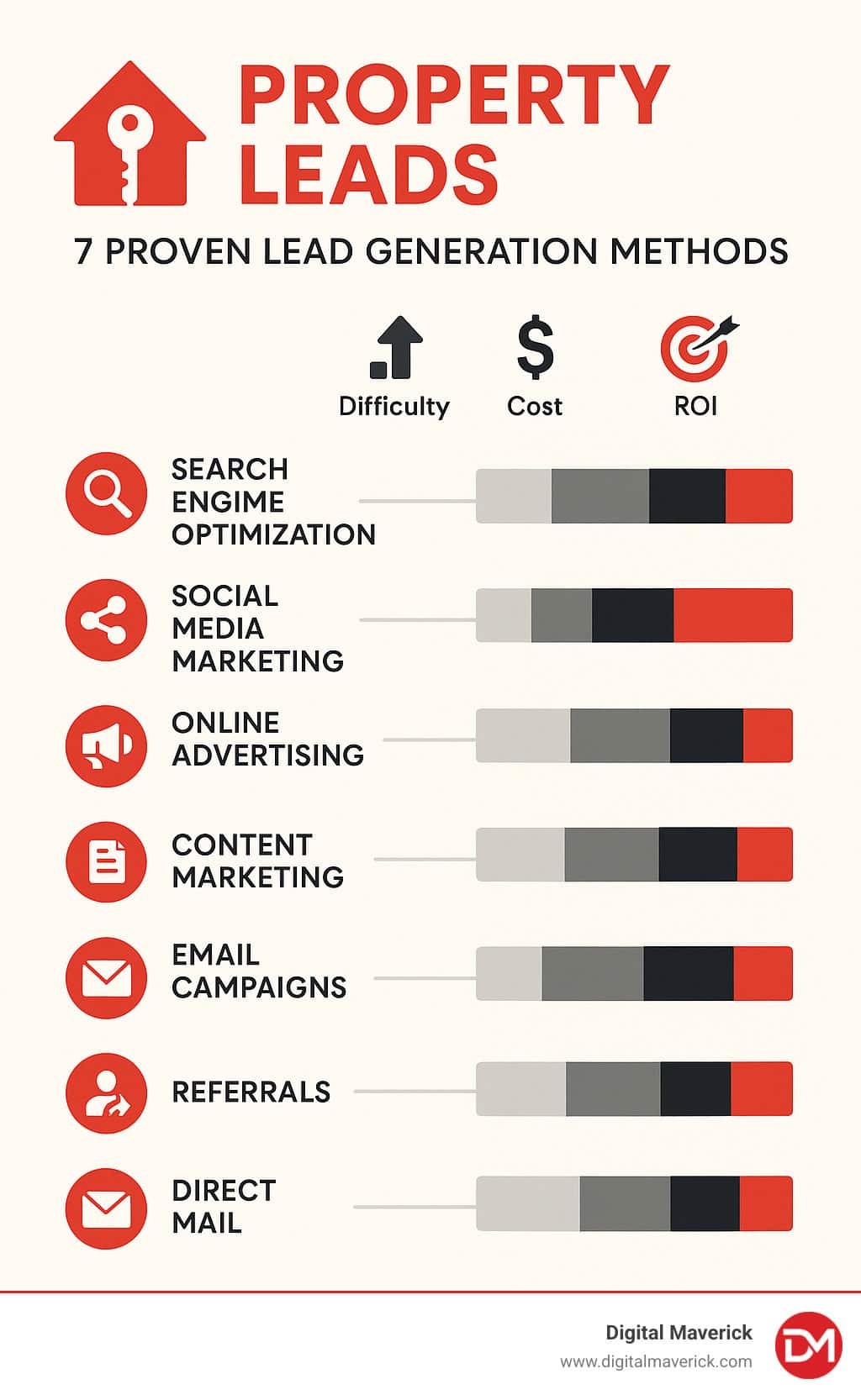
Finding quality property leads requires a multi-faceted approach that combines data-driven targeting, strategic partnerships, and systematic follow-up. The seven methods we’ve explored provide a comprehensive framework for building a sustainable lead generation system:
- Leverage public records and hyperlocal data
- Tap into online pay-per-lead marketplaces
- Build inbound funnels with content and lead magnets
- Mine social media and influencer networks
- Implement direct outreach strategies
- Develop strategic partnerships and referral networks
- Automate follow-up and nurture sequences
The journey to consistent real estate success isn’t about chasing every lead source available—it’s about creating a thoughtful blend of strategies that work together. Like a master chef combining ingredients, the right mix of lead generation methods creates something far more powerful than any single approach could deliver.
At Digital Maverick, we’ve seen how these strategies transform real estate businesses. We’ve helped hundreds of teams move beyond the frustration of wasted leads and inconsistent results to build predictable, scalable systems that consistently convert opportunities into closings.
What makes our approach different? We’re operators, not just vendors. We’ve walked in your shoes, scaled real estate businesses ourselves, and developed frameworks that actually work in today’s competitive market. Our comprehensive programs combine expert conversion services with hands-on coaching that teaches your team not just what to do, but how to think about lead generation and follow-up.
The right operating rhythm makes all the difference—ensuring your agents have more meaningful conversations, stay accountable to their goals, and consistently close more deals. Whether you’re struggling with speed-to-lead, sitting on a goldmine of untouched database contacts, or trying to build a high-performance conversion culture, we provide the structure and support to make it happen.
Success with property leads isn’t just about finding them—it’s having the systems, training, and people to consistently turn those leads into conversations, and those conversations into closings. By focusing on quality over quantity and implementing the strategies outlined in this guide, you can build a predictable pipeline that drives sustainable growth for your real estate business.
The difference between occasional success and consistent results comes down to execution. With the right partner, you can eliminate lead waste, increase your GCI, and open up higher ROI from your existing investments in your database, ad spend, and CRM.
Ready to transform your approach to property leads? Learn more about our services or contact us to discuss how we can help you build scalable systems for growth. Let’s turn your lead challenges into closing opportunities together.

Preston Guyton is a co-founder at Digital Maverick and a seasoned real estate operator who’s spent over two decades helping agents build smarter, more scalable businesses. He’s passionate about helping teams avoid the missteps that cost time, money, and momentum. At Digital Maverick, Preston leads strategy across ISA support, CRM systems, and coaching programs—bringing together the tools, accountability, and rhythm that turn leads into consistent closings.