

Why Every Real Estate Team Needs a Lead Management System
A lead management system for real estate is a specialized platform that helps agents capture, organize, nurture, and convert leads through their sales pipeline. It combines CRM capabilities with automation tools specifically designed for property sales workflows.
What is a Lead Management System for Real Estate?
- A centralized platform for managing all prospect interactions
- Automates lead capture from websites, social media, and listing portals
- Streamlines follow-up with automated email, text, and call sequences
- Provides visibility into pipeline status and conversion metrics
- Integrates with property data sources and marketing platforms
These systems have become essential as 96% of homebuyers now use the internet in their home search according to the National Association of Realtors. And even for that remaining 4%, you still need a lead management system to effectively serve them. The difference between thriving and merely surviving in real estate often comes down to how effectively teams manage their leads.
Real estate is fundamentally a relationship business, with 82% of new property sales coming from referrals from existing contacts, previous clients, and personal networks. A proper lead management system doesn’t just organize data—it creates a framework for consistent follow-up and meaningful conversations.
“I’ve called tens of thousands of neighborhood leads in the last 11 years and never have I seen so many motivated sellers within one list.” – said one of the agents we work with who is a veteran listing specialist
The most effective systems combine human touch with powerful automation. Top performers have seen dramatic improvements after implementing comprehensive lead management: a 300% increase in lead conversion rates, 41% revenue growth per salesperson, and 47% higher customer satisfaction.
My name is Preston Guyton, and over my 20+ years in real estate leadership, I’ve helped countless teams implement effective lead management systems for real estate that transform their businesses from reactive to proactive, creating predictable growth and consistent client experiences.
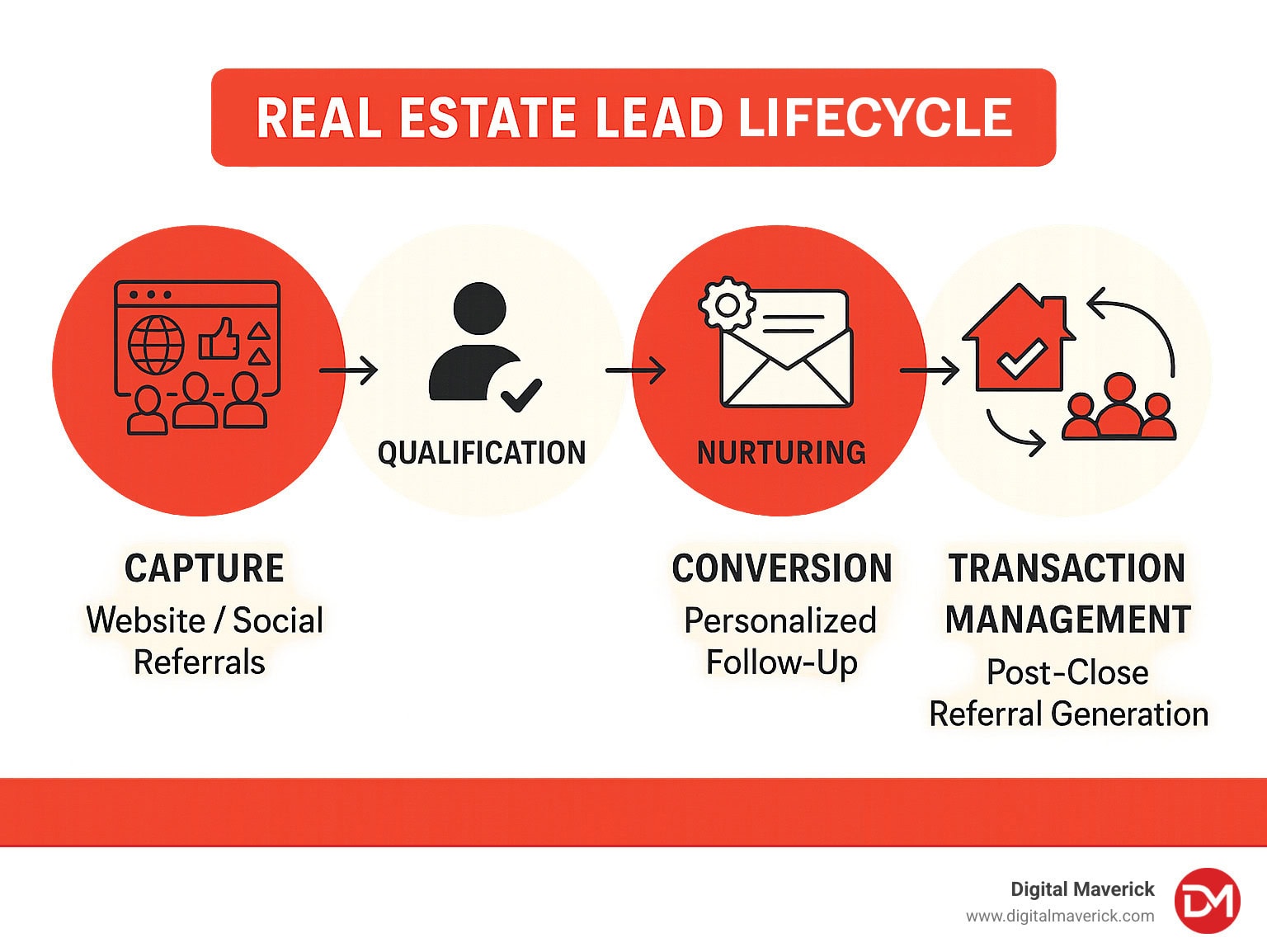
Understanding a Lead Management System for Real Estate
Let’s face it – keeping up with today’s tech-savvy homebuyers is challenging. With research showing that 96% of buyers start their journey online, having a system that captures and nurtures these digital leads isn’t just nice to have – it’s essential.
A lead management system for real estate does exactly what the name suggests – it helps you manage your leads from first click to closing day. But there’s so much more beneath the surface that makes these systems game-changers for growing teams.
What is a Lead Management System for Real Estate?
Think of a lead management system for real estate as your team’s digital command center. It’s where potential clients first enter your world and where you guide them through their buying or selling journey.
These systems work around the clock to make sure no opportunity slips through the cracks. They automatically capture leads from your website, social media, and listing portals. Then they tag and organize these prospects based on their interests and behaviors.
The magic happens when the system routes these leads to the right team member and kicks off personalized follow-up sequences. Some leads need immediate attention (like that buyer who wants to see a property today), while others need nurturing over months (like the family planning to move next year).
Research from the National Association of Realtors shows that different generations have vastly different home-search behaviors – a good lead management system helps you tailor your approach to each.
As one of our clients puts it: “My system doesn’t just store contacts – it reminds me who needs attention, suggests what to say, and tracks everything so I can focus on having real conversations instead of wondering who I should call next. I just have to follow the action plan.”
Lead Management System for Real Estate vs Traditional CRM
“But I already have a CRM!” I hear this all the time from agents. While there’s overlap, a specialized lead management system for real estate offers distinct advantages over general-purpose CRMs:
| Feature | Traditional CRM | Real Estate Lead Management System |
|---|---|---|
| Property data | Limited or manual entry | Automated IDX/MLS integration |
| Workflow focus | General sales pipeline | Property-specific buying/selling stages |
| Marketing tools | Basic email templates | Property alerts, valuation tools, listing updates |
| Automation depth | Generic follow-up | Time-sensitive transaction workflows |
| Reporting | General sales metrics | Real estate KPIs (e.g., price per square foot, days on market) |
| Mobile capabilities | Basic contact access | On-the-go showing scheduling, property notes |
| Compliance | General business rules | Real estate-specific disclosure tracking |
The difference is like comparing a Swiss Army knife to a professional chef’s kitchen. Both can cut things, but one is specifically designed for preparing gourmet meals.
A proper real estate lead system understands the nuances of property transactions. It knows that a buyer looking at $500K homes in the suburbs needs different nurturing than an investor exploring multi-family properties downtown.
These systems centralize your data so everyone on your team sees the same information. No more awkward moments where two agents on your team call the same lead, or worse – nobody calls at all. You get complete pipeline visibility from new leads to pending deals, with the speed-to-lead capabilities (ideally under 5 minutes) that today’s impatient consumers expect.
As your business grows, the right system grows with you – turning what would be chaos into clarity, and converting more of those hard-earned leads into happy homeowners.
Core Features That Drive Capture & Conversion
What makes a lead management system for real estate truly effective? It’s not just about collecting contact information—it’s about changing those contacts into relationships and closed deals. Let’s explore the features that actually move the needle for real estate teams.
Multi-Channel Lead Capture
Today’s homebuyers and sellers don’t follow a single path to find you. They’re browsing listings at midnight, scrolling Instagram during lunch breaks, and driving by your signs on weekends. Your lead system needs to be everywhere they are.
The best systems seamlessly gather prospects from your IDX website, social media inquiries, portal leads, open house sign-ins, and even traditional sources like direct mail and cold calls. This comprehensive approach ensures no opportunity falls through the cracks.
Effective lead capture systems help real estate professionals “find deals fast and connect with homeowners first”—exactly what you need when competition for listings is fierce. With thousands of real estate investors trusting these platforms, the proof is in the results.
Intelligent Lead Scoring and Prioritization
Let’s be honest—some leads deserve your immediate attention while others can wait. But how do you know which is which? Smart lead management doesn’t just collect leads; it helps you prioritize them.
Modern systems analyze behavior like website browsing patterns, email engagement, and showing request urgency to automatically flag your hottest prospects. AI-driven platforms help agents “predict and prioritize homeowners most likely to sell within the next 90 to 180 days,” allowing you to focus your energy where it matters most.
This intelligent sorting means your morning starts with clarity about who needs attention first—not with panic about who might slip away.
Automated Nurture Campaigns
The truth about real estate leads? Most aren’t ready to transact immediately.
“Think about it, if people in your area move on average every five (5) years (shorter than the national average), that means that 95% of the contacts in your database are not actively buying/selling. Your GSC fundamentally changes when your follow up segments your database, and meets your clients where they are”, said Kurt Uhlir, Chief Marketing Officer at ez Home Search.
Your system needs to maintain relationships over time without requiring you to manually remember to follow up with every contact.
Effective nurture campaigns include timely drip emails customized for buyer and seller stages, text message follow-ups at critical decision points, and content delivery aligned with property interests. When a lead goes quiet, re-engagement sequences automatically kick in to rekindle the conversation.
One agent using a comprehensive platform saw “a 33% increase in tour-to-lease conversion and a 15% increase in resident retention year-over-year” thanks to consistent, automated communication. These aren’t just convenience features—they’re revenue generators.
AI-Powered Assistance
The newest frontier in lead management is artificial intelligence, and it’s changing everything. AI assistants now provide 24/7 response to initial inquiries, qualify leads through natural-sounding chatbots, and even suggest the best times to reach out based on past interactions.
One enthusiastic real estate professional described their AI assistant as “not a game-changer, it totally has us playing a different game than everyone else.” That’s because AI doesn’t just make existing processes faster—it creates entirely new possibilities for connecting with prospects.

Automation & AI Inside Modern Systems
Remember when “following up” meant setting calendar reminders and manually sending emails? Those days are gone. Today’s lead management systems for real estate use automation and AI to handle repetitive tasks while making your outreach more effective.
Predictive analytics now anticipate client needs before they even express them. Advanced AI assistants analyze contact patterns to suggest the best days and times to reach each prospect—dramatically improving connection rates without any guesswork on your part.
Voice assistants have become game-changers for busy agents. Imagine updating records, scheduling follow-ups, and retrieving prospect information while driving between showings. This hands-free capability ensures you capture details in real-time rather than trying to remember everything at the end of a hectic day.
Smart notifications have replaced the old “check everything” approach. When a prospect who previously viewed a $500,000 property suddenly starts looking at $700,000 homes, your system flags this change in buying power for immediate follow-up. These behavioral triggers help you respond to what clients are actually doing, not just what they initially told you.
As one property manager using a modern lead management system noted, “Data entry is becoming a thing of the past.” The system handles the administrative burden so you can focus on what you do best—building relationships.
Integrations That Matter
A lead management system for real estate is only as good as its connections to your other tools. The most valuable integrations create a seamless ecosystem where information flows automatically—no duplicate entry, no missed opportunities.
IDX Website Integration creates a direct pipeline from your website visitors to your lead nurture sequences. When someone registers to view properties or saves a search, their information and preferences flow directly into your system. Effective IDX integration creates a continuous flow of qualified leads without any manual steps.
Marketing Platform Connections tie your advertising directly to results. When your lead system connects with Facebook Ads, Google Ads, and email platforms, you’ll know exactly which marketing dollars generate actual transactions. The best platforms provide closed-loop reporting so you can double down on what works.
Property Data Sources enrich your leads automatically. Instead of manually researching property details, advanced systems offer “300+ real estate filters to refine lead lists,” giving you deep insights the moment a lead enters your system.
Transaction Management integration ensures that when leads become clients, their information moves seamlessly into your transaction process. Top brokerages use these integrations partly because these workflows eliminate redundant data entry.
At Digital Maverick, we help teams create a unified tech ecosystem where data flows freely between systems, automatically assigns meaningful tags to segment your clients, creating a single source of truth for all client information. The right integrations don’t just save time—they transform how your entire business operates.
Implementation & Best Practices
Successfully implementing a lead management system for real estate requires more than just purchasing software. It demands strategic planning and consistent execution of best practices.
Speed-to-Lead: The 60-Second Rule
Research consistently shows that contacting leads within the first minute dramatically increases conversion rates. Your system should be configured to:
- Immediately notify agents of new leads via mobile push notifications
- Provide one-click calling directly from the notification
- Deploy an AI assistant for instant response when agents aren’t available
- Auto-assign leads based on agent availability and response time history
As one agent reported, “I instantly followed up and converted 4 out of 5 new buyers into listings” by leveraging automated text alerts.
Structured Nurture Cadence
Consistency is key to conversion. Implement a structured communication schedule:
Day 0: Immediate response (under 60 seconds)
Day 1: Personalized follow-up call and email
Day 2-3: Value-add content related to their search criteria
Day 5: Check-in text or video message
Day 7: Market update or property alert
Day 10: Final “break-up” message
Day 30+: Long-term nurture campaign
This approach aligns with industry best-practice recommendations to “follow up with every new lead within 60 seconds to beat the competition.”
Segmentation and Personalization
Generic messaging yields generic results. Effective lead management requires:
- Segmenting leads by buyer/seller status, price point, timeline, and neighborhood
- Personalizing communications with relevant property data and market insights
- Adapting nurture sequences based on engagement metrics
- Creating distinct workflows for different lead sources
Agents who implement this level of personalization often “manage and close more deals” by delivering the right message at the right time.
Team Accountability and Performance Tracking
The best system is only as good as its implementation. Establish:
- Daily lead follow-up metrics for each team member
- Weekly conversion rate reviews
- Monthly pipeline velocity assessments
- Quarterly ROI analysis by lead source
At Digital Maverick, we emphasize “clear daily reporting, CRM audits, and accountability metrics built into every plan” because we know that what gets measured gets improved.
Metrics to Track for Success
To maximize the value of your lead management system for real estate, focus on these key performance indicators:
Lead Response Time
- Average time to first contact
- Percentage of leads contacted within 5 minutes
- Response rates by time of day
Conversion Metrics
- Lead-to-appointment ratio
- Appointment-to-client conversion rate
- Client-to-closing percentage
- Average days in pipeline by stage
ROI Measurements
- Cost per lead by source
- Cost per acquisition
- Lifetime value of clients
- Referral generation rate
Teams tracking these metrics have reported “a 300% improvement in lead conversion rates, a 41% revenue increase per salesperson, a 26% improvement in customer retention rates, and a 47% increase in customer satisfaction rates.”
Lead Management System for Real Estate Nurture Playbook
Beyond basic follow-up, a comprehensive nurture strategy should include:
The 10-Day New Lead Plan
- Immediate intro email, call, and text
- Day 1-2: Information gathering and preference check
- Day 3-8: Daily value-adding drip emails
- Day 10: Final reconnection attempt
Multi-Channel Approach
- Email for detailed information and resources
- SMS for quick updates and time-sensitive opportunities
- Phone calls for relationship building and complex questions
- Video messages for personal connection (81% more effective than traditional email)
Educational Content Strategy
- Market reports custom to their search areas
- Buyer/seller guides based on their stage
- Neighborhood spotlights for areas of interest
- Process explainers to reduce anxiety
Re-Engagement Loops
- 30/60/90 day check-ins for dormant leads
- Seasonal market updates
- Life event triggers (birthdays, purchase anniversaries)
- New listing alerts matching original criteria
As one agent noted, “It’s like before we were just shooting blindly hoping to hit something; now we can reach numerous sellers with a much higher guarantee of getting a closing.”
Common Challenges & Tech Solutions
Let’s face it – even the best lead management systems for real estate come with their fair share of headaches. But understanding these common roadblocks (and how to overcome them) can help your team get the most from your technology investment.
Lead Overload and Quality Issues
When leads pour in by the hundreds, it can quickly become overwhelming. Many teams find themselves drowning in quantity while starving for quality, leaving agents burned out from chasing dead-end prospects.
This is where AI-driven lead scoring becomes your best friend. Rather than treating every lead equally, modern systems can automatically prioritize prospects based on their actual behavior and intent signals. As one user put it, their “propensity to sell score helps us narrow down our search to specific criteria and remove less likely sellers, saving us time and money.”
Instead of making 100 calls to unqualified leads, your team can focus their energy on the 10 most likely to convert. That’s not just efficiency—it’s sanity preservation!
Data Silos and Integration Gaps
Nothing frustrates agents more than bouncing between multiple platforms to piece together a complete picture of their client. When your property data lives in one system, contact details in another, and communication history somewhere else entirely, critical information inevitably falls through the cracks.
The solution? Choose a lead management system for real estate with robust API capabilities and pre-built integrations. Some platforms shine here, offering “a single login integration” that creates “a centralized hub for leads and listings.” When your systems talk to each other, your data tells a complete story.
Inconsistent Follow-Up Execution
We’ve all been there—setting up beautiful automation sequences only to find months later that agents have been ignoring alerts or skipping crucial follow-up steps. Even the best technology can’t overcome human inconsistency.
Smart teams tackle this challenge with accountability dashboards and a touch of friendly competition. Some lead management platforms include performance tracking that “substantially increases wins” by making follow-up metrics visible to the entire team. When everyone can see who’s following through (and who isn’t), consistency tends to improve dramatically.
Compliance and Documentation Concerns
Real estate transactions involve serious legal requirements and paperwork. Without proper systems, important documents get lost, compliance steps get missed, and risk increases.
Dedicated transaction-management tools have become industry standards because they ensure “all documents are stored securely and compliantly,” giving both agents and brokers peace of mind.

Compliance, Security & Privacy Essentials
With great data comes great responsibility. Today’s real estate professionals need to steer an increasingly complex landscape of privacy regulations:
Data privacy has gone from afterthought to essential business practice. Your lead management system for real estate needs to address GDPR compliance for international clients, CCPA requirements for California residents, TCPA (and do not call) compliance for all US residents, and maintain proper consent records for all marketing communications. Clients expect transparency about how their information will be used—and the law demands it.
Security isn’t optional either. Look for platforms that offer end-to-end encryption for sensitive client details, require multi-factor authentication for system access, and conduct regular security testing. One data breach can destroy years of client trust in an instant.
Smart access controls round out the compliance picture. Your system should offer role-based permissions so team members see only what they need, maintain detailed audit logs of all activities, and provide controlled API access for any third-party connections.
At Digital Maverick, we’ve seen how proper compliance practices can actually improve productivity rather than hinder it—when implemented thoughtfully. Think about it this way: your clients care what happens with their personal contact and budget information. When they know that you care about it as well, it builds the trust they have with you.
How Teams & Solo Agents Benefit Differently
A lead management system for real estate isn’t one-size-fits-all. The benefits vary dramatically depending on your business structure.
For teams, the magic happens through structured collaboration. Role-based access controls ensure everyone stays in their lane, while lead distribution rules match prospects to the right agent based on strengths and availability. A shared inbox creates seamless client communication even when multiple team members are involved. Perhaps most valuable are the performance dashboards that let leaders compare individual and team metrics, identifying both superstars and those who need additional coaching.
Solo agents, meanwhile, gain an entirely different advantage—the ability to appear larger than they are. An effective system serves as their virtual assistant, automated workflows create the impression of a much bigger operation, and mobile-first design lets them run their business from anywhere. As one independent agent noted after implementing an automated CRM, “I went from catching up on tasks on the weekend to turning my computer off on Friday and I don’t have to worry about it until Monday.”
The right system doesn’t just organize your data—it multiplies your capabilities, whether you’re a team of twenty or a solo practitioner.
How to Choose the Right System
Selecting the optimal lead management system for real estate requires careful consideration of your specific business needs and growth objectives.
Assess Your Current Workflow
Before evaluating systems, document your existing process:
- How do leads currently enter your business?
- What is your follow-up sequence?
- Where do leads commonly fall through cracks?
- Which manual tasks consume the most time?
- What metrics matter most to your business model?
Determine Must-Have Features
Based on your workflow analysis, identify non-negotiable capabilities:
- Multi-channel lead capture from your primary sources
- Integration with existing tools and platforms
- Mobile accessibility for your on-the-go team
- Automation capabilities matching your follow-up strategy
- Reporting aligned with your key performance indicators
Consider Scalability Needs
Your chosen system should grow with your business:
- User pricing that accommodates team expansion
- Customization options for evolving workflows
- API access for future integration needs
- Training resources for new team members
- Storage capacity for growing client databases
Evaluate Support and Training
The best technology fails without proper implementation:
- Onboarding process and timeline
- Ongoing technical support availability
- Training resources for team members
- User community for peer learning
- Regular updates and feature improvements
Key Questions to Ask Vendors
When evaluating potential lead management systems for real estate, ask these critical questions:
Integration Capabilities
- “Does your system integrate directly with [your specific tools]?”
- “What is the depth of these integrations? Data sync only, or full workflow?”
- “Can we access your API for custom integrations if needed?”
Customization Options
- “Can we modify lead stages to match our sales process?”
- “Are email/text templates customizable with our branding?”
- “Can we create custom fields for our specific data needs?”
AI and Automation Roadmap
- “What AI capabilities are currently available in your platform?”
- “What automation features are on your near-term roadmap?”
- “How do you train your AI on real estate-specific scenarios?”
Training and Support
- “What does your onboarding process look like?”
- “Is support included, or is it an additional cost?”
- “What are your average response times for support issues?”
Performance and Reliability
- “What is your guaranteed uptime percentage?”
- “How often do you release updates and improvements?”
- “What happens to our data if we decide to switch systems?”
Final Checklist Before Buying
Before making your final decision:
- Define clear goals for what success looks like after implementation
- Map your entire workflow to ensure the system accommodates all stages
- Test with real scenarios during your demo or trial period
- Create a data migration plan for existing contacts and historical data
- Establish implementation timelines with specific milestones
- Develop a training schedule for all team members
- Set performance benchmarks to measure ROI after launch
At Digital Maverick, we help teams through this entire evaluation process, ensuring they select a system that aligns with their specific business model and growth objectives.
Frequently Asked Questions about Lead Management Systems
Why is lead management important for real estate professionals?
If you’ve ever wondered why some agents consistently outperform others, effective lead management is often the answer. It’s not just about collecting contact information – it’s about nurturing relationships that turn into transactions.
Professionals who implement a solid lead management system for real estate routinely see dramatic improvements in their business. Some users report a remarkable 300% improvement in lead conversion rates after getting serious about systematic follow-up.
Beyond just closing more deals, proper lead management helps you spend your marketing dollars wisely. As one agent put it, “The propensity to sell score helps us narrow down our search to specific criteria and remove less likely sellers, saving us time and money.” In today’s competitive market, you simply can’t afford to waste resources on low-probability prospects.
There’s also the peace-of-mind factor that shouldn’t be underestimated. A user shared, “I sleep better. The peace of mind knowing that we’re providing a great service…has just made life a lot easier.” When your follow-up is systematized, you no longer wake up wondering which opportunities might be slipping through the cracks.
Perhaps most importantly, structured lead management creates the foundation for growth. One property manager wasn’t exaggerating when they said their system is “the process management software that will enable us to grow from 500 to 5,000 units.” Without scalable systems, your business will always be limited by your personal capacity.
Can automation replace human follow-up entirely?
Let’s be honest – technology is amazing, but it hasn’t made real estate agents obsolete, and it won’t replace the human elements of lead follow-up either.
The sweet spot is finding the right balance between automation and personal touch. Automation shines at handling routine tasks like sending immediate responses, scheduling follow-up reminders, collecting basic information, and maintaining consistent contact. It’s your tireless assistant that works 24/7.
But humans remain irreplaceable for building genuine connections. When a prospect has complex questions about neighborhood dynamics, needs emotional reassurance about a major life decision, or presents unique objections, no AI can match a knowledgeable agent’s ability to respond with empathy and local expertise.
As industry experts note, “Technology will never replace the value of real estate agents.” The most successful professionals use automation to handle the routine so they can focus their human energy on meaningful conversations that actually close deals.
What KPIs prove my system is working?
When you invest in a lead management system for real estate, you need to know if it’s actually delivering results. Here are the numbers that truly matter:
First, watch your speed-to-lead time – how quickly are you making first contact after a lead comes in? This should drop dramatically with a good system, ideally getting under that critical five-minute mark where conversion rates peak.
Your lead-to-appointment ratio tells you if your follow-up sequences are actually moving prospects forward. A working system will steadily increase this percentage as more leads turn into face-to-face opportunities.
Keep a close eye on your cost per acquisition – the total investment required to gain a new client. As your conversion efficiency improves, this number should decrease, meaning each marketing dollar generates more revenue.
Pipeline velocity measures how quickly and predictably leads move through your sales funnel. A properly implemented system creates a more consistent flow from initial contact to closing.
Finally, track agent productivity metrics like meaningful conversations per day and administrative time. Your team should be talking more and typing less after implementation.
One team leader summed it up perfectly when they reported that after focusing on these metrics, their team “prioritized data and efficiency to drive higher transaction volume” with measurable results. At the end of the day, the numbers don’t lie – a properly implemented lead management system for real estate will show its value in these concrete measurements.
Conclusion
A well-implemented lead management system for real estate isn’t just a nice-to-have anymore—it’s become essential for teams who want to thrive in today’s competitive market. The right system transforms what was once chaotic lead handling into something structured and scalable, ensuring no opportunity falls through the cracks.
At Digital Maverick, we’ve learned through years of experience that technology alone doesn’t solve problems. The magic happens when powerful systems meet human expertise. That’s why our approach combines both elements to drive consistent results for the real estate teams and brokerages we work with.
We don’t just provide software—we deliver complete solutions that include:
- Scalable growth systems that virtually eliminate lead waste
- Expert conversion services, including our full-service ISAs and our always-on 24/7 AI assistant
- Hands-on coaching that helps your team develop and maintain the right operating rhythm
- Practical operational frameworks that transform leads into meaningful conversations—and ultimately into closings
One client put it perfectly: “It’s like before we were just shooting blindly hoping to hit something; now we can reach numerous sellers with a much higher guarantee of getting a closing.”
While technology and marketing trends will continue to evolve, one fundamental truth remains constant: the teams that consistently convert leads into clients will dominate their local markets. A comprehensive lead management system for real estate provides the foundation for that consistency.
Are you ready to transform how your team handles leads? Digital Maverick provides the systems, training, and people to help you consistently turn leads into conversations—and those conversations into closings. Learn more about our offerings and find how we can help your team eliminate lead waste, build scalable systems for growth, and open up higher ROI from your existing database, ad spend, and CRM investments.
What makes us different is that we were built by operators—not vendors. We’ve been in your shoes, scaled real businesses, and know exactly what it takes to succeed in today’s real estate landscape. Let us help you write your success story.

Preston Guyton is a co-founder at Digital Maverick and a seasoned real estate operator who’s spent over two decades helping agents build smarter, more scalable businesses. He’s passionate about helping teams avoid the missteps that cost time, money, and momentum. At Digital Maverick, Preston leads strategy across ISA support, CRM systems, and coaching programs—bringing together the tools, accountability, and rhythm that turn leads into consistent closings.