

Mastering Home Buyer Leads: The Foundation of Real Estate Success
Home buyer leads are potential clients actively searching for a property to purchase. They form the lifeblood of any successful real estate business and require strategic acquisition and nurturing to convert into closed transactions.
| Quick Guide to Home Buyer Leads |
|---|
| 1. Definition: Potential clients actively looking to purchase property |
| 2. Types: Online (portals, social media, IDX websites) and offline (open houses, referrals, networking) |
| 3. Average Cost: $30-$300+ per lead depending on quality and exclusivity |
| 4. Conversion Rate: Typically 0.4% to 1.2% from lead to closed transaction |
| 5. Best Practices: Respond within 5 minutes, use multi-channel follow-up, implement consistent nurturing |
Maintaining a healthy pipeline of buyer leads isn’t just helpful—it’s essential for sustainable growth.
Yes, you may want seller leads, and you should. Just remember that most buyers are also sellers, and in the majority of cases, people start looking for their next property (and searching for infotainment purposes more frequently) before they decide to discuss listings. By identifying these buying signals, you’ll gain more buyer and more seller leads.
Whether you’re a solo agent looking to establish yourself or a team leader aiming to scale, your ability to consistently generate and convert home buyer leads will determine your success.
The challenge? Most real estate professionals struggle with inconsistent lead generation, poor follow-up systems, and inefficient conversion strategies. This guide will help you overcome these problems with proven tactics that work in today’s market.
I’m Preston Guyton, co-founder of Digital Maverick where I’ve spent over 20 years helping real estate teams implement effective home buyer lead generation and conversion systems that significantly increase closed transactions and GCI. My experience has shown that the difference between struggling and thriving teams isn’t just about getting more leads—it’s about having the right systems to maximize every opportunity.

Why this guide matters
According to the National Association of REALTORS®, about 32% of real estate professionals generate business through third-party lead providers. Yet many agents fail to create sustainable businesses because they don’t understand the complete lead lifecycle—from generation to nurturing to conversion.
This guide provides a comprehensive roadmap for establishing a consistent flow of qualified home buyer leads, whether you’re just starting out or looking to scale your existing operation. We’ll cover everything from defining what makes a quality lead to implementing systems that convert those leads into closed transactions.
What Are Home Buyer Leads & Why They’re Essential
Home buyer leads are potential clients who have shown interest in purchasing property, and the majority of time, they will also be listing a property. These aren’t just names in your database—they’re real people at different stages of their homebuying journey, from those just starting to browse listings online to serious prospects who are actively touring homes and securing financing.
Think of these leads as the seeds of your future commissions. Without consistently planting and nurturing them, your business will inevitably experience those dreaded feast-or-famine cycles that keep many agents up at night.
As one of our top-producing partners puts it: “Think of lead generation like farming, not hunting. If you only plant seeds at harvest time, you’ll always have dry spells.” This mindset shift—from reactive to proactive—is often what separates sustainable businesses from struggling ones.
The conversion math tells a compelling story about why home buyer leads matter so much:
- With an average commission of $9,000
- And a typical conversion rate of 1% (industry average ranges from 0.4-1.2%)
- Each lead in your pipeline represents approximately $90 in potential revenue
This simple calculation reveals something powerful: even small improvements in either generation or conversion can dramatically impact your income. Boost your conversion from 1% to 2%? You’ve effectively doubled your business without spending an extra dollar on marketing.
Understanding the buyer journey helps you meet prospects where they are:
- Awareness: The moment someone realizes they might want to buy a home
- Consideration: Their research phase—exploring neighborhoods, price points, and financing options
- Decision: The active phase of touring homes and submitting offers
- Post-Purchase: Moving in and potentially becoming your advocate through referrals
Each stage requires different approaches, messaging, and nurturing strategies to move leads forward. According to NAR data, approximately 32% of real estate professionals rely on third-party lead providers to fill their pipelines, yet many struggle to convert these opportunities due to poor understanding of this journey.
Research on word-of-mouth marketing shows that referrals remain the highest-converting lead source, with prospects being 4x more likely to buy when referred by someone they trust. This underscores why nurturing every lead—even those not ready to buy immediately—creates long-term value beyond the immediate transaction.
The quality of your home buyer leads matters as much as quantity. A smaller pool of highly-engaged prospects will always outperform a massive database of unqualified contacts. As we’ll explore in later sections, distinguishing between different lead types and tailoring your approach accordingly is crucial for maximizing your return on investment.
Primary Categories of Home Buyer Leads
Not all home buyer leads are created equal. Understanding the different categories will help you allocate your resources effectively and set appropriate expectations for conversion rates.
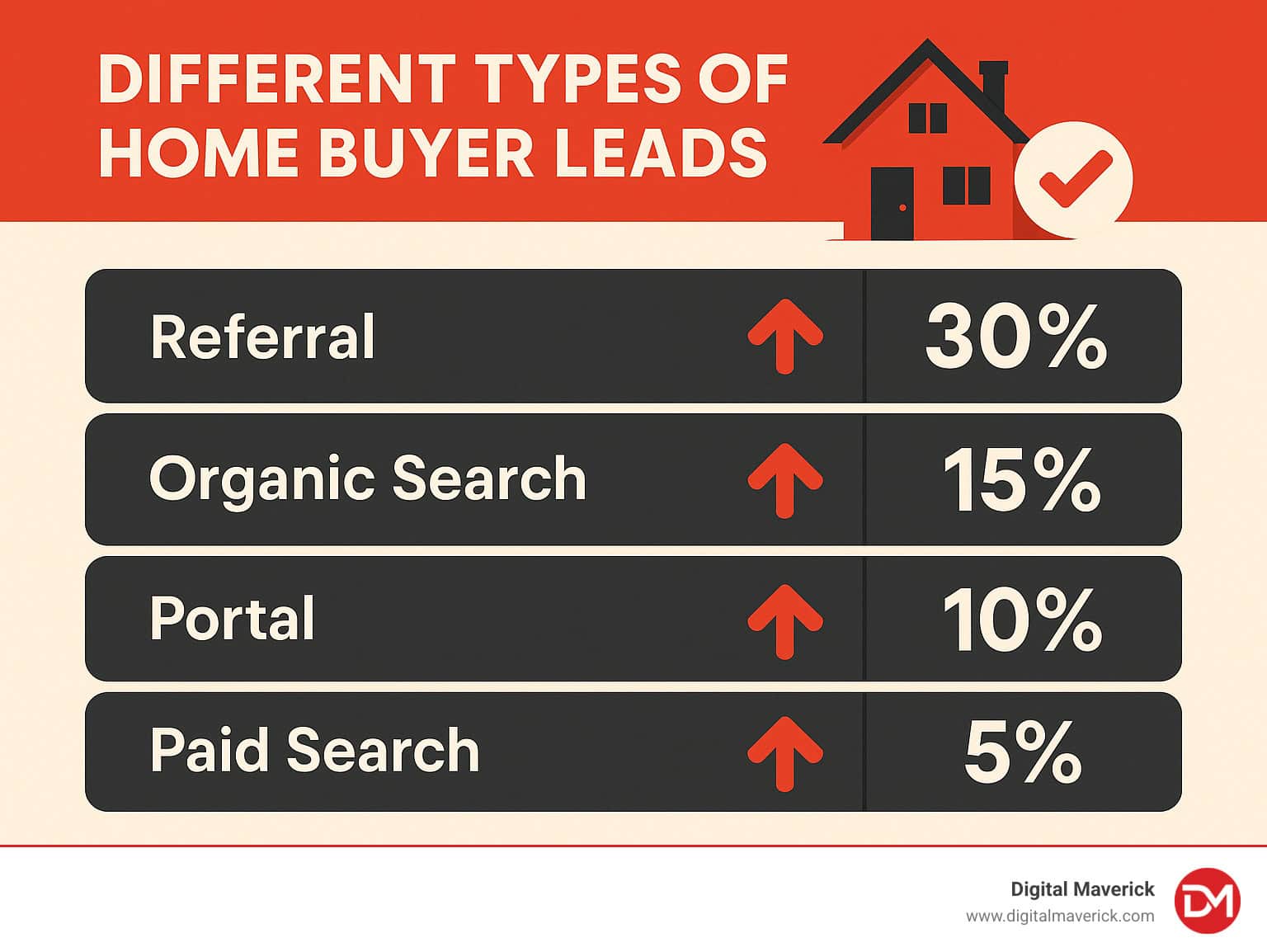
When I first started generating leads, I was shocked by how differently they performed based on their source. Think of your lead sources like different types of fishing spots—some yield trophy catches while others provide a steady stream of smaller fish. Both have their place in a well-rounded strategy.
The real estate world typically divides leads into several key categories: paid versus organic, online versus offline, exclusive versus shared, and warm versus cold. Each has distinct characteristics that affect not just cost, but also how you should approach nurturing them.
Paid leads typically require immediate investment but can deliver quicker results, while organic leads build more slowly but often convert at higher rates. Similarly, exclusive leads might cost more upfront but won’t be shopped to multiple agents, unlike shared leads which may come at a lower price point but face more competition.
Understanding lead intent is crucial too. A lead who’s just starting their research journey needs very different nurturing than someone who’s mortgage-approved and ready to tour homes this weekend.
Online Home Buyer Leads
The digital revolution has transformed how we find clients, with online leads now representing the fastest-growing segment in real estate lead generation.
Search PPC (Pay-Per-Click) Leads capture active buyers right when they’re searching for properties. When someone types “homes for sale in Austin” or “best neighborhoods for families in Portland,” your ads can appear at the perfect moment. CINC’s platform, which starts around $900 monthly for solo agents, can be particularly effective for capturing this high-intent traffic.
Social Media Leads work differently—they often catch people earlier in their journey. Facebook, Instagram, and TikTok allow you to target based on life events (like marriage or new jobs) that often trigger moves. I’ve seen agents have great success with carousel ads showcasing local neighborhoods or video tours. Market Leader’s Network Boost reaches about 10 million consumers monthly through these channels, generating approximately 1 million leads yearly.
IDX Website Leads come from your own digital home base. When optimized correctly, your website becomes a 24/7 lead generation machine. The magic happens when you pair property search capabilities with smart lead capture tools like saved search alerts or neighborhood guides. One agent I coached saw a 300% increase in leads after adding a simple “What’s My Home Worth?” widget from ez Home Search.
Real Estate Portal Leads bring volume but at a price. These major platforms attract millions of active shoppers monthly, making them valuable sources despite their higher costs—typically $20-$60 per lead in smaller markets and $1,000+ monthly in major metros. The key is having systems ready to quickly engage these leads before they contact other agents.
Chatbot & AI-Generated Leads represent the cutting edge of lead generation. Modern AI tools like Offrs’ RAIA can engage website visitors around the clock, qualifying prospects through natural conversations before they ever speak with you. One team I worked with increased their lead-to-appointment ratio by 40% after implementing AI chat on their site.
Offline Home Buyer Leads
Despite our digital world, traditional methods still deliver exceptional results when executed with creativity and consistency.
Open Houses remain powerful lead generators when you approach them strategically. As one of my coaching clients likes to say, “Most open houses feature a cheese plate, a few nosy neighbors, and a bored agent.” Make yours memorable! Try themed events like “Sunset Showcase” with wine and cheese, or neighborhood walking tours that start at your listing. The agents who treat open houses as marketing events rather than chores consistently outperform their peers.
Networking & Referrals still form the backbone of sustainable real estate businesses. Research on word-of-mouth marketing confirms what successful agents already know—personal recommendations drive the highest-converting leads. Developing a strong sphere of influence creates a referral engine that grows more powerful over time, especially when you consistently provide value between transactions.
Direct Mail has made a surprising comeback in recent years. In a world of digital overwhelm, a well-designed physical mailer can cut through the noise. The most successful campaigns target specific neighborhoods or demographics and include clear calls to action that bridge to digital follow-up.
Community Events position you as a local expert while naturally generating leads. I’ve seen agents host first-time homebuyer workshops, neighborhood block parties, and even outdoor movie nights at listed properties. These experiences create meaningful connections that digital advertising simply can’t match.
The most successful agents don’t rely on just one category—they build a diverse lead portfolio that balances immediate results with long-term sustainability. Like a smart investor, they spread their resources across different lead types to maximize returns while minimizing risk.
10 High-ROI Tactics to Generate Home Buyer Leads in 2024
Ready to fill your pipeline with qualified home buyer leads? Let’s explore strategies that actually work in today’s market—not just theory, but tactics real agents are using to grow their businesses right now.
1. Build a Local SEO Engine
The beauty of search engine optimization is that it keeps working for you long after you’ve put in the effort—like planting a tree that bears fruit year after year.
Your local SEO strategy should focus on being the neighborhood expert buyers turn to first. Create detailed content hubs about specific communities, with insider information on schools, parks, restaurants, and market trends that generic websites simply don’t have.
“The key to local SEO is thinking like a buyer,” explains Trevor, a former agent who now coaches top producers. “What specific questions are they asking about neighborhoods, school districts, or commute times? Answer those questions comprehensively, and Google will reward you.”
Don’t forget to optimize your Google Business Profile with consistent, accurate contact information. When someone searches “real estate agent near me,” you want your name popping up with glowing reviews attached.
2. Launch Targeted Social Campaigns
Social media isn’t just for sharing listing photos anymore—it’s a sophisticated targeting machine that can put you in front of people right when they’re thinking about buying.
Meta ads (Facebook and Instagram) can target people experiencing major life changes—like marriage, new jobs, or growing families—all signals someone might be house-hunting soon. Our research shows these life-event triggers convert at significantly higher rates than generic demographics.
Consider partnering with local micro-influencers who already have the trust of your target audience. These collaborations feel more authentic than traditional advertising and can generate warm leads who already feel connected to you. According to our data, brands working with micro-influencers see sales increases up to 18%, and 63% of younger consumers trust influencer recommendations more than brand messages.
Short-form video content on platforms like Instagram Reels or TikTok can showcase your personality while delivering valuable market insights. One agent I know gained 15 new buyer clients after her “10 Hidden Gems in Portland Under $400K” video went locally viral.
3. Master Paid Lead Platforms
Paid lead platforms offer something invaluable: predictability. When your business needs a steady flow of prospects, these services can deliver—though quality varies dramatically.
Before investing, understand what you’re really paying for. Exclusive leads typically convert 3-5 times better than shared leads, but they’ll cost you more upfront. A basic lead might cost $30, while a qualified, exclusive lead could run $300+.
“The key is understanding your conversion metrics,” says Joe Rosen, an agent who built his business using paid lead platforms. “If you know your close rate and average commission, you can calculate exactly how much you can afford to pay per lead and still be profitable.”
For example, premium lead services offer guaranteed exclusive leads starting at $139 plus $25 per lead, with some programs delivering approximately 25+ leads for $399/month, depending on your market competitiveness.
4. Deploy AI & Automation
AI tools aren’t replacing agents—they’re supercharging the ones who accept them. The right automation can help you nurture 10x more leads without working longer hours.
Imagine having a system that scores every lead based on their behavior, automatically prioritizing the hot prospects ready to make moves. Or AI-crafted email templates that sound like you wrote them personally, but scale across hundreds of contacts.
At Digital Maverick, we’ve seen agents boost their reply rates to over 50% using smart, AI-driven nurture sequences—dramatically outperforming traditional “check-in” emails that feel generic and forgettable.
The real magic happens when your website can analyze user behavior and respond accordingly. When someone views multiple properties in the same neighborhood or price range, that’s a buying signal your system should catch, triggering personalized outreach that acknowledges their specific interests.
5. Host Memorable In-Person Experiences
Face-to-face experiences stand out more than ever. The standard open house with a plate of cookies won’t cut it anymore—you need to create memorable moments that get people talking.
I’ve seen agents transform ordinary showings into events that buyers actually look forward to attending. Think themed open houses like “Coastal Living Night” for waterfront properties, complete with a local chef preparing seafood bites, or “Design Your Dream Space” workshops where potential buyers can visualize themselves in the home.
One particularly creative agent in a beach community organized “underwater virtual showcases” for waterfront properties, creating an immersive experience that not only attracted serious buyers but also local media attention—giving her free publicity that generated even more home buyer leads.
Community workshops on topics like “Navigating the Mortgage Process” or “First-Time Homebuyer Secrets” position you as a helpful expert rather than just another salesperson, building trust before buyers are even ready to tour homes.
6. Combine Sphere & Referral Marketing
Your existing relationships remain your most valuable asset. People who know, like, and trust you are not only more likely to work with you themselves but also to send others your way.
The key is staying top-of-mind without being annoying. Regular, value-added touchpoints through personalized emails, social media engagement, and occasional direct mail keep you connected. But the real magic happens with micro-events—small, intimate gatherings like coffee meetups or dinner parties that strengthen relationships in ways digital communication simply can’t.
“Where do Realtors get most of their leads? Effective agents blend paid platforms with traditional methods like networking, referrals, open houses, and free social-media tactics,” our research confirms.
For new agents especially, simply letting your social circles know you’re in real estate can jumpstart your business. Join clubs, sports teams, volunteer organizations—anywhere you can authentically connect with potential clients while contributing to your community.
7. Leverage Data & Predictive Tools
Today’s data tools can help you identify potential buyers before they even list themselves as “in the market”—giving you a massive competitive advantage.
Geo-farming has evolved beyond just sending postcards to the same neighborhood repeatedly. Now you can use predictive analytics to target areas with high turnover probability or households showing “move likely” signals based on factors like property tenure, life events, and online behavior.
Quality predictive analytics services aggregate data from over 25 sources to achieve 72% accuracy in predicting homeowners likely to move within 18 months. Similarly, advanced AI has developed models that can predict inherited property sales with 40% precision within a 50-mile radius—identifying potential sellers (and thus, creating opportunities for your buyers) before traditional methods would catch them.
8. Optimize for Compliance & Privacy
As lead generation becomes more sophisticated, staying compliant with privacy regulations isn’t just about avoiding fines—it’s about building trust with potential clients.
Every call, text, and email you send needs to comply with regulations like the TCPA (Telephone Consumer Protection Act) and CAN-SPAM Act. Make sure you’re regularly scrubbing your contact lists against the DNC (Do Not Call) registry, and that all your lead capture forms have clear, explicit opt-in mechanisms.
Quality lead management tools automatically handle compliance issues by scrubbing phone numbers against the Do Not Call list, giving you peace of mind while cold calling expired or FSBO leads that might connect you with potential buyers.
9. Track ROI & Conversion Metrics
Without tracking your results, you’re essentially flying blind. The most successful agents know exactly which lead sources deliver value and which are draining their budget.
Focus on these critical metrics:
- Cost Per Lead (CPL): What you’re paying to acquire each prospect
- Cost Per Acquisition (CPA): Your all-in cost to acquire a closed client
- Speed-to-Lead: How quickly you’re responding to inquiries (aim for under 5 minutes)
- Pipeline Velocity: How efficiently leads move through your sales process
“You should calculate your monthly ROI—if your lead spend leads to enough closed transactions, paid leads can be worthwhile,” our research confirms. This calculation should include not just the direct cost of the leads but also the time and resources required to nurture and convert them.
10. Tailor Strategy: New Agents vs Teams
Your lead generation approach should match your experience level and team structure. What works for a solo new agent won’t necessarily work for an established team with dedicated roles.
For new agents, start with low-cost methods that leverage your existing relationships and build your conversion skills. Focus on becoming the go-to expert in a specific neighborhood or niche where you can outshine even established agents through deeper local knowledge.
For teams, implement specialized roles for lead generation, nurturing, and closing. Invest in more sophisticated technology and analytics that can distribute leads efficiently and track performance across team members. Consider comprehensive end-to-end solutions starting at $899/month for solo agents or $1,299/month for teams.
The best strategy combines multiple approaches, creating a diverse lead pipeline that can weather market changes and algorithm updates. As one of our coaching clients puts it: “The agents who survive any market are the ones who never rely on just one source of home buyer leads.”
Following Up, Nurturing & Converting Leads
Getting home buyer leads is just the beginning. The real magic happens when you nurture those connections and turn them into happy homeowners – and commission checks.
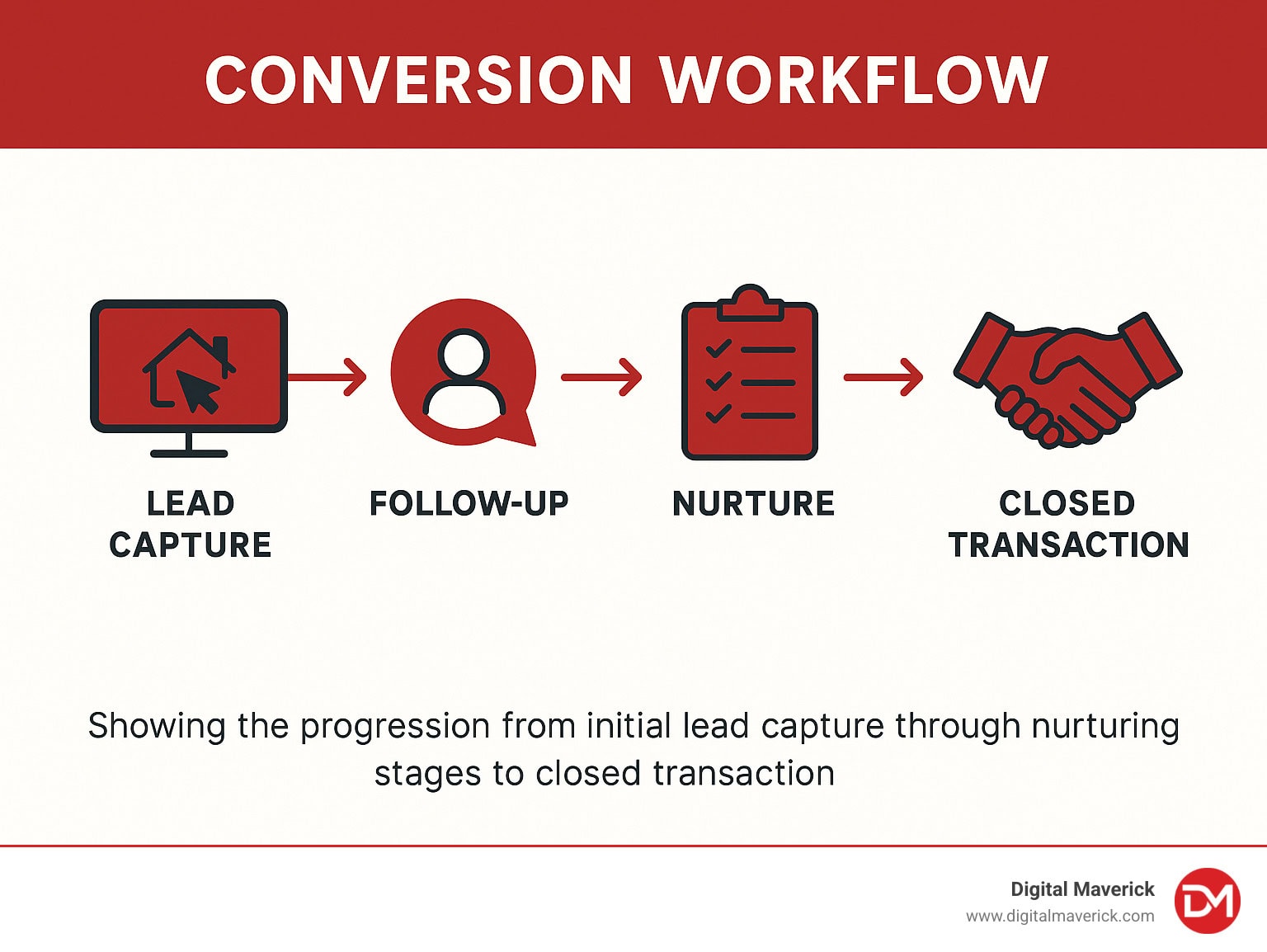
If there’s one thing I’ve learned after years in this business, it’s that speed matters. A lot. Responding to a new lead within 5 minutes makes you 9 times more likely to convert them than waiting half an hour. Think about it – when someone’s excited about buying a home, they want answers now, not tomorrow.
At Digital Maverick, we’ve seen incredible results with a multi-channel approach. We immediately send a friendly text acknowledgment, follow up with a phone call within those crucial first 5 minutes, email helpful resources, send a personal video text (people love seeing a real face!), and use retargeting ads to stay on their radar. This wraparound strategy keeps leads engaged and prevents them from wandering off to other agents.
Assessing Lead Quality
Let’s be honest – not every lead deserves the same amount of your precious time. Learning to quickly spot the difference between tire-kickers and serious buyers will save you countless hours and frustration.
When evaluating lead quality, pay attention to their digital body language. Are they opening your emails? Clicking links? Revisiting your website multiple times? These engagement signals speak volumes. Also consider practical factors like their pre-approval status, timeline (are they looking to move next month or next year?), and their core motivation for moving.
I recommend using a simple A/B/C grading system to keep things organized:
A Leads are your hot prospects – ready to buy within 30 days, pre-approved, and actively engaging with your content. These deserve your immediate and consistent attention.
B Leads have a 1-3 month timeline, are working on financing, and show moderate engagement. Keep them warm with regular value-added touchpoints.
C Leads are looking 3+ months out with uncertain financing and minimal engagement. Don’t ignore them, but put them on a longer-term nurturing plan.
This simple classification helps you prioritize your efforts where they’ll have the biggest impact while making sure no lead falls through the cracks.
Best Practices for Conversion
Converting home buyer leads into clients isn’t about luck – it’s about having a system and sticking to it religiously.
For new leads, implement what I call the “10-day blitz” – an intensive follow-up sequence that starts with multiple touchpoints on day one (call, text, email), followed by value-add content on day two (perhaps a neighborhood guide or market report), another check-in call on day three, and alternating touchpoints through day ten. This approach demonstrates your professionalism and persistence without crossing into annoying territory.
For longer-term nurturing, develop a consistent rhythm. Start with 3-5 touches in the first week, then taper to 1-2 weekly touchpoints for the next few weeks. By months 2-3, weekly value-add content keeps you top of mind, and beyond that, bi-weekly or monthly check-ins maintain the connection until they’re ready to move forward.
Video texting has been a game-changer for many of our clients. In a world of faceless digital communication, a quick 30-second video introducing yourself creates an instant personal connection. Property highlight videos and neighborhood tours add tremendous value and showcase your local expertise.
And don’t forget to master those common objection handlers. When a lead says “I’m just looking right now,” respond with warmth: “Perfect! Most of my clients start by just looking. What specifically are you hoping to find?” This acknowledges their position while gently moving the conversation forward.
As Trevor, who sold 150 homes during his transition from agent to coach, wisely notes: “Conversion isn’t about pressure—it’s about consistency and adding value at every touchpoint. The agents who win are the ones who stay in the game longer than their competition.”
Integrating Tech Stack
A thoughtfully connected technology ecosystem can transform your lead management from chaotic to clockwork.
Start with seamless CRM synchronization. Every lead source should feed directly into your CRM without requiring manual data entry. This eliminates dangerous delays and human error while ensuring leads are automatically routed to the right team member based on territory or expertise.
Next, leverage marketing automation to keep conversations flowing. Set up behavior-triggered email sequences that respond to specific actions (like viewing a particular property multiple times), automated text message follow-ups that feel personal but don’t require your constant attention, and smart reminders that prompt you when it’s time for a personal touchpoint.
Finally, implement reporting dashboards that give you real-time visibility into what’s working and what isn’t. Track your key performance indicators, monitor conversion rates by lead source, and quickly identify bottlenecks in your sales process.
At Digital Maverick, we help teams build tech stacks that eliminate lead waste and maximize conversion. But we don’t just set it and forget it – we conduct regular CRM audits and establish accountability metrics to ensure the system continues working as intended. Because the best technology in the world only works when it’s properly maintained and actually used.
More info about growth systems
Frequently Asked Questions about Home Buyer Leads
What’s the average cost of purchasing home buyer leads?
Let’s talk money—because this is probably what you’re most curious about! The cost of home buyer leads varies dramatically depending on quality, whether they’re exclusively yours, and your local market conditions.
At the lower end, basic shared leads might cost you $30-$50 each. These are typically less qualified prospects who might be shopping around with multiple agents. Moving up the quality ladder, mid-tier leads typically run $50-$150 each, while premium exclusive leads with serious buyers can cost anywhere from $150 to over $300 per lead.
If you’re looking at specific platforms, here’s what you might expect to pay:
Premium lead services charge around $20-$60 per lead in smaller markets but can easily run $1,000+ monthly in major metropolitan areas. Some providers start at $189 monthly plus $30-$50 per lead, while others have a different model at $899 monthly for solo agents with leads included. Some services offer buyer leads for approximately $12 each.
Remember though—the raw cost per lead isn’t nearly as important as what you do with those leads. A $200 lead that converts at 5% delivers way more value than a $20 lead with a 0.1% conversion rate. It’s all about the return, not just the investment!
Are exclusive home buyer leads worth the premium?
In a word: usually! Exclusive home buyer leads typically convert at 3-5 times the rate of shared leads, which often justifies their higher price tag.
Think about it from the buyer’s perspective—when they submit their information and suddenly get bombarded by five different agents all claiming to be the neighborhood expert, it creates a terrible first impression. With exclusive leads, you’re not competing in a race to the bottom with other agents desperately trying to win the same prospect.
The benefits of exclusivity include building trust more easily (since the buyer isn’t juggling multiple agent relationships), having proper time to nurture the lead, and creating a more professional experience overall.
Quality lead providers guarantee specific numbers of exclusive leads monthly that won’t be shared with competitors. Similarly, some premium programs in selected areas ensure only one agent works each buyer lead.
That said, exclusivity doesn’t automatically mean quality. I’ve seen expensive exclusive leads that went nowhere, and shared leads that turned into million-dollar transactions. Always evaluate based on engagement signals, motivation factors, and timeline—regardless of whether you’re the only agent in their inbox.
How can I measure the true ROI of my lead-generation efforts?
This is where many agents struggle—knowing whether their lead gen is actually paying off. Calculating your true return on investment means tracking several interconnected metrics.
First, you need to understand your total investment, which includes the obvious direct costs like platform fees and advertising spend. But don’t forget the hidden costs—the hours you spend nurturing leads, the technology tools you pay for, and even the opportunity cost of what else you could have done with that time and money.
On the return side, track your closed transaction volume, commission revenue, and—this is important—the referral business generated from those leads over time. A lead that becomes a client who refers three friends is vastly more valuable than one who simply buys a home and disappears.
The key performance indicators worth monitoring include your cost per lead, cost per appointment, cost per closed transaction, and the lifetime value of the clients you acquire. At Digital Maverick, we build clear daily reporting and accountability metrics into every plan so our clients can make data-driven decisions about scaling what works and cutting what doesn’t.
Here’s a simplified ROI calculation to get you started: If you spend $5,000 on leads in a month and close two transactions with an average commission of $9,000 each, your gross return is $18,000 on a $5,000 investment—that’s a 360% ROI before accounting for your time and operational costs.
The best agents I know review these numbers monthly and adjust their strategy accordingly. They don’t just blindly spend on leads—they invest in systems that maximize the return on every dollar and minute they put into their business.
Conclusion
Generating and converting home buyer leads is both an art and a science. The most successful real estate professionals combine strategic systems with authentic relationship-building to create sustainable businesses.
At Digital Maverick, we’ve seen how implementing the right lead generation and conversion systems can transform real estate businesses. Our clients benefit from:
- Eliminating lead waste through proper tracking and follow-up
- Building scalable systems that support sustainable growth
- Generating more high-quality leads through targeted strategies
- Increasing GCI without proportionally increasing workload
- Open uping higher ROI from existing database, ad spend, and CRM investments
What sets our approach apart is that we’re built by experienced operators who have scaled real estate businesses—not marketing agencies. We provide full-service conversion support, from ISAs to coaching to CRM automation, all backed by clear daily reporting and accountability metrics.
The journey from lead to client isn’t always straightforward, but with the right systems and support, you can create a predictable pipeline that delivers consistent results.
Whether you’re just starting out or looking to scale your existing business, success with home buyer leads comes down to three fundamental principles:
- Consistency: Implement daily lead generation activities rather than sporadic efforts
- Quality: Focus on leads with genuine motivation and capability to purchase
- Systems: Build repeatable processes that don’t depend on individual heroics
By applying the strategies outlined in this guide and continuously refining your approach based on results, you’ll be well on your way to mastering the art and science of home buyer leads.
For more information about how Digital Maverick can help you implement scalable growth systems that turn leads into conversations—and conversations into closings—visit our offerings page.

Preston Guyton is a co-founder at Digital Maverick and a seasoned real estate operator who’s spent over two decades helping agents build smarter, more scalable businesses. He’s passionate about helping teams avoid the missteps that cost time, money, and momentum. At Digital Maverick, Preston leads strategy across ISA support, CRM systems, and coaching programs—bringing together the tools, accountability, and rhythm that turn leads into consistent closings.