

The Listing Lead Challenge: What Every Agent Needs to Know
Listing leads for real estate agents are the lifeblood of a sustainable real estate business. In today’s competitive market, securing seller clients is more challenging—and more valuable—than ever.
Here’s what you need to know about finding listing leads:
- Speed matters: 70% of homeowners choose the first agent they meet when deciding to list
- Limited opportunity: Only 5% of homeowners are thinking of selling at any point in time
- Quality over quantity: Targeted strategies yield better results than mass marketing
- Multiple touchpoints: Most leads require 12-20 contacts before converting
- Consistent follow-up: Systematic nurturing turns cold leads into clients
The reality is that seller inventory remains tight in most markets, making effective lead generation and conversion systems essential for growth-minded agents and teams.
Most real estate professionals struggle with listing leads not because of a lack of sources, but because of inconsistent follow-up and poor lead qualification. The difference between top producers and average agents often comes down to systems, not effort.
I’m Preston Guyton, and as a real estate leader with over 20 years of experience helping teams generate and convert listing leads for real estate agents, I’ve seen how the right strategies can transform struggling agents into listing machines.

Way 1: Tap Your Sphere of Influence & Past Clients
The most overlooked gold mine for listing leads for real estate agents is often right under your nose: your existing database of contacts and past clients. According to the National Association of REALTORS®, approximately 64% of real estate leads come from personal referrals and word-of-mouth.
Your sphere of influence (SOI) consists of everyone you know personally—friends, family, former colleagues, neighbors, and past clients. These people already know, like, and trust you, making them more likely to refer business your way. It doesn’t matter whether you were calling them or you have an ISA reaching out to set up calls. What matters is that you are staying in contact with them and that you know what is going on with them and that you were keeping your database up-to-date.
At Digital Maverick, we’ve found that agents who systematically nurture their database generate 3-5 times more listing opportunities than those who don’t. Here’s how to mine your database effectively:
- Organize your contacts: Segment your database by relationship strength, past transaction history, and likelihood to move
- Implement regular touchpoints: Create a communication calendar with varied outreach methods
- Track engagement: Monitor which contacts open emails, respond to calls, or engage with your social content
- Provide value first: Share market updates, home maintenance tips, and local insights before asking for business
“I was struggling to find new listings until I really focused on my past clients,” shares Tom, a Digital Maverick client. “After implementing a systematic follow-up plan, I generated three listing appointments in just two weeks from people I already knew.”
How to request referrals without sounding salesy
The key to generating listing leads for real estate agents from your sphere is asking for referrals in a way that feels natural and helpful rather than pushy. Try these approaches:
The value-first script: “I just helped the Johnsons sell their home for 5% above asking price. I’m looking to help more homeowners in the area achieve similar results. Do you know anyone who might be considering a move in the next 6-12 months?”
The specific-need approach: “I have a buyer looking for a 3-bedroom ranch in Oakwood. Do you know anyone in that neighborhood who might be thinking about selling?”
The gratitude method: Send a handwritten note after providing value: “I enjoyed catching up and sharing those market stats with you. My business thrives on referrals from people I trust. If you know someone who could use my help, I’d be grateful for an introduction.”
Pro tip: Follow up referral business with thoughtful thank-you gifts. One Digital Maverick client sends personalized cutting boards to contacts who refer business, creating a visible reminder of their relationship in the referrer’s home.
Way 2: Leverage Predictive Analytics & AI Platforms
Remember when finding potential sellers felt like searching for a needle in a haystack? Those days are quickly becoming history thanks to the power of predictive analytics and AI. These sophisticated tools have transformed how savvy agents identify listing leads for real estate agents before properties ever hit the market.
Advanced analytics platforms have revolutionized lead generation by analyzing hundreds of homeowner data points that signal selling intent. Instead of guessing who might move next, these systems examine:
The length of time someone has owned their home, significant life events (like marriages, new babies, divorces, or deaths in the family), financial indicators that suggest a move might be coming, online behavior patterns, specific property characteristics, and current market conditions.
The results are impressive. Industry research shows predictive analytics can identify over 70% of listings before they appear on the MLS. Modern AI platforms leverage more than 250 data points to accurately predict which homeowners are most likely to sell in the upcoming 6-12 months.
“I was skeptical at first,” shares one of our Digital Maverick clients. “But predictive analytics helped me close 38 listings in my second year using the program. I stopped wasting marketing dollars on the entire neighborhood and focused exclusively on homeowners most likely to sell.”
This first-mover advantage is crucial in markets where inventory remains tight. Being the first agent to connect with a potential seller dramatically increases your chances of securing the listing.
Why predictive analytics boosts listing leads for real estate agents
The magic of AI-driven lead generation happens in three powerful ways:
First, micro-targeting transforms your approach. Rather than blanketing entire neighborhoods with generic marketing, you can focus your efforts exclusively on the 5-10% of homeowners analytics show are most likely to sell soon. This precision targeting means more meaningful conversations with genuinely motivated sellers.
Second, your cost per lead drops dramatically when you’re only marketing to high-probability sellers. Our clients typically see their marketing ROI improve by 30-40% after implementing these targeted strategies.
Third, prioritized follow-up becomes possible when AI helps you rank leads by likelihood to convert. Instead of treating all leads equally, you can invest more time with those showing the strongest selling signals.
“By integrating predictive analytics with our CRM workflows, we’ve seen teams increase their listing appointments by 40% while reducing marketing spend by 25%,” notes our head of database conversion at Digital Maverick.
The truth is, most agents who struggle with predictive analytics aren’t failing because the leads are poor quality. They’re failing because they lack consistent follow-up systems. The data alone isn’t enough—you need disciplined action plans to convert these high-potential leads into listings.
That’s why at Digital Maverick, we don’t just help you access these powerful AI tools—we help you build the accountability systems and follow-up workflows that turn data insights into signed listing agreements. The combination of knowing who to target and exactly how to reach them creates a powerful advantage in capturing more listing leads for real estate agents.
For more information on the latest in real estate technology, check out the Best of PropTech Awards which highlights the most innovative solutions in the industry.
Way 3: Master Geographic Farming — The Ultimate Engine for listing leads for real estate agents
There’s something incredibly powerful about becoming “the agent” for a specific neighborhood. Geographic farming isn’t just an old-school technique that still works—it’s a relationship-building strategy that creates a consistent pipeline of listing leads for real estate agents when done right.
Think of farming like tending a garden—you plant seeds through consistent marketing, nurture relationships over time, and eventually harvest listings when homeowners are ready to sell. The beauty of this approach is its predictability when you follow the system.
I’ve seen the remarkable results firsthand. In one of the most comprehensive studies ever conducted in real estate lead generation, 2,500 agents collectively generated an astounding 20,000 listing appointments and closed $7.5 billion in transaction volume through strategic geographic farming. These aren’t random results—they’re the product of consistency and presence.
Choosing and sizing your farm for maximum impact
Not every neighborhood will yield a bountiful harvest. Before investing your time and marketing dollars, you need to analyze a few critical metrics to ensure your farming efforts will pay off.
First, examine the turnover rate—the percentage of homes that sell annually in your potential farm area. Calculate this by dividing homes sold in the past 12 months by the total number of homes, then multiply by 100. Aim for areas with at least 6-8% turnover. Anything below 5% might not generate enough listing opportunities to justify your investment.
Next, consider the absorption rate, which tells you how quickly homes are selling. When you divide homes sold in the past year by homes currently available and multiply by 100, you’ll get a percentage that indicates market demand. Rates above 20% signal a strong seller’s market—fertile ground for your farming efforts.
Don’t forget to scope out the competition. If one agent already handles more than 20% of the listings in an area, you’ll face an uphill battle establishing yourself as the new neighborhood expert.
“When I started farming, I made the mistake of choosing too large an area,” shares Maria, who works with Digital Maverick. “I scaled back to just 300 homes in a neighborhood with an 8% turnover rate. The more focused approach made all the difference—after 12 months of consistent marketing, I captured 5 listings worth over $60,000 in commission.”
For most agents, a farm of 250-500 homes strikes the right balance between manageable costs and sufficient opportunity. Your success depends less on farm size and more on your consistency and multi-channel approach:
Create a neighborhood presence through direct mail newsletters and postcards every 4-6 weeks, but don’t stop there. Follow up with personal door-knocking visits to high-probability sellers. Host community events that position you as a neighborhood advocate. Develop neighborhood-specific social media content that showcases your local expertise. And always leverage your successes with Just Listed/Just Sold announcements that demonstrate your results.
At Digital Maverick, we’ve helped countless teams build farming systems with clear accountability metrics. The agents who succeed aren’t necessarily the most charismatic or experienced—they’re the ones who follow the system consistently, month after month. Geographic farming isn’t about quick wins; it’s about building a sustainable engine for listing leads for real estate agents that compounds over time.
Way 4: Dominate Online Search with Home-Valuation Landing Pages
When homeowners start thinking about selling, their journey often begins with a simple question: “What’s my home worth?” This curiosity creates the perfect opportunity to capture listing leads for real estate agents at exactly the right moment.
Home valuation landing pages work like digital magnets, attracting potential sellers by offering something they genuinely want—insight into their property’s value—in exchange for their contact information. When done right, these pages don’t just generate leads; they generate high-intent leads who are actively considering a move.
“Our valuation pages have become our most consistent source of seller leads,” shares Jamie, a Digital Maverick client who implemented this strategy last year. “The quality is noticeably better because these homeowners are coming to us with a specific need.”
The magic happens when these pages are properly optimized for search engines and supported with targeted ads. Homeowners searching phrases like “what’s my home worth in [neighborhood]” land on your page instead of your competitor’s.
What makes a valuation page convert? Our highest-performing clients include:
- Benefit-focused headlines that speak to seller concerns (“Find Your Home’s True Market Value in Today’s Shifting Market”)
- Simple, step-by-step forms that gather information gradually rather than all at once
- Local market statistics that establish your expertise in their specific area
- Mobile-friendly designs (because more than 60% of these searches happen on phones)
- Real testimonials from homeowners you’ve helped
- Crystal-clear next steps that guide the homeowner’s journey
At Digital Maverick, we’ve seen teams achieve conversion rates of 12-18% with optimized valuation pages—nearly triple the industry average. The difference lies in the details and the follow-up strategy.
Converting clicks into conversations
Capturing listing leads for real estate agents is just the beginning. The real art lies in nurturing these digital hand-raisers into face-to-face appointments.
Speed matters tremendously. Our data shows that responding within 5 minutes makes you 21 times more likely to have a meaningful conversation than waiting even 30 minutes. This is where automation becomes your best friend.
We recommend setting up an immediate SMS response that acknowledges their inquiry: “Hi [Name], thanks for requesting a home valuation! I’m putting together your custom report and will have it to you shortly. In the meantime, do you have any specific questions about the market in [Neighborhood]?”
Modern chatbot technology can then help qualify these leads by asking about their timeline, motivation, and property condition—all while feeling surprisingly human.
The follow-up sequence is where most agents drop the ball. Your valuation leads need a carefully crafted nurture campaign that delivers incremental value while building trust. A winning sequence might include:
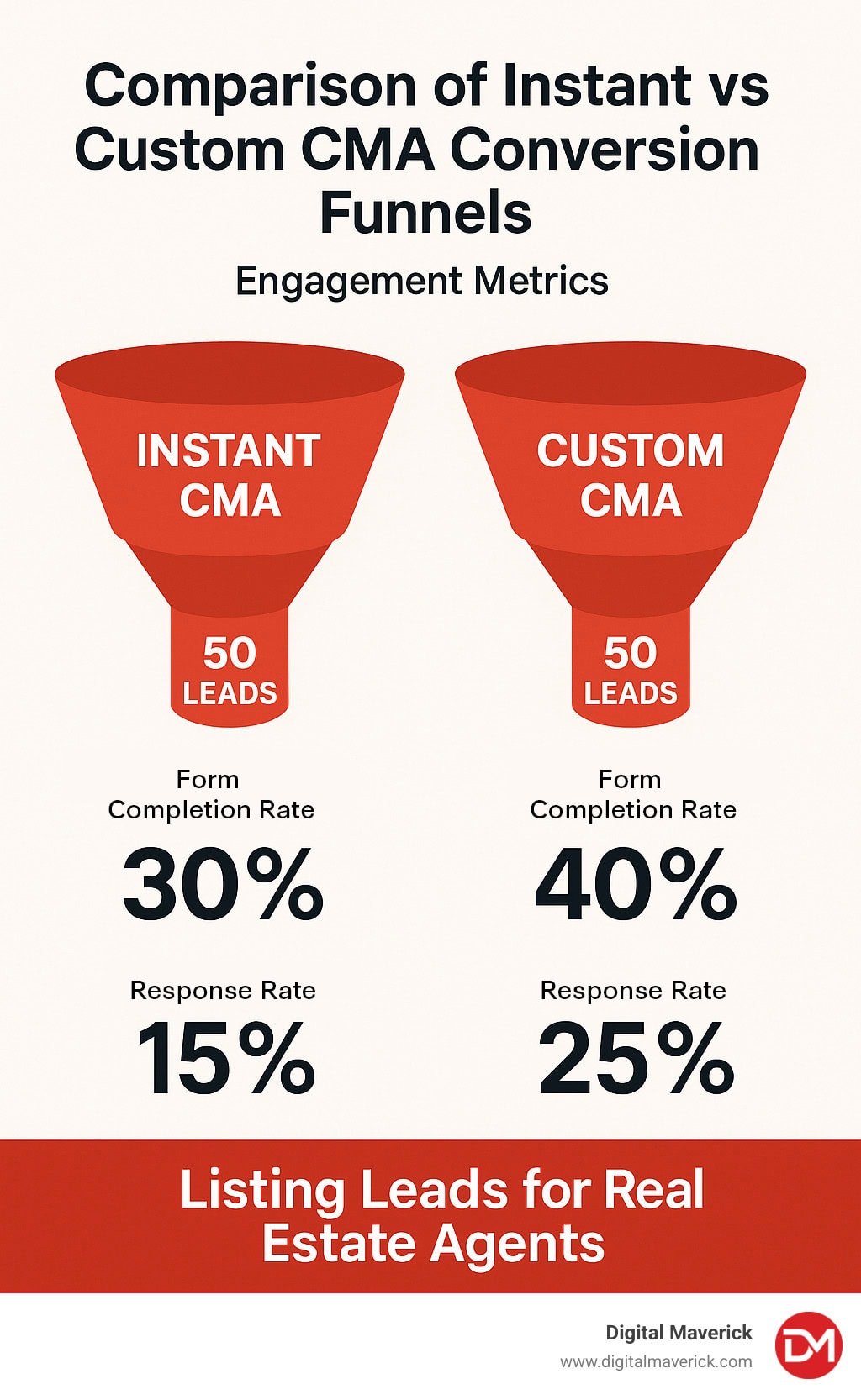
Day 1: Their automated CMA with a personalized video introduction from you
Day 3: A neighborhood-specific market update relevant to their property
Day 5: A helpful “Preparing to Sell” checklist of small improvements that boost value
Day 7: A case study of a similar home you’ve recently sold above asking price
Day 10: A warm invitation to schedule a no-pressure consultation
“The key is balancing automation with authentic human connection,” explains our conversion coach at Digital Maverick. “Technology handles the immediate response and consistent follow-up, but your personal touch is what ultimately earns their trust.”
Don’t forget the power of retargeting ads that follow homeowners who visited your valuation page but didn’t convert. These gentle reminders keep you top-of-mind as they continue their research.
Way 5: Pursue High-Intent Niches (Expired, FSBO, Probate, Pre-Foreclosure)
When you’re hunting for seller opportunities, sometimes the most motivated leads come from specific situations where homeowners have already shown their hand. These high-intent niches are absolute gold mines for listing leads for real estate agents who know how to approach them with the right touch.
Think about it – these aren’t cold prospects who might sell someday. These are people who have already decided to sell or who face circumstances making a sale likely. They’re essentially raising their hands in the marketplace.
The four most valuable high-intent niches include:
Expired Listings: These homeowners are often frustrated but still motivated. Their listing period ended without a sale, leaving them wondering what went wrong. Their disappointment creates your opportunity.
For Sale By Owner (FSBO): These ambitious homeowners thought they could handle it themselves. Many quickly find they’ve underestimated the complexity, time commitment, and marketing reach needed to sell effectively.
Probate Properties: When someone passes away, their home often needs to be sold as part of settling the estate. This represents a massive opportunity – industry data shows probate leads account for roughly $69 billion in annual property sales across the U.S.
Pre-Foreclosure: These homeowners face the stress of falling behind on payments. While they haven’t lost their homes yet, they’re often searching for solutions during a difficult time.
Each of these situations requires a custom approach that respects their circumstances while positioning you as the solution.
For Expired Listings, focus on differentiation: “I noticed your home at 123 Maple Street is no longer active. I’ve studied what happened and have specific ideas about why it didn’t sell and what we could do differently.” These sellers need to hear how you’ll succeed where others failed.
With FSBOs, acknowledge their goals first: “I respect your decision to sell independently. I’ve prepared a market analysis that might help you price more effectively – no strings attached.” Show respect for their choice while demonstrating your expertise.
For Probate situations, lead with empathy: “I understand this is an incredibly difficult time. When you’re ready to discuss the property, I specialize in helping families steer probate sales with minimal stress.” They’re dealing with loss first, real estate second.
With Pre-Foreclosure leads, position yourself as a problem-solver: “I’ve helped several homeowners in similar situations explore their options, including alternatives to foreclosure you might not be aware of.” Your approach should offer solutions, not opportunism.
Listing leads for real estate agents who hate cold calling
“But I hate cold calling!” I hear this all the time from agents who avoid these niches. Good news – you don’t need to be a cold-calling machine to succeed with high-intent leads. Here are proven alternatives that actually work better for many agents:
Value-first direct mail creates connections without the awkward cold call. For FSBOs, send a helpful guide like “Top 10 Mistakes FSBO Sellers Make” or offer free professional photography before asking for their business. These tangible value offerings open doors naturally.
The 5-touch mailer sequence works wonders for expired listings. Instead of one desperate contact, build credibility through a strategic series:
- Mailer 1: “Why didn’t your home sell? 3 common reasons”
- Mailer 2: “How professional photography increases offers by 7%”
- Mailer 3: “The pricing strategy that sold 28 homes last year”
- Mailer 4: “What past clients say about working with me” (testimonials)
- Mailer 5: “I’m still here when you’re ready” (with a specific offer)
Social proof stories demonstrate your ability to solve similar problems. “After 82 days with another agent, the Johnsons listed with me. We made strategic updates, repriced their home, and sold in just 7 days for $15,000 more than the previous list price.” Real results speak volumes.
At Digital Maverick, we’ve helped countless teams build complete workflows for these niches – from lead acquisition and compliance management to conversion scripts that work in real-world situations. Our clients consistently report conversion rates 2-3 times higher with these targeted approaches than with general cold leads. And, if you really just do not want to do the initial calls, we have ISAs with proven workflows to handle that for you, so you can focus on other parts of your business.
The secret isn’t just finding these leads (though that matters) – it’s having a systematic, respectful approach that positions you as the solution to their specific challenge. When you nail that combination, these high-intent niches become your most reliable source of listing leads for real estate agents.
Way 6: Use Social Media & Video to Become the Local Expert
Social media has transformed how listing leads for real estate agents are generated, offering unprecedented opportunities to demonstrate expertise, showcase personality, and connect with potential sellers before they need an agent.
The key is positioning yourself as the local market expert through consistent, valuable content that addresses homeowners’ questions and concerns.
Effective platforms for real estate listing lead generation include:
Facebook: Ideal for community-focused content, market updates, and targeted advertising
Instagram: Perfect for visual content like property photos, neighborhood highlights, and day-in-the-life stories
LinkedIn: Excellent for connecting with high-net-worth individuals and establishing professional credibility
YouTube: Powerful for longer-form content like market updates, property tours, and educational videos
“I was skeptical about social media marketing until I committed to a consistent strategy,” shares Carlos, a Digital Maverick client. “After six months of weekly market updates and neighborhood spotlights, I started receiving direct messages from homeowners asking for valuations. Social media now generates 40% of my listing appointments.”
Content pillars that generate listing leads for real estate agents
The most effective social media strategies for generating listing leads for real estate agents focus on four content pillars:
Educational Content: Explain the selling process and address common concerns
- Market update videos with local data and trends
- “Selling Mistakes to Avoid” posts
- Home preparation checklists
- Explanation of forms and contracts
Proof of Success: Demonstrate your track record without bragging
- Just Sold announcements with permission
- Client testimonial videos
- Before/after staging changes
- Days-on-market comparisons
Community Spotlights: Showcase your local knowledge
- Neighborhood guides
- Local business features
- School information
- Community event coverage
Interactive Elements: Encourage engagement
- Polls asking “Thinking of selling in the next 12 months?”
- “Ask me anything” sessions about the market
- Home value quizzes
- “This or that” renovation choices
Each post should include a clear call-to-action, such as “Message me for a free home valuation” or “Comment below if you’d like more information about selling in today’s market.”
At Digital Maverick, we help teams build content calendars with pre-approved templates and messaging that maintains brand consistency while saving time.
“The key is consistency,” notes our team. “Posting sporadically yields minimal results. Agents who commit to at least 3 weekly posts see exponentially better engagement and lead generation.”. It needs to be part of your weekly operating rhythm.
Way 7: Partner With Local Businesses & Events for Hyper-Local Exposure
There’s something magical about local partnerships that online marketing just can’t replicate. Building strategic relationships with businesses and organizations in your community creates powerful opportunities to generate listing leads for real estate agents through shared audiences and the credibility that comes from local connections.
When homeowners see you collaborating with businesses they already trust, they’re more likely to trust you with their biggest asset—their home. These partnerships position you as someone who’s genuinely invested in the community, not just another agent looking for a quick commission.
I’ve seen agents transform their businesses through smart local partnerships. Take Jennifer, one of our Digital Maverick clients, who created a “Pre-Listing Home Improvement Package” with three local service providers—a painter, a landscaper, and a handyman.
“We co-host quarterly workshops for homeowners thinking about selling,” Jennifer explains. “Not only do we share the marketing costs, but each workshop generates 3-5 serious seller leads. The best part? These leads already trust me because I’m associated with service providers they respect.”
The beauty of local partnerships is the variety of opportunities available:
Local Businesses connections can include home improvement stores, interior designers, landscapers, moving companies, stagers, mortgage lenders, and title companies—all businesses that intersect with the home selling journey.
Community Organizations like schools, PTAs, chambers of commerce, homeowners associations, and charitable groups can put you in front of homeowners in meaningful contexts.
Events and Sponsorships at farmers markets, festivals, charity runs, school fundraisers, and holiday celebrations give you visibility while demonstrating your community commitment.
Creating win-win co-marketing packages
The most successful partnerships deliver clear value to everyone involved. Here’s how to structure arrangements that benefit both you and your partners:
Create service bundles that combine your expertise with complementary businesses. A free staging consultation with every listing not only adds value for your clients but gives your stager partner access to potential customers.
Exchange special offers with local businesses. Provide moving company discount cards to your sellers while they distribute your business cards to their customers. One Digital Maverick client partnered with a high-end furniture store to offer a “New Home Furnishing Package” discount to buyers, and in return, the store displays the agent’s listings on digital screens in their showroom.
Develop co-branded content that showcases both your expertise. A “Complete Guide to Downsizing” created with a mortgage lender can attract pre-retirees considering their next move.
Establish formal referral arrangements with contractors and home service providers who often hear homeowners say, “We’re thinking about selling.” Our clients who implement structured referral programs report that contractor-sourced leads convert at nearly twice the rate of online leads.
Co-sponsor community events that put you face-to-face with homeowners in a non-sales environment. A “neighborhood appreciation night” at a local restaurant builds goodwill while giving you quality time with potential sellers.
Cross-promote on each other’s platforms by featuring a “Local Business of the Month” in your newsletter or social media. This gives you fresh content while helping your partners reach new audiences.
To measure effectiveness, use custom QR codes or dedicated landing pages for each partnership. This tracking allows you to focus on relationships that generate the most listing leads for real estate agents and adjust your approach for those that don’t.
“The Local Business Alliance system we implement for our clients takes the guesswork out of community partnerships,” explains our community outreach specialist at Digital Maverick. “With tracking tools, co-marketing templates, and accountability metrics built in, teams using this approach see a 30% increase in community-sourced listing leads.”
The most powerful aspect of local partnerships is that they create opportunities for authentic connection—something increasingly rare and valuable in today’s digital-first world. When you’re genuinely engaged in your community, listings don’t just come from marketing tactics; they come from real relationships.
Frequently Asked Questions about Quick Listing Lead Generation
How fast can I expect to convert a seller lead?
When it comes to listing leads for real estate agents, one question I hear constantly is about conversion timelines. The truth is, it varies widely depending on where the lead came from and what’s motivating them to sell.
If you’re working with high-intent leads like expired listings or FSBOs, you might see conversions in as little as 2-4 weeks with consistent follow-up. These sellers already have their minds set on moving—they just need the right agent to help them.
Warm sphere referrals typically take a bit longer, usually 1-3 months, as they often trust you but may not be in a rush. Predictive analytics leads might need 3-6 months of nurturing before they’re ready to list.
Your geographic farming efforts require patience, with most leads taking 6-12 months to mature. Similarly, social media and content marketing leads generally need 3-12 months of relationship building before they’re ready to sign a listing agreement.
“The key is understanding where each lead is in their seller journey,” our Digital Maverick conversion coach often reminds clients. “Some leads need immediate solutions, while others are just beginning to consider selling. Your follow-up strategy should match their timeline.”
Think of your seller lead pipeline as having four distinct stages:
- Awareness: When homeowners first realize they might sell eventually
- Consideration: When they’re actively researching the process and local market
- Decision: When they’re ready to interview agents and list their home
- Action: When they’re signing a listing agreement
At Digital Maverick, we help teams organize their CRM around these pipeline stages, with specific nurture campaigns designed for each one. This structured approach ensures no lead falls through the cracks, regardless of their timeline.
What’s the ideal follow-up cadence?
Here’s a sobering reality: industry research shows most real estate leads need 12-20 touches before converting. We’ve seen it take at least 20 touches to properly qualify and convert leads. Yet the average agent gives up after just 2-3 attempts—leaving business on the table for more persistent competitors.
I’ve found that an effective follow-up system for listing leads for real estate agents follows a carefully orchestrated rhythm:
In the first 3 days, you want to create a strong first impression with immediate response (ideally within 5 minutes), a phone call, value-focused email, text message, and even a social media connection request.
Days 4-14 should include a second call, a value-add email (perhaps a market report specific to their neighborhood), a personalized video message, and a direct mail piece.
Between days 15-30, make a third call, share educational content relevant to their situation, send a casual check-in text, and engage with them on social media.
For the longer nurture period (days 31-90), implement monthly check-in calls, a consistent drip email campaign, quarterly direct mail pieces, and invitations to your events.
“The most successful agents understand that lead conversion is a marathon, not a sprint,” our operations director likes to say. This is why at Digital Maverick, we’ve developed what we call “The 90-Day Nurture” for every new lead, ensuring consistent follow-up that matches the typical seller’s decision timeline.
Are paid leads or organic strategies better for ROI?
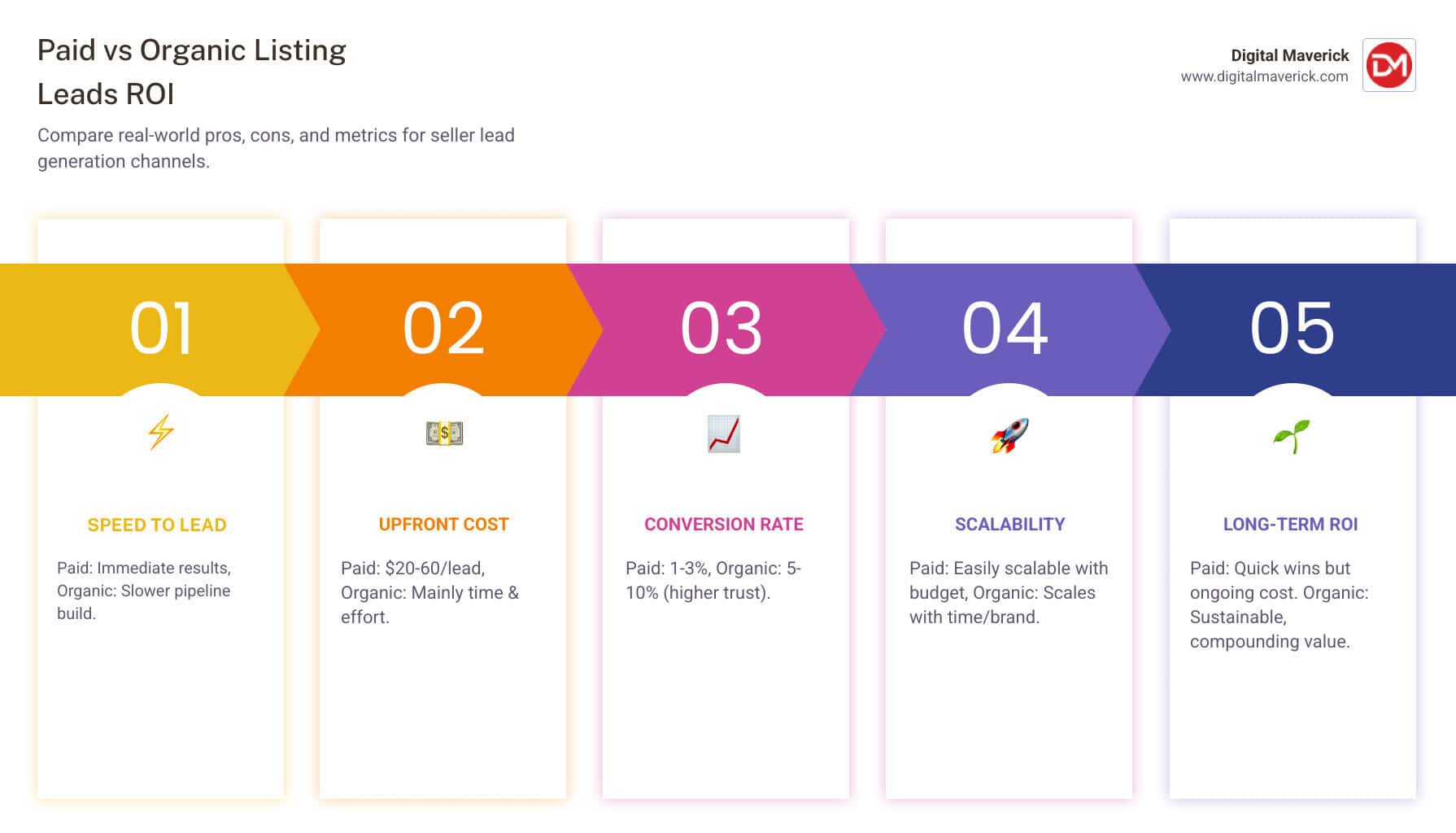
This question always sparks lively debate among our clients. The truth is, both paid and organic strategies can be effective for generating listing leads for real estate agents, but they offer different ROI profiles.
Paid leads deliver faster results with predictable volume and are easily scalable when you need to grow quickly. The downside? Higher upfront costs (typically $20-60 per lead), potentially lower conversion rates (usually 1-3%), and often intense competition from other agents targeting the same leads.
Organic strategies, on the other hand, build higher trust and deliver better conversion rates (often 5-10%) with lower long-term costs. The tradeoff is slower initial results, the need for consistent effort, and challenges scaling quickly when you want to grow.
In my experience, the most successful agents don’t choose one or the other—they thoughtfully combine both approaches:
- Use paid leads when you need to build your pipeline quickly
- Simultaneously invest in organic strategies for sustainable, long-term growth
- Put 60-70% of your budget toward what’s already working well for you
- Set aside 10-15% to experiment with new approaches
- Carefully track both cost-per-appointment and cost-per-closing for all lead sources
“We recommend a 70/30 split between proven channels and experimental approaches,” our Digital Maverick marketing strategist often advises clients. “And regardless of where your leads come from, having a robust conversion system is what ultimately determines ROI.”
Conclusion
Finding listing leads for real estate agents doesn’t need to feel like searching for buried treasure. With the right approach, you can build a consistent pipeline of seller opportunities that keeps your business thriving year-round.
Throughout this guide, we’ve explored seven proven strategies that work together to create a comprehensive listing lead generation system:
Tap Your Sphere of Influence & Past Clients: The relationships you’ve already built remain your most valuable asset. A thoughtful referral strategy can open up listings hiding in plain sight.
Leverage Predictive Analytics & AI Platforms: Technology gives you the power to identify likely sellers before they even know they’re ready—and long before your competition comes knocking.
Master Geographic Farming: Building neighborhood dominance through consistent, valuable touchpoints creates a steady stream of listing opportunities from homeowners who already know your name.
Dominate Online Search with Home-Valuation Pages: By capturing sellers during their research phase, you position yourself as the solution at exactly the right moment in their journey.
Pursue High-Intent Niches: From expired listings to FSBOs, focusing on motivated sellers who need solutions now gives you immediate listing opportunities while building specialized expertise.
Use Social Media & Video to Become the Local Expert: Sharing valuable content builds your authority and keeps you top-of-mind when it’s time to sell.
Partner With Local Businesses & Events: Strategic relationships extend your reach and credibility throughout the community, bringing listing opportunities from unexpected places.
What truly separates top-producing agents from the rest isn’t some secret lead source—it’s their unwavering commitment to systems and consistency. At Digital Maverick, we’ve seen how agents transform their businesses when they shift from chasing the next shiny object to optimizing what’s already working.
“I used to jump from one lead source to another whenever things slowed down,” shares Michael, a team leader from Las Vegas. “Working with Digital Maverick changed everything. Now we have clear systems for each lead channel, with accountability metrics and conversion protocols. Our listing inventory has doubled while our cost-per-acquisition has decreased by 35%.”
The truth is, the most valuable investment you can make isn’t in more lead sources—it’s in maximizing the conversion of the leads you already have. From responding quickly to new inquiries to nurturing long-term prospects, the right operating rhythm makes all the difference in turning possibilities into signed listings.
Ready to transform your approach to listing leads for real estate agents? Digital Maverick equips real estate teams with the systems, training, and people needed to consistently turn leads into conversations—and conversations into closings. Our comprehensive approach combines expert conversion services, hands-on coaching, and operational frameworks that drive predictable results.
Whether you’re struggling with speed-to-lead, sitting on a goldmine of untapped database contacts, or looking to build a conversion culture that brings consistency to your business, we provide the structure and support to make it happen.
Don’t let another potential listing slip through the cracks. Implement these seven strategies with discipline, and watch your seller pipeline—and your business—grow steadily month after month.
More info about our conversion services

Preston Guyton is a co-founder at Digital Maverick and a seasoned real estate operator who’s spent over two decades helping agents build smarter, more scalable businesses. He’s passionate about helping teams avoid the missteps that cost time, money, and momentum. At Digital Maverick, Preston leads strategy across ISA support, CRM systems, and coaching programs—bringing together the tools, accountability, and rhythm that turn leads into consistent closings.