Real Estate Coaching Archives - Digital Maverick

05.22.2025

Sales Training for Real Estate Agents: The Ultimate Guide

Sales Training for Real Estate Agents | Digital Maverick

Mastering the Sales Conversation: Why Training Matters

Sales training for real estate agents is essential for open uping higher conversion rates and consistent growth. Here’s what effective training includes:

  • Proven scripts and dialogues for handling objections and closing deals
  • Follow-up systems that prevent leads from falling through cracks
  • Role-play practice to build confidence before real client interactions
  • Mindset coaching to overcome rejection and maintain motivation
  • Time management techniques to focus on high-ROI activities

Sales training for real estate agents transforms uncertain conversations into predictable outcomes. In today’s competitive market, where consumers are more informed than ever, agents without proper training risk leaving significant commission dollars on the table. The difference between struggling agents and top producers often isn’t their market knowledge or even their lead volume—it’s their ability to convert opportunities through effective sales conversations.

Real-world evidence from high-enrollment sales programs across multiple industries proves that core selling skills are universal and transferable. Yet real estate requires specific approaches that address unique client concerns about what is typically the largest financial decision of their lives.

Effective training isn’t just about memorizing scripts. It’s about internalizing communication frameworks that build trust, demonstrate value, and guide clients through complex decisions with confidence.

I’m Preston Guyton, founder of Digital Maverick, where I specialize in sales training for real estate agents focused on conversion strategies and lead generation systems that produce measurable results through our Inside Sales Coaching programs.

Comprehensive infographic showing the real estate sales training ecosystem including online courses, in-person workshops, coaching programs, role-playing exercises, and technology integration with arrows showing how these elements connect to increase agent conversion rates and income - sales training for real estate agents infographic

Why Sales Training Matters in Real Estate

Proper sales training isn’t just a nice-to-have for agents wanting to grow their business—it’s absolutely essential for both survival and success. Modern real estate consumers arrive incredibly informed, discerning, and yes, sometimes skeptical. They’ve spent hours researching online before ever contacting an agent, forming opinions about property values, neighborhood trends, and even how negotiations should unfold.

Jon Cheplak, puts it perfectly: “With fierce competition, realtors must develop clear strategies to showcase their value unmistakably. The days of simply showing up and expecting to close deals are long gone.”

What really drives this point home is compelling consumer research from outside of real estate showing clients willingly pay a 17-20% premium when buying from someone they genuinely trust and like. Think about that—this “trust premium” represents thousands of additional dollars in transaction value that well-trained agents capture through effective relationship building and communication skills. While they may not overpay for a house, this trust premium shows up in who they select to work with and who they will refer their friends to.

As one respected industry training philosophy states, “Your ability to negotiate is the most referable skill you have.” This perfectly highlights why agents who invest in continuous sales education see exponential returns on that investment.

Defining “sales training for real estate agents”

Sales training for real estate agents goes far beyond basic closing techniques or memorizing scripts. Today’s effective training centers on consultative selling approaches that position you as a trusted advisor rather than just another pushy salesperson.

Travis Halverson of Digital Maverick explains it beautifully: “True sales training teaches agents how to guide clients through a complex decision-making process, not how to manipulate them into saying yes. It’s about creating value at every touchpoint and earning the right to represent them.”

Comprehensive training programs build skills in consultative selling frameworks that put client needs first, develop habit loops reinforcing consistent prospecting, apply communication science for building genuine rapport, and implement ethical approaches to handling objections. They also cover systematic lead nurturing that respects client timelines and the psychology of decision-making in high-stakes transactions.

When properly implemented, these elements create what Nikki Pais of Digital Maverick calls “a virtuous cycle of trust, action, and results that naturally leads to referrals and repeat business.”

The Cost of Skipping Training

The financial impact of inadequate sales training can be staggering—yet it often remains invisible to agents who don’t carefully track their metrics. Consider these sobering consequences:

Lost GCI (Gross Commission Income): Untrained agents typically convert at rates 30-50% lower than their well-trained peers. On a typical transaction, this translates to thousands in lost commission opportunities.

Pipeline Decay: Without proper follow-up systems and communication skills, potentially valuable leads that might convert in 6-18 months simply disappear. As one workshop participant noted: “Before training, I was essentially paying for leads twice—once to acquire them and once to replace them when they went cold.”

Burnout Risk: Agents without proper training often find themselves working harder, not smarter. A graduate from a leading skills-based program shared: “I’m able to spend more time with my family and I can schedule my day to make my most important things happen first.”

Kurt Uhlir of ez Home Search, a leading national real estate search portal trusted by millions annually, observes: “The most expensive lead is the one you’ve already paid for but failed to convert because of inadequate follow-up skills or systems.”

When you consider these costs alongside the ethical standards and fair-housing compliance requirements that proper training reinforces, the case for investing in comprehensive sales training for real estate agents becomes undeniable—not just for your bottom line, but for building a sustainable, respected business.

Core Formats of Modern Real-Estate Sales Training

The learning landscape for real estate professionals has evolved dramatically in recent years. Whether you’re a new agent looking to build foundational skills or a seasoned pro wanting to sharpen your edge, there’s a training format perfectly suited to your needs, schedule, and learning style.

“Finding the right training format is like finding the right home for a client,” says Travis Halverson of Digital Maverick. “It needs to fit your lifestyle, goals, and the way you naturally absorb information.”

Let’s explore the main options available today:

Format Cost Range Time Commitment Retention Rate Best For
Online Courses $99-$2,500 Self-paced 20-30% Foundational knowledge, specific skills
In-Person Workshops $500-$5,000 1-5 days 40-60% Role-play practice, networking
Live Virtual Coaching $500-$2,500/mo Weekly sessions 50-70% Accountability, ongoing growth
Mastermind Groups $500-$10,000/mo Monthly meetings 60-80% Peer learning, advanced strategies

Online Platforms & Self-Paced Modules

The beauty of online training lies in its flexibility. Picture this: you’re sitting in your car between showings, pulling up a quick lesson on objection handling right before meeting a tough client. That’s the power of digital learning.

Modern online sales training for real estate agents offers incredible convenience without sacrificing quality. Quality online training platforms have become trusted resources for millions of learners precisely because they meet agents where they are – busy professionals who need training that fits into the nooks and crannies of their hectic schedules.

What makes online training particularly valuable is its accessibility. Those crucial video lessons on handling specific objections are available exactly when you need them most – perhaps at 10 PM when you’re preparing for tomorrow’s listing presentation. The interactive quizzes help cement what you’ve learned, turning passive watching into active skill-building.

“We’ve found that agents who consistently engage with bite-sized online lessons between our coaching calls show dramatically faster improvement,” notes Nikki Pais of Digital Maverick. “It’s about building that muscle memory through regular practice.”

The key to success with online training isn’t just consuming content – it’s applying it. That’s why Digital Maverick pairs online modules with structured implementation calendars and regular check-ins to ensure what’s learned actually gets used in the field.

More info about Digital Maverick services

Workshops & Live Installations

There’s something magical about being in a room full of ambitious agents all focused on growth. In-person workshops create an energy that’s hard to replicate through a screen.

Immersive training installations have transformed the careers of thousands of associates through multi-day training experiences. Why do these intensive workshops work so well? They create what neuroscientists call “state-dependent learning” – skills become anchored to powerful emotional experiences, making them easier to recall when you need them most.

The heart of effective workshops is practice. Role-play labs give you safe spaces to try new approaches and fail forward without real clients on the line. Those “objection battles” might feel uncomfortable in the moment, but they build the confidence that carries you through tough conversations later. Even neighborhood tours during training can transform how you think about farming techniques by seeing strategies in action.

As many training philosophies emphasize, “No other event in real estate compares to a live training event.” There’s simply no substitute for the collective energy and focused attention of learning alongside peers who share your challenges and ambitions.

Coaching & Accountability Groups

Knowledge without implementation is just trivia. That’s where coaching and accountability groups become game-changers.

“Your life grows to the extent that you do,” Jon Cheplak often reminds his coaching clients. This profound insight explains why ongoing coaching produces such remarkable results – it focuses not just on what you know, but who you’re becoming as a professional.

Effective coaching relationships create structure around your growth. Those weekly scorecards tracking key performance indicators aren’t just paperwork – they’re the guardrails keeping you on the path to success. Peer mastermind pods provide both support and gentle pressure, creating environments where mediocrity isn’t an option.

One of the most valuable aspects of quality coaching is the recorded call reviews. Having an experienced coach listen to your actual client conversations and provide specific feedback accelerates improvement faster than almost anything else. It’s like having a golf pro analyze your swing – small adjustments can lead to dramatic improvements.

“I finally have a clear business plan and know exactly what to do to stay on track,” shared one coaching participant. This clarity and accountability is often the bridge between knowing what to do and consistently doing it – day after day, week after week.

Skills & Topics Every Program Should Cover

When it comes to sales training for real estate agents, there are several essential skills that can make or break your success in this competitive industry. While fancy techniques might come and go, mastering these core competencies will directly impact your conversion rates and keep clients singing your praises.

Prospecting & Lead Generation

Let’s face it — without consistent prospecting, even the most charismatic agent’s business will eventually dry up. As one veteran coach wisely points out, “Geo-farming success depends on knowledge and expertise, not budget size.” This is such good news for agents who might not have deep pockets but are willing to put in the work!

Effective prospecting isn’t about cold-calling strangers until you’re blue in the face. Today’s most successful agents build sphere campaigns that thoughtfully nurture relationships with past clients and personal connections. They become neighborhood experts through strategic geo-farming techniques that establish their local credibility. Many are finding tremendous success with social video hooks that showcase their personality while delivering value, and smart teams are leveraging ISA integration to qualify leads more efficiently.

At Digital Maverick, we’re big believers in what we call “permission-based prospecting” — positioning yourself as a helpful resource rather than just another salesperson. This approach aligns perfectly with industry research showing that relationship-first prospecting not only converts better but generates significantly more referrals over time.

Conversion & Follow-Up Routines

The space between first contact and signed contract is where real estate dreams either come alive or die a quiet death. This is why Travis Halverson of Digital Maverick often says, “The follow-up is where most agents fail. We’ve found that implementing a structured 12-touch follow-up sequence can increase conversion rates by 300% compared to the typical 1-2 contact attempts most agents make.”

Mastering conversion requires several interconnected skills: implementing speed-to-lead response systems that dramatically increase your connection rates, setting up CRM workflows that ensure no lead falls through the cracks, balancing scripting vs. authentic dialogue for different personality types, and optimizing your follow-up cadence based on where the lead came from and how interested they seem.

Many top producers swear by frameworks like the LPMAMA(S) qualification method, which provides a structured approach to understanding a prospect’s Location, Price, Motivation, Agent status, Mortgage readiness, Appointment timing, and Situation — ensuring you gather crucial information while building genuine rapport.

Negotiation & Objection Handling

If there’s one skillset worth its weight in gold, it’s the ability to handle objections and negotiate effectively. Quality training in this area teaches you value articulation that justifies your commission rates, data-driven pricing discussions that take emotion out of the equation, and positioning commission as investment by highlighting the seller’s ROI.

Here’s a powerful statistic for your next listing presentation: homes sold through the MLS sell for 17% more on average than FSBO sales. That single piece of data, when delivered with confidence, can overcome many commission objections.

A seasoned agent who once struggled for years before mastering pricing presentations and objection handling illustrates the point: “After focusing on these skills, my career turned around in just 90 days.”

Client Experience & Referral Engines

Creating remarkable experiences that generate referrals doesn’t happen by accident. The best training programs teach you to build trust triggers that establish credibility from day one, develop handshake to hand-off systems that ensure smooth transaction management, and implement post-closing nurture campaigns that maintain relationships long after the deal is done.

“Referral business growth is a core outcome of effective sales training,” emphasizes a respected industry training framework. The top agents in any market don’t just focus on getting to closing — they intentionally design experiences their clients can’t wait to tell others about.

The experience you create becomes the story your clients tell. By mastering these four essential skill areas, you’ll not only close more deals today but build a sustainable referral business that grows year after year.

The Long-Term ROI of Ongoing Training

Investing in continuous sales training isn’t just about short-term gains—it’s about building a sustainable career with exponential returns. The numbers tell a compelling story: agents who commit to ongoing professional development earn up to 30 times more than their untrained counterparts over the course of their careers.

This dramatic income difference doesn’t happen overnight. It compounds gradually as trained agents build deeper client relationships, refine their systems, and master the art of generating recurring referrals. As one Digital Maverick client put it: “Training isn’t an expense—it’s the foundation of my business growth strategy.”

Travis Halverson of Digital Maverick shares: “What separates the top 1% from everyone else isn’t just talent or market knowledge—it’s their commitment to continuous improvement. The best agents are perpetual students of the business.”

Beyond the immediate commission boost, trained agents experience a significant increase in client lifetime value. When you deliver exceptional service backed by professional skills, clients don’t just come back—they bring their friends, family, and colleagues with them.

“The training we received completely transformed our approach to database management,” notes Nikki Pais of Digital Maverick. “Now every past client represents not just one transaction but potentially 5-7 future deals through their sphere.”

For team leaders and brokers, a culture of training becomes a powerful recruiting magnet. As Jon Cheplak frequently emphasizes: “Top talent is attracted to environments where they can grow. When agents see others thriving because of your training systems, they want access to that same advantage.”

How Training Impacts Income, Relationships, Growth

The financial impact of proper training reveals itself through several key metrics:

Pipeline velocity increases as agents learn to move prospects through the sales process more efficiently. Trained agents typically see a 40-60% reduction in their average days-to-contract compared to untrained peers handling similar leads.

Conversion rate improvements directly translate to bottom-line growth. Even a modest 5% increase in lead conversion can represent tens of thousands in additional annual income without spending an extra dollar on marketing.

Recurring referrals become the lifeblood of a sustainable practice. According to research from the National Association of REALTORS®, agents who receive specialized training generate up to 47% more referral business than those who rely solely on their licensing education.

The impact extends far beyond financial metrics. Trained agents report significantly higher job satisfaction and lower burnout rates. When you have the skills and systems to handle challenging situations with confidence, the emotional toll of real estate decreases dramatically.

“Before training, I dreaded certain client conversations,” one agent shared. “Now I look forward to objections because I know exactly how to address them in a way that builds trust rather than creating tension.”

This confidence carries over into personal relationships as well. Many agents report that the communication skills they develop through sales training positively impact their family dynamics and friendships.

The science supports these experiences. According to adult learning research published by the National Association of REALTORS®, professionals who engage in structured skill development show measurable improvements in problem-solving abilities, emotional intelligence, and resilience—benefits that extend well beyond their professional lives.

As Kurt Uhlir of former eXp Realty executive observes: “The agents who consistently invest in their skills don’t just earn more—they enjoy the business more. They’ve transformed what could be a stressful sales job into a fulfilling consultative profession.”

For brokerages and team leaders, the culture-building aspect of training creates a positive feedback loop. When agents see their peers succeeding through applied learning, it motivates them to engage more deeply with training resources, creating a rising tide that lifts all boats.

The most successful real estate professionals understand that training isn’t something you “complete”—it’s an ongoing commitment that evolves with the market, consumer expectations, and technology. Those who accept this mindset find themselves not just surviving but thriving through market shifts that derail their less-prepared competitors.

The Long-Term ROI of Ongoing Training

When real estate agents commit to consistent, quality sales training, something remarkable happens. Many coaches refer to this as the “Stacking Effect” — where small improvements in skills and daily habits don’t just add up, they compound year after year, creating exponential growth in your business and income.

Return on investment chart for real estate sales training showing progressive income growth - sales training for real estate agents infographic  - sales training for real estate agents infographic

One veteran agent shared this about his experience with ongoing coaching: “I’ve never invested a dollar into professional training and coaching that didn’t come back 10, 20 and even 30 fold!” This kind of return isn’t unusual — it’s actually the norm for agents who stick with professional development for the long haul.

But the benefits go far beyond just closing more deals. When you invest in ongoing training, you’re also building:

Client lifetime value that grows exponentially as your service quality improves, leading to stronger retention and an army of enthusiastic referrers who practically do your marketing for you.

A magnetic culture that naturally attracts talented agents to your team or brokerage. Top performers want to work with other professionals who are committed to excellence.

Team cohesion that reduces costly turnover and creates a supportive environment where productivity flourishes.

“The most successful real estate teams we work with at Digital Maverick have institutionalized learning,” Travis Halverson points out. “They’ve made training a non-negotiable part of their weekly rhythm, not an occasional event.” This consistent approach transforms training from an expense into one of your most valuable assets.

How Training Impacts Income, Relationships, Growth

The benefits of sales training for real estate agents cascade through every corner of your business, creating a virtuous cycle of improvement:

Your metrics tracking naturally becomes more sophisticated as you learn what to measure and how to interpret the data. This leads to smarter, more strategic decisions about where to invest your time and resources.

Your pipeline velocity increases dramatically — not just because you’re generating more leads, but because you’re converting them more efficiently at each stage of the journey.

Perhaps most valuable of all, recurring referrals begin creating predictable income streams that reduce your dependence on paid marketing. There’s nothing quite like the feeling of opening your email to find a warm introduction from a past client.

Nikki Pais of Digital Maverick explains it beautifully: “When agents master both the art and science of real estate sales, they don’t just close more deals—they create more value for clients, which naturally leads to stronger relationships and more referrals.”

The science backs this up too. Research on adult learning shows that consistent application of new skills in real-world scenarios is absolutely critical for retention. That’s why the most effective training programs don’t just dump information on you — they include structured implementation periods between learning modules where you can practice and internalize what you’ve learned.

When you commit to ongoing training, you’re not just investing in skills — you’re investing in a fundamentally better business and a more rewarding career path that will continue paying dividends for years to come.

How to Choose the Right Sales Training for Real Estate Agents

With so many options on the market, finding the perfect sales training for real estate agents can feel like searching for a needle in a haystack. The right program can transform your business, while the wrong one might just waste your time and money.

I’ve seen agents struggle with this decision countless times. Let’s break down what really matters when evaluating your options.

Start by considering these five essential factors:

First, look at the curriculum depth. Does the program cover the complete sales cycle from prospecting to post-closing, or does it just focus on isolated techniques? Complete programs create complete agents.

Second, consider your learning style. Are you someone who thrives in interactive group settings, or do you prefer self-paced learning you can do between showings? As Travis Halverson of Digital Maverick often says, “The best training is the one you’ll actually complete.”

Third, investigate the instructor’s credibility. Have they personally sold real estate successfully? Theory is nice, but nothing beats learning from someone who’s walked the path before you.

Fourth, examine the tech integration. The program should incorporate tools you actually use daily, not force you to adopt an entirely new tech stack.

Finally, ensure budget alignment. Be realistic about whether the investment makes sense for your current production level. The rule of thumb I recommend: a training investment should aim to return at least 10x its cost in additional GCI within 12 months.

The best training program is the one you’ll actually complete and implement. Look for programs with high completion rates and proven implementation frameworks, not just compelling marketing.

Must-Ask Questions Before Enrolling

Before you pull out your credit card, ask these critical questions to avoid buyer’s remorse:

Does the program offer state continuing education credits? Many quality programs, including several from NAR, include CE credits that satisfy your licensing requirements – essentially letting you kill two birds with one stone.

What certification or designation will you earn? Programs like NAR’s Commitment to Excellence (C2EX) provide credentials that can differentiate you in a crowded marketplace.

What happens after the initial training ends? The best programs offer ongoing support through community forums, office hours, or coaching. Learning doesn’t stop when the course ends.

How large is the graduate community? Larger communities, like Ninja Selling’s 80,000+ graduates, provide invaluable networking opportunities and peer support when you hit obstacles.

“Training is only as good as the implementation support that follows it,” notes Travis Halverson of Digital Maverick. “Look for programs that bridge the gap between knowledge and action.”

Red Flags to Avoid

Keep your eyes open for these warning signs that might indicate a program isn’t worth your investment:

One-size-fits-all scripts that don’t account for regional market differences or your unique personality. Authentic communication beats robotic script-reading every time.

Upsell traps where the initial program is just bait to sell you increasingly expensive offerings. The valuable content should be in the program you paid for, not hidden behind another paywall.

Vanity metrics that focus on the trainer’s Instagram followers rather than the actual production results of their students. Social media fame doesn’t necessarily translate to teaching ability.

No customization options to adapt materials to your specific market conditions or business model. Real estate varies dramatically by region – your training should acknowledge this reality.

“The strategies for growing your business and achieving financial success should be concrete, actionable, and practical—not hypothetical,” warns Ryan Serhant, founder of Sell It. This practical focus separates truly valuable training from theoretical programs that don’t translate to real-world results.

I’ve seen too many agents waste thousands on programs that looked flashy but delivered little substance. Take your time with this decision – the right training partnership can become one of your most valuable business assets.

The world of real estate sales training is changing before our eyes, with innovation reshaping how agents learn and grow their skills. These changes aren’t just exciting—they’re creating practical new paths for agents to sharpen their abilities and stay competitive in today’s market.

“The future of real estate training isn’t just about new tools—it’s about new ways of learning that adapt to individual needs and provide immediate application opportunities,” says Travis Halverson of Digital Maverick.

One of the most fascinating developments is the rise of AI role-play bots that never tire, never judge, and are available whenever inspiration strikes. Imagine practicing that tough objection handling at 11 PM when you suddenly think of the perfect response—these tools make that possible. Similarly, virtual classrooms have evolved beyond simple Zoom calls into interactive environments where agents can collaborate in real-time while enjoying the comforts of home.

Some forward-thinking brokerages are even using VR listing tours to train agents on property presentation skills. This technology allows agents to practice highlighting features and addressing concerns in a simulated environment before standing in front of actual buyers.

The certification landscape is evolving too, with micro-credential badges that recognize specific skill mastery rather than one-size-fits-all designations. These targeted credentials allow agents to showcase their specialized expertise in areas like luxury properties, first-time buyers, or investment properties.

Many growing teams are finding the power of ISA outsourcing, which allows them to leverage specialized inside sales talent without the overhead of full-time hires. This approach gives agents more time to focus on face-to-face client work while ensuring leads receive proper nurturing.

National portals like ez Home Search are increasingly powering data-driven demonstrations that give agents real-time market insights to share with clients. As Kurt Uhlir notes, “When agents can show clients exactly how their marketing strategies leverage data from platforms millions of consumers use daily, their value proposition becomes undeniable.”

Tech-Enabled Accountability & Analytics

Technology isn’t just changing what agents learn—it’s changing how they track their progress and stay accountable. Today’s training platforms often include performance dashboards that visualize key metrics and instantly identify areas for improvement.

Call-record scoring using AI has become a game-changer, providing objective feedback on client interactions without the awkwardness of having a manager listen in. These tools can identify everything from talk-to-listen ratios to the emotional tone of conversations, offering insights that were previously impossible to capture at scale.

For agents who struggle with consistency, habit-stack reminders are proving invaluable. These smart notifications use behavioral science principles to reinforce training concepts at just the right moments throughout the day.

“What gets measured gets managed,” is a principle Digital Maverick applies through our CRM audits and accountability metrics built into every training plan. “Clear daily reporting creates both awareness and motivation,” explains Nikki Pais.

Community & Peer-Learning Innovations

While technology plays a crucial role, the human connection in learning remains irreplaceable. Innovative training programs are finding new ways to harness the power of community:

Social learning platforms now facilitate peer-to-peer knowledge sharing in ways that feel more like social media than formal education. Agents can share wins, ask questions, and learn from colleagues’ experiences in real-time.

Many programs have introduced gamified leaderboards that tap into agents’ natural competitive spirit. These friendly competitions keep motivation high while creating natural opportunities for top performers to share their strategies.

Perhaps most powerful are the live hot-seat coaching sessions where one agent’s challenge becomes a learning opportunity for all. These vulnerable moments often create the deepest insights and strongest community bonds.

A working parent who recently completed a comprehensive skills course shared: “The program gave me a clear blueprint to run my business while still having time for my family.” This testimonial highlights how community support can help agents integrate professional growth with personal priorities.

The training landscape continues to evolve, but one thing remains constant: the agents who accept continuous learning and adapt to these new approaches will be the ones who thrive in tomorrow’s market.

Frequently Asked Questions About Sales Training

Do I need state-specific certification hours?

Real estate licensing requirements vary across states, and this often leads to confusion about training hours. The good news is that many quality sales training for real estate agents programs pull double duty — they’ll sharpen your sales skills while also satisfying your continuing education requirements.

Courses approved by state real estate commissions frequently include CE credits that count toward your licensing obligations. Digital Maverick helps agents identify training options that serve both purposes—improving conversion skills while checking the regulatory boxes their state requires.

“Always do your homework before enrolling,” advises Travis Halverson of Digital Maverick. “We make a point of helping our agents find training that serves dual goals so they maximize their time and investment.”

How quickly can training increase my GCI?

This is probably the question we hear most often from agents considering training investments. While I wish I could give you a one-size-fits-all answer, the truth is that results depend on both the quality of the training and how consistently you implement what you learn.

That said, many agents see meaningful improvements surprisingly quickly. For example, participants in an eight-week intensive skills program reported averaging more than $50,000 in income and six transactions shortly after starting the curriculum.

Nikki Pais from Digital Maverick shares: “We’ve seen agents double their conversion rates within 30 days by implementing just three key follow-up techniques consistently. The agents who see the fastest results aren’t necessarily the most talented—they’re the most disciplined about putting new skills into practice immediately.”

Can online training replace live role-play?

Online training has revolutionized how we learn, offering incredible convenience and comprehensive content libraries. But when it comes to mastering the nuanced art of real estate sales conversations, most top producers find that some form of live practice remains irreplaceable.

As many coaching programs emphasize, “Practice alone isn’t enough; you need perfect practice with proven scripts.” There’s simply no substitute for the pressure and spontaneity of real-time interaction when preparing for actual client conversations.

At Digital Maverick, we’ve found the sweet spot lies in blending approaches. “The fastest path to mastery combines knowledge acquisition through on-demand online modules with skill development through structured live practice,” explains Travis Halverson. “Our virtual role-play sessions create a safe space to stumble through new techniques before trying them with actual prospects.”

Many agents find that online training works beautifully for learning concepts and frameworks, while live role-play (whether in-person or virtual) helps translate that knowledge into natural, confident delivery that actually converts when it matters most.

Conclusion: Turning Training into Results

When it comes to sales training for real estate agents, the journey doesn’t end with learning—it begins with implementation. At Digital Maverick, we’ve built our entire approach around this fundamental truth. We don’t just deliver information; we equip real estate teams with scalable growth systems that blend expert conversion services, hands-on coaching, and proven operational frameworks.

The right training creates the right rhythm in your business—ensuring you’re having meaningful conversations daily, staying accountable to your goals, and consistently closing more deals. Whether your team struggles with speed-to-lead response times, has a database full of neglected contacts, or needs to optimize CRM workflows, we provide the structure and support to transform those challenges into opportunities.

What makes Digital Maverick different is our foundation—we’re built by operators, not vendors. We’ve walked in your shoes, scaling real estate businesses ourselves, and intimately understand the day-to-day challenges agents face. As Travis Halverson often says, “Theory without application is just entertainment.” That’s why our approach combines:

  • Full-service conversion support that spans from ISA implementation to coaching to CRM automation
  • Clear daily reporting with CRM audits and accountability metrics built into every plan
  • Tactical playbooks with real-time coaching for both agents and team leaders

Training to Systems to Closings workflow showing how proper sales training creates systems that lead to consistent closings - sales training for real estate agents infographic

The change our clients experience reminds me of one agent’s reflection after completing Ninja Selling training: “It was the best use of my time and money ever… and I’ve been at this for 20 years.” This sentiment captures exactly what happens when the right training meets the right implementation at the right time.

Our Inside Sales Agent (ISA) team has become the leading solution for real estate professionals across America. We don’t just provide training—we deliver the systems, the coaching, and even the people needed to consistently turn leads into conversations and conversations into closings.

“The difference between knowing and doing is the difference between average and exceptional,” notes Nikki Pais of Digital Maverick. “Our job isn’t complete until we see our clients implementing what they’ve learned and achieving measurable results.”

Are you ready to transform your real estate business through effective sales training and systems? We’ve helped countless teams eliminate lead waste, build scalable systems, generate more qualified leads, increase GCI, and open up higher ROI from their existing investments. The path forward starts with a conversation about where you are and where you want to go.

Explore our real-estate growth solutions and find how Digital Maverick can help you build the business you’ve always envisioned—one conversation, one closing, one success at a time.

05.22.2025

How to Overcome Your Real Estate Call Reluctance Fears

Overcome Real Estate Call Reluctance | Digital Maverick

Conquering the Silent Career Killer in Real Estate

Real estate call reluctance affects up to 80% of agents, causing missed opportunities and dramatically reduced income. If you’re struggling with making prospecting calls, you’re not alone.

Quick Solution for Call Reluctance:

  1. Acknowledge it – Call reluctance is normal and fixable
  2. Schedule dedicated calling blocks – 9-11am and 4-6pm are optimal times
  3. Use proven scripts – Eliminates uncertainty and builds confidence
  4. Start with 10 calls daily – Aim for one appointment per 10 contacts
  5. Reframe rejection – It’s not personal, just “not now”
  6. Focus on high-value targets – Expired listings and FSBOs yield 3-5x more appointments

The stomach-churning dread before picking up the phone isn’t a character flaw—it’s a common psychological barrier that even top producers face daily.

According to research from the Keller Center at Baylor University, most real estate professionals experience at least one form of call reluctance. Even more telling: in 2024, a staggering 71% of licensed Realtors sold zero homes, largely because they avoided consistent prospecting.

The good news? This is entirely fixable.

I’m Preston Guyton, and after 20+ years in real estate leadership, I’ve helped thousands of agents overcome real estate call reluctance through proven systems that transform fear into consistent action and predictable commissions. As founder of Digital Maverick, I specialize in training teams to engage databases effectively through calls, texts, and emails to set more appointments and close more deals.

Diagram showing how call reluctance creates a cycle of avoidance behaviors, leading to fewer contacts, fewer appointments, and reduced income, with intervention points for breaking the cycle through mindset shifts, scripts, accountability, and technology support - real estate call reluctance infographic

Understanding Real Estate Call Reluctance

Real estate call reluctance isn’t just a fancy term for being lazy—it’s a often a genuine psychological barrier that stops agents from picking up the phone and reaching out to potential clients. Research from Behavioral Sciences Research Press has identified 16 different ways this reluctance can show up in your daily work life.

When the Keller Center at Baylor University partnered with researchers to study over 3,300 real estate professionals, they finded something eye-opening: most agents experience at least one form of call reluctance that directly hits their earning potential.

The financial impact is clear and immediate. When you avoid making calls, you set up fewer appointments. Fewer appointments mean fewer closings. Fewer closings mean less money in your pocket. It’s a simple but painful equation that plays out in thousands of real estate careers every year.

Real Estate Call Reluctance vs General Procrastination

We all put things off sometimes, but real estate call reluctance is a different animal entirely.

While general procrastination might mean delaying your expense reports or organizing your desk, call reluctance specifically targets the activities that generate income. The emotional stakes are much higher—there’s real fear of rejection involved, not just tedium.

“The difference is in the opportunity cost,” explains Travis Halverson of Digital Maverick. “When you procrastinate on administrative tasks, you might create inefficiency. When you avoid prospecting calls, you’re literally leaving money on the table and creating gaps in your pipeline that will hurt you 60-90 days from now.“

When you avoid making calls today, you’re not just affecting today’s schedule—you’re creating a financial hole that will show up in your bank account two or three months down the road. That’s what makes this form of avoidance particularly dangerous to your real estate career.

Symptoms Agents Should Watch For

Recognizing real estate call reluctance in yourself is the first step toward fixing it. Your body and behavior will give you clear signals if you pay attention:

Your mouth gets dry and your heart races when you think about picking up the phone. You find yourself checking Facebook “just one more time” before making calls. Your CRM—the very tool designed to help you connect with prospects—suddenly feels like something to avoid at all costs.

You might notice yourself endlessly rewriting scripts or researching neighborhoods, telling yourself you’re “preparing” when really you’re just delaying. Or perhaps you become the world’s most dedicated admin clerk during prime calling hours, suddenly passionate about filing and paperwork. Posting on social media? That can be helpful for your business but not if you’re using it to avoid making your calls.

One successful agent shared with us: “I used to tell myself I’d call after checking my Facebook feed… for the fifth time that day. I was making $45,000 a year. Once I recognized this pattern and forced myself to call first thing, my income jumped to $120,000 within 12 months.”

These symptoms aren’t character flaws—they’re warning signs of a common condition that affects most agents at some point. The good news is that once you recognize them, you can take specific steps to overcome them and transform your business.

Looking at scientific research on sales call reluctance confirms what many of us know intuitively: this is a well-documented phenomenon that affects sales professionals across industries, with particularly strong effects in real estate where personal rejection can feel especially painful.

Root Causes & Consequences

Have you ever felt that knot in your stomach right before making a call? You’re not alone. Real estate call reluctance has some deep psychological roots that affect even the most ambitious agents.

At its core, this reluctance often stems from our very human fear of rejection. Nobody enjoys hearing “no” or feeling dismissed, and our brains are wired to avoid potential pain. This avoidance gets amplified by perfectionism—that nagging voice insisting you need the “perfect script” or “perfect timing” before picking up the phone.

“Many agents who struggle with calls are actually highly empathetic people,” explains Travis Halverson of Digital Maverick. “They worry so much about bothering prospects that they talk themselves out of making valuable connections that could genuinely help those same people.”

You have to realize that by not calling people that you are depriving them of an agent that wants what is best for them, someone that will help them make a wise decision when the time is right, etc.

Self-image concerns play a significant role too. We worry about sounding unprofessional, unprepared, or pushy. And let’s be honest—our brains naturally prefer scrolling through Instagram (instant dopamine hit) over making calls that might lead to rejection before reward.

The research backs this up. In a fascinating study of over 3,300 real estate professionals, only about a third reported being primarily motivated by money. Most were driven by deeper values like freedom, helping others, and personal growth. Yet even these purpose-driven agents can freeze when rejection fears take hold.

The consequences? They’re brutal on your business and your bank account.

The National Association of Realtors reported 4.06 million home sales in 2024. Top-producing agents who consistently prospect earn around $561,600 annually by converting just one lead weekly at a 2.7% commission. Meanwhile, those paralyzed by call reluctance watch from the sidelines.

This explains the industry’s shocking churn rate—80% of new salespeople fail within their first year, with real estate call reluctance being a major factor. It’s the classic 80/20 rule in action: approximately 20% of agents (those who overcome call reluctance) produce 80% of the industry’s income.

The Psychology Behind the Phone Fear

That flutter of anxiety before dialing isn’t just you being “lazy” or “unmotivated.” There’s real psychology at work here.

Experts call it “telephobia”—a genuine anxiety response that affects millions. “When we think about making a call, our brain catastrophizes,” explains Scott Lockhart. “We imagine the worst possible outcomes—rejection, embarrassment, conflict—when in reality, the worst thing that happens is someone says ‘no’ or hangs up, which has zero actual consequences to our wellbeing.”

What’s happening biologically? Your amygdala—the emotional processing center of your brain—treats social rejection similarly to physical pain. It triggers the same avoidance instincts that would keep you from touching a hot stove.

Plus, our brains are incredibly efficient energy conservers. They naturally deprioritize tasks perceived as stressful or low-reward. This is why scrolling social media (high dopamine, low effort) often wins out over prospecting calls (potentially low dopamine, high perceived effort).

The breakthrough comes when you shift your mindset from “I’m bothering people” to “I’m providing a valuable service.” This mental reframing transforms reluctance into purpose-driven action.

What Happens If You Don’t Fix It

Ignoring real estate call reluctance creates a predictable downward spiral that many agents don’t recognize until it’s too late.

First come the pipeline holes. With inconsistent prospecting, your lead flow develops gaps that will manifest as income drops 60-90 days later. This delayed consequence makes it especially dangerous—by the time you feel the financial pain, you’re already months behind.

As one experienced agent put it, “What happens if you don’t prospect for 30, 60, or 90 days? Nothing happens—and that’s the problem.” That nothing becomes a serious something when bill-paying time arrives.

The cash flow crunch leads many promising agents to exit the industry entirely, contributing to that 80% failure rate for new agents. And while you’re avoiding calls, your competitors are connecting with the very prospects who could have been your clients.

Nikki Pais of Digital Maverick puts it bluntly: “The real estate agents who consistently earn six figures aren’t necessarily the most knowledgeable or talented—they’re the ones who picked up the phone when others found excuses not to or they have ISAs that are setting up their appointments.”

The good news? This pattern is breakable, and the solutions are simpler than you might think. With the right mindset shifts, practical routines, and support systems, you can transform real estate call reluctance from your biggest obstacle into your greatest opportunity for growth.

Battle-Tested Strategies to Crush Call Reluctance

Now that we understand the problem, let’s focus on concrete solutions to overcome real estate call reluctance:

Avoidance Habit Action Routine
Morning social media scrolling Pre-call ritual (music, affirmations)
Endless script revision Role-play with a partner weekly
“I’ll call later” syndrome Calendar blocking with accountability
Fear of sounding unprepared Record calls and review for improvement
Dreading rejection Track and celebrate “nos” as progress
Awkward conversations F-O-R-D framework for rapport building

The truth about overcoming call reluctance isn’t about becoming fearless overnight. Even top producers feel that flutter of anxiety before dialing. The difference? They’ve built systems that help them act despite their fears. Think of it as a muscle that strengthens with consistent use, not a permanent personality trait holding you back.

Daily Habits to Defeat Real Estate Call Reluctance

Start your day with purpose by blocking out 9-11 AM specifically for outbound calls. This morning window isn’t just random – it’s when contact rates consistently peak, giving you the best chance of reaching people. Many successful agents swear by their pre-call rituals – maybe it’s blasting their favorite pump-up song, knocking out a quick workout, or reciting affirmations that remind them why they’re making these calls in the first place.

“I tell all our agents to think like a 5-year-old in the toy aisle,” shares Travis Halverson of Digital Maverick with a smile. “They never give up asking for what they want. That persistence is exactly what makes top producers successful—they keep dialing when others quit.”

Try keeping a small mirror near your phone. It sounds silly, but watching yourself smile during calls actually changes your voice tone and boosts your confidence. The person on the other end can hear the difference. Another game-changer? Start tracking and celebrating rejection. Yes, celebrating. Set a goal for the number of “nos” you’ll collect each day – it’s concrete proof you’re putting in the work.

And remember the “eat the frog” principle – make your most dreaded calls first thing in the morning. The relief you’ll feel afterward will fuel the rest of your day.

Scripts, Routines & Tech to Tackle Real Estate Call Reluctance

Having the right tools in your arsenal dramatically reduces call anxiety by eliminating uncertainty. As one top producer put it, “Knowledge equals confidence, and ignorance equals fear.” Invest time in mastering proven scripts that outline key qualifying questions – not as robotic dialogues, but as frameworks that ensure you hit important points.

The F-O-R-D framework is particularly effective for building genuine rapport with prospects:

  • Family: “Do you have family in the area?”
  • Occupation: “What line of work are you in?”
  • Recreation: “What do you enjoy doing when you’re not working?”
  • Dreams: “What are your goals for this move?”

Technology can be your ally too. Auto-dialers eliminate the physical barrier of manual dialing, while solid CRM systems ensure consistent follow-up. Digital Maverick’s 24/7 AI assistant can qualify leads and schedule appointments, taking pressure off those initial live calls. Many agents also find value in recording their successful calls – these recordings become personal blueprints for replicating positive outcomes.

Scripts or talking points aren’t a crutch—they’re a foundation. The best agents internalize scripts to the point where they sound natural while covering all the essential points that drive appointments.

Choosing High-Yield Prospecting Activities

Not all prospecting calls offer equal return on your emotional investment. When you’re working to overcome real estate call reluctance, focus first on these high-conversion opportunities:

Expired listings often represent sellers who are already motivated but disappointed by their previous experience. FSBOs (For Sale By Owner) have already demonstrated they’re serious about selling, but may be struggling without professional help. Probate and divorce leads frequently create situations where motivated sellers face deadlines.

Making buyer need calls to neighborhoods where you have active buyers looking creates immediate value for the person answering the phone. And following up phone calls after door-knocking significantly increases your connection rates.

According to data from ez Home Search, a leading national real estate search portal trusted by millions of people every year, expired listings and FSBOs yield 3-5x more appointments than general “circle dialing” around a neighborhood. The 2024 NAR reported 243,600 FSBO sales, 365,760 expired listings, 81,200 probate sales, and 67,399 divorce sales—all high-conversion opportunities for agents willing to make the calls.

Handling Rejection & Negative Self-Talk

The fear of rejection sits at the heart of real estate call reluctance. Learning to reframe it changes everything. Start by adopting the “not now” mindset – when someone says no, they’re not rejecting you personally. They’re simply not ready at this moment. Their timing doesn’t match yours – that’s all.

Focus on service first in every conversation. Lead with how you can help solve their problem, not what you want from them. This subtle shift takes the pressure off both you and the prospect.

When negative thoughts creep in, try journaling them. Write down what you’re afraid might happen, then challenge these catastrophic assumptions. Are they really likely? Has the worst-case scenario ever actually happened?

Kurt Uhlir of ez Home Search offers this valuable perspective: “Ask yourself after every rejection: ‘What am I making their ‘no’ mean?’ Usually, you’re attaching a personal narrative that isn’t there. They’re not rejecting you—they’re just not ready for your services right now.”

Create a small reward loop for yourself too. Schedule something enjoyable immediately after your calling session as positive reinforcement – maybe a coffee break, a quick walk, or time for something you enjoy. This builds positive associations with prospecting over time.

When an ISA or Coach Makes Sense

Sometimes the most effective solution is getting help. If call reluctance has severely impacted your business despite trying multiple strategies, it may be time for specialized support. Professional ISAs can provide clarity on metrics like contact rates, conversion percentages, and appointment setting success.

For agents already closing multiple deals monthly, outsourcing initial calls often makes financial sense – your time is better spent in client-facing activities where your expertise adds the most value.

“Our ISA team doesn’t just make calls—we create a conversion culture,” explains Nikki Pais of Digital Maverick. “We train agents to understand that every conversation is an opportunity, whether it leads to an immediate appointment or plants seeds for future business.”

The right support system transforms prospecting from a dreaded task into a natural part of your business rhythm. Whether that’s through Digital Maverick’s offerings or another solution that fits your specific needs, even the most successful agents have faced and overcome the same challenges you’re experiencing now.

Frequently Asked Questions about Real Estate Call Reluctance

What are the best times to make prospecting calls?

Finding the right time to pick up the phone can dramatically increase your contact rates. The data consistently points to these golden windows of opportunity:

  • Morning: 9-11 AM catches people as they’re settling into their day but before they’re deep in meetings
  • Afternoon: 4-6 PM works well as people wrap up work and have a moment to breathe
  • Weekend mornings: 10 AM-12 PM reaches folks who are simply unreachable during the workweek

Protect these prime calling hours like they’re sacred. Your emails, paperwork, and admin tasks can wait until after you’ve made your calls. When you schedule your most important activity first, everything else falls into place.

How can I measure my progress in overcoming reluctance?

Tracking your progress gives you both accountability and confidence as you work through real estate call reluctance. Focus on these revealing metrics:

Your daily contact count tells you how many decision-makers you actually spoke with—not just dials, but real conversations. The appointment ratio is your north star; aim for one appointment per 10 quality conversations, which is the industry benchmark for success. Your CRM activity metrics show how much time you’re investing in your database making calls rather than just organizing contacts. And of course, your weekly appointment total is the ultimate measure of whether your prospecting efforts are paying off.

Digital Maverick clients appreciate our comprehensive dashboards that track these metrics for their teams, creating both accountability and clarity. As one agent told us, “When I started measuring my calls, I realized I was only making half as many as I thought. Once I had real data, I could set realistic goals.”

Which lead sources are safest for nervous beginners?

If you’re just starting to flex your calling muscles and overcome real estate call reluctance, it’s perfectly fine to begin with lower-pressure conversations. Think of it as building your confidence with a series of small wins:

Start with past clients who already know and trust you. The conversation flows naturally because you have shared history. Referrals from mutual connections give you instant credibility—someone has already vouched for you. Online inquiries represent people who have already raised their hand expressing interest, making them receptive to your call. And your circle of influence—friends, family, and acquaintances—offers a forgiving audience as you practice your approach.

“Start where you’re comfortable, but don’t stay there,” advises Kurt Uhlir of ez Home Search. “I’ve seen too many agents get stuck calling only their sphere for years. The highest-converting leads—the ones that can truly change your business—often require stepping outside your comfort zone.”

Chart showing conversion rates for different lead types, with expired listings and FSBOs showing highest conversion potential - real estate call reluctance infographic

While these “safer” lead sources might feel more comfortable, they typically convert at lower rates than more challenging prospects like expired listings or FSBOs. As your confidence grows, gradually incorporate these higher-yielding opportunities into your calling routine. Your business will thank you for it.

Conclusion

Real estate call reluctance isn’t a career death sentence—it’s a common challenge with proven solutions. Throughout this guide, we’ve unpacked the psychology behind this silent productivity killer and equipped you with practical strategies to overcome it.

The journey from anxious avoidance to confident prospecting isn’t about becoming fearless—it’s about creating systems that help you act despite those natural hesitations. As one of our top-producing agents finded, “The butterflies never completely disappear, but they start flying in formation once you have a reliable process.”

Remember what truly matters: successful agents aren’t necessarily the most knowledgeable or talented—they’re the ones who consistently pick up the phone when others find excuses not to. They’ve built daily habits that make prospecting inevitable rather than optional.

Your change begins with a single decision—to prioritize progress over perfection. Start with just 10 calls today (not tomorrow, not when you “feel ready”). Track your results, celebrate your effort regardless of outcome, and build on that momentum tomorrow.

“The difference between top producers and everyone else isn’t talent or market knowledge,” Travis Halverson of Digital Maverick explains with a smile. “It’s their willingness to do uncomfortable things consistently until they become comfortable.”

At Digital Maverick, we’ve helped countless agents break through their call reluctance barriers. We don’t just provide motivational pep talks—we install the systems, training, and support you need to create lasting behavioral change. Whether you need full-service ISA support to handle calls while you build confidence, personalized coaching to address specific fears, or CRM optimization to make every conversation count, we provide the structure and accountability that turns good intentions into predictable results.

Your potential clients are waiting for someone to solve their real estate problems. With the right mindset, scripts, routines, and support, that someone can be you—starting today.

Ready to leave call reluctance behind and open up your true earning potential? Visit Digital Maverick to find how our conversion systems can help you eliminate lead waste and increase your GCI through proven, repeatable processes that turn conversations into closings.

05.19.2025

A Comprehensive Guide to Inside Sales Coaching

The Evolution of Inside Sales Coaching

Inside sales coaching is a structured approach to developing remote sales professionals through personalized guidance, skill development, and performance feedback. Unlike traditional sales training, coaching provides ongoing support custom to individual strengths and weaknesses.

Overview: A real estate ISA (Inside Sales Agent) plays a crucial role in the real estate industry by managing leads, setting appointments, and supporting the sales team. The core responsibilities of a real estate ISA include lead management, appointment setting, and nurturing client relationships, making them essential for driving sales growth and ensuring a steady pipeline of qualified prospects. ISAs help ensure that new leads are contacted immediately, which is a key factor for 94% of buyers when selecting a real estate agent.

What is Inside Sales Coaching?

  • Definition: One-on-one guidance for sales professionals who sell remotely via phone, email, and virtual meetings
  • Purpose: Improve conversion rates, reduce ramp time, and increase revenue per rep
  • Key Components: Call reviews, skill development, mindset coaching, and accountability systems
  • Delivery Methods: In-person sessions, virtual meetings, call recordings analysis, and role-play exercises
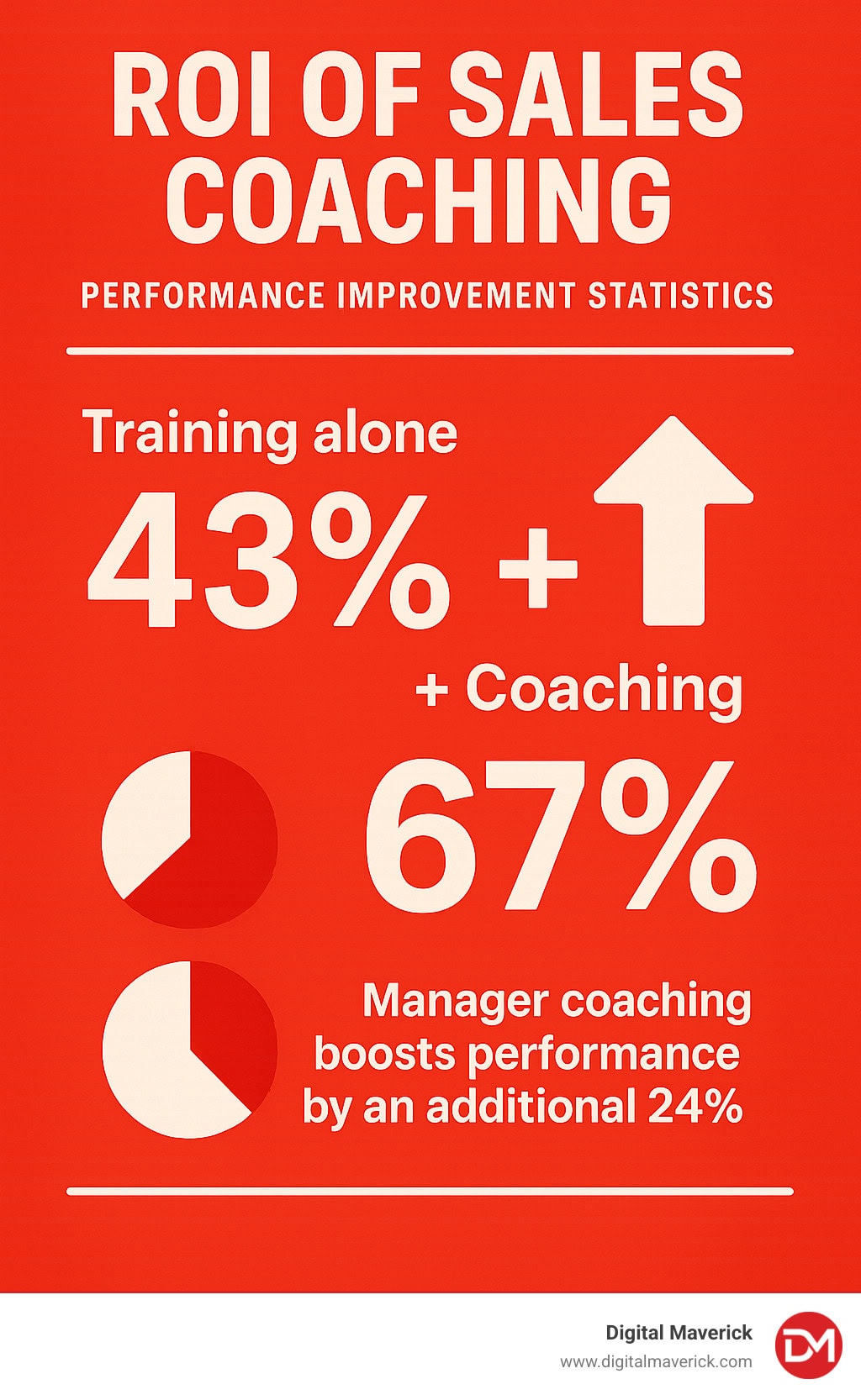
  • Benefits: 43-67% performance improvement when combining training with manager coaching (Wilson Learning)

The skills needed for inside sales success are constantly evolving. Ongoing training is essential to help sales professionals develop new competencies, adapt to industry changes, and bridge skill gaps.

Inside sales coaching has become essential as more sales teams operate remotely. Unlike product training or generic sales courses, effective coaching addresses the unique challenges of virtual selling—from building rapport without face-to-face interaction to managing higher call volumes and shorter sales cycles. Fast response times are crucial in this environment to connect with hot leads and improve conversion rates.

According to the Salesforce State of Sales report, 26% of high-performing sales reps receive weekly one-on-one coaching, yet 72% of salespeople are expected to miss their annual quota. Weekly one-on-one coaching significantly improves sales rep performance and accountability, making it a critical practice for teams aiming to close this gap. This gap represents a massive opportunity for teams willing to invest in structured coaching programs.

“Coaching a sales call is more than just guiding a conversation; it’s an art form that requires finesse, skill, and a deep understanding of human psychology.”

The most effective inside sales coaching programs focus on both tactical skills and mental resilience. They combine regular feedback sessions with measurable goals, creating an environment where reps continually improve rather than simply completing one-time training events. Regular training is necessary to keep up with industry demands and ensure long-term success, as the sales landscape evolves rapidly.

I’m Preston Guyton, co-founder of Digital Maverick where I focus on helping real estate teams with conversion and lead generation strategies through our power house of Inside Sales Agents who are trained to engage databases through calls, texts, and emails to set more appointments and close more deals.

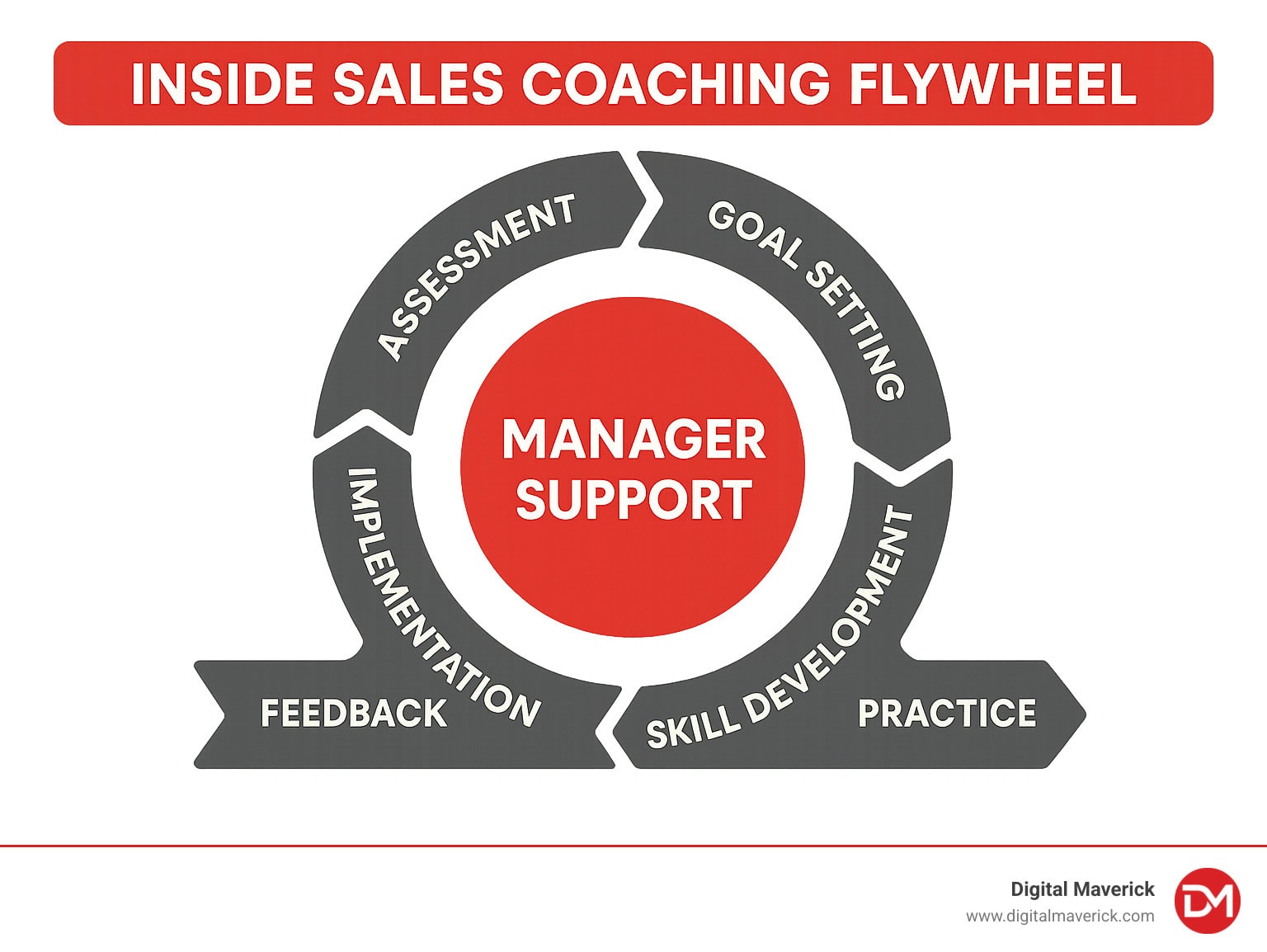
Inside Sales Coaching Flywheel showing the continuous cycle of Assessment, Goal Setting, Skill Development, Practice, Feedback, and Implementation with Manager Support at the center - inside sales coaching infographic

Why This Guide Matters

In today’s competitive real estate market, the difference between thriving teams and struggling ones often comes down to conversation quality and follow-up consistency. With leads costing more than ever (it takes around 300 cold emails to generate a single outbound lead), the stakes are too high to leave conversion to chance.

This guide matters because:

  1. Inside sales is increasingly the norm, not the exception – Even traditionally field-based industries like real estate have shifted toward remote engagement
  2. The revenue impact is substantial – Wilson Learning found that adding manager coaching to sales training increases performance by 24% to 67% overall
  3. Retention hinges on development – 94% of employees would stay longer at companies that invest in their careers. Choosing the right team members and coaching strategies is crucial for long-term success in inside sales.
  4. Investment in training – Sales training can be expensive, with companies spending $2,020 per sales rep on average, but the returns often justify the cost.

As Travis Halverson, often says: “In real estate, leads are expensive assets that require dedicated follow-up. Without a structured coaching system, you’re essentially burning money.”

Inside sales coaching is a systematic approach to developing sales professionals who primarily sell remotely—via phone, email, video conferencing, and social media—rather than through face-to-face meetings. Unlike traditional training, which typically focuses on one-time knowledge transfer, coaching provides ongoing guidance custom to each rep’s specific needs. Training usually focuses on outreach methods, using data to persuade, and sales tools, which are essential for modern sales success.

Think of it as having a personal fitness trainer for your sales skills. Just as a good trainer adjusts your workout plan based on your progress, a skilled inside sales coach tailors their guidance to help you grow where you need it most.

The magic of coaching lies in its personalized nature. It’s not about generic advice but rather a customized development path that recognizes your unique strengths and challenges. This coaching is continuous, happening through regular check-ins rather than once-a-year training events. It’s action-oriented, focusing on specific behaviors you can implement immediately, and data-driven, using actual call recordings and metrics rather than guesswork. Perhaps most importantly, it’s collaborative—built on meaningful two-way conversations rather than lectures.

For real estate teams, inside sales coaching is particularly valuable because it helps Inside Sales Agents (ISAs) and agents maximize every lead opportunity. Inside sales training can help close the talent gap by upskilling existing representatives, ensuring they are equipped to handle the demands of modern sales environments. ISAs aid in maintaining consistent engagement with cold leads, which can help improve conversion rates over time. As Kurt Uhlir of ez Home Search notes, “The best agents aren’t necessarily born with natural talent—they’re coached to execute disciplined follow-up systems that convert prospects into clients.”

Inside Sales Coaching vs General Sales Coaching

While general sales coaching and inside sales coaching share fundamental principles, they differ in several important ways. Sales training is typically more effective when accompanied by training for sales managers, as this ensures alignment and reinforces the coaching process across all levels of the team.

Aspect

Inside Sales Coaching

General Sales Coaching

Primary Focus

Remote engagement skills

Broad selling techniques

Interaction Type

Phone, email, video, social

Face-to-face meetings

Sales Cycle

Typically shorter, higher volume

Often longer, relationship-based

Technology Emphasis

CRM mastery, digital tools, AI

Presentation skills, in-person demos

Coaching Cadence

More frequent, shorter sessions

Less frequent, longer sessions

Key Metrics

Call volume, response time, conversion rates

Meeting quality, deal size, relationship depth

“Inside sales coaching requires a different approach because the medium changes everything,” explains Nikki Pais of Digital Maverick. “Without body language cues, inside sales reps must excel at voice tonality, pacing, and digital engagement—skills that require specialized coaching.”

The virtual nature of inside sales means coaching often focuses on different skills—like how to build rapport quickly without physical presence, managing higher call volumes efficiently, and leveraging technology to create meaningful connections. It’s about mastering the art of selling when you can’t read body language or shake hands.

Core Objectives of Inside Sales Coaching

Effective inside sales coaching programs typically focus on five core objectives:

First, performance improvement sits at the heart of any coaching program—increasing key metrics like contact rates, appointment setting, and conversion percentages. Closely tied to this is revenue growth, boosting both overall sales output and individual rep productivity.

But great coaching goes beyond numbers. Rep wellbeing is increasingly recognized as critical, with 70% of sellers reporting struggles with mental health issues. The right coaching approach provides support against burnout and builds resilience.

Smart teams also recognize coaching’s impact on talent retention. In today’s competitive hiring market, investing in professional development keeps your best people engaged and committed. Finally, consistent coaching builds a culture of continuous improvement where learning becomes part of daily work rather than an occasional event. Agents who love the coaching process are more likely to stay engaged and motivated, fueling ongoing growth and improvement.

Jon Cheplak, emphasizes that “inside sales coaching isn’t just about hitting numbers—it’s about building a sustainable conversion culture where agents thrive rather than merely survive.”

The best inside sales coaching combines accountability with encouragement, balancing the push for results with genuine support for growth. It transforms selling from a lonely numbers game into a collaborative journey of skill development and personal achievement.

Designing an Effective Inside Sales Coaching Program

Creating an impactful inside sales coaching program isn’t about complexity—it’s about building a framework that actually works in the real world. At Digital Maverick, we’ve found that the most successful programs balance structure with flexibility, giving reps clear guidance while adapting to their individual needs.

Think of your coaching program as the foundation of a house. Without it, everything else you build will eventually crumble. The strongest foundations include competency assessments that honestly identify where each rep stands, clear goal-setting tied to business outcomes, and focused skill development that targets the capabilities most critical for inside sales success. It’s also essential to choose the right metrics and data points to track, so you can measure coaching effectiveness and increase conversions.

“The secret to effective coaching isn’t complexity—it’s consistency,” says Travis Halverson of Digital Maverick. “When we implement coaching programs for real estate teams, we focus on creating daily operating rhythms that agents can sustain long-term.”

What separates great coaching programs from mediocre ones? Regular cadence. The teams we see thriving maintain weekly coaching sessions no matter what. They make call reviews a priority, analyzing recorded conversations with curiosity rather than judgment. They incorporate role-play practice that might feel uncomfortable at first but builds the muscle memory reps need when facing tough objections.

Between formal coaching sessions, the best programs deliver bite-sized micro-learning opportunities—quick tips, short videos, or reminder texts that reinforce key concepts. They build in accountability without micromanagement and celebrate improvements, no matter how small.

Skills Needed & Competencies to Prioritize

While every real estate team has unique needs, certain skills consistently drive inside sales success. Lead qualification tops our list—the ability to quickly separate the serious prospects from the tire-kickers saves countless hours and focuses energy where it matters most. Identifying viable prospects is crucial, and using a systematic lead qualification checklist helps agents evaluate and qualify leads more effectively. Training ISAs should include using a lead qualification checklist to prioritize high-potential leads effectively.

Objection handling might be the most valuable skill we coach. When an ISA can confidently address concerns about timing, pricing, or competition without sounding defensive, conversion rates soar. We teach the SWIIFT framework (“So What’s In It For Them”) to help reps master consultative questioning that uncovers true motivations rather than surface-level interests.

The best inside sales professionals excel at active listening even without visual cues, demonstrating understanding through thoughtful responses rather than rushing to the next talking point. They’ve mastered value articulation, explaining benefits in terms that resonate with specific client needs rather than rattling off generic features. All successful ISAs should be confident in using the Customer Relationship Management (CRM) system to track interactions and manage leads effectively, as this is critical for maintaining organized and productive workflows. ISAs should be trained to use scripts effectively, which aids in delivering structured and engaging conversations with leads.

Follow-up mastery separates the elite performers from the average. As one Digital Maverick client shared: “Our ISAs were sending too many generic follow-ups. Once we coached them on personalized messaging tied to property interests, our appointment rates tripled in just one week.”

We also prioritize CRM proficiency because organized data drives better conversations. Social selling skills help reps build relationships through digital channels when face-to-face isn’t an option. Time management coaching ensures reps focus on high-value activities, and resilience training helps them bounce back from the inevitable rejections that come with the territory.

Inside Sales Coaching Formats & Methods

No single coaching format works for everyone, which is why we recommend a blended approach for most real estate teams. One-on-one sessions provide the deep, personalized guidance reps need for breakthrough improvement, though they require significant time investment from managers. Sales coaching programs that incorporate role-playing enhance retention and application of skills, making them an indispensable part of a comprehensive coaching strategy. Using scenarios that actually happened in real sales situations makes role-play exercises more relevant and impactful for inside sales training.

Call reviews offer perhaps the most direct improvement path—there’s nothing quite like hearing yourself on a recording to recognize improvement opportunities. Shadowing works wonders for new hires who learn best by example, while role-play exercises create safe spaces to practice difficult scenarios before facing them with actual prospects.

“The most successful coaching programs combine scheduled one-on-ones with impromptu micro-coaching moments,” notes Nikki Pais of Digital Maverick. “It’s the daily five-minute check-ins that often make the biggest difference.”

Format

Limitations

Implementation Tips

One-on-One Sessions

Deep individual development

Time-intensive

Schedule weekly 30-minute blocks

Group Coaching

Shared challenges, peer learning

Less personalized

Limit to 5-8 participants

Call Reviews

Specific conversation improvements

Can feel judgmental

Focus on wins before gaps

Shadowing

New hire development

Disrupts workflow

Schedule during peak call times

Role-Play Exercises

Practicing difficult scenarios

Can feel artificial

Use real past objections and scenarios that actually happened

Virtual Coaching

Remote teams, flexibility

Technology barriers

Use video when possible

Self-Guided Learning

Independent skill builders

Lacks accountability

Pair with check-in system

Manager Playbook for Inside Sales Coaching

For team leaders implementing inside sales coaching, one approach is the COACHN model (adapted from Factor 8’s framework) to structure your approach:

Begin by Clarifying Expectations for each session—what specific skill or outcome are you focusing on today? Then Observe Behavior by reviewing actual calls or metrics before jumping to conclusions. When providing feedback, Ask Questions first—”What do you think went well in that call?”—before offering your own perspective.

Help reps Commit to specific improvements rather than vague intentions. Then Help by providing resources, examples, or additional practice opportunities. Finally, establish clear Next Steps with timelines and accountability measures.

“The key is to focus on one improvement area at a time,” explains Travis Halverson. “When we coach real estate ISAs, we’ve found they make faster progress mastering a single skill over two weeks than trying to improve three skills simultaneously.”

The most effective managers document coaching sessions in the CRM, creating a progress record that builds over time. They follow up on previous commitments before introducing new ones. They celebrate small wins enthusiastically while balancing positive reinforcement with constructive feedback. Managers should also double-check that all required participants are present for each session and that all procedural details are followed. And they adapt their coaching style to match each rep’s experience level, learning preferences, and personality.

As Jon Cheplak often reminds us, “The best coaching doesn’t feel like coaching at all—it feels like someone who truly cares helping you find your own path to excellence.”

Leveraging Technology & Data in Inside Sales Coaching

The days of coaching sales teams based on gut feelings are long gone. Today’s inside sales coaching has evolved into something much more precise—blending the human touch with powerful data insights that show exactly where improvement is needed. High-performing sales teams leverage technology and data insights to personalize coaching, ensuring that each rep receives targeted guidance for their unique challenges. Conversational intelligence tools allow sales teams to analyze performance and measurable behaviors.

When I work with real estate teams, I’m always amazed at how the right technology transforms their coaching approach. Instead of general advice like “be more persuasive,” managers can now say, “I noticed you’re speaking 70% of the time on calls—let’s work on asking more questions and listening more.”

“Technology doesn’t replace human coaching—it amplifies it,” as Kurt Uhlir of ez Home Search perfectly puts it. “When our partner agents use conversation intelligence tools, they can focus coaching on exactly where each ISA needs help rather than guessing.”

For real estate teams looking to lift their coaching game, five key technologies stand out:

Call recording systems capture every conversation for later review, creating a library of teachable moments. Managers can revisit specific calls to identify exactly where a conversation went right—or wrong.

Conversation intelligence platforms go a step further by analyzing those recordings, highlighting talk ratios, spotting keywords, and even detecting emotional signals that might indicate buyer interest or hesitation.

CRM dashboards bring metrics to life, showing not just activity levels but meaningful patterns in how reps engage with leads. These insights help coaches focus on behaviors that actually drive conversions, not just busy work.

Learning management systems keep training consistent between coaching sessions, ensuring skills continue developing even when the manager isn’t directly involved.

AI coaching assistants are the newest addition, offering real-time guidance during calls—like having a coach whispering in your ear exactly when you need advice.

Tools That Amplify Inside Sales Coaching

The technology landscape for inside sales coaching keeps evolving, but several categories have proven especially valuable for real estate teams:

Speech analytics platforms do more than just transcribe calls—they’re like having an assistant who listens to every conversation and highlights the important parts. These tools identify patterns across hundreds of calls, showing where reps consistently struggle with certain objections or miss opportunities.

Sales enablement systems create a single source of truth for coaching materials. Instead of digging through emails for the latest script or best practice, everything lives in one accessible hub. This consistency ensures everyone receives the same quality coaching resources.

Learning management systems bridge the gap between coaching sessions with structured content that reinforces key concepts. The best systems adapt to each rep’s learning style and pace, creating personalized development paths.

Virtual role-play technology gives reps a safe space to practice difficult conversations without the pressure of a live prospect. The AI-driven feedback helps them refine their approach before taking it to real calls.

CRM integration tools connect coaching activities directly to sales outcomes, helping teams understand which coaching interventions actually move the needle on results.

At Digital Maverick, we’ve found that most real estate teams don’t need to add more tools—they need to better use what they already have. “The goal isn’t adding more tools—it’s making your current tools work harder,” as Travis Halverson explains. “Often, teams already have powerful coaching capabilities within their CRM that they’re not utilizing.”

Measuring ROI of Inside Sales Coaching

Let’s be honest—coaching programs that can’t demonstrate their value don’t survive budget cuts. That’s why measuring return on investment isn’t optional—it’s essential for sustaining your inside sales coaching program.

The most telling metrics fall into two categories: performance indicators and financial outcomes.

On the performance side, track how coaching impacts quota attainment (are more reps hitting their targets?), ramp time (are new hires becoming productive faster?), and conversion metrics (are key ratios improving at critical funnel stages?).

For financial validation, monitor revenue per rep before and after coaching implementation, calculate changes in retention rates (replacing an ISA costs 1.5-2x their annual salary), and measure improvements in activity levels that drive revenue.

ROI of sales coaching showing performance improvement statistics - inside sales coaching infographic

The numbers don’t lie—and they’re impressive. According to Wilson Learning’s study on coaching ROI, sales training alone increased performance by 43%, but adding manager coaching boosted performance by an additional 24% to 67% overall. That dramatic lift explains why inside sales coaching consistently ranks as one of the highest-ROI investments real estate teams can make.

“We’ve seen real estate teams achieve a 5X return within 90 days of implementing structured coaching,” notes Travis Halverson. “The key is measuring both leading indicators—like call quality scores—and lagging indicators like closed transactions.”

The beauty of modern coaching technology is that it makes this measurement much easier. Today’s platforms automatically track improvement over time, creating direct lines between coaching activities and bottom-line results that make it easy to justify continued investment.

Overcoming Challenges & Sustaining Momentum

Let’s face it – even the most brilliantly designed inside sales coaching programs hit roadblocks. It’s not about avoiding these challenges but recognizing them early and tackling them head-on that separates thriving teams from struggling ones.

Common Obstacles in Inside Sales Coaching

Time is the enemy of every sales manager. Between putting out fires, analyzing reports, and managing their own pipeline, finding space for meaningful coaching often falls to the bottom of the priority list. The solution isn’t complicated, but it requires discipline: block dedicated coaching time on your calendar and protect it like you would a meeting with your biggest client. Even 15-minute coaching sessions can transform performance when they happen consistently.

“The biggest mistake we see in real estate is treating coaching as an event rather than a process,” explains Jon Cheplak. “Teams launch with enthusiasm but fail to build the accountability systems needed for lasting change.”

Another common hurdle is what I call the “Monday motivation problem” – reps leave coaching sessions fired up but gradually slip back into comfortable old habits by Wednesday. Combat this by implementing quick daily check-ins and leveraging your CRM to monitor whether new behaviors are sticking. A simple Slack message asking, “What’s one thing from our coaching session you’re applying today?” can work wonders.

Resistance to feedback remains a persistent challenge, especially with veteran agents who’ve “seen it all.” The trick here is starting with self-reflection. Before offering your observations, ask questions like “How do you feel that call went?” or “What would you do differently next time?” This approach disarms defensiveness and creates space for genuine learning.

For remote teams, the isolation factor can undermine coaching effectiveness. Without the energy of a shared office space, virtual teams need intentional connection points. Create digital spaces where wins are celebrated and peer recognition flows freely – this builds the supportive culture where coaching thrives.

Data overload is the silent killer of many coaching programs. When everything is measured, nothing matters. Focus on just 2-3 key performance indicators that directly drive revenue for your real estate business. For most teams, these include contact-to-appointment ratio, appointment-to-client conversion, and average commission per transaction.

Building a Culture of Continuous Inside Sales Coaching

Creating a sustainable inside sales coaching culture isn’t something that happens overnight – it’s built through consistent, intentional actions that gradually reshape your team’s DNA.

Start by celebrating the small stuff. When an agent successfully handles a difficult objection or improves their talk-to-listen ratio, make a big deal about it. These micro-wins create momentum that fuels ongoing improvement far more effectively than waiting to recognize only closed deals.

Share success stories liberally during team meetings. When coaching helps an agent overcome a challenge, turn it into a teaching moment for everyone. This not only reinforces the value of coaching but also spreads effective techniques throughout your team.

“The teams that sustain coaching momentum are those that make it part of their identity,” notes Nikki Pais. “When we work with real estate teams, we help them weave coaching into their daily operating rhythm—making it as routine as checking email.”

Leadership modeling makes a tremendous difference. When managers demonstrate their own coachability by seeking feedback and visibly working on their skills, it sends a powerful message that growth is expected at every level. No one should be “above” improvement.

Developing a shared language around your sales process creates clarity and consistency. When everyone understands what “SWIIFT questioning” or “value articulation” means in your organization, coaching conversations become more efficient and effective.

Perhaps most importantly, foster a growth mindset throughout your team. Frame challenges not as failures but as valuable learning opportunities. The question after a lost deal shouldn’t be “What went wrong?” but rather “What can we learn from this for next time?”

Digital Maverick’s approach focuses on creating this sustainable coaching culture by combining expert guidance with practical frameworks that teams can maintain independently. Learn more about our coaching services.

Frequently Asked Questions about Inside Sales Coaching

How often should inside sales coaching sessions occur?

Finding the right coaching rhythm is a bit like Goldilocks—too little and reps don’t improve, too much and they get overwhelmed. Based on our experience with high-performing real estate teams, there’s a sweet spot that tends to work well:

Weekly one-on-ones (30 minutes) give reps personalized attention without overwhelming their schedule. These sessions provide the perfect space to review calls, discuss challenges, and set focused goals for the coming week.

Many teams also benefit from daily huddles (15 minutes) to keep everyone aligned and celebrate quick wins. These brief check-ins help maintain momentum between deeper coaching sessions.

We’ve also found that monthly deep dives (60 minutes) allow for more comprehensive performance reviews where you can step back and look at bigger patterns.

For new team members, the coaching calendar looks a bit different. “The investment in upfront coaching pays dividends in faster ramp time and higher retention,” Travis Halverson often reminds our clients. New hires typically benefit from daily coaching for their first two weeks, gradually transitioning to the standard cadence as they gain confidence.

Which metrics best show coaching effectiveness?

When it comes to measuring whether your inside sales coaching is actually working, not all metrics are created equal. The numbers that truly tell the story include:

Revenue per rep remains the ultimate scorecard—at the end of the day, are they producing more? This bottom-line metric doesn’t lie.

Contact-to-appointment ratio reveals how effectively reps are converting conversations into opportunities. As coaching improves their skills, this number should climb steadily.

Speed-to-lead might seem simple, but it’s a powerful indicator of process discipline and urgency—qualities that good coaching reinforces.

Talk time ratio offers fascinating insights into conversation quality. As reps improve their questioning and listening skills, this often shifts from rep-dominated conversations to more balanced exchanges.

Rep satisfaction scores shouldn’t be overlooked. Happy, engaged agents typically perform better and stick around longer.

Nikki Pais from our team puts it perfectly: “In real estate, we’ve found that tracking both behavioral metrics—like follow-up consistency—and outcome metrics like appointments set provides the clearest picture of coaching impact.”

How can technology personalize inside sales coaching at scale?

Remember when coaching meant sitting next to someone all day? Those days are gone. Today’s technology allows us to deliver personalized coaching even to large, distributed teams through some pretty remarkable innovations:

AI-powered call analysis has been a game-changer. These tools can review hundreds of calls and pinpoint exactly where each rep needs help—whether it’s handling specific objections, improving their questioning technique, or adjusting their tone.

Adaptive learning platforms are like personal trainers for sales skills, automatically adjusting content based on how each rep performs on assessments and real calls.

Many teams are finding success with automated coaching prompts delivered right through their CRM. These timely nudges help reinforce training exactly when reps need it most.

Personalized dashboards give each rep visibility into their own progress against individual goals, creating accountability without constant manager intervention.

Virtual role-play scenarios custom to each rep’s specific skill gaps allow for private practice before facing real prospects.

Kurt Uhlir of ez Home Search, a leading national real estate search portal trusted by millions, notes: “The future of inside sales coaching is hyper-personalization at scale. The best systems can now identify exactly which skills each agent needs to work on and deliver micro-learning moments throughout their day.”

At Digital Maverick, we integrate these technologies into practical coaching solutions for real estate teams of all sizes. Our approach ensures every ISA and agent receives guidance specific to their needs, helping them convert more leads into appointments and ultimately, closed deals. Using AI tools can automate tasks and enhance productivity for sales reps, allowing them to focus more on high-value activities like building relationships and closing deals. Whether you have three agents or thirty, technology now makes it possible to give everyone the personalized coaching they deserve.

Inside sales coaching has transformed from a luxury into an essential component for real estate teams that want to stay competitive. Throughout this guide, we’ve seen how thoughtful coaching creates remarkable improvements in performance, revenue, and team retention—with research showing performance increases of 43-67% when training gets reinforced through consistent coaching.

The real estate teams that truly excel don’t treat coaching as something to check off a list. Instead, they weave it into their daily operations, combining clear frameworks with personalized guidance. They use technology wisely to extend their impact, and build cultures where giving feedback and constantly improving become second nature.

Here at Digital Maverick, we partner with real estate teams to provide the systems, training, and people they need to transform leads into meaningful conversations—and ultimately, into closings. Our approach to inside sales coaching blends proven methods with real-world experience scaling successful real estate businesses.

“The most successful teams don’t just train their people—they coach them consistently,” Travis Halverson often tells our clients. “It’s the difference between knowing what to do and actually doing it every day.”

Whether your team struggles with response times, needs help reconnecting with past leads, wants to get more from your CRM, or dreams of building a conversion-focused culture, we provide the structure and support to make it happen.

As Jon Cheplak wisely puts it: “Training teaches skills, but coaching changes behaviors—and behaviors drive results.” This simple truth explains why coaching makes such a profound difference between teams that merely survive and those that consistently thrive.

Ready to lift your team’s inside sales performance? Explore our offerings to find how Digital Maverick can help your real estate business achieve sustainable, scalable growth through expert coaching and conversion support. We don’t just hand you a playbook—we walk alongside you to ensure it works.

Building Product Knowledge for Inside Sales Success

Building product knowledge is absolutely essential for inside sales agents aiming to reach their full potential and deliver outstanding sales performance. While Inside Sales is different for real estate than say a SaaS company, the niches, areas, and services you offer are different than what other agents/teams offer. Your ISA team MUST know what is unique to you to be effective in taking actions that will boost your GCI.

When agents possess in-depth knowledge of their products or services, they’re able to identify the unique needs of each client and provide valuable, tailored solutions that resonate. This expertise not only increases the chances of closing deals but also establishes agents as trusted advisors in the eyes of their clients.

To develop this level of knowledge, agents should actively participate in structured training sessions, regularly review SOPs and product manuals, and seek out opportunities to learn from experienced colleagues. Staying current with real estate trends through ongoing market research is equally important, as it allows agents to offer relevant insights and position themselves as industry experts. By consistently updating their knowledge base, agents can confidently address client questions, highlight the most valuable features, and differentiate their offerings in a crowded market.

Ultimately, building strong service and niche knowledge is a proven way to drive revenue growth and increase sales performance. Agents who invest in their own development not only boost their own results but also contribute to the overall success of the team and the business. In today’s competitive landscape, being able to provide clients with valuable, up-to-date insights is what sets top-performing agents apart.

Coaching for Lead Generation and Qualification

Coaching for lead generation and qualification is a cornerstone of effective inside sales coaching strategies. The ability to identify and qualify potential leads is what fuels a healthy sales pipeline and ensures that agents are focusing their efforts on the most promising opportunities. Through targeted coaching, agents learn to master processes that streamline lead generation, from initial outreach to in-depth qualification.

Effective coaching programs teach agents how to use proven sales coaching strategies—like the LPMAMA technique—to engage with leads, ask insightful questions, and listen actively to uncover true client needs. By focusing on the right questions and listening for key insights, agents can quickly identify which leads have the highest potential to convert into clients. This not only increases the number of qualified leads but also boosts overall sales performance by reducing time spent on unqualified prospects.

Regular review and analysis of lead generation and qualification processes are essential for continuous improvement. By monitoring key metrics and conducting periodic process reviews, coaches can identify areas where agents may need additional guidance or training. This data-driven approach ensures that coaching remains relevant and impactful, helping agents to consistently boost their results and drive revenue growth.

Ultimately, coaching for lead generation and qualification empowers agents to work smarter, not harder—focusing their energy on the leads most likely to become valuable clients and maximizing the impact of every interaction.

Coaching for Initial Contact and Engagement

The initial contact with a potential client is a pivotal moment in the inside sales process, and coaching agents to excel at this stage can make a significant difference in conversion rates. Effective coaching focuses on teaching agents how to craft compelling opening messages that incorporate relevant keywords and resonate with the target audience. By using language that speaks directly to the client’s needs and interests, agents can quickly establish credibility and spark interest.

Guidance on asking engaging questions and listening attentively is equally important. Agents who listen carefully to potential clients are better able to identify pain points and tailor their approach, increasing the likelihood of building trust and rapport. Coaching should also emphasize the importance of focusing on the client’s perspective, ensuring that every interaction feels personalized and valuable.

Role-playing and regular practice are great tools for building confidence and refining these skills. By simulating real-world scenarios, agents can develop the knowledge and discipline needed to handle a variety of initial contact situations. With the right coaching and support, agents are empowered to make every first impression count—laying the foundation for strong client relationships and increasing the chances of successful appointments and closed deals.

Overcoming Objections and Handling Concerns

Overcoming objections and handling concerns is an essential skill set for any inside sales agent aiming to increase sales performance and drive revenue growth. Potential clients often raise questions or express hesitations that, if not addressed effectively, can stall or derail the sales process. Coaching agents to identify common objections and respond with confidence is a critical part of their development.

Effective coaching focuses on teaching agents to use active listening skills to truly understand the concerns of potential clients. By listening carefully and analyzing the root of each objection, agents can provide tailored solutions that directly address client needs. This approach not only reassures clients but also demonstrates the agent’s expertise and commitment to finding the best outcome.

Guidance on developing effective counterarguments and practicing objection handling through role-play and scenario analysis helps agents build the confidence and discipline needed to navigate even the toughest conversations. Regular review of sales performance and analysis of lost deals can help identify patterns and areas where additional training may be needed, ensuring that agents are always improving their ability to handle objections.

By making objection handling a core focus of coaching, teams can increase their close rates, build stronger client relationships, and achieve sustained revenue growth. The best way to ensure agents are prepared for any challenge is through ongoing, structured coaching that prioritizes listening, analysis, and actionable guidance.

05.19.2025

The Complete Guide to Inside Sales Manager Tips and Strategies

Inside Sales Manager Tips for Success | Digital Maverick

Inside Sales Leadership: The Foundation of High-Performance Teams

Inside sales manager tips are essential for driving team performance and meeting revenue targets in today’s competitive market. Here are the key strategies successful inside sales managers use:

  • Set clear expectations – Define specific goals and KPIs for each team member
  • Implement structured coaching – Hold regular 1:1s focused on skill development
  • Optimize your CRM – Ensure data hygiene and meaningful reporting
  • Balance admin with coaching – Protect 70% of your time for team development
  • Create accountability systems – Use shared documents and visual dashboards
  • Shield your team – Remove obstacles so reps can focus on selling

Inside sales managers stand at the intersection of strategy and execution, balancing administrative demands with the critical work of developing top-performing sales representatives. According to research, over 55% of sales in some industries now originate from inside teams, making effective management of these operations more important than ever.

The role has evolved significantly beyond simple call monitoring. Today’s inside sales managers must master consultative coaching, data-driven decision making, and creating environments where reps can thrive despite rejection and pressure. As organizations increasingly compete on customer experience (with over 80% citing CX as a primary competitive factor), inside sales leaders must ensure their teams deliver meaningful conversations that build trust and drive revenue.

What separates high-performing inside sales managers from the rest? It’s not just tactical expertise but their ability to:

  1. Establish clear, measurable expectations
  2. Create highly efficient onboarding systems
  3. Implement regular, structured coaching
  4. Balance reporting with developmental activities
  5. Shield their teams from non-selling tasks
  6. Foster healthy competition and collaboration

I’m Preston Guyton, a real estate leader with over 20 years of experience helping teams achieve their sales goals through inside sales manager tips and strategies that drive conversion and lead generation, particularly at Digital Maverick where our Inside Sales Coaches transform databases into appointments and closed deals.

Inside Sales Manager Ecosystem showing key responsibilities, skills, metrics, and tools with connections between pipeline management, team coaching, technology enablement, and performance tracking - inside sales manager tips infographic

Core Responsibilities of an Inside Sales Manager

Leading an inside sales team isn’t just about watching call metrics or checking boxes. It’s about orchestrating the perfect balance of people, processes, and performance that drives your organization forward.

“The inside sales manager is the linchpin that connects strategy to execution,” says Travis Halverson of Digital Maverick. “They’re responsible for translating company objectives into daily activities that drive results while developing talent that can scale with the organization.”

The modern inside sales manager wears many hats – team leader, pipeline guardian, process architect, and cross-departmental diplomat. The best managers don’t just monitor activities; they actively shape how customers experience your brand while ensuring their teams have everything they need to succeed.

Recruiting & Staffing Essentials

Finding the right people might be your most important job as an inside sales manager. The stats don’t lie – research shows about 55% of sales reps would actually perform better in non-sales roles, which makes thoughtful recruitment absolutely critical.

When building your dream team, you need to determine whether your organization needs “builders” or “growers”:

Builders thrive in entrepreneurial environments where they can create pipelines from scratch. They’re perfect for startups or new market initiatives. Growers, on the other hand, excel in established systems where process refinement drives results – ideal when you’re scaling existing operations.

“One of the biggest mistakes I see real estate teams make is hiring solely based on personality or industry experience,” notes Nikki Pais of Digital Maverick. “The best inside sales reps often have transferable skills from customer service, hospitality, or even teaching—they’re naturally curious, resilient, and empathetic.”

For real estate inside sales teams, look beyond the resume for candidates who show comfort with rejection, exceptional listening skills, an ability to build instant phone rapport, natural curiosity, and – perhaps most importantly – a genuine desire for feedback and growth.

Process Ownership & Optimization

One of the most valuable inside sales manager tips is to align your sales methodology with the customer’s actual buying journey. With over 80% of organizations now competing primarily on customer experience, this alignment isn’t optional – it’s essential.

A truly effective inside sales process should feel natural to both your reps and your prospects. It should map directly to how people actually make buying decisions, include flexible conversation frameworks (not rigid scripts), anticipate common objections, clearly define next steps, and integrate seamlessly with your CRM.

The best inside sales processes feel natural to both the rep and the prospect. They guide the conversation without constraining it, allowing for the human connection that ultimately drives decisions in real estate.

Don’t create your process in a vacuum. Regularly gather feedback from marketing, operations, and especially your agents. Survey customers to find friction points. And most importantly, empower your team through role-playing and call reviews to master the process rather than just follow it.

Reporting Up & Out

Great inside sales managers translate complex sales data into stories that inspire action – both for leadership and for their teams. This requires becoming fluent in dashboard creation, pipeline analysis, and stakeholder communication.

“Great inside sales managers are bilingual,” explains Kurt Uhlir of ez Home Search. “They speak the language of metrics and KPIs with leadership, while translating those same numbers into practical coaching opportunities for their reps.”

When reporting upward to leadership, focus on pipeline health, stage-by-stage conversion rates, and revenue forecasts that help executives make informed decisions. But when communicating with your team, shift the emphasis from raw numbers to the specific behaviors and activities that actually drive those metrics. Your reps don’t need more pressure about numbers – they need clarity about actions.

The most effective managers create dashboards that tell stories, forecasts that inspire confidence, and team updates that motivate rather than intimidate. They know that data without context is just noise, but data with meaning becomes the compass that guides everyone toward success.

Must-Have Skills for 2024

The landscape for inside sales managers is evolving at lightning speed. As we move deeper into 2024, success in this role requires a blend of technical savvy and human-centered leadership that might surprise you. It’s no longer enough to simply track numbers and push for results.

“Today’s inside sales managers need to be part data scientist, part psychologist, and part futurist,” says Travis Halverson of Digital Maverick. “The ones who thrive are constantly learning and adapting their approach.”

Technical Proficiency That Scales

Let’s be honest – CRM mastery isn’t just a nice-to-have anymore; it’s the foundation everything else builds upon. The most effective inside sales managers I’ve worked with don’t just use their CRM – they transform it into a powerful engine that drives their entire operation.

One inside sales manager from a growing real estate team recently told me: “I used to drown in spreadsheets and call logs. Now I’ve built dashboards that automatically flag coaching moments based on call patterns. It’s like having an extra set of eyes on the team.”

Beyond your CRM, you’ll need working knowledge of call recording platforms, email automation tools, and video conferencing software. And yes, AI-assisted tools are changing everything. The best managers aren’t fighting this tide – they’re riding it by using AI to handle routine tasks while redirecting their human talent toward building meaningful connections.

“AI isn’t replacing inside sales teams,” notes Nikki Pais of Digital Maverick. “It’s freeing them to focus on the parts of the job that machines can’t replicate: building trust, reading emotional cues, and having authentic conversations.”

Coaching & Development Mindset

If there’s one skill that separates extraordinary managers from the merely competent, it’s the ability to coach effectively. When I look at the highest-performing inside sales teams in real estate, they all have managers who prioritize development over micromanagement.

Active listening sits at the heart of great coaching. This means truly hearing what your reps are saying (and what they’re not saying). The best coaches I know spend more time asking questions than giving answers.

Feedback loops create the structure for continuous improvement. Rather than saving all feedback for quarterly reviews, top inside sales managers create daily and weekly touchpoints that keep development front and center.

“The best inside sales managers act more like thermostats than thermometers,” explains Nikki Pais. “They don’t just read the temperature of performance—they actively adjust it through consistent coaching interventions.”

For real estate teams specifically, coaching needs to zero in on qualification skills and objection handling. These directly impact appointment setting and conversion rates – the lifeblood of your operation. Inside sales manager tips that really move the needle include “in-the-moment” coaching, where you provide immediate feedback while the experience is still fresh.

Underrated Power Skills

While everyone talks about tech skills and coaching abilities, several quieter skills often determine which managers truly excel:

Time management might sound basic, but it’s actually rare to find managers who protect their coaching time religiously. The most effective inside sales leaders block at least 70% of their calendar for team development activities, treating this time as sacred even when other priorities come knocking.

Cross-functional collaboration becomes increasingly crucial as inside sales teams interface with marketing, operations, and external agents. Managers who build bridges across departments remove obstacles for their teams and ensure everyone rows in the same direction.

Adaptability isn’t just helpful – it’s survival. In an environment where buyer behaviors, technologies, and market conditions constantly shift, rigid managers simply can’t keep up. The best leaders accept change and model this flexibility for their teams.

Scientific research has consistently shown that empathy correlates strongly with sales leadership success. According to studies published in scientific journals like the Journal of Personal Selling & Sales Management, managers who understand and respond to the emotional needs of their teams create environments where reps feel supported through the inevitable challenges of sales work.

When reps feel truly seen and supported, they’re more likely to weather the storms of rejection and uncertainty that come with inside sales roles. This emotional resilience translates directly to better performance and lower turnover – two metrics every sales manager should care deeply about.

Inside Sales Manager Tips: A Day-in-the-Life Playbook

What does a typical day look like for a high-performing inside sales manager, particularly one overseeing entry-level SMB closers? Understanding this daily cadence helps new managers structure their time effectively and veteran managers identify optimization opportunities.

Morning: Dashboards Before Emails — inside sales manager tips

The most effective inside sales manager tips start with a disciplined morning routine. Top performers consistently check dashboards before emails, focusing on leading indicators rather than yesterday’s results.

6:30-7:30 AM: Review key performance indicators and identify coaching opportunities

  • Pipeline health by stage
  • Previous day’s activity metrics
  • Upcoming appointments and closing opportunities
  • Gaps requiring immediate attention

“I look for patterns, not just performance,” shares a veteran inside sales manager. “Are certain lead sources converting better? Is a particular objection derailing multiple reps? These insights drive my coaching priorities for the day.”

By 8:00 AM: Conduct a brief team huddle (15 minutes maximum)

  • Celebrate previous day’s wins
  • Address immediate challenges
  • Set clear expectations for the day
  • Provide quick, targeted coaching on a single skill

For real estate inside sales teams, morning huddles should emphasize speed-to-lead for new inquiries from platforms like ez Home Search, which delivers millions of home search sessions annually. “The difference between a 5-minute and 30-minute response time can be dramatic for conversion rates,” notes Kurt Uhlir.

Mid-Day: High-Impact 1:1s & IFMs — inside sales manager tips

The core of an inside sales manager’s day revolves around Individual Focus Meetings (IFMs) and one-on-one coaching sessions. These structured conversations drive accountability and skill development.

Inside sales manager tips for effective IFMs include:

  1. Prepare thoroughly: Review each rep’s pipeline, recent calls, and previous coaching notes before meetings
  2. Use shared documents: Create collaborative agendas where both manager and rep contribute topics
  3. Focus on upstream activities: Discuss prospecting, first appointments, and needs findy rather than just closed deals
  4. Ask powerful questions: “What’s your next step on this account?” and “When will you complete it?”
  5. Balance praise and development: Spend 80% of time reinforcing strengths and 20% addressing improvement areas

“The IFM is where the magic happens,” explains Travis Halverson. “It’s where you transform from a manager who monitors performance to a coach who improves it.”

For maximum impact, schedule these meetings consistently—ideally weekly with each rep—and make them non-negotiable on your calendar. One hour per rep allows sufficient time to cover 2-3 key accounts and 2-3 target accounts in depth.

Afternoon: Shield the Team & Strategize

The afternoon presents an opportunity for inside sales managers to fulfill one of their most valuable yet underrated functions: shielding their team from non-selling activities while advancing strategic initiatives.

3:00-4:00 PM: Remove obstacles and handle administrative burdens

  • Field cross-departmental requests
  • Complete reporting requirements
  • Address operational issues
  • Manage up to leadership

“The best managers I’ve worked with take administrative issues off my plate so I can focus on selling,” shares a top-performing inside sales rep. “They don’t just say ‘protect your selling time’—they actively make it possible.”

4:00-5:30 PM: Strategic planning and pipeline generation

  • Analyze team performance data
  • Refine processes based on observed patterns
  • Collaborate with marketing on lead generation
  • Develop training materials for skill gaps

For real estate inside sales teams, this strategic time should include regular collaboration with agents to ensure alignment on lead handling expectations and appointment scheduling protocols. Digital Maverick’s approach emphasizes creating clear handoff procedures between ISAs and agents to prevent leads from falling through the cracks.

Onboarding, Coaching, and Development Framework

When it comes to building a high-performing inside sales team, your onboarding and development approach can make or break your success. The numbers don’t lie—organizations with structured onboarding programs see a remarkable 82% improvement in new hire retention and 70% increase in productivity. But what does an effective framework actually look like in practice?

World-Class Onboarding in 6 Steps

I’ve seen countless inside sales teams struggle with haphazard onboarding that leaves new hires feeling overwhelmed and underprepared. The best managers follow a clear, systematic approach instead.

Start by establishing clear expectations from day one. This means documenting specific performance metrics for each role and creating tangible 30-60-90 day milestone plans. Be realistic about ramp-up timelines based on your actual lead volume—nothing kills motivation faster than impossible targets.

Next, clean up your CRM before new hires arrive. This often-overlooked step prevents frustration and confusion. Audit your data quality, set appropriate access permissions, and pre-build essential reports and dashboards so your new team members can hit the ground running.

“Onboarding isn’t just about teaching systems—it’s about immersing new team members in your culture and expectations,” explains Nikki Pais of Digital Maverick. “For inside sales teams, that means hearing real calls, practicing real scripts, and getting immediate feedback.”

The third step is to clarify team-wide workflow management by documenting and automating repetitive processes. Visual workflow maps for common scenarios help new hires understand the big picture, while clear handoff procedures prevent leads from falling through the cracks.

Don’t forget to create a comprehensive knowledge repository where team members can find answers independently. This should include a centralized resource library, training videos for common processes, and detailed documentation about your products and competitive positioning.

Implement structured shadowing programs that pair new hires with experienced team members. I recommend rotating these assignments to provide diverse exposure to different selling styles and situations. Make sure to include both successful calls and challenging ones—real learning happens when things get difficult.

Finally, develop role-play scenarios that mirror real interactions. Script common objection scenarios, practice findy questioning techniques, and simulate difficult customer situations. The more realistic these practice sessions, the better prepared your team will be for actual customer conversations.

High-Frequency Coaching Loops

The most successful inside sales managers don’t treat coaching as an occasional activity—they build it into the daily rhythm of their teams through high-frequency feedback loops.

Call recording reviews form the foundation of effective coaching. By regularly listening to actual customer interactions together with your reps, you can identify specific coaching opportunities around opening techniques, findy questioning, objection handling, and closing language.

For coaching to stick, follow a structured feedback process: Listen to calls together, ask the rep to self-evaluate first (which builds self-awareness), provide specific positive reinforcement (to reinforce what’s working), focus on just 1-2 improvement areas (to prevent overwhelm), role-play alternative approaches (to build new skills), and schedule follow-up (to ensure accountability).

The difference between good and great often comes down to conversation quality. Consistent coaching on how to have better conversations drives everything from appointment setting to referral generation.

Career Pathing & Succession

Looking beyond immediate performance to long-term development separates truly exceptional inside sales managers from the rest. Creating clear career paths isn’t just nice to have—it directly impacts your bottom line by increasing retention, motivating continuous improvement, building organizational bench strength, and reducing your workload through effective delegation.

An effective career path includes documented growth plans for each team member that outline specific skills they need to develop and milestones they need to reach. Create leadership tracks for those with management potential, and ensure everyone has written goals with specific timelines and metrics. Most importantly, hold regular check-ins on progress at least monthly to maintain momentum.

The best inside sales managers are constantly working themselves out of a job. They identify and develop future leaders who can take over aspects of their role, allowing the manager to focus on higher-level strategy.

For real estate inside sales teams, progression typically flows from Junior ISA to Senior ISA to Team Lead to ISA Manager and eventually to Director of Inside Sales. Digital Maverick recommends creating “mini-promotions” within each role that recognize skill development before full position changes—these incremental steps keep team members engaged while building the capabilities needed for larger jumps.

By approaching onboarding, coaching, and development with this level of intention and structure, you’ll not only improve current performance but also build a sustainable inside sales operation that can scale with your business growth.

Metrics, KPIs, and Tech Stack for High-Performance Teams

Running a successful inside sales team without the right metrics is like driving with your eyes closed. The most effective managers I’ve worked with accept data not as a burden, but as their most powerful coaching tool. They understand that numbers tell stories about what’s working and where opportunities hide.

Comparison of lagging vs leading KPIs for inside sales teams - inside sales manager tips infographic

The Non-Negotiable Scorecard

Every morning, top inside sales managers open their dashboards to check their team’s vital signs. Think of these core metrics as your team’s health indicators – ignore them at your peril.

Your lead-to-opportunity ratio reveals how effectively your team qualifies prospects. In real estate inside sales, you should aim for 10-15% conversion. When this number drops, it’s usually a sign your team needs coaching on their qualification questions. I worked with a team that doubled this ratio simply by refining their initial findy process.

Call-to-connect ratio might seem basic, but it’s incredibly revealing. With cold outreach typically landing between 8-12%, any significant deviation tells you something about your calling patterns, scripts, or list quality. One manager I know finded her team’s numbers jumped 30% just by shifting their calling times by 90 minutes.

Sales velocity combines multiple metrics into one powerful indicator of overall health. By multiplying your opportunity count, average deal size, and win rate, then dividing by sales cycle length, you get a comprehensive view of performance. What makes this metric special is how it helps you target specific improvement areas rather than just saying “sell more.”

Don’t overlook customer experience metrics in your pursuit of efficiency. Your Net Promoter Score, satisfaction ratings, and referral rates ensure you’re building a sustainable business, not just hitting short-term numbers. As one manager told me, “I’d rather have slightly fewer deals with raving fans than more deals with customers who never come back.”

“For real estate inside sales teams, speed-to-lead is perhaps the most critical metric,” explains Kurt Uhlir of ez Home Search. “Our data shows conversion rates drop dramatically after the first five minutes, making this a key performance indicator for teams handling online leads.”

Leveraging Technology for Visibility

The days of managers hovering over reps’ shoulders are long gone. Today’s best inside sales manager tips center around using technology to maintain visibility while giving teams room to work.

Great dashboards do more than display numbers – they tell stories. They highlight patterns, flag coaching opportunities, and help managers spot trouble before it becomes a crisis. The most effective dashboards I’ve seen share five key qualities: they prioritize critical metrics, blend leading and lagging indicators, enable easy drill-downs, update frequently, and work on mobile devices for managers on the go.

“The best dashboards tell stories, not just display numbers,” says Travis Halverson. “They help managers identify patterns and coaching opportunities without requiring hours of analysis.”

The technology backbone for this visibility typically includes a robust CRM platform, call tracking systems that record and analyze conversations, email engagement tools that show how prospects interact with messages, and activity capture solutions that eliminate manual data entry.

For real estate teams specifically, Digital Maverick has found success building dashboards that separate team and individual metrics, with special emphasis on the metrics that directly impact conversion: speed-to-lead, appointment-setting rates, and performance by lead source.

Selecting & Integrating Tools

I’ve seen too many teams buy shiny new tech that ends up collecting dust because it doesn’t fit their workflow. When building your tech stack, integration trumps features every time.

The most productive inside sales teams build their technology around five core principles. First, tools must talk to each other seamlessly – data silos kill productivity. Second, interfaces should be intuitive enough that reps actually use them. Third, look for automation that eliminates busywork. Fourth, ensure you can customize the system to your specific processes. Finally, everything should work on mobile devices for today’s increasingly flexible workplace.

At minimum, your inside sales tech stack should include:

A CRM system that serves as your single source of truth. This is non-negotiable – without it, you’re flying blind.

Dialer technology that increases call volume while capturing valuable data. The difference between manual and power dialing can be hundreds of additional conversations per week.

Scheduling tools that eliminate the back-and-forth of appointment setting. These simple integrations often deliver the fastest ROI of any tech investment.

Sales enablement platforms that centralize your training, content, and playbooks. These ensure your team delivers consistent messaging and follows best practices.

Communication tools that keep your team connected, especially if you’re working with remote or hybrid arrangements.

“The best technology decisions start with process, not features,” advises Nikki Pais. “Define your ideal workflow first, then select tools that support it—not the other way around.”

At Digital Maverick, we’ve seen how the right technology stack transforms real estate teams. Our approach focuses on eliminating lead waste by optimizing CRM workflows and integrating tools that work together seamlessly. The result? More conversations, more appointments, and ultimately, more closings – without adding more complexity to your agents’ day. More info about CRM services

Building Culture, Handling Challenges, and Leadership Growth

Inside sales management goes well beyond tracking numbers and creating processes. The heart of exceptional leadership lies in building a vibrant culture, navigating inevitable challenges, and continuously growing as a leader.

Fostering a Winning Culture

The magic of high-performing inside sales teams doesn’t happen by accident. It’s carefully cultivated through intentional culture-building that balances personal achievement with team success.

Recognition systems form the foundation of winning cultures. The most successful inside sales managers make celebration a daily practice, not just a quarterly event. They highlight both effort and outcomes, understanding that reinforcing the right behaviors leads to better results.

“Culture isn’t what you say—it’s what you celebrate,” explains Travis Halverson of Digital Maverick. “In the best inside sales teams, managers actively recognize the behaviors they want to see more of, not just the results.”

When managing real estate inside sales teams, I’ve found that creating specific recognition for different types of wins works wonders. Acknowledging someone who excels at lead generation differently from the team member who’s masterful at nurturing relationships shows you value diverse contributions to the team’s success.

Healthy competition energizes teams when structured thoughtfully. Rather than creating cutthroat environments where reps undermine each other, smart managers design contests with collaborative elements. Team challenges, rotating focus areas, and competitions against historical benchmarks rather than just peer-to-peer comparisons maintain motivation without sacrificing unity.

Perhaps surprisingly, shared dashboards play a crucial role in culture-building. Transparency around performance creates natural accountability and helps everyone see how their work contributes to team goals. Visual displays that connect daily activities to outcomes help reps understand the “why” behind what they’re asked to do each day.

Tackling Underperformance & Turnover

Even the most carefully built teams face performance challenges and turnover. How you handle these inevitable bumps often defines your effectiveness as a leader.

When addressing underperformance, start with genuine curiosity rather than judgment. Conduct a root-cause analysis to determine whether you’re dealing with skill gaps, motivation issues, process problems, or personal circumstances affecting work. This detective work pays dividends by ensuring your solution matches the actual problem.

A study by Harvard Business Review found that only about 40% of sales reps have a strong understanding of their company’s differentiation—often a hidden cause of performance issues. This highlights why continuous training on value proposition matters so much.

“In real estate inside sales, underperformance frequently stems from script adherence issues or qualification problems,” notes Nikki Pais of Digital Maverick. “Targeted coaching in these areas can often turn around struggling performers before more drastic measures are needed.”

When coaching doesn’t solve the issue, well-designed Performance Improvement Plans (PIPs) provide clear structure. Effective PIPs include specific, measurable goals, reasonable timelines with regular checkpoints, defined support resources, and transparent consequences. The goal should always be improvement rather than documentation for termination.

Smart managers also maintain a hiring bench of potential talent, knowing that some turnover is inevitable. Ongoing passive recruitment, internal development pipelines, and cross-training for coverage minimize disruption when someone leaves.

Elevating Your Leadership Brand

The most impactful inside sales managers view their own development as a never-ending journey. They’re as intentional about growing their leadership capabilities as they are about developing their teams.

Thought leadership development opens doors professionally while benefiting your organization. Consider sharing insights on industry platforms, contributing to your company’s knowledge base, or participating in professional communities. These activities position you as a forward-thinking leader while helping you refine your own ideas.

Strategic networking multiplies your effectiveness by building relationships across departments, connecting with peers in similar roles, and engaging with industry thought leaders. These connections provide fresh perspectives and solutions to challenges you might be facing.

Mentorship (both giving and receiving) accelerates growth exponentially. Seek guidance from experienced leaders while providing mentoring to emerging talent. Creating structured mentorship programs within your organization benefits everyone involved.

“The best inside sales managers are perpetual students,” says Travis Halverson of Digital Maverick. “They’re constantly learning new techniques, testing new approaches, and sharing their findings with others.”

For real estate inside sales managers specifically, leadership development should include staying current with market trends, understanding consumer behavior patterns, and mastering agent coaching techniques. This knowledge helps you support both your team members and the agents they serve, creating value throughout the organization.

Digital Maverick’s leadership programs emphasize these areas specifically because we’ve seen how dramatically they impact a manager’s ability to drive results across real estate organizations.

Frequently Asked Questions about Inside Sales Management

What metrics matter most for new inside sales teams?

When you’re just getting your inside sales team off the ground, it’s easy to get overwhelmed by the sheer number of possible metrics to track. I’ve found that simplicity is your friend in the early days.

Focus first on the activities that drive results. Track call volumes, emails sent, and meaningful conversations your team is having. These activity metrics create the foundation for everything else. Without consistent activity, nothing else matters.

Next, pay attention to your contact rates – what percentage of your outreach attempts actually result in conversations? This tells you if your team is reaching prospects effectively or if you need to adjust calling times or messaging.

Conversion metrics become your next priority – how effectively is your team moving leads through each stage of your pipeline? From initial contact to appointment, and from appointment to opportunity, these conversion points tell the story of your sales process effectiveness.

“New teams should prioritize activity and contact metrics while building pipeline,” advises Kurt Uhlir of ez Home Search. “As the team matures, shift focus toward conversion quality and efficiency metrics.”

For real estate teams specifically, speed-to-lead is absolutely critical. Digital Maverick’s data consistently shows that responding to new inquiries within 5 minutes dramatically increases conversion rates. Also track appointment-setting rates by lead source, show rates, and ultimately conversion to client by agent.

How often should I run 1:1 coaching sessions?

This is one of the most common questions I hear from new inside sales managers, and the answer depends largely on where your reps are in their development journey.

For brand new team members in their first three months, daily touch points are essential. These don’t need to be formal – a quick 15-minute check-in to address immediate challenges works wonders. Pair these micro-coaching moments with a more structured weekly 60-minute deep dive to review progress and work on skill development.

As reps gain experience (3-12 months), you can scale back to 2-3 micro-sessions weekly while maintaining the weekly in-depth review. Your most seasoned performers (12+ months) might need only weekly or bi-weekly formal coaching, with additional support as specific challenges arise.

“Consistency matters more than duration,” explains Nikki Pais of Digital Maverick. “A 15-minute coaching session every day delivers better results than a 2-hour session once a month.”

The most effective coaching sessions follow a simple structure: review recent performance, analyze actual customer interactions, focus on developing one specific skill, and create an action plan with clear commitments. This focused approach prevents overwhelming your reps while ensuring steady improvement.

Which tech tools deliver the fastest ROI?

In today’s tech-saturated world, it’s easy to get distracted by shiny new tools that promise to revolutionize your sales process. But if you’re looking for quick returns on your technology investments, some tools consistently outperform others.

Call recording and analysis software often delivers the fastest impact. Being able to review actual customer conversations provides immediate coaching opportunities that can transform your team’s effectiveness overnight.

Automated dialers are another game-changer, typically increasing call volume by 30-50% without adding headcount. For teams focused on outbound activity, this boost in productivity often pays for itself within weeks.

Email sequence tools ensure your team maintains consistent follow-up without falling through the cracks, while calendar scheduling solutions eliminate the frustrating back-and-forth of appointment setting.

“The fastest ROI typically comes from tools that either dramatically increase activity volume or significantly reduce administrative burden,” notes Travis Halverson of Digital Maverick.

For real estate inside sales teams specifically, Digital Maverick has found that implementing automated text follow-up sequences and online scheduling tools delivers the quickest impact. These simple technologies often pay for themselves within the first month through increased conversion rates, making them ideal starting points for teams with limited technology budgets.

Conclusion

The journey to becoming an exceptional inside sales manager isn’t just about hitting numbers—it’s about creating an environment where people can thrive while delivering consistent results. Throughout this guide, we’ve explored the inside sales manager tips that separate good teams from great ones.

Think of these strategies as your roadmap to building a sales operation that doesn’t just meet targets but creates sustainable growth for your organization. The most successful managers I’ve worked with over my career share common traits that you can develop too.

They create crystal-clear expectations that leave no room for confusion. Their teams know exactly what success looks like—not just in results but in the daily activities that drive those outcomes. These managers don’t leave training to chance, instead building structured onboarding systems and coaching routines that continuously lift performance.

Technology becomes their ally, not their burden. They leverage CRM systems, call analytics, and automation tools to increase efficiency while maintaining the human connection that drives sales. Perhaps most importantly, they craft cultures that balance accountability with genuine support—where high standards exist alongside high levels of encouragement.

“The most effective inside sales managers never stop learning,” Travis Halverson of Digital Maverick often reminds me. “They’re continuously developing their leadership capabilities, staying curious about new approaches, and adapting as markets evolve.”

At Digital Maverick, we’ve built our entire approach around these principles. We partner with real estate professionals to implement systems that combine expert conversion services, hands-on coaching, and operational frameworks proven to drive consistent results. Our team understands the unique challenges of real estate sales because we’ve lived them—we’re operators, not vendors.

Whether you’re struggling with speed-to-lead response times, looking to breathe new life into a neglected database, or wanting to build a conversion culture from the ground up, we provide the structure and support to make it happen. Our programs teach and reinforce the right operating rhythm so your agents have more meaningful conversations, stay accountable, and consistently close more deals.

The strategies we’ve shared aren’t just theoretical—they’re battle-tested approaches that help our clients eliminate lead waste, build scalable systems, generate more opportunities, and increase GCI. Most importantly, they help open up higher ROI from existing investments in your database, ad spend, and CRM.

For more information about how Digital Maverick can help you implement these inside sales manager tips and build growth systems custom to your real estate business, visit our offerings page. Let’s transform your inside sales operation into the competitive advantage your business deserves.

08.24.2022

Digital Maverick

It’s critical that we meet you where you are NOW, at the intersection of your Single Most Greatest obstruction to growth and our specific solution that will break you through. This is why we do not offer a cookie-cutter program – it’s more like an (un)program – that is specific to you.