

The Gold Standard: Finding Qualified Leads in Real Estate
Qualified leads in real estate are prospects who have shown genuine interest, have the financial means to complete a transaction, and are ready to make a decision within a specific timeframe. Unlike general inquiries, these leads have a higher probability of converting into actual clients.
| What Makes a Qualified Real Estate Lead | Why It Matters |
|---|---|
| ✓ Has financial pre-approval or cash | Ensures ability to complete transaction |
| ✓ Clear timeline for buying/selling | Creates urgency and actionable steps |
| ✓ Defined property requirements | Allows targeted property matching |
| ✓ Decision-making authority | Prevents delays from consulting others |
| ✓ Not working with another agent | Avoids competitive situations |
If you’re a real estate professional, you know the frustration all too well. Your CRM is bursting with leads, but your closed deals don’t reflect those numbers. According to the National Association of Realtors, real estate agents typically convert leads at a rate of only 0.4% to 1.2%. That’s not just disappointing—it’s a business killer.
The problem isn’t necessarily your lead generation strategy. It’s your qualification process.
Think about it: out of 100 real estate leads, only a handful will ultimately yield revenue this year. This isn’t just about having conversations—it’s about having the right conversations with the right people at the right time.
I’m Preston Guyton, founder of Digital Maverick, where I’ve spent over two decades helping real estate teams implement proven systems for identifying and converting qualified leads in real estate through strategic follow-up and database management.

Qualified Leads Real Estate 101
Let’s get real about what makes a qualified lead in real estate. Think of it as the difference between someone casually browsing open houses for fun versus a buyer with mortgage pre-approval letter in hand and a moving truck scheduled for next month.
A truly qualified lead in real estate is someone who:
- Has genuine interest in buying or selling property
- Possesses the financial means to complete a transaction
- Is working with a specific timeframe
- Has decision-making authority
- Isn’t already committed to another agent
In the real estate world, we typically talk about two types of leads: Marketing Qualified Leads (MQLs) and Sales Qualified Leads (SQLs).
Marketing Qualified Leads are the folks who’ve shown initial interest. They’ve downloaded your first-time homebuyer guide, signed up for listing alerts, or requested a home valuation. They’re curious and engaging with your content, but they might not be ready to move forward immediately.
Sales Qualified Leads, on the other hand, have moved well beyond casual interest. These prospects are actively house-hunting or preparing to list. They’ve likely had meaningful conversations with you about specific properties or selling timelines, and they’ve often secured mortgage pre-approval. Your ISA may have helped qualify them and move them from a MQL to this stage for you.
The journey from casual browser to closed deal tells an important story. Industry data shows only about 10-15% of MQLs convert to SQLs, and from there, just 1-2% of original leads typically close as clients. That’s why proper qualification is so crucial.
“The average cost-per-lead in real estate ranges from $20 to $100 depending on the source,” explains Lisa Thompson, who closed over 40 transactions last year. “But the real cost isn’t the money spent on leads—it’s the opportunity lost when agents spend time on unqualified leads while ignoring the qualified ones hiding in their database.”
The Difference Between Qualified & Unqualified Leads
Think of lead qualification like dating. Some people are ready for commitment, while others just want to browse profiles without any intention of meeting up. Understanding this distinction helps you invest your time and energy wisely.
Qualified leads have their financial house in order with a specific budget and pre-approval. They possess actual decision-making authority rather than “asking for a friend.” These prospects express clear needs about what they’re looking for, work within a defined timeline (typically ready to move in 30-90 days), and show genuine urgency. They respond promptly to your messages and aren’t working with a handful of other agents simultaneously.
On the flip side, unqualified leads often have vague or unrealistic budget expectations. They lack decision-making authority (constantly needing to “check with my spouse first”). Their needs remain unclear or change with every conversation. Timelines? They’re “just browsing.” Urgency? None whatsoever. Their communication is spotty at best, and they’re probably shopping your services against several other agents.
It is not that these are bad leads. You need to have an operating rhythm that works through your database and has you (or someone else) optimizing your database. This requires pulling in data, setting up filtering, and someone contacting each lead that is following a proven process.
Mark Davis, who manages a team of 15 agents, puts it perfectly: “We used to treat all leads the same way, but we were drowning in follow-up tasks while our conversion rates stayed flat. When we implemented a strict qualification process, our team started closing twice as many deals with half the leads.”
Why Lead Qualification Matters for Agents & Brokerages
Proper lead qualification isn’t just a nice-to-have—it’s essential for your sanity and success. Here’s why it matters:
Time Management is perhaps the biggest benefit. Most agents work 40+ hours weekly, but how much of that time gets wasted on tire-kickers? By focusing on qualified prospects, you reclaim precious hours that can be spent on activities that actually generate income.
Your Gross Commission Income directly reflects how effectively you identify qualified leads. Teams with structured qualification processes typically see a 30-40% increase in GCI within their first year of implementation. That’s not a typo—30-40%!
Return on Investment matters for every dollar you spend on lead generation. Without qualification, you might as well be tossing money into the wind, hoping some of it lands in the right places.
The client experience improves dramatically when you focus on qualified leads. You’re matching motivated buyers and sellers with properties that truly meet their needs, creating smoother transactions and happier clients.
Your reputation grows with each successful transaction. When you close more deals by focusing on qualified leads, your reputation strengthens, naturally attracting more qualified referrals—creating a positive cycle of growth.
One of our Digital Maverick clients summed it up perfectly: “Before implementing a qualification system, I was spending 70% of my time chasing ghosts. Now I spend 90% of my time with people who actually want to buy or sell, and my income has doubled as a result.”
The bottom line? Not all leads deserve equal time and attention. Learning to quickly separate the serious prospects from the window-shoppers might be the most valuable skill you can develop as a real estate professional.
Frameworks & Smart Questions to Identify Winners Fast
Now that we understand the importance of qualification, let’s explore proven frameworks for quickly identifying your most promising prospects.

The goal here isn’t to complicate things—it’s quite the opposite. You need a simple, repeatable system that helps you quickly determine which leads deserve your immediate attention and which should be nurtured for the future.
BANT for Qualified Leads Real Estate
One framework I’ve seen work wonders for our clients is BANT—Budget, Authority, Need, and Timeline. This isn’t some newfangled approach; IBM developed it back in the 1960s, but it remains remarkably effective for today’s real estate professionals.
Let’s break down how BANT works specifically for qualified leads real estate:
Budget is your starting point. You need to know if your prospect can actually afford to complete a transaction. Instead of awkwardly asking “How much money do you have?”, try these more natural questions:
“Have you already spoken with a lender about pre-approval?” This question not only reveals financial readiness but also shows how serious they are about the process.
“What monthly payment range feels comfortable for your household?” This approach feels less invasive while still giving you crucial information.
Authority helps you understand if you’re talking to the decision-maker. There’s nothing worse than spending weeks with someone only to find their spouse or partner has veto power.
“Who else will be part of making the final decision?” This question respectfully acknowledges family dynamics without making assumptions.
Need gets to the heart of their motivation. Understanding the “why” behind their move gives you incredible insight.
“What features are absolute must-haves in your new home?” Their answer reveals not just preferences but priorities.
“What’s prompting your move right now?” Sometimes the timing reveals everything—a new job, growing family, or empty nest can significantly impact urgency.
Timeline is often the most revealing qualification element. As Jennifer Martinez (who increased her team’s conversion rate by 35% after working with Digital Maverick) told me, “Timeline and Budget carry more weight for us because they’re the strongest indicators of readiness to transact.”
“When do you hope to be settled in your new home?” This open-ended question often reveals their true timeline better than asking for a specific date.
What makes BANT powerful is its simplicity. You can quickly assign a score (1-5) to each element, then calculate an overall qualification score. A prospect scoring 16-20 points might be considered “hot,” 11-15 “warm,” and below 10 “cold.”
11 Questions Every Agent Should Ask a Prospect
Beyond the BANT framework, there are specific questions that cut straight to the heart of qualification. Our data at Digital Maverick shows that leads who provide clear answers to at least 8 of these 11 questions are 3.5 times more likely to convert:
Location preferences tell you if they’re in your service area and how flexible they are. “Which neighborhoods are you considering, and how firm are you on that location?” gives you much more information than simply asking where they want to live.
Budget range needs to be realistic. “What’s your comfortable price range, and could that number flex for the perfect property?” This two-part question reveals both their expectations and their flexibility.
Timeline establishes urgency. “Do you have a specific date by which you need to complete this move?” Someone with a firm deadline is typically more motivated than someone with a vague “someday” answer.
Decision maker clarity prevents surprises. Michael Rodriguez, who leads a team of 8 agents, shared something fascinating with me: “When I ask if they’re ready to make an offer today if we find the perfect home, their body language tells me everything I need to know about their true timeline.”
Financing status confirms capability. A prospect who answers “Yes, I’m pre-approved for $450,000” to your financing question is fundamentally different from someone who says “I’m planning to look into that soon.”
Agent relationships prevent ethical issues. “Are you currently working with another real estate agent?” is a simple but crucial question that can save you from complicated situations.
Must-have features help match them with appropriate properties. Understanding their non-negotiables helps you avoid wasting time on properties that will never work.
Motivation reveals the underlying need. “What’s prompting your decision to move at this time?” often uncovers time-sensitive situations like job relocations or family changes.
Previous experience helps you gauge their familiarity with the process. First-time buyers need different guidance than experienced investors.
Immediate availability tests true readiness. “If I found the perfect property today, would you be ready to make an offer?” This question often separates the serious buyers from the browsers.
Communication preferences establish expectations for follow-up. “What’s the best way to reach you, and how quickly do you typically respond?” This not only improves your communication but also gives insight into their responsiveness.
These questions aren’t meant to be fired like a rapid-fire interrogation. The best agents weave them naturally into conversation, creating a comfortable dialogue that builds rapport while gathering critical information.
“The qualification process shouldn’t feel like an interview,” one of our top-performing clients told me. “It should feel like the beginning of a relationship—because that’s exactly what it is.”
By implementing these frameworks and questions consistently, you’ll quickly develop an intuition for which leads deserve your immediate attention and which need nurturing for the future. This isn’t about dismissing people—it’s about matching your time and energy to the leads most ready to take action now.
Automation & Tech: Speed-to-Lead Without Losing the Human Touch
Responding quickly to new leads can make or break your business. Research shows something truly eye-opening: when you (or your ISA) contact a lead within 5 minutes, you’re 900% more likely to convert them compared to waiting just 30 minutes.
But let’s be honest – how can you possibly respond that quickly while showing properties, meeting clients, or handling paperwork? This is where smart automation becomes your secret weapon.
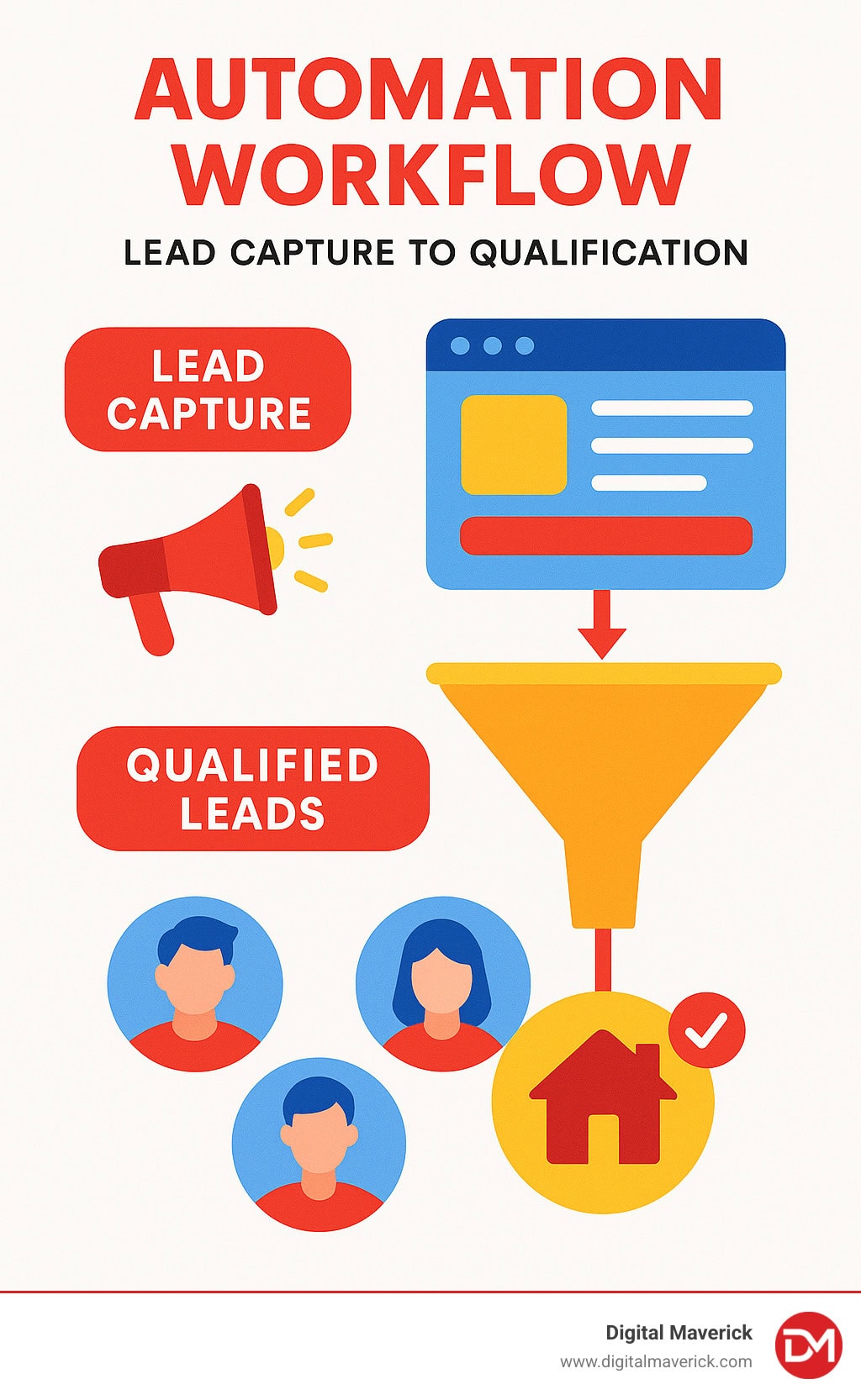
At Digital Maverick, we’ve found the perfect balance: use automation for that crucial first response, then bring in the human touch for proper qualification. It’s like having a 24/7 assistant who handles the initial greeting while you focus on meaningful conversations with your most promising prospects.
Here’s how our most successful clients implement this approach:
First, they configure their CRM to automatically assign and respond to leads based on specific criteria. Next, they deploy AI assistants that engage leads around the clock, asking those initial qualification questions and scheduling appointments with real agents. They create segmented drip campaigns that nurture leads with personalized content based on qualification level and interests.
The system continues with automated text follow-up for immediate acknowledgment, quickly followed by personalized agent texts. Instant alerts ensure the team knows immediately when high-potential leads take action. Everything connects seamlessly through integrations like Zapier, creating a smooth workflow from lead capture to conversion. Finally, predictive analytics help identify which leads are most likely to convert based on behavior patterns.
Thomas Wilson, who leads a team of 25 agents, shared something that really stuck with me: “Before our automated qualification system, we only managed to respond to about 30% of leads within the first hour. Now we hit 100% within 5 minutes, and our conversion rate has doubled.” That’s the power of blending technology with human expertise!
Tools & Platforms That Level-Up Qualified Leads Real Estate
Finding the right tech stack can dramatically improve how you identify and nurture qualified leads in real estate. Think of these tools as your qualification dream team:
Smart lead capture forms collect qualification data upfront, going beyond basic contact information to include timeline, budget, and property preferences. Intelligent chatbots engage your website visitors 24/7, answering common questions and gathering qualification data before scheduling agent calls. Efficient power dialers allow your team to make more calls in less time, with automatic voicemail drops for consistent messaging.
Data enrichment services improve your lead records with valuable information like property ownership history and demographic details, making qualification more accurate. Meanwhile, predictive analytics platforms like SmartZip and Catalyze AI can identify likely sellers before they’ve even decided to list – SmartZip maintains an impressive 72% accuracy in predicting homeowners most likely to move within 18 months. Then, there are tools like ezVerify.ai that give you peace of mind with real-time Do Not Call flagging and monthly database scans.

I recently spoke with a Digital Maverick client who shared a success story that perfectly illustrates the impact of these tools: “We implemented a lead capture form that asked about timeline and budget upfront. By the second month, we were spending 40% less time on unqualified leads and had increased our closing ratio by 22%.”
The magic happens when you create a workflow that feels personal to the lead while saving you precious time. Imagine this: a prospect completes your form or chats with your bot. Immediately, they receive a personalized response asking qualification questions. Based on their answers, they’re scored and categorized. Your high-scoring leads go straight to agents for immediate follow-up, while medium-scoring leads enter a nurture sequence, and low-scoring leads receive educational content until they show more interest.
This thoughtful approach ensures every lead receives attention while protecting your team’s time for the most promising opportunities. It’s not about replacing the human element – it’s about enhancing it with technology that handles the repetitive tasks so you can focus on building relationships where they matter most.
More info about CRM automations
Balancing Lead Quality vs Quantity, Nurture & Compliance
The age-old debate in real estate lead generation: should you chase more leads or better leads? It’s like asking whether you’d prefer a hundred dollar bills or ten hundred dollar bills—the answer seems obvious until you consider the effort involved in finding each.
In my years working with successful teams, I’ve found that most thrive with a balanced approach that leans slightly toward quality. Think of it as the difference between fishing with a net versus a spear—both work, but they require different skills and yield different results.

Let’s compare these approaches side by side:
| Quality-Focused Approach | Quantity-Focused Approach |
|---|---|
| Fewer leads with higher conversion rates | More leads with lower conversion rates |
| Lower cost-per-acquisition | Higher cost-per-acquisition |
| More time per lead | Less time per lead |
| Higher average transaction value | Lower average transaction value |
| Better client experience | Potentially rushed service |
| Stronger referral network | More dependent on paid lead sources |
| Slower initial growth | Faster initial growth |
| More sustainable long-term | Risk of burnout and reputation issues |
Sarah Jenkins, who manages a team of 6 agents, shared a valuable lesson with me recently: “We got seduced by the high-volume approach for a year. We were drowning in 500+ monthly leads but closing fewer deals than when we focused on 100 quality leads. The difference wasn’t magic—it was simply having time for proper qualification and meaningful follow-up.”
Follow-Up Cadence That Converts Qualified Leads Real Estate
Even the most promising leads need nurturing. It’s like growing a garden—planting seeds isn’t enough; you need consistent care to see results. Industry research tells us that up to 80% of deals close after five or more touchpoints, yet only 8% of agents stick around long enough to see that happen.
I’ve seen remarkable success with this strategic follow-up rhythm for qualified leads real estate prospects:
Day 1 is all about immediate connection. Respond within those crucial first 5 minutes, make your first call attempt, send a friendly text if they don’t answer, and follow up with a helpful email containing market insights or property information.
On Day 2, try reaching them in the morning (when people tend to be more responsive), send a quick personalized video message showing a property that matches their criteria, and connect on social media to build relationship.
Days 3-5 are perfect for your third call attempt, sharing valuable content like a neighborhood guide or market report, and sending a text with a specific property suggestion that aligns with their needs.
Between Days 7-14, make your fourth call, send something tangible via direct mail (which stands out in our digital world), and share an email featuring a success story from a similar client.
For Days 15-30, make your fifth call attempt, invite them to an upcoming event like an open house or webinar, and send a friendly check-in text that feels personal, not pushy.
Robert Chen, whose team saw a 28% conversion increase after implementing this exact approach, put it perfectly: “Speed-to-lead gets all the attention, but persistence is what actually puts money in the bank. Most agents give up after a couple tries, essentially leaving commission checks on the table.”
For leads that don’t respond to this initial sequence, don’t throw them away—move them into a long-term nurture program with monthly touchpoints. Sometimes the best leads are simply on a longer timeline than you initially thought.
Smart retargeting ads can also work wonders for keeping your brand in front of prospects who’ve visited your website but haven’t committed yet. Think of them as gentle reminders that you’re still there when they’re ready.
Common Mistakes & How to Avoid Them
Even seasoned real estate pros make qualifying mistakes. Let me share the most common pitfalls I’ve observed and how you can sidestep them:

Slow Response Time kills conversion potential. The difference between responding in 5 minutes versus 30 minutes can slash your success rate by up to 900%. Set up automated immediate responses that buy you time for personal follow-up.
Working Without Scripts leads to inconsistent questions and missed qualification signals. Develop standardized conversation guides that cover all your BANT elements while still feeling natural.
Discarding “Not Now” Leads is like throwing away money. Not every qualified prospect is ready to move immediately. Create specific nurture campaigns for those 6-12 month timeline folks instead of writing them off.
Fair Housing Missteps can create serious legal issues. Ensure your qualification process strictly complies with Fair Housing laws by focusing on financial readiness and timeline rather than demographic factors. For more information on Fair Housing compliance, check out the HUD’s Fair Housing Act overview.
Messy CRM Practices make it impossible to effectively score and segment your database. Establish clear protocols for data entry and maintenance to keep your digital house in order.
Premature Surrender is perhaps the costliest mistake. 80% of sales happen after the fifth contact, so build a follow-up system that ensures consistent outreach.
David Martinez, who now leads one of Texas’s top-performing teams, shared this confession: “Our biggest mistake was treating every lead the same way. Once we implemented a proper qualification system and follow-up cadence, our conversion rate tripled within just three months.”
At Digital Maverick, we’ve consistently found that the most successful teams combine thorough qualification with persistent follow-up. They respect their time too much to waste it on clearly unqualified leads, but they’re also patient enough to nurture qualified prospects who need multiple touchpoints before making a decision.
Finding this balance isn’t just good business—it’s the difference between struggling and thriving in today’s competitive real estate landscape. When you focus on qualified leads real estate opportunities, you create space for deeper connections, better service, and ultimately, more closings.
Conclusion & Next Steps
Let’s be honest – finding and converting qualified leads in real estate doesn’t have to feel like searching for a needle in a haystack. The frameworks, questions, and systems we’ve explored can transform your business from constant frustration to consistent conversion.
Here’s what I hope you’ll take away from our journey together:
First, get crystal clear on what “qualified” means for your specific business. The BANT framework gives you a practical structure – Budget, Authority, Need, and Timeline – that cuts through the noise and helps you focus on prospects who are truly ready to move forward.
When you’re talking with potential clients, those 11 questions we covered aren’t just a checklist – they’re conversation starters that reveal whether someone is worth your valuable time. The right questions, asked with genuine curiosity, can save you countless hours of chasing dead-end leads.
Technology should be your friend, not your master. The best agents use automation to respond lightning-fast without losing that essential human connection. Your prospects don’t want to talk to a robot – they want to know there’s a real person who cares about their real estate journey.
Persistence pays off. That follow-up cadence with 5-12 touches isn’t excessive – it’s necessary. Most agents give up far too soon, leaving money on the table and relationships unbuilt. Your future clients are often just waiting for you to demonstrate that you’re truly committed to helping them.
Finding the right balance between lead quality and quantity depends on your unique situation. A solo agent might need a different approach than a team of 20. The key is developing a system that works for your specific business model and sticking with it long enough to see results.
Avoid those all-too-common mistakes we discussed. Slow responses, inconsistent follow-up, and poor CRM habits are silent business killers. And always, always maintain Fair Housing compliance throughout your qualification process – it’s not just legally required, it’s the right thing to do.
At Digital Maverick, we’ve walked alongside hundreds of real estate teams as they transform their approach to lead qualification. Our clients consistently see conversion rates jump by 30-40% and GCI growth of 25-50% after implementing our systems. It’s not magic – it’s methodology.
Jennifer Torres, who leads a team of 12 agents, shared: “Working with Digital Maverick transformed how we approach lead qualification. Their ISA team handles our initial lead qualification, their coaching helped us implement effective scripts, and their systems ensure we never drop the ball on follow-up. Our business has grown by 47% in just nine months.”
Whether you’re drowning in unqualified leads, struggling to maintain consistent follow-up, or just not seeing the ROI from your database that you know should be there, we’ve built solutions specifically for these challenges. Our programs create the right operating rhythm – one that ensures more meaningful conversations, better accountability, and consistently more closings.
The difference between struggling and thriving often comes down to something remarkably simple: talking to the right people, at the right time, with the right message. A systematic approach to lead qualification puts this principle to work for you every single day.
Ready to transform how you identify and convert qualified leads in real estate? Learn more about our offerings and find how Digital Maverick can help you eliminate lead waste, build scalable systems for growth, and open up higher ROI from your existing database, ad spend, and CRM investments.
The path to more closings isn’t about working harder – it’s about working smarter with the leads you already have.

Preston Guyton is a co-founder at Digital Maverick and a seasoned real estate operator who’s spent over two decades helping agents build smarter, more scalable businesses. He’s passionate about helping teams avoid the missteps that cost time, money, and momentum. At Digital Maverick, Preston leads strategy across ISA support, CRM systems, and coaching programs—bringing together the tools, accountability, and rhythm that turn leads into consistent closings.