Real Estate Business Growth Archives - Page 3 of 4 - Digital Maverick

05.19.2025

The Complete Guide to Finding the Right Lead Generation Agent

Lead Generation Agent | Digital Maverick

The Growing Impact of Lead Generation Agents on Business Growth

A lead generation agent is a specialized professional who identifies, qualifies, and nurtures potential customers for a business. They bridge the gap between marketing and sales by turning prospects into qualified opportunities through various outreach methods.

What is a Lead Generation Agent?

  • A professional who sources and qualifies potential customers
  • Uses multiple channels like email, phone, social media, and content
  • Qualifies leads using criteria like BANT (Budget, Authority, Need, Timeline)
  • Nurtures relationships until prospects are sales-ready
  • Manages the early stages of the sales pipeline

In today’s competitive marketplace, businesses face a critical challenge: generating high-quality leads consistently without burning out their sales teams. A skilled lead generation agent serves as the crucial first point of contact with potential customers, using strategic outreach and qualification techniques to ensure sales teams focus only on the most promising opportunities.

“A pipeline full of high-quality prospects is vital for any business. It’s one of the best ways to close new sales and win new customers,” notes industry research, highlighting why dedicated lead generation specialists have become essential for growth-focused organizations.

The most effective lead generation agents combine technical expertise with interpersonal skills, leveraging both automation tools and personalized communication to maximize results. They don’t just collect contact information—they initiate meaningful conversations that reveal genuine business needs and buying intent.

I’m Preston Guyton, co-founder of Digital Maverick where I specialize in helping real estate teams implement effective lead generation agent strategies that convert prospects into clients through our specialized inside sales coaching and proprietary lead conversion systems.

Lead Generation Agent Process Showing Research, Outreach, Qualification and Handoff Steps with Key Metrics and Tools for Each Phase - lead generation agent infographic

Understanding the Role of a Lead Generation Agent

When you hear “lead generation agent,” think of the person who’s actively building your business’s future. These professionals aren’t just collecting names and emails—they’re the architects of your sales pipeline, the first friendly voice your prospects hear, and often the secret ingredient that transforms struggling businesses into thriving ones.

What Does a Lead Generation Agent Do?

At its heart, a lead generation agent connects your business with people who might need what you’re selling. They’re the bridge between “stranger” and “valued customer.”

Every day, these professionals are hunting for your next great client. They’re digging through LinkedIn profiles, researching industry databases, and working their network to identify promising prospects. As one agency puts it, “We build a target list of look-alike customers” before launching any campaign.

But finding names isn’t enough. A good lead generation agent enriches basic contact info with valuable context—uncovering pain points, budget authority, and buying timelines by updating and managing you CRM (e.g. FUB).

Then comes the outreach. Whether it’s crafting personalized emails, making warm phone calls, engaging on social media, or even sending thoughtful direct mail, these specialists know how to start conversations. And they get results—industry data shows that “Cold email outreach can yield around 38% reply rates and 81% open rates” when done properly.

Not all responses are created equal, though. The best lead generation agents are expert qualifiers, using frameworks like BANT or MEDDIC to separate serious buyers from casual browsers. As one expert notes, “A lead works at the right company, with the right title and seniority, and replies with interest.”

For prospects who show potential but aren’t ready to buy today, these agents nurture the relationship through automated drip campaigns and personal check-ins. And when a lead is sales-ready, they handle appointment setting, creating a seamless handoff to your sales team.

lead generation agent working with CRM and multiple communication channels - lead generation agent

Why Teams Rely on a Lead Generation Agent

So why are more teams and brokerages bringing dedicated lead generation agents into their teams? The benefits are both immediate and long-lasting.

First, there’s the growth factor. With a consistent pipeline of qualified opportunities, businesses can achieve predictable revenue increases. One real estate lead generation company found their clients experienced “12 extra deals in year one” after implementing their system.

Then there’s the speed advantage. We all know the saying “time kills deals,” and research backs this up. When you have a lead generation agent focused solely on new inquiries, your response time drops dramatically. One case study showed a “40% improvement in lead response time” after creating a dedicated lead gen team.

These specialists also solve the classic marketing-sales divide. They ensure marketing-generated leads receive proper follow-up while providing honest feedback about lead quality, creating harmony between departments that often clash.

There’s a financial upside too. Having specialized talent handle prospecting is typically more cost-effective than watching your highest-paid salespeople struggle with cold outreach. Industry data suggests that “outsourcing lead generation is more cost-effective long term than in-house efforts.”

Perhaps most importantly, lead generation agents let everyone focus on what they do best. Your closers can close, your marketers can market, and your business can grow. As one service provider perfectly summarizes: “We manage your outreach as though you suddenly gained an extra six hours a day.”

The real-world impact speaks for itself. One real estate agent shared: “I closed an extra 12 deals in year one and built referrals” after implementing a dedicated lead generation system.

When done right, a lead generation agent doesn’t just find leads—they find the right leads, at the right time, and move them smoothly toward becoming your next great customer.

Skills, Tools & Daily Workflow

The magic behind a successful lead generation agent isn’t just luck or natural charisma—it’s a blend of specific skills, powerful tools, and a well-structured daily routine. Let’s peek behind the curtain to see what really drives their success.

Must-Have Skills for a Modern Lead Generation Agent

Today’s top lead generation agents are like Swiss Army knives—equipped with multiple capabilities that make them invaluable to any sales organization.

Great research skills form the foundation of effective lead generation. The best agents know how to dig deep to understand not just who might buy, but why they would buy now. They’re digital detectives who can uncover decision-makers and their pain points before making that first contact.

Communication excellence isn’t optional in this role—it’s everything. As one agency puts it, “We use manual research to find lines that make your message stand out.” The ability to craft messages that actually get read (and responded to) separates the good from the great.

When prospects push back with objections, skilled agents don’t get discouraged—they get curious. Objection handling requires thinking on your feet and truly understanding your product or service well enough to address concerns authentically.

Behind every successful campaign is someone who loves data analysis. Numbers tell stories, and the best lead gen professionals know how to read those stories and adjust their approach accordingly.

Perhaps the most underrated quality is simple persistence. The data is clear—most leads need multiple touchpoints before they convert. The best agents understand this isn’t rejection; it’s just part of the process.

Adaptability keeps agents relevant in a rapidly evolving landscape. What worked last year might not work today, and tomorrow’s techniques are probably being developed right now.

Finally, CRM proficiency ties everything together. Without masterful management of your customer database, even the best outreach efforts can fall through the cracks.

multichannel technology stack for lead generation - lead generation agent

Tech Stack & Software Toolkit

A modern lead generation agent without the right tools is like a chef without a kitchen. Their tech stack typically includes several categories of solutions working in harmony:

Once they know who to contact, outreach tools amplify their efforts. Email platforms like Outreach.io or Reply.io let them scale personalized communication. Modern phone systems do more than just make calls—they track, record, and analyze conversations for continuous improvement. LinkedIn automation tools (when used thoughtfully) can multiply connection efforts, while AI chatbots capture and qualify website visitors around the clock.

At the heart of it all sits the CRM—usually Follow Up Boss, kvCore, or Pipedrive. These aren’t just contact databases; they’re the central nervous system of the entire lead generation operation. Smart agents customize these systems with fields that track qualification criteria and automate follow-up tasks at the perfect moment.

The final piece is robust analytics and reporting. Custom dashboards show what’s working and what isn’t, A/B testing tools refine messaging for maximum impact, and call recording software turns every conversation into a learning opportunity.

A Day in the Life of a Lead Generation Agent

Curious what a day actually looks like for a lead generation agent? While every business has its own rhythm, the most successful agents follow a structure designed to make the most of different times of day:

Morning: List Building & Planning (8:00-10:00 AM)

The early hours are for strategy, not reactivity. Smart agents start by reviewing who needs follow-up today and prioritizing their most promising leads. They’ll spend time researching new prospects to add to their pipeline and analyzing yesterday’s results to refine today’s approach.

Mid-Morning: Initial Outreach (10:00 AM-12:00 PM)

This prime calling window is when decision-makers are most likely to answer their phones. It’s also the perfect time to send fresh LinkedIn connection requests and messages, and to launch new email campaigns to catch people during their mid-morning email check.

Early Afternoon: Follow-Ups (1:00-3:00 PM)

After lunch, the focus shifts to responding to replies, conducting qualification calls with interested prospects, and the most satisfying part of the job—scheduling meetings between qualified leads and sales representatives. This is when all the morning’s work starts to pay off.

Late Afternoon: Administrative & Preparation (3:00-5:00 PM)

The day closes with careful documentation—updating the CRM with new information, preparing tomorrow’s prospect lists, and generating performance reports. This often-overlooked administrative work is what ensures no opportunities slip through the cracks.

Continuous: Lead Monitoring

Throughout the day, great agents remain responsive. When a lead engages with content, they get notified immediately. When an inbound inquiry comes in, they pounce—because speed-to-lead can make or break conversion rates. They’re also scanning social media for buying signals from target accounts.

As one lead generation service confidently promises: “Expect your first lead to come in within 36 hours of launching our campaign, and then every work day after that.”

The best lead generation agents aren’t just working hard—they’re working smart, with a deliberate rhythm that maximizes the likelihood of connecting with prospects at the right time, with the right message, through the right channel.

Lead Generation Strategies & Best Practices

The strategies a lead generation agent uses can truly transform your pipeline development. I’ve seen how the right approach can fill a calendar with qualified appointments—and how the wrong one can leave you wondering where all your prospects went.

Inbound vs. Outbound — Which Works Best?

The age-old question in lead generation isn’t about picking sides—it’s about knowing when each approach shines brightest.

Inbound lead generation draws prospects to you through valuable content, SEO strategies, webinars, and social media engagement. It’s like creating a magnetic field that attracts the right people. The industry data speaks volumes: content marketing generates three times as many leads as traditional outbound methods while costing 62% less. The leads tend to arrive with stronger buying intent, though you’ll need patience as this approach builds momentum over time.

Outbound lead generation, on the other hand, is about proactive outreach—picking up the phone, sending personalized emails, and connecting on LinkedIn. It’s direct, it’s fast, and when targeted correctly, it delivers immediate results. The key is personalization and precision rather than spray-and-pray tactics.

Comparison of Inbound vs Outbound Lead Generation Funnels - lead generation agent infographic

At Digital Maverick, we’ve finded that successful real estate teams don’t choose—they blend. Our clients build authority through inbound content while maintaining consistent pipeline growth with structured outbound campaigns. This balanced approach delivers both immediate results and long-term sustainability.

B2B vs. B2C Playbooks for a Lead Generation Agent

The playbook a lead generation agent follows changes dramatically between business (investor) and consumer (buyer/seller) contexts:

In the investor world, sales cycles could stretch from 3-12 months with an average of 5.4 decision-makers involved in each purchase. Your lead generation agent needs patience and strategic thinking to steer complex organizational structures. They must speak the language of ROI and business outcomes while managing multiple relationships within the same account.

For B2C lead generation—especially in real estate—emotional factors drive decisions more powerfully. Typically only 1-2 decision-makers are involved, and trust becomes the currency that matters most. Geographic targeting becomes critical, and as one real estate lead service accurately notes, “Websites should be your indisputable best lead generation channel.”

At Digital Maverick, our real estate specialization gives us unique insight into consumer-driven property transactions. We’ve developed systems that bring B2B-level process and consistency to consumer-focused real estate operations, creating predictable results in an often unpredictable market.

Proven Tactics to Maximize Response Rates

Whether you’re focused on inbound or outbound, B2B or B2C, certain approaches consistently improve how effectively your lead generation agent performs:

Personalization at scale transforms ordinary outreach into conversations that get responses. This isn’t about inserting a first name into a template—it’s about research-driven messaging that speaks to specific challenges or goals. As one leading agency emphasizes: “No AI—ever. We use manual research to find lines that make your message stand out.” The extra effort pays dividends in response rates.

Multi-channel touchpoints create a surround-sound effect that’s hard to ignore. The magic happens when your LinkedIn connection request is followed by a thoughtful email, then a well-timed phone call—all delivering consistent messaging but through different channels. This coordinated approach significantly boosts engagement compared to single-channel efforts.

Strategic timing and cadence can mean the difference between being seen and being ignored. The best lead generation agents know exactly when to reach out based on industry and role, how long to wait between touchpoints, and how to be persistent without becoming a nuisance.

Value-first approaches build relationships before asking for anything in return. By leading with genuine insights rather than sales pitches, sharing relevant content, and offering help without expectations, your agent establishes credibility that makes prospects more receptive when it’s time to request a meeting.

At Digital Maverick, we’ve refined these tactics specifically for real estate lead conversion. Our ISA team implements proven scripts and multi-channel follow-up sequences that dramatically improve contact rates and appointment setting. We don’t just implement these strategies—we teach them, measure them, and continuously improve them to drive consistent results for our clients.

Measuring Success, Hiring & Cost Insights

When it comes to getting the most from your lead generation agent, you need three things: clear metrics to track progress, smart hiring strategies, and realistic budget expectations. Let’s break down each of these crucial elements.

Key Metrics Every Lead Generation Agent Tracks

The best lead generation agents live and breathe by their numbers. They don’t just work hard—they work smart by tracking what matters:

Think of activity metrics as your daily pulse check. How many calls did your agent make today? What’s the email open rate looking like? Are people accepting those LinkedIn connection requests? These numbers tell you if your outreach engine is running smoothly.

Qualification metrics dig deeper. They reveal how many of those initial contacts are turning into genuine opportunities. Your lead generation agent should be tracking how quickly leads move through qualification, what percentage meet your BANT criteria, and which lead sources are delivering the best results.

But at the end of the day, it’s all about outcomes. How many meetings were set? How many sales-qualified leads made it to your closers? What’s the total pipeline value being generated? And perhaps most importantly—what’s your cost per lead and overall ROI?

One agency I know puts their money where their mouth is with this promise: “We guarantee 20+ sales-qualified leads per month or your money back.” That’s the kind of concrete result you should expect.

At Digital Maverick, we believe transparency and protecting client info creates trust. That’s why we build comprehensive tracking systems with daily reporting, regular CRM audits, and clear accountability metrics into every plan. Our real estate clients always know exactly how their lead generation investment is performing—no guesswork required.

How to Hire the Right Lead Generation Agent

Finding someone who can actually deliver results requires a thoughtful approach. First, you’ll need to decide between building an in-house team or partnering with outside help.

In-house teams give you direct control over processes and priorities. Your agents become deeply immersed in your company culture and product knowledge. Plus, you’re building long-term capabilities within your organization. The downside? Recruiting, training, and managing this specialized talent takes significant time and resources.

Agency or freelance solutions bring specialized expertise and established processes to the table from day one. They offer flexibility to scale up or down as your needs change, and they already have access to premium tools and technologies. Best of all, you’ll typically see faster implementation and results.

As we like to say at Digital Maverick: “Built by operators—not vendors—we partner with top-performing real estate professionals to install the people, training, and systems needed to turn leads into conversations—and conversations into closings.”

When interviewing potential lead generation agents, ask questions that reveal their true capabilities: “What specific metrics did you improve in your previous role?” or “Walk me through your process for qualifying a lead.” Don’t just take their word for it—request campaign examples, review their actual outreach messages, and speak with previous clients.

For real estate teams, we’ve eliminated this hiring headache completely. Our pre-vetted, fully-trained ISAs understand the unique dynamics of real estate lead conversion, providing immediate expertise without the hiring risk.

Budgeting & Compensation Models

Let’s talk money. Understanding what lead generation agents actually cost helps set realistic expectations and prevents budget surprises.

For in-house hires, expect entry-level agents to command $40,000-$55,000 annually, while experienced professionals range from $55,000-$85,000. Senior agents or team leads can cost $85,000-$120,000+ per year. And don’t forget to add benefits, training costs, and management overhead to these figures.

If you’re exploring agency or freelance options, the pricing models vary widely:

Hourly rates typically range from $20-$150 depending on expertise level. According to marketplace research, “Lead generation experts on Upwork offer services starting as low as $10/hr, with rates ranging up to $150/hr depending on experience and specialization.”

Monthly retainers generally fall between $2,000-$10,000+ for dedicated service, while performance-based models might combine a base fee with bonuses for qualified leads or meetings set.

Pay-per-lead pricing varies dramatically by industry and qualification level, ranging from $20-$500 per lead. In real estate specifically, buyer leads typically cost $20-$60 each on major platforms, while qualified seller leads (a much hotter commodity) can run $200-$500.

Our programs focus on meaningful outcomes—turning leads into conversations and conversations into closings—with clear accountability metrics that ensure positive ROI from your lead generation investment.

Want to learn more about how our conversion services can help your real estate business grow? Visit our offerings page for more information.

Frequently Asked Questions about Lead Generation Agents

What qualifications should a lead generation agent have?

Finding the right lead generation agent is a bit like dating – you need someone with the right mix of experience, skills, and personality to make the relationship work.

A truly qualified agent typically brings at least 2 years of relevant experience to the table. Many specialists on platforms like Upwork have been in the game for 5+ years, with some veterans boasting over a decade of expertise in digital marketing and sales.

Beyond experience, look for someone who speaks “tech” fluently. They should steer CRMs, email platforms, and social selling tools with ease. The best agents aren’t intimidated by new technologies – they get excited about them!

Communication skills are non-negotiable. Your lead generation agent will be the first voice many prospects hear from your company. They need to write compelling emails, speak confidently on calls, and adapt their approach based on who they’re talking to.

The best agents are also part-detective, part-analyst. They should enjoy digging into data, spotting patterns, and tweaking campaigns based on what the numbers tell them. As one agency owner told me, “I can teach someone our tools, but I can’t teach curiosity.”

For real estate teams specifically, an agent who understands the home buying journey and local market dynamics will hit the ground running much faster than someone learning the industry from scratch.

While certifications are nice bonuses (showing commitment to professional development), they’re far less important than demonstrated results and a track record of success.

How do I integrate an agent’s work with my sales team?

The handoff between your lead generation agent and sales team can make or break your conversion rates. Think of it like a relay race – even the fastest runners can lose if they fumble the baton exchange.

Start by establishing crystal-clear criteria for when a lead is “sales-ready.” Document exactly what information needs to be gathered and what level of interest signals it’s time for the handoff. Vague definitions like “qualified lead” lead to confusion and finger-pointing.

Technology plays a crucial role here. Both teams should work within the same CRM system with appropriate visibility. When your lead generation agent enters detailed notes about a prospect’s pain points or timeline, your sales team should see that information immediately.

Many successful teams implement a simple lead scoring system – assigning points based on behaviors and characteristics that indicate buying readiness. This creates a common language between teams and helps prioritize follow-up efforts.

Regular communication prevents silos from forming. Weekly meetings between lead generation and sales teams create space for honest feedback and continuous improvement. One Digital Maverick client told us, “These meetings were awkward at first, but now they’re where some of our best ideas come from.”

The most overlooked aspect of successful integration? Aligned incentives. When both teams share some stake in ultimate outcomes (not just their individual metrics), collaboration improves dramatically.

At Digital Maverick, we’ve refined this integration process specifically for real estate teams. Our ISA services include detailed lead notes, recorded conversations, and clear qualification documentation that make handoffs smooth and effective.

How much does it cost to outsource lead generation?

Talking about outsourcing costs is a bit like asking “how much does a car cost?” The answer depends on what you’re looking for and what kind of performance you expect.

Industry complexity plays a huge role in pricing. B2B services in specialized fields like investors or relocation often cost $150-$500 per lead because the qualification process is more complex and the sales cycles longer. Consumer-focused leads, including real estate prospects, typically range from $20-$50 per lead.

The level of qualification dramatically impacts cost. Basic contact information costs far less than fully vetted, sales-ready opportunities. As one agency owner puts it, “You can buy cheap leads or good leads, but rarely both.”

Exclusivity is another factor. Exclusive leads (only sold to you) command premium pricing compared to shared lead lists that might go to multiple competitors.

Most providers offer several pricing models to choose from:

Monthly retainers ($2,000-$10,000+) provide dedicated service and predictable costs, making them popular with established teams.

Pay-per-lead models ($20-$500 per lead) reduce upfront risk but can lead to quality concerns if not structured properly.

Performance-based arrangements combine a modest base fee with success payments for meetings set or deals closed, aligning incentives beautifully.

For real estate teams specifically, Digital Maverick offers customized pricing based on your growth goals, market dynamics, and existing lead sources. Our programs focus on maximizing ROI through improved conversion rates rather than just pumping up lead volume.

As one of our clients shared, “We actually spend less on lead generation now, but close more deals because our conversion systems are so much stronger.”

More info about conversion services

Conclusion

Finding the right lead generation agent isn’t just a business decision—it’s a growth catalyst that can transform your entire sales trajectory. Whether you’re building an in-house team, bringing on freelancers, or partnering with specialists, what truly matters is having systems that reliably convert prospects into opportunities.

At Digital Maverick, this philosophy is in our DNA. We’re not just marketing consultants who’ve read about lead generation—we’re operators who’ve built and scaled real estate businesses ourselves. We’ve walked in your shoes and understand the frustration of watching potential deals slip through the cracks.

Our approach combines the human touch with powerful systems:

  • Full-service ISA teams who pounce on new leads within minutes (because we know response time is everything)
  • 24/7 AI assistants that never sleep, ensuring no weekend or late-night inquiry goes unanswered
  • Hands-on coaching that turns good agents into great converters
  • CRM optimization that transforms your database from a digital filing cabinet into a revenue machine
  • Daily reporting that keeps everyone accountable and focused on what matters

The results speak for themselves. Our clients stop wasting leads, build systems they can scale as they grow, generate more qualified opportunities, and finally see real ROI from their existing database, marketing spend, and CRM investments.

The most effective lead generation agent does far more than collect contact information. They’re conversation starters who uncover genuine needs and buying intent. Think of them as the first critical link in your revenue chain—when you invest here properly, the returns ripple through your entire business.

Whether you’re a small team looking to level up or an established brokerage trying to tighten your conversion processes, implementing the right lead generation strategy with qualified professionals isn’t just helpful—it’s essential for thriving in today’s competitive landscape.

Ready to transform your lead generation from a frustrating money pit into a predictable growth engine? Learn more about our growth systems and find how Digital Maverick can help you turn more leads into meaningful conversations—and more conversations into closings.
05.19.2025

An Essential Guide to Real Estate Lead Generators

Real Estate Lead Generator | Digital Maverick

The Real Estate Lead Generation Landscape in 2025

A real estate lead generator is a tool, platform, or strategy that helps agents and brokers attract potential clients interested in buying, selling, or investing in property.

What is a real estate lead generator?

  • Definition: Systems or platforms that capture potential client information
  • Types: Online (websites, social ads), offline (open houses, networking)
  • Cost: From free organic methods to $20-$60 per lead on premium platforms
  • Top providers: Various industry platforms and specialized tools
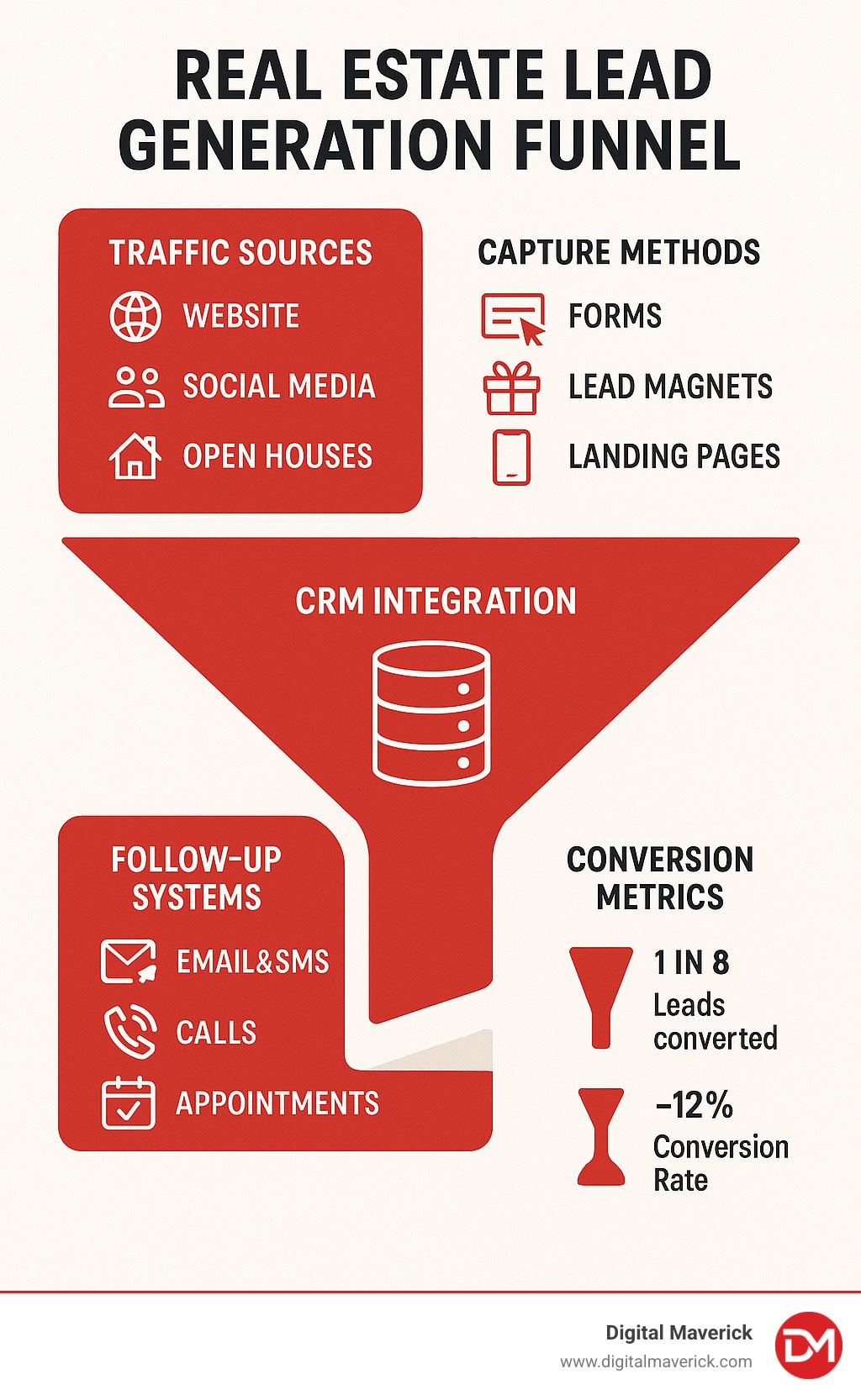
  • Conversion rates: Expect to close 1 in 8 to 1 in 15 leads depending on your follow-up system

The modern real estate business revolves around a simple truth: no leads means no listings, no buyers, and ultimately, no commissions. Whether you’re a solo agent or managing a growing team, implementing effective lead generation systems remains one of the most crucial—yet challenging—aspects of scaling your business.

Lead generation has evolved dramatically in recent years. What once relied primarily on cold calls, door knocking, and referrals has transformed into a sophisticated ecosystem of AI-powered platforms, predictive analytics, and multi-channel marketing automation. Today’s top-performing teams don’t just collect contact information—they build comprehensive systems that nurture prospects through personalized touchpoints at exactly the right moments.

As Preston Guyton, I’ve spent over 20 years helping real estate teams optimize their lead generation and conversion systems, including founding Digital Maverick where we implement proven real estate lead generator strategies that transform databases into consistent deal flow through our specialized coaching and conversion systems.

Real estate lead generation funnel showing traffic sources, capture methods, CRM integration, follow-up systems, and conversion metrics with average performance benchmarks - real estate lead generator infographic

What is a Real Estate Lead Generator?

A real estate lead generator is your business’s lifeline – it’s the system that transforms strangers into clients and prospects into commissions. At its core, it’s any tool, strategy, or platform that helps you capture information from people interested in buying, selling, or investing in real estate.

Think of lead generation as fishing with the right bait. You’re not just collecting random contact information – you’re strategically attracting potential clients who need your expertise. The most effective systems work through a natural progression:

First, you attract prospects with something valuable – maybe a home valuation tool or neighborhood market report that speaks to their needs. Then you capture their information through smart, well-designed forms or conversations. Once you have their details, the qualification process helps you understand their timeline, motivation, and financial readiness. This leads to the crucial nurturing phase where you build trust through personalized follow-up. Finally, your system guides them to conversion – turning that initial interest into a closed transaction.

What separates the top producers from the pack? Often it’s lead exclusivity (are you sharing these leads with ten other agents?), strict compliance with regulations like the Do Not Call Registry, and increasingly, the integration of predictive analytics that can identify likely sellers before they’ve even decided to list.

As we often tell our clients at Digital Maverick, “The riches are in the niches.” The most powerful real estate lead generators don’t try to be everything to everyone – they target specific market segments with messages that feel personally crafted for each prospect.

How a Real Estate Lead Generator Works

Behind every successful transaction is a well-oiled lead generation machine working systematically to move potential clients from curious browsers to committed buyers or sellers. Here’s what that journey typically looks like:

The process begins with traffic generation – making yourself visible where your ideal clients are already spending time. This might be through organic search results when someone Googles “homes for sale in [your area],” targeted Facebook ads, or even community events where you connect face-to-face.

When someone engages with your content or advertising, the lead capture phase kicks in. This is where strategic conversion points like home valuation tools, property search registration forms, or even chatbot conversations collect their contact information. The most effective capture methods offer a fair value exchange – giving something useful in return for their details.

Within seconds, a good system will trigger CRM integration, automatically syncing that new lead to your database and starting to build a profile of their interests and behaviors.

Then comes the make-or-break moment: the speed-to-lead response. This isn’t just important – it’s critical. Research shows contacting a lead within 5 minutes versus waiting 30 minutes can increase conversion rates by a staggering 21 times. That initial window of opportunity closes quickly.

Finally, automated nurturing takes over, delivering the right messages at the right times based on lead behavior and engagement signals – keeping you top-of-mind without requiring you to manually follow up with every prospect.

One of our clients put it perfectly: “Before working with Digital Maverick, we were getting leads but letting them slip through the cracks. Now with our automated nurture sequences and 24/7 AI assistant handling initial qualification, we’re converting three times more leads without working longer hours.”

Types of Real Estate Lead Generators

The world of real estate lead generators offers something for every business model, budget, and target market. Understanding your options helps you create a diversified strategy that won’t collapse if one source dries up.

Online portals and listing sites remain powerhouses for connecting with active buyers and sellers. These platforms offer immediate access to prospects actively searching for properties, though often at a premium price.

IDX website solutions create your own lead-capturing hub with custom branding, MLS integration, and neighborhood-specific content that ranks well in local searches. These become assets you own rather than platforms you rent. If you have your own website (on your own domain, using wordpress, on a host you not an agency controls), it will stay with you when you change brokerages.

Social media advertising has revolutionized how agents target specific demographics – from first-time buyers to luxury downsizers – with visually compelling ads and videos. The ability to retarget people who’ve already shown interest in your content makes these platforms particularly effective.

Home valuation widgets that leverage predictive analytics tap into homeowners’ natural curiosity about their property’s worth – a perfect entry point for potential listing conversations.

Direct mail campaigns remain surprisingly effective in our digital age, especially when targeting specific neighborhoods, expired listings, or FSBO prospects with custom messaging that addresses their specific situation.

Events and community engagement create face-to-face opportunities that often yield higher-quality leads. From open houses and homebuyer workshops to local sponsorships, these methods build relationships that digital channels simply can’t match.

Referral networks with other agents, lenders, attorneys, and past clients often produce the highest-quality leads with the lowest acquisition costs. A structured referral program turns occasional recommendations into a consistent lead source.

The most successful agents don’t put all their eggs in one basket. They strategically combine multiple lead generators to create a steady pipeline that can withstand market shifts and platform changes. This diversification isn’t just smart – it’s essential for sustainable growth.

Essential Lead Generation Strategies & Tools

Let’s talk about what really works when it comes to building your real estate lead generator strategy. After years of helping agents grow their businesses, I’ve seen that the most successful approach combines both high-tech tools and good old-fashioned relationship building.

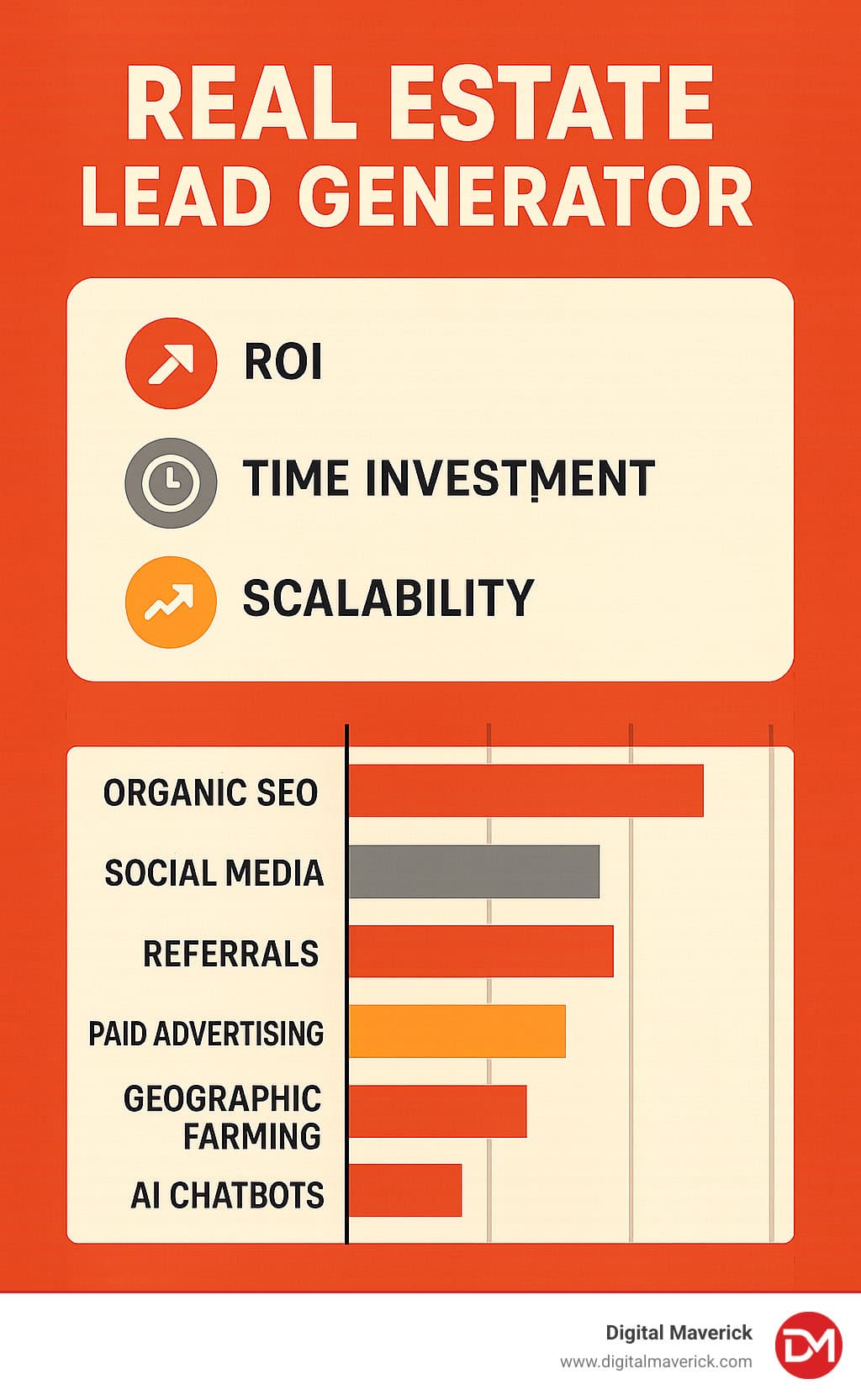
Organic SEO & Content Marketing

The beauty of search engine optimization is that it keeps working for you long after you’ve put in the effort. When you create neighborhood guides, market reports, and helpful resources that answer the exact questions your potential clients are asking Google, you’re building a 24/7 lead machine.

I love sharing this win: One of our Las Vegas teams generated 37 transactions in a single year just from their neighborhood pages. That’s a 900% return on their content investment! The key was creating genuinely helpful information about specific communities rather than generic real estate content.

Social Media Engagement

Social media isn’t just about posting listings anymore. Today’s buyers and sellers are looking for authentic connections before they ever think about working with you. Research shows that 63% of younger consumers (18-34) trust recommendations from influencers and authentic content creators more than traditional marketing messages.

The agents who thrive on social platforms share a mix of market insights, behind-the-scenes glimpses of their work, and their genuine personality. It’s about building relationships first, not just broadcasting sales pitches.

Referral Systems

Word-of-mouth remains the gold standard in our industry. As one of our coaching clients puts it: “A referral is like a warm hug wrapped in a commission check.” But great referrals don’t happen by accident.

The most successful teams build structured programs with clear incentives, regular client appreciation events, and systematic follow-up. Your past clients should feel appreciated enough to become your unofficial sales force. Check out this Forbes article on the power of word-of-mouth marketing for more insights on building this invaluable resource.

Sometimes you need leads now, not three months from now. That’s where strategic paid advertising comes in. Google Ads typically cost between $0.11-$0.50 per click for real estate keywords, while social media actions can range from $0-$2 depending on your targeting.

The key is having a clear follow-up system before you spend a dime on ads. Without proper nurturing, you’re essentially renting expensive attention with nothing to show for it afterward.

Geographic Farming

There’s something powerful about becoming the go-to agent for a specific neighborhood. Successful geographic farming combines consistent direct mail, community involvement, and hyper-local content that demonstrates your expertise.

A color-coded map showing a real estate geographic farming strategy with heat mapping of transaction activity and response rates - real estate lead generator infographic

AI Chatbots & Predictive Analytics

The most exciting development in real estate lead generation is how artificial intelligence is changing what’s possible. Modern systems can qualify leads 24/7 and even identify likely sellers before they’ve decided to list.

One of our clients shared this win: “Our AI assistant handles the initial conversation with every website lead. It qualifies them based on timeframe and motivation, then either schedules them directly with an agent or places them in a nurture sequence. This automation alone has increased our lead-to-appointment ratio by 62%.”

Modern advertising platforms now leverage aggregated data from tens of thousands of agents to target prospects in micro-niches with incredible precision. The future belongs to agents who accept these capabilities while maintaining the human touch that closes deals.

Online & AI-Driven Tactics

The digital world offers some incredible opportunities to generate leads while you sleep. Here’s what’s working best right now:

Local SEO Optimization has become essential as more buyers start their search online. Creating content around neighborhood-specific keywords like “Westside Denver homes for sale” or “Best schools in Austin” helps you capture highly motivated prospects.

Content Marketing positions you as the local expert. Market analysis videos, first-time homebuyer guides, and neighborhood comparison tools all provide genuine value while capturing contact information.

Video Marketing generates 1200% more shares than text and images combined. Property tours, market updates, client testimonials, and FAQ sessions all perform exceptionally well on both social media and your website.

AI Chatbots provide immediate response to website visitors, asking basic qualification questions about timeline, budget, and preferences. The best part? They work 24/7, scheduling appointments while you sleep.

Email Automation & Behavioral Triggers allow you to send the right message at exactly the right moment. When a prospect views a property three times, gets a price change alert, or clicks on a particular neighborhood guide, your system can automatically follow up with relevant information.

Remarketing Campaigns keep you visible to prospects who’ve already shown interest. Dynamic listing ads can showcase properties similar to ones they’ve viewed, keeping you top-of-mind until they’re ready to make a move.

Offline & Relationship Tactics

While digital dominates the conversation, traditional relationship-based approaches still deliver impressive results, especially in luxury and high-touch markets.

Strategic Open Houses can be lead-generating gold mines when done right. Pre-market neighbor previews, targeted Facebook invitations, and systematic post-event follow-up turn casual visitors into appointments. Some of our teams even host neighborhood “mega” open houses with entertainment and refreshments to draw bigger crowds.

FSBO & Expired Listing Outreach targets sellers who are already motivated. The key is focusing on solving their problems rather than making a sales pitch. Value-focused presentation packages and market analysis comparisons open doors when combined with systematic follow-up.

Professional Networking with complementary service providers creates a referral ecosystem. Mortgage lenders, home inspectors, estate attorneys, and relocation specialists all work with your ideal clients before they need you. Building these relationships can create a steady stream of pre-qualified referrals.

Community Involvement establishes presence and trust. Sponsoring local events, hosting educational workshops, and volunteering with neighborhood organizations makes you recognizable and trusted before people ever need an agent.

Direct Mail Campaigns still perform surprisingly well in our digital world. As one agent told me: “I was skeptical about direct mail, but our quarterly market reports to my geographic farm consistently generate 3-5 listing appointments. The key is consistency and providing genuine value, not just self-promotion.”

Buying vs. Organic Leads – Pros & Cons

The “build or buy” question is one every agent faces. Here’s the straight talk on both approaches:

Buying Leads gives you immediate pipeline activity with predictable volume. It’s especially valuable for newer agents or those entering a market. The downside? Higher acquisition costs ($20-60 per lead typically), variable quality, and potential dependence on third-party platforms.

Organic Leads typically convert at 2-3x the rate of purchased leads and cost less in the long run. You’re building valuable brand equity and maintaining control over your lead quality and data. The tradeoff is slower initial results (expect a 3-6 month ramp-up) and the need for consistent content creation.

Most successful teams we work with at Digital Maverick take a hybrid approach – using purchased leads for immediate activity while simultaneously building organic systems for long-term sustainability. As one team leader explained: “We started with a 70/30 split favoring paid leads. After 18 months of consistent content marketing and database nurturing, we’ve flipped that ratio completely. Now 70% of our business comes from organic sources, which has dramatically improved our profit margins.”

The right balance depends on your business stage, market conditions, and available resources. Want to learn more about building sustainable growth systems? Check out more information about growth systems at Digital Maverick.

Evaluating & Selecting the Right Lead Generation Solution

Choosing the right real estate lead generator solution requires careful consideration of multiple factors beyond just cost-per-lead. Here’s a comprehensive framework for evaluation:

Lead Quality & Intent

Not all leads are created equal. Consider:

  • Search intent signals (specific property inquiries vs. general browsing)
  • Qualification depth (timeline, financing, motivation)
  • Exclusivity (shared with multiple agents or exclusive to you)
  • Data completeness (email, phone, property interests)

Contract Terms & Flexibility

Review the fine print carefully:

  • Contract length requirements (month-to-month vs. annual)
  • Cancellation policies and fees
  • Lead volume guarantees
  • Performance guarantees or refund policies

Integration Capabilities

Your lead generation system should connect seamlessly with:

  • Your primary CRM platform
  • Email marketing tools
  • Text messaging systems
  • Team assignment workflows
  • Reporting dashboards

Support & Training

The best real estate lead generator platforms provide:

  • Onboarding assistance
  • Conversion coaching
  • Technical support
  • Strategy optimization
  • Regular performance reviews

Budget Alignment

Consider the full financial picture:

  • Initial setup costs
  • Monthly subscription fees
  • Per-lead costs
  • Expected ROI timeline
  • Total cost-per-acquisition

At Digital Maverick, we help teams build scalable growth systems that maximize lead ROI through expert conversion services and operational frameworks. Our approach focuses not just on lead volume but on meaningful conversations that drive closings.

“After years of wasting money on low-quality leads, working with Digital Maverick helped us implement a lead scoring system that prioritizes our follow-up efforts,” shares one brokerage owner. “Now we’re spending less but closing more because we’re focusing our energy on the right prospects.”

Choosing the Best Real Estate Lead Generator for Your Market

Market conditions, competition, and your specific business model should heavily influence your real estate lead generator selection. Consider these market-specific factors:

Market Size & Dynamics

  • Large metropolitan areas may require more targeted niche focus
  • Rural areas might benefit from broader lead generation approaches
  • Vacation markets need seasonal strategy adjustments
  • Luxury markets demand higher-touch, relationship-based systems

Seller vs. Buyer Focus

  • Seller-focused markets benefit from valuation tools and predictive analytics
  • Buyer-heavy strategies should emphasize property alerts and search registration
  • Investment markets require cash flow calculators and ROI tools
  • First-time buyer markets need educational content and financing resources

Competitive Landscape

  • Saturated agent markets may require higher lead generation budgets
  • Emerging markets offer opportunities for lower-cost organic growth
  • Brand differentiation becomes crucial in competitive environments
  • Consider competitor CPC (cost-per-click) when planning ad budgets

AI Integration Depth

  • Consider how advanced the platform’s artificial intelligence capabilities are
  • Look for predictive analytics that identify likely sellers
  • Evaluate chatbot sophistication and natural language processing
  • Assess automated nurture sequence intelligence

Scalability Potential

  • Will the system grow with your business?
  • Can it handle team-based lead routing and accountability?
  • Does it offer enterprise-level features for larger organizations?
  • Is there tiered pricing that accommodates growth?

ROI Modeling

  • Calculate expected return based on:
    • Average commission in your market
    • Typical lead-to-close conversion rate
    • Average sales price
    • Lead cost and nurturing expenses

One Las Vegas team we work with finded that by focusing exclusively on a specific neighborhood and price point, they could reduce their cost-per-acquisition by 40% while increasing their conversion rate by 15% – demonstrating that sometimes a narrower focus yields better results.

Common Mistakes to Avoid

When implementing real estate lead generator systems, watch out for these common pitfalls that can undermine your success:

Shiny Object Syndrome

  • Constantly switching platforms before giving any system time to work
  • Chasing the newest technology without mastering fundamentals
  • Implementing too many systems simultaneously

Slow Follow-Up

  • Waiting hours or days to respond to new leads
  • Lacking a 24/7 response mechanism
  • Missing critical engagement windows

Neglecting CRM Hygiene

  • Failing to properly tag and categorize leads
  • Allowing duplicate records to accumulate
  • Not updating status and notes consistently
  • Missing opportunities for database reactivation

Inadequate Performance Tracking

  • Not establishing clear KPIs for lead performance
  • Failing to track source attribution accurately
  • Missing cost-per-acquisition calculations
  • Neglecting to measure ROI by lead source

Misaligned Team Incentives

  • Compensation structures that don’t reward lead conversion
  • Lack of accountability for follow-up activities
  • Unclear responsibility for lead nurturing
  • No consequences for lead waste

“The biggest mistake we see teams make is treating all leads equally,” explains our lead conversion specialist. “A hot buyer lead requires immediate phone response, while a seller exploring options six months out needs a different approach entirely. Without proper segmentation and prioritization, teams waste enormous resources on the wrong activities.”

Converting Leads: Nurture Best Practices, ROI Tracking & FAQs

Generating leads is only half the battle. Converting them into clients requires systematic nurturing, precise tracking, and continuous optimization. Here are the best practices we implement with our Digital Maverick clients:

Speed-to-Lead Optimization

The difference between average and exceptional conversion rates often comes down to response time:

  • Aim for initial contact within 5 minutes of lead capture
  • Implement 24/7 response systems (AI chatbots or live ISAs)
  • Use text messaging for immediate acknowledgment
  • Schedule follow-up attempts at strategic intervals (15min, 1hr, 3hr, 24hr)

Multi-Channel Engagement

Different leads respond to different communication channels:

  • Implement coordinated email, text, and phone outreach
  • Use video messages for higher engagement rates
  • Leverage social media retargeting to maintain visibility
  • Consider direct mail for high-value prospects

Value-Driven Nurturing

Focus on providing genuine value rather than just “checking in”:

  • Share relevant market updates and property alerts
  • Offer neighborhood guides and local insights
  • Provide financing resources and calculators
  • Create custom property valuations and equity analyses

Accountability Systems

What gets measured gets managed:

  • Track key metrics like contact rate, appointment set rate, and close rate
  • Implement daily activity minimums for lead follow-up
  • Use leaderboards and performance dashboards
  • Conduct regular lead conversion audits

One agent implementing our systems shared: “Before working with Digital Maverick, we were lucky to convert 1 in 30 online leads. After implementing their conversion playbook and accountability systems, we’re now closing 1 in 12 consistently. The difference is having a systematic approach rather than random effort.”

AI & Human Hybrid Nurture

The most effective real estate lead generator strategies combine technology with human touch:

AI-Powered Initial Engagement

  • Chatbots for 24/7 lead qualification
  • Automated property recommendations
  • Smart drip campaigns based on behavior
  • Predictive lead scoring to prioritize follow-up

Human Relationship Building

  • Personal phone calls at critical decision points
  • Video messages addressing specific questions
  • Face-to-face meetings and property tours
  • Personalized market analyses and recommendations

Inside Sales Agents (ISAs)

  • Dedicated lead nurturing specialists
  • Consistent follow-up protocols
  • Lead qualification and appointment setting
  • Database reactivation campaigns

Personalized Scripts & Messaging

  • Custom communication based on lead source and intent
  • Value-focused conversation starters
  • Objection handling frameworks
  • Motivation-based questioning techniques

At Digital Maverick, our hybrid approach combines our AI assistant for initial engagement and our full-service ISA team for meaningful conversations. This creates a seamless experience for leads while maximizing agent productivity.

“The magic happens at the intersection of technology and human connection,” notes one of our top-performing clients. “Our AI handles the initial qualification and keeps leads warm through automated touches, but it’s our ISAs who build rapport and convert conversations to appointments. Neither could achieve the same results alone.”

Measuring Success & Optimizing ROI

To truly understand the effectiveness of your real estate lead generator strategies, implement these measurement practices:

Key Performance Indicators (KPIs)

  • Cost-per-lead by source
  • Lead-to-appointment ratio
  • Appointment-to-client conversion rate
  • Cost-per-acquisition (CPA)
  • Return on ad spend (ROAS)
  • Lifetime value of clients

Attribution Modeling

  • Track first-touch and last-touch attribution
  • Implement multi-touch attribution for complex journeys
  • Use UTM parameters for digital campaign tracking
  • Record lead source in CRM for every contact

Conversion Optimization

  • A/B test landing pages and lead magnets
  • Experiment with different call-to-action messaging
  • Optimize form fields and capture processes
  • Test various follow-up sequences and timing

ROI Analysis

  • Calculate true cost including time and resources
  • Compare performance across lead sources
  • Adjust budget allocation based on performance
  • Project long-term value including referrals

One Digital Maverick client found through careful tracking that while leads purchased from a major home-search portal had a higher upfront cost ($42 per lead vs. $12 for Facebook leads), the conversion rate was 3.5x higher, making them more cost-effective overall. This insight allowed them to reallocate budget to maximize results.

Frequently Asked Questions about Real Estate Lead Generators

What is lead exclusivity and why does it matter?

Lead exclusivity means you’re the only agent receiving a particular lead. Exclusive leads typically convert at 2-3x the rate of shared leads because you’re not competing with multiple agents for the same prospect. Some lead providers, for example, guarantee a set number of exclusive leads per month, which can significantly improve ROI despite potentially higher per-lead costs.

How many leads do I need to generate each month?

The number depends on your goals, market, and conversion rates. As a general formula:

  • Determine your income goal
  • Divide by your average commission
  • Calculate number of transactions needed
  • Apply your lead-to-close conversion rate

For example, if you want $100,000 in commission, average $5,000 per deal, and convert 1 in 20 leads, you’d need 400 leads annually or about 33 per month.

What’s the best follow-up cadence for new leads?

Our data shows this optimal cadence for new online leads:

  • Immediate: Text message acknowledgment
  • 5 minutes: Phone call attempt
  • 15 minutes: Voicemail + email if no answer
  • 1 hour: Second call attempt
  • 3 hours: Text message with value proposition
  • 24 hours: Email with relevant resources
  • 48 hours: Final call attempt in initial sequence
  • Then transition to a longer nurture sequence based on timeline and interest level

Should I focus on buyer or seller leads?

This depends on your market conditions and expertise. In inventory-constrained markets, seller leads often provide better ROI since they’re scarcer. In markets with ample inventory, buyer leads might convert more quickly. The ideal approach is usually a balanced strategy with specialized nurturing for each type.

How long should I stick with a lead generation strategy before evaluating results?

Give any new real estate lead generator strategy at least 90 days before making major changes. This provides enough data to evaluate performance while allowing for lead nurturing cycles to complete. That said, monitor early indicators like lead quality and engagement rates to make minor optimizations along the way.

Conclusion

The world of real estate lead generation is changing faster than ever, with AI and predictive analytics creating exciting new possibilities. But amid all this technological change, the fundamentals haven’t changed: successful agents still need systematic approaches to find prospects, nurture relationships, and turn those connections into clients.

What works best isn’t choosing between cutting-edge digital tools or tried-and-true traditional methods. The real magic happens when you create an integrated system where online and offline strategies complement each other, creating a seamless experience for potential clients.

At Digital Maverick, we’ve seen how the right combination of technology and human touch transforms businesses. We partner with real estate teams to build scalable growth systems that consistently turn leads into meaningful conversations—and ultimately, into closings. Our hands-on coaching, conversion expertise, and operational frameworks provide the structure needed for sustainable success.

Ready to take your lead generation to the next level? Here are five action steps you can implement today:

  1. Audit your current lead sources with a critical eye toward their true cost-per-acquisition and actual conversion rates (not just what vendors promise)
  2. Create a lightning-fast response system that connects with new leads within minutes, not hours—this single change often delivers dramatic improvements
  3. Develop structured nurture sequences custom to different types of leads and their unique timeframes and motivations
  4. Build clear accountability metrics so everyone knows exactly what’s expected in lead follow-up and conversion activities
  5. Balance paid and organic strategies for immediate results and long-term sustainability

The best real estate lead generator isn’t any single tool or platform—it’s a comprehensive approach that aligns perfectly with your unique business, market conditions, and personal strengths. By thoughtfully combining the right lead sources with systematic nurturing and clear accountability, you’ll create a predictable pipeline that drives growth in any market condition.

The real estate professionals who master this balanced approach will continue to thrive in 2025 and beyond, regardless of market fluctuations or economic uncertainty.

Want to learn how Digital Maverick can help you implement these strategies and eliminate lead waste in your business? Visit our offerings page or reach out for a personalized consultation. We’d love to show you how our proven systems can transform your lead generation efforts and help you build a more profitable, sustainable business.

05.19.2025

How to Master Real Estate Lead Generation Funnels in 30 Days

Real Estate Lead Generation Funnel | Digital Maverick

The Ultimate Blueprint for Converting More Real Estate Leads

A real estate lead generation funnel is a systematic, step-by-step process designed to attract potential clients, nurture them through defined stages, and guide them toward a transaction. Unlike traditional websites, funnels are purpose-built conversion machines that move prospects through awareness, interest, decision, and action phases.

Quick Answer: Real Estate Lead Generation Funnel Essentials

Funnel StagePurposeLead Magnet ExamplesConversion Rate
AwarenessAttract prospectsMarket reports, blogs2-5% click-through
InterestCapture contact infoHome valuation tools, buyer guides0.4-1.2% submission
ConsiderationNurture & qualifyNeighborhood tours, mortgage calculators5-10% engagement
DecisionConvert to clientConsultation calls, property alerts10-15% appointment

The hard truth is that the average real estate lead conversion rate sits between just 0.4% and 1.2%. This means without a structured funnel, you’re likely leaving deals—and commission—on the table.

Most agents struggle with inconsistent follow-up, overwhelmed by juggling too many leads with no clear system. According to industry data, it takes an average of nine touchpoints to convert a lead, yet most agents give up after just two or three attempts.

What separates top-producing teams from the rest isn’t just lead volume—it’s having a conversion system that works while they sleep.

I’m Preston Guyton, co-founder of Digital Maverick, where I’ve helped hundreds of real estate teams implement real estate lead generation funnels that consistently convert cold traffic into closed transactions through my 20+ years of experience in the industry.

Real estate lead generation funnel showing the four stages (Awareness, Interest, Consideration, Decision) with corresponding marketing tactics, lead capture methods, and follow-up sequences for each stage. The funnel narrows from top to bottom, illustrating the qualification process with conversion metrics at each transition point. - real estate lead generation funnel infographic

What Is a Real Estate Lead Generation Funnel & Why It Beats Traditional Websites

Ever walk into an open house where nobody asks for your contact information? That’s essentially what your traditional real estate website is doing. Visitors come, they browse, and they leave without a trace. A real estate lead generation funnel, however, works more like a professional property tour where your guide collects your information while showing you exactly what you need to see.

The results speak for themselves. One of our Las Vegas clients put it perfectly: “I spent $15,000 on a gorgeous website that generated exactly zero leads in six months.” Unfortunately, this story is all too common in our industry.

Comparison of traditional website versus lead generation funnel - real estate lead generation funnel

The numbers don’t lie – interactive real estate lead generation funnels convert up to 62% more leads than traditional websites. Why such a dramatic difference? Because funnels are built with a single purpose: guiding visitors through a journey that ends with them becoming your client.

Core Stages of a Real Estate Lead Generation Funnel

A well-designed real estate lead generation funnel flows through four essential stages:

  1. Awareness (TOFU – Top of Funnel): This is your first impression – where prospects find you through blog content, social media posts, paid ads, or organic search. The goal isn’t selling yet; it’s attracting attention and providing value.

  2. Interest (MOFU – Middle of Funnel): Now that they know you exist, it’s time to capture their contact information. This happens through valuable lead magnets like instant home valuations, neighborhood guides, or first-time buyer resources.

  3. Consideration (MOFU): At this point, prospects are weighing their options. Your job is nurturing the relationship through targeted content, personalized property recommendations, and thoughtful follow-up sequences.

  4. Decision (BOFU – Bottom of Funnel): The moment of truth – when prospects become clients. This happens through consultation calls, property showings, and direct personal outreach.

Our data at Digital Maverick shows that high-funnel leads typically need 12-16 months of consistent nurturing before closing a deal, while bottom-funnel leads can convert in as little as 30 days. This qualification process is what makes funnels so powerful – they sort your prospects by readiness.

Website vs Funnel: The Conversion Gap

Traditional real estate websites fail in three critical areas that real estate lead generation funnels address beautifully:

  1. High Bounce Rates: Standard real estate websites suffer from 45-65% bounce rates – meaning visitors land and immediately leave. Funnels solve this by presenting clear value and an obvious next step on every single page.

  2. Unclear Click Paths: Most websites overwhelm visitors with too many options, creating decision paralysis. A well-crafted funnel gives just one clear path forward at each stage.

  3. Missing Lead Capture: Traditional sites often hide contact forms in navigation menus or footers. Funnels integrate lead magnets and capture forms directly into the user journey, making them impossible to miss.

The change can be dramatic. After implementing our funnel system, one Las Vegas broker told us: “We went from capturing 2% of our website traffic to over 15% in just 30 days. That’s an extra 37 leads per month from the same traffic.”

When you consider that industry research from the National Association of Realtors shows most real estate websites convert at less than 1%, the advantage of a properly structured funnel becomes undeniable. It’s not about having more traffic – it’s about doing more with the traffic you already have.

30-Day Blueprint: Build & Launch Your Funnel From Scratch

Ready to turn knowledge into action? Let’s roll up our sleeves and build your real estate lead generation funnel in just 30 days. This isn’t theory—it’s the exact blueprint we’ve used to help hundreds of agents at Digital Maverick create conversion machines that work around the clock.

30-day blueprint roadmap for real estate lead generation funnel - real estate lead generation funnel

Week 1 – Map Your Real Estate Lead Generation Funnel Strategy

Your first week is all about laying the proper foundation. Think of this as your funnel’s blueprint phase—getting this right makes everything else fall into place.

On days 1-2, you’ll get crystal clear about who you’re trying to reach. I always tell our clients, “If you’re talking to everyone, you’re connecting with no one.” Spend time creating detailed buyer personas—whether that’s first-time buyers struggling with down payments, luxury sellers concerned about privacy, or investors hunting for cash flow. Dig into their specific pain points and find where they hang out online.

By days 3-5, you’ll inventory what you’re offering at each funnel stage. One of our Las Vegas agents created a brilliant value ladder starting with a free “Hidden Gems Neighborhood Guide,” progressing to a “First-Time Buyer Workshop,” and ultimately to their full-service buying package. The key is making each step a logical next move for your prospect.

Round out the week on days 6-7 by crafting your messaging. What makes you different? Why should someone choose you? One of our most successful clients puts it perfectly: “The biggest mistake I made was trying to be everything to everyone. When we niched down to focus exclusively on first-time buyers, our lead quality improved dramatically.”

Week 2 – Design & Build Funnel Assets

Now it’s time to bring your funnel to life with pages that convert.

During days 8-10, focus on creating your main landing page. This isn’t just any webpage—it’s a focused conversion tool. Include compelling testimonials (people trust what others say about you more than what you say about yourself), clear benefits (not features), and a single, unmistakable call-to-action. Confusion kills conversions!

On days 11-12, build your thank-you pages. Most agents miss this opportunity completely! Your thank-you page isn’t just a “thanks for submitting” dead end—it’s prime real estate to offer the next step in your value ladder. One of our clients uses their thank-you page to invite leads to a weekly virtual coffee chat, boosting their appointment rate by 22%.

Finish the week on days 13-14 by optimizing your forms. Here’s a pro tip I share in all our coaching sessions: Every field you add to a form reduces conversions by approximately 4%. Test different lengths to find your sweet spot. The most effective real estate lead generation funnel forms we’ve seen include just 3-4 fields plus one qualifying question that helps with lead scoring.

Week 3 – Integrate Tech & Automate Follow-Up

This is where your funnel becomes a true 24/7 sales machine.

Start days 15-16 by connecting your landing pages to your CRM. This sounds technical, but most modern tools make this surprisingly simple. The magic happens when you set up automatic tagging and scoring—suddenly, your hottest leads bubble to the top instead of getting lost in the shuffle.

For days 17-18, build your email nurture sequences. The key here is thinking in terms of conversations, not campaigns. One sequence that works beautifully is what we call the “9-touch wonder”—a mix of value, questions, and soft offers spread across 9 emails. Customize versions for different segments (buyers vs. sellers, first-timers vs. move-ups).

Cap the week with days 19-21 implementing SMS and call sequences. Text messages boast a jaw-dropping 98% open rate compared to email’s 20%. When one of our Las Vegas teams added automated text responses to their real estate lead generation funnel, their contact rate jumped from 35% to over 70%. As they told me, “Speed-to-lead isn’t just important—it’s everything in this market.”

Week 4 – Launch, Measure, Optimize

The final week is where most agents fall short—but it’s actually where the real magic happens.

Use days 22-24 to officially launch your funnel. Start directing traffic through social media, paid ads, or your email list. Watch those initial metrics like a hawk and be ready to make quick adjustments. One client noticed their landing page was getting traffic but few conversions—a quick headline change boosted their conversion rate by 31% overnight.

On days 25-27, dig deeper into your metrics. Track not just cost-per-lead (the most common metric) but also cost-per-qualified-lead and lead-to-appointment ratios. These downstream metrics tell the real story about your funnel’s effectiveness.

Finish strong with days 28-30 by optimizing performance. Identify where leads are dropping off and run simple A/B tests on those parts of your funnel. Is it the headline? The form? The offer itself? Small tweaks often yield big results.

According to research from Rain Sales Training, it takes an average of 8 touchpoints to convert a lead, but our data at Digital Maverick shows that for real estate, that number is closer to 9-12 touches over a 7-day period for new leads. This is precisely why automation is so critical to funnel success.

Your 30-day blueprint isn’t the end—it’s just the beginning. The most successful real estate lead generation funnels evolve based on real performance data. Start with this framework, measure what matters, and watch your conversion rates climb.

Tools, Automation & Traffic Engine: Fueling Your Funnel at Scale

A real estate lead generation funnel isn’t just a static creation—it’s a living, breathing system that needs constant fuel to thrive. Think of it as a high-performance car: you need the right engine, premium fuel, and regular maintenance to keep it running smoothly.

Tech stack map for real estate lead generation funnel - real estate lead generation funnel

Must-Have Tech Stack Components

Building your funnel without the right tools is like trying to build a house with just a hammer. Here’s what you’ll need in your toolbox:

First, you’ll want a landing page builder like ClickFunnels, Unbounce, or Leadpages. These platforms make creating gorgeous, conversion-focused pages a breeze—even if you’ve never written a line of code in your life.

Your CRM system serves as the brain of your operation. It tracks every interaction, reminds you when to follow up, and shows you exactly where each lead stands in your pipeline. Without a good CRM, you’re essentially flying blind.

Don’t forget about marketing automation tools like ActiveCampaign or Mailchimp. If you have FUB (Follow Up Boss), you already have much of what you will need. These platforms handle the heavy lifting of nurturing leads through custom email sequences that feel personal but run on autopilot.

One of my favorite additions to any modern funnel is a chatbot or AI assistant. As one of our Las Vegas clients told me recently, “Having Digital Maverick’s AI assistant is like hiring a full-time team member who never sleeps, never complains, and always follows the script perfectly.”

Lead Magnets That Convert at Each Stage

Not all lead magnets are created equal, and what works at the top of your funnel might bomb at the bottom. Here’s what our testing shows works best at each stage:

When you’re just trying to get on someone’s radar (awareness stage), lighter content like market update videos, neighborhood guides, and first-time buyer blogs work wonderfully. They’re easy to consume and provide immediate value without asking for much commitment.

As prospects show more interest, they’ll happily trade their contact info for meatier resources like home valuation tools (our consistent champion with a 2.7% average conversion rate), comprehensive buyer guides, or detailed school district reports.

By the consideration stage, interactive tools shine brightest. Mortgage calculators, virtual home tours, and neighborhood comparison tools keep prospects engaged while helping them imagine their future with your help.

At the decision stage, it’s all about direct value. Free home staging consultations convert at a remarkable 15-25% rate, while pre-approval assistance and private property showings often see 20-40% of prospects saying “yes.”

Traffic Channels & Budget Allocation

Even the best real estate lead generation funnel is useless without visitors. Here’s how to smartly allocate your marketing dollars:

Facebook & Instagram should get about 40% of your budget. These platforms excel at filling the top of your funnel with prospects who might not be actively searching yet but match your ideal client profile. Expect to pay around $5-15 per lead here.

Reserve about 30% for Google Ads, which capture people actively searching for real estate services. These leads cost more ($15-30 each) but convert faster because they have immediate intent.

Don’t overlook retargeting (about 15% of budget). These ads follow people who’ve already visited your website, reminding them to come back and complete their journey. At $3-10 per lead, they’re often your most cost-effective channel.

The final 15% should go toward content marketing and SEO. This is your long game—creating helpful content that ranks well in search engines and establishes your expertise. After the initial investment, these leads can cost nearly nothing.

As one of our clients finded, “When we balanced our spending across channels instead of dumping everything into Facebook, our cost per closed deal dropped by over a third.”

Follow-Up & Nurture Framework

The moment a lead enters your real estate lead generation funnel is when the real work begins. Your follow-up system can make or break your success.

The first week is critical—this is your “high intensity” period. Start with immediate contact (within 5 minutes) through text, email, and phone. Then maintain daily touchpoints through day 7, alternating between calls, texts, value emails, and property recommendations.

From days 8-30, dial back to a “medium intensity” approach with weekly valuable emails, bi-weekly text check-ins, and property alerts custom to their preferences.

For long-term nurturing (31+ days), keep them warm with monthly market updates, quarterly personal check-ins, and thoughtful messages on special occasions.

Statistics showing conversion rates and engagement metrics for different follow-up methods in real estate lead generation funnels - real estate lead generation funnel infographic

Text messages boast a staggering 98% open rate compared to email’s modest 20%. That’s why at Digital Maverick, we’ve found that using multiple channels in harmony (text + email + calls) boosts contact rates by over 300% versus relying on email alone.

The beauty of a well-built real estate lead generation funnel is that much of this follow-up can be automated while still feeling personal and timely. Your system works while you sleep, ensuring no lead falls through the cracks while you focus on high-value activities like closing deals.

Want to see how Digital Maverick can help you implement these systems in your business? Learn more about our growth services designed specifically for real estate professionals.

Frequently Asked Questions about Real Estate Lead Generation Funnels

How long before a funnel produces closings?

One question I hear constantly from real estate professionals is: “When will I see actual closings from this funnel?” The truth is, it depends on a few key factors.

If you’re working with buyer leads, expect a 45-120 day journey from first contact to closing day. Seller leads typically move a bit faster, usually in the 30-90 day range. Market conditions play a huge role too – in those hot seller’s markets where homes fly off the shelf, you might see closings in just 30-60 days. In cooler markets? Be patient – it could stretch to 90-180 days.

The source of your leads matters tremendously. Those high-intent Google leads who are actively searching “homes for sale in Las Vegas” might close in as little as 30 days. Meanwhile, those awareness-stage Facebook leads could be a 6-12 month nurturing project before they’re ready to make a move.

From our experience at Digital Maverick, most of our clients see their first closings from a fresh real estate lead generation funnel within 60-90 days after launch. By month four, you should be seeing consistent, predictable results if you’ve followed the blueprint correctly.

What metrics matter most at each stage?

Tracking the right numbers can mean the difference between a thriving funnel and a money pit. Here’s what you should be monitoring at each stage:

At the Awareness Stage, focus on traffic volume and sources, time on site, and how many pages people view per session. These metrics tell you if you’re attracting the right audience.

Once leads enter the Interest Stage, watch your opt-in conversion rate like a hawk. Also track cost per lead, where those leads are coming from, and what percentage actually complete your forms.

In the Consideration Stage, email open rates and click-throughs become your best friends. Are people engaging with your content? Are lead scores improving over time?

By the time leads reach the Decision Stage, it’s all about appointment-setting rate, how many actually show up, offer submission rate, and ultimately, your close rate.

As one of our Digital Maverick coaches loves to say: “The biggest mistake we see teams make is focusing exclusively on lead volume. A funnel generating 100 leads at a 1% close rate is far less valuable than one generating 50 leads at a 5% close rate.”

Can automation replace human follow-up entirely?

While the technology behind real estate lead generation funnels gets more impressive every year, the human element remains irreplaceable in real estate transactions.

Automation shines at handling initial responses, maintaining drip campaigns, sending property alerts, doing basic qualification, and keeping long-term nurturing going without dropping the ball.

But when it comes to deep qualification, handling objections, showing properties, negotiation, and genuine relationship building – nothing beats a skilled human touch.

The sweet spot we’ve finded at Digital Maverick is using automation for about 70-80% of touchpoints, with strategic human intervention at critical decision moments. Our AI assistant handles the initial heavy lifting – engaging leads 24/7, answering basic questions, and qualifying interest. Then, when someone shows serious buying or selling intent, we seamlessly transition them to a human ISA who can take the relationship to the next level.

This hybrid approach gives you the best of both worlds: consistent follow-up at scale without losing the personal connection that ultimately closes deals.

Conclusion

Implementing a real estate lead generation funnel isn’t just about fancy technology—it’s about creating a systematic approach that transforms strangers into clients. The 30-day blueprint we’ve shared gives you a clear path to build something that works around the clock, freeing you to focus on what you do best: helping clients find and sell homes.

At Digital Maverick, we’ve walked hundreds of real estate teams through this exact process. The results speak for themselves:

When you build a proper funnel, you eliminate lead waste by capturing and nurturing prospects who might otherwise slip through the cracks. Those leads who aren’t ready today aren’t lost—they’re simply placed in the right nurture sequence until the timing is right.

The beauty of this approach is that it creates scalable systems that grow alongside your business. Whether you’re generating 10 leads a month or 1,000, the funnel architecture handles the load without requiring proportionally more of your time.

Our clients consistently find they generate more qualified leads while actually spending less per acquisition. Why? Because a well-designed funnel doesn’t just capture leads—it qualifies them, improving your signal-to-noise ratio dramatically.

Perhaps most importantly, teams using our funnel approach see measurable increases in GCI through both higher conversion rates and higher average transaction values. When you’re having the right conversations with the right people at the right time, better results naturally follow.

Many agents are surprised to find the hidden ROI sitting dormant in their existing database, ad spend, and CRM investments. A proper funnel activates these resources, squeezing more value from dollars you’ve already spent.

The real secret to mastering real estate lead generation funnels isn’t just building them once—it’s continuously fine-tuning based on what the data tells you. Start small, track everything, and double down on what works. That’s how good agents become great, and great agents become legendary.

Ready to transform your lead generation approach? Learn more about our offerings and how we can help you implement a high-converting funnel in just 30 days.

The truth is, the gap between struggling agents and top producers rarely comes down to talent or effort—it’s about systems. And a well-designed real estate lead generation funnel might just be the most powerful system you’ll ever implement.

05.19.2025

7 Proven Ways to Find Quality Property Lead Sources

Property Leads: Boost Real Estate Success | Digital Maverick

Finding Quality Property Leads: The Foundation of Real Estate Success

Property leads are the lifeblood of any successful real estate business. These are not simply people looking for infotainment or potential buyers; they are people with a current property. They represent potential sellers and buyers at various stages of the transaction process.

Quick Answer: What Are Property Leads?

  • Definition: Contacts of property owners or buyers who have shown interest or have potential motivation to transact
  • Types: Motivated seller leads, buyer leads, probate leads, distressed property leads, off-market leads
  • Sources: Public records, online marketplaces, content marketing, social media, direct outreach, referral networks
  • Conversion: Typically 1 in 8 to 1 in 15 motivated seller leads close, depending on market and follow-up process
  • Cost: Ranges from $125-$350 per exclusive lead, depending on location and lead quality

Finding reliable property lead sources can feel overwhelming. With 96% of homebuyers using the internet in their home search, digital channels have become essential – but they’re just one piece of the puzzle.

The challenge isn’t just finding leads; it’s finding quality leads that convert into closed deals. Whether you’re pursuing motivated sellers, probate opportunities, or first-time buyers, your success depends on targeting the right prospects and implementing effective follow-up systems.

I’m Preston Guyton, founder of Digital Maverick, where I’ve spent over 20 years helping real estate teams generate and convert property leads through proven systems and coaching, specializing in empowering teams to close more deals through effective lead management strategies.

Property Lead Generation Funnel showing 7 lead sources (Public Records, Pay-Per-Lead Marketplaces, Content Marketing, Social Media, Direct Outreach, Strategic Partnerships, and Automated Follow-up) flowing into lead qualification, nurturing, and conversion stages with typical conversion metrics and timelines - property leads infographic

What Are Property Leads & Why They Matter

Ever wonder what separates the top 1% of real estate professionals from everyone else? From my experience coaching agents to unlocking success, it often comes down to how they source and nurture their property leads.

So what exactly are property leads? They’re potential real estate opportunities represented by contacts who have either raised their hand with interest or match specific criteria suggesting they may soon buy or sell. Unlike generic real estate inquiries, property leads connect directly to a physical asset and typically include valuable information about both the owner and the property itself.

Think of property leads as existing on a motivation spectrum:

When you connect with highly motivated sellers—those actively searching “sell my house fast” or similar terms—you’re at the top of the motivation scale. In the middle are moderately motivated folks who might be requesting property valuations or exploring their options without urgency. At the lower end are latently motivated individuals whose life circumstances (like probate situations or pre-foreclosure status) suggest they might need real estate services soon, even if they don’t know it yet.

“Property leads are considered the premier source of potential deals because they combine both a motivated party and a specific asset,” explains veteran investor Mark Johnson, who has closed over 700 transactions in his career. “When you know both who to contact and what property they’re connected to, your conversation becomes immediately relevant.”

The quality of your leads matters far more than quantity—something I’ve seen proven time and again with our clients. The conversion math tells the story: average motivated seller leads typically close at rates between 1 in 8 to 1 in 15. However, when you focus on high-quality, exclusive leads, those numbers can improve dramatically to around 1 in 3 within just 90 days.

This is why exclusivity and data accuracy are so crucial. One premium lead that closes is worth more than dozens of low-quality leads that go nowhere. That single transaction can cover your marketing costs for months while building your reputation in the community.

With this foundation in mind, let’s explore the seven proven methods for finding quality property leads that actually convert into closings.

Leverage Public Records & Hyperlocal Data

Public records represent a goldmine of property lead information, giving you access to ownership details, transaction history, and property characteristics that can help identify motivated sellers before they ever list.

Platforms like PropertyRadar provide access to over 150 million properties and more than 1 billion recorded documents nationwide. Then, there is ez Home Search that offers agents and consumers information on every residential property in the United States. This wealth of information allows for hyperlocal targeting—focusing on specific neighborhoods or even individual streets where you want to build your business.

“It’s about being first to connect,” says Sarah, a user who consistently sources off-market deals. “When you can identify potential sellers before they’ve made a public decision to sell, you’re not competing with every other agent in town.”

Key benefits of public records for property lead generation include:

  • Identifying pre-distressed properties before foreclosure listings appear
  • Finding high-equity owners who could sell without financing contingencies
  • Targeting absentee owners who may be tired of property management
  • Finding recent inheritance situations that often lead to sales

Modern platforms improve these records with skip tracing capabilities, allowing you to find current contact information for property owners even if they don’t live at the address.

Using County Courthouse & Probate Filings

“Probate leads are the low-hanging fruit,” according to US Probate Leads, which has been sourcing these opportunities for over 20 years. Why? Because executors almost always want to sell inherited properties, as heirs typically prefer cash over managing real estate.

Probate filings are available in over 3,000 markets nationwide and represent a significant opportunity as trillions of dollars transfer between generations in the coming years. These property leads offer several advantages:

  • Highly motivated executors with fiduciary responsibilities to liquidate assets
  • Less competition compared to on-market properties
  • Potential for below-market acquisitions due to condition or timeline pressures

The pandemic created an additional opportunity in this space. Pre-pandemic, probate properties typically sold within 2-6 months of filing. Today, backlogs have extended that timeline to 12-36 months, creating a larger pool of aged leads available at bulk pricing—sometimes as low as $0.45 per lead for volume purchases.

Stacking Multiple Data Filters to Pre-Qualify Property Leads

The true power of public records comes from combining multiple filters to pinpoint precisely the type of property leads you want to pursue.

For example, you might create a list that includes:

  • Single-family homes
  • Owned for 10+ years
  • 70%+ equity
  • Absentee owner
  • No mortgage refinance in last 5 years
  • Property tax delinquency

“When you stack filters like this, you’re essentially pre-qualifying leads based on data,” explains Tom Wilson, who uses BatchLeads to find off-market opportunities. “Instead of sifting through hundreds of contacts, you’re focusing on the 10-20% most likely to convert.”

Most platforms offer 300+ data filters, allowing you to create highly targeted lists based on your investment strategy or buyer needs. This precision targeting dramatically improves ROI by ensuring your outreach efforts focus on the most promising prospects.

Tap Into Online Pay-Per-Lead Marketplaces

Finding quality property leads has never been easier thanks to pay-per-lead marketplaces. These platforms have transformed how real estate professionals connect with motivated sellers and buyers, offering a straightforward approach: you only pay for the leads you receive.

Think of these marketplaces as your on-demand lead generation team. They handle all the marketing heavy lifting—creating ads, building landing pages, and qualifying prospects—then deliver ready-to-contact leads straight to your inbox.

“I was spinning my wheels trying to build my own lead generation system,” shares Michael, a real estate agent in Denver. “Switching to a pay-per-lead model gave me immediate results without the headache of managing marketing campaigns.”

When comparing your options, consider this helpful breakdown of the three main lead generation models:

ModelProsConsBest For
Pay-Per-Lead• Pay only for what you get
• No upfront investment
• Immediate results
• Higher per-lead cost
• Quality varies by provider
• Limited control over volume
Teams needing predictable lead flow without setup costs
Subscription• Lower per-lead cost at volume
• Consistent monthly expense
• Often includes tools/CRM
• Pay regardless of lead volume
• Requires longer commitment
• Setup and learning curve
Established teams with consistent marketing budgets
DIY Generation• Complete control over process
• Brand building opportunity
• Lowest long-term cost
• High upfront investment
• Technical skills required
• Delayed results
Teams with marketing expertise and patience for ROI

The beauty of pay-per-lead platforms is that the leads come to you already seeking solutions. As Property Leads explains, “These sellers are raising their hands asking for help, not being interrupted by cold calls or mailers.” This inbound approach typically creates warmer conversations and higher conversion rates.

Evaluating Lead Cost & Close Rates for Property Leads

When it comes to property leads, the old saying rings true: you get what you pay for. Costs typically range from $125-$350 per exclusive lead, with prices varying based on several factors.

Location plays a huge role—leads in competitive markets like Miami or San Francisco command premium prices compared to smaller markets. The type of lead matters too, with motivated seller leads generally costing more than buyer leads due to their higher potential value.

Smart real estate professionals focus on ROI rather than just the upfront cost. As Elizabeth Avery, who sources leads through multiple channels, puts it: “I’d rather pay $300 for a lead with a 1-in-8 close rate than $30 each for leads with a 1-in-100 chance.”

When evaluating a marketplace, look beyond the sticker price and ask these essential questions:

What are the actual close rates? (A 1-in-8 ratio is solid, while 1-in-3 is exceptional)
How do they verify lead quality? (Phone verification is better than just email)
What’s the average time-to-close? (Faster closes mean quicker ROI)
Do they offer quality guarantees or refunds?

The best platforms are transparent about these metrics, giving you confidence that your investment will pay off.

Protecting Your Budget With Refund & Off-Market Clauses

Nobody wants to pay for property leads that don’t deliver. Quality marketplaces understand this and offer protection through clear refund policies.

Some platforms will refund or replace leads that don’t meet their standards.

Look for marketplaces that offer refunds when:

  • The property type doesn’t match your specifications (like getting mobile homes when you asked for single-family)
  • The property is already listed on the MLS when marketed as off-market
  • Contact information proves invalid or unreachable
  • The lead is actually another investor or wholesaler
  • The submission is clearly spam or fraudulent

Another possible protection is the “off-market guarantee.” This ensures the leads you receive aren’t simultaneously listed on the MLS or working with other agents—giving you exclusive access to these opportunities.

The industry has also moved away from long-term contracts, with most quality marketplaces now offering flexible arrangements. This means you can adjust your strategy based on results without being locked into ongoing commitments.

“The ability to scale up or down based on my pipeline has been game-changing,” shares Thomas, a team leader in Charlotte. “During busy seasons, I can reduce my lead volume and focus on closings, then ramp back up when I need more inventory.”

By carefully selecting the right marketplace partner, you can create a reliable stream of high-quality property leads without the overhead of building and maintaining complex marketing systems.

Build Inbound Funnels with Content, SEO & Lead Magnets

Creating your own inbound property lead generation system might take longer than buying leads, but it pays dividends for years to come. Think of it as planting a garden that continuously produces fresh leads without the ongoing expense of purchasing them.

The digital house-hunting revolution is in full swing. According to the National Association of Realtors, a whopping 96% of homebuyers now use the internet during their home search. This presents an incredible opportunity to position your website as the destination for these motivated searchers.

“I was spending thousands monthly on purchased leads before building our content strategy,” shares Torres, a broker who transitioned to inbound marketing. “Now our website generates 30-40 qualified property leads monthly at less than a third of what we were paying before.”

A successful inbound funnel isn’t just a website—it’s an ecosystem designed to attract, capture, and nurture potential clients. The essential components include:

SEO-optimized landing pages that speak directly to local buyers and sellers, addressing their specific concerns and questions. These pages should rank for terms people actually search for in your market.

IDX website integration that keeps visitors engaged with current listings rather than sending them elsewhere to see homes. “Just be sure to use an IDX provider that doesn’t use subdomains, to avoid the 80%+ bounce rate often seen with outdated IDXs”, says Kurt Uhlir, CMO at ez Home Search.

Lead magnets that provide genuine value—think neighborhood guides, first-time buyer checklists, or investment property calculators—in exchange for contact information.

Retargeting ads that maintain visibility with prospects after they leave your site, gently reminding them of your services as they browse elsewhere online.

“The most successful real estate websites aren’t just beautiful—they’re conversion machines,” notes digital strategist Emma Chen. “Every element should guide visitors toward providing their contact information in exchange for something they genuinely value.”

Converting Organic Traffic Into Property Leads

Getting traffic to your website is only half the battle. The real challenge is changing anonymous visitors into identified property leads you can nurture into clients.

Gated Comparative Market Analyses work wonderfully because they offer substantial value (answering the critical “what’s my home worth?” question) while requiring contact information. Smart agents make this process feel like a fair exchange rather than a trap.

Home valuation tools that deliver initial estimates instantly but send detailed results via email create another natural exchange of value for contact information. This is one of the reasons agents partner with ez Home Search to allow them to easily offer AVMs to their clients.

Behavioral tracking helps identify your hottest prospects based on their actions. Someone who returns to your “selling timeline” page four times in a week is sending clear signals about their intentions. These signals can trigger personalized follow-up sequences that feel timely rather than random.

“We noticed one visitor had viewed the same luxury condo listing eight times in three days,” recalls listing agent Sophia Washington. “Our automated system flagged this behavior, prompting a personalized outreach. That visitor became a $1.2 million buyer within three weeks.”

Tracking Keywords Like “Sell My House Fast”

The words people use in search engines reveal volumes about their motivation and timeline. High-intent keywords signal someone actively seeking solutions rather than casually exploring options.

When someone searches “sell my house fast in Phoenix,” they’re practically raising their hand as a motivated seller. Other revealing searches include:

“Cash offer for home in [neighborhood]”
“How to sell inherited property”
“Selling home in foreclosure”

Creating content specifically addressing these high-motivation scenarios not only improves your search rankings but attracts the most conversion-ready property leads.

“We created neighborhood-specific landing pages targeting phrases like ‘sell house quickly in Riverside Heights’ and saw our lead quality improve dramatically,” explains SEO specialist Jamal Williams. “These longer, more specific phrases might have lower search volume, but the conversion rates are exponentially higher.”

This long-tail keyword approach—focusing on specific neighborhoods or situations—often faces less competition than broader terms while attracting prospects with clear intentions. A page addressing “selling a home during divorce in Westlake” might only get a few visitors monthly, but those visitors are precisely the motivated sellers you want to connect with.

By building these inbound funnels systematically, you create an asset that generates property leads around the clock without requiring constant investment. While it takes time to develop, the long-term return makes content marketing one of the most sustainable lead generation approaches available to real estate professionals.

Mine Social Media & Influencer Networks

Social media platforms offer powerful ways to identify and connect with potential property leads through both organic engagement and targeted advertising.

According to research published in Forbes, word-of-mouth remains one of the most powerful marketing tools, with 63% of consumers between 18 and 34 trusting what influencers say about brands more than the brands themselves. This trust factor makes social media an ideal channel for real estate lead generation.

Effective social media strategies for generating property leads include:

  • Joining and actively participating in local Facebook groups
  • Creating neighborhood-specific content that showcases your expertise
  • Conducting live video walkthroughs of properties
  • Using Instagram story polls to identify followers considering buying or selling
  • Partnering with local micro-influencers who can refer clients

“Brands leveraging micro-influencers can see up to an 18% increase in sales,” notes social media expert Jessica Martinez. “In real estate, this translates to more leads and listings from people who already trust the influencer’s recommendations.”

Both paid and organic approaches have their place in a comprehensive social media strategy for property lead generation.

Paid social advertising offers:

  • Precise targeting based on demographics, interests, and behaviors
  • Look-alike audience creation based on your existing clients
  • Lead forms that capture contact information without leaving the platform
  • Retargeting capabilities to re-engage website visitors

“Network Boost integration delivers exclusive social media leads and automatically nurtures them in the agent’s CRM,” explains Market Leader, which generates over 1 million social media leads annually. This automation helps overcome the follow-up challenges that often plague social media lead generation.

Organic engagement, while slower to produce results, builds deeper relationships and credibility:

  • Regular posting of market updates and insights
  • Responding to questions in community groups
  • Sharing client success stories (with permission)
  • Creating educational content about the buying/selling process

The most effective approach combines both strategies: paid ads to generate immediate leads and organic engagement to build long-term authority and referral networks.

Leveraging User-Generated Content & Testimonials

User-generated content—reviews, testimonials, and client stories—serves as powerful social proof that can significantly increase lead conversion rates.

“Hearing from other homeowners who had a positive experience selling their property creates trust that no amount of self-promotion can match,” explains Samantha Wright, who has built a thriving business largely through referrals and testimonials.

Effective ways to leverage user-generated content include:

  • Video testimonials from satisfied clients
  • Before-and-after photos of renovated properties
  • Client quotes highlighting specific pain points you solved
  • Neighborhood features written by current residents

This content not only builds credibility but also helps potential clients envision themselves working with you, making them more likely to convert from leads to clients.

Direct Outreach: Driving for Dollars & Door-Knocking

There’s something magical about getting out into neighborhoods and seeing properties with your own eyes. Despite all our digital advances, this old-school approach remains one of the most effective ways to uncover quality property leads—especially if you’re hunting for those elusive off-market deals.

I’ve seen countless investors transform their businesses through what we affectionately call “driving for dollars”—systematically exploring neighborhoods to spot potential opportunities before anyone else. The beauty of this method is how it now combines traditional legwork with modern technology.

“Within 30 days of driving, I found my very first deal!” shared an enthusiastic investor who finded the power of this approach. This isn’t unusual—when you physically see properties that others miss while scrolling online, you gain a serious competitive edge.

What should you look for? The telltale signs of a potentially motivated seller include overgrown lawns, peeling paint, accumulated mail, code violation notices posted on doors, FSBO signs, or even renovation dumpsters that might indicate a flip in progress. These visual cues often reveal opportunity before it hits any listing platform.

Today’s driving apps make this process incredibly efficient. You can map optimal routes, snap photos of interesting properties, and instantly access ownership information—all while you’re still parked outside. Some apps even provide immediate skip-tracing so you can contact owners directly after spotting a promising property.

Building a Field Data Collection Checklist

To make the most of your neighborhood scouting, you’ll want a consistent way to evaluate potential property leads. Think of it as your treasure hunt checklist:

First, assess the property’s condition. Look for exterior maintenance issues like damaged roofs or siding, broken windows, and neglected landscaping. These visual cues often correlate with an owner’s motivation to sell.

Next, verify occupancy. Are there curtains in the windows? Furniture visible? Is the utility meter running? Sometimes a friendly neighbor can confirm whether someone’s still living there.

Finally, gather owner contact information. This is where modern apps shine—providing skip-tracing results on the spot. Neighbors can sometimes provide owner details too, especially for properties that have been vacant for a while.

“The key is consistency and volume,” veteran investor Robert Chen told me. “I aim to identify at least 20 potential properties during each driving session, knowing that only 1-2 might convert to actual leads.” It’s a numbers game, but with remarkably better odds than many digital approaches.

Many successful investors take this a step further by immediately knocking on doors when appropriate. That personal connection can be invaluable—there’s simply no substitute for a face-to-face conversation with a potential seller.

Before you grab your car keys and hit the road, let’s talk about doing this right. Direct outreach requires thoughtful attention to safety, etiquette, and staying on the right side of the law.

Always respect boundaries. “No Soliciting” signs aren’t suggestions—they’re boundaries to honor. The same goes for neighborhood restrictions and local ordinances that might limit door-knocking activities.

Timing matters too. Stick to daylight hours when people feel more comfortable opening their doors to strangers. Dress professionally, carry business cards, and consider bringing a partner when exploring unfamiliar areas.

The goal is to be seen as a professional resource, not an intrusion. Your approach should communicate respect for the homeowner’s time and privacy from the moment they see you.

From a legal standpoint, know your disclosure requirements. In many states, you must immediately identify yourself as a real estate professional and clearly explain why you’re there. This transparency isn’t just legally required—it builds trust from the start.

When done respectfully and consistently, this direct approach to finding property leads can yield opportunities that digital methods simply can’t match. The combination of your trained eye, technology tools, and personal connection creates a powerful advantage in today’s competitive market.

Strategic Partnerships & Referral Networks

When it comes to property leads, some of the highest-quality opportunities never make it to the open market. They come through relationships with other professionals who regularly interact with potential buyers and sellers at critical decision points.

Think about it: who knows someone is considering selling before they even call an agent? Often it’s their attorney, financial advisor, or contractor. These strategic partnerships can become your most reliable source of pre-qualified property leads.

“I couldn’t imagine having to do all that by hand,” shares one agent who receives regular referrals from a network of financial planners. These warm introductions typically convert at 3-5 times the rate of internet leads because they come with an established trust connection already in place.

Your potential referral network is likely more extensive than you realize. Consider building relationships with:

  • Real estate attorneys handling transactions and estate planning
  • Probate specialists working with executors and heirs
  • Contractors who identify homeowners planning major renovations
  • Loan officers speaking with clients about refinancing vs. selling
  • Local businesses deeply connected to your community

Structuring Win-Win Referral Agreements

The most sustainable partnerships create value for everyone involved. When approaching potential referral partners, focus on how you’ll make their lives easier and their clients happier—not just what’s in it for you.

“When you win, we win” should be more than just a catchphrase. It should guide how you structure these relationships. Clear agreements benefit both parties and prevent misunderstandings down the road.

Most successful referral partnerships include some combination of:

Commission Splits typically range from 25-35% for residential referrals, providing meaningful compensation without eroding your profit margin. Be upfront about your structure and put it in writing.

Co-Marketing Arrangements can work beautifully when you share costs and leads with complementary businesses. A mortgage broker and real estate agent splitting the cost of a homebuyer workshop creates value for both while attracting qualified property leads.

Reciprocal Referrals ensure the relationship isn’t one-sided. Track who you’re sending business to and make sure there’s a healthy balance over time.

Value-Added Services like offering free CMAs to a financial planner’s clients or market analyses for a divorce attorney’s clientele demonstrate your expertise while providing genuine value.

Remember to check compliance requirements in your state. In most jurisdictions, referral fees can only be paid to licensed real estate professionals, though marketing partnerships remain available for non-licensed partners.

Hosting Educational Events to Attract Property Leads

Educational events position you as a trusted advisor rather than a salesperson—perfect for attracting potential clients who might ignore direct sales approaches.

The most effective educational events solve specific problems rather than covering general topics. Compare these two workshop titles:

  • “Real Estate 101” (too generic, attracts tire-kickers)
  • “How to Maximize Your Home’s Value Before Selling in Westlake” (specific, attracts motivated sellers in a target neighborhood)

Your event format options are endless: first-time homebuyer workshops, investment property seminars, downsizing strategies for seniors, home renovation ROI presentations, or local market update webinars. The key is providing genuine value while collecting contact information for personalized follow-up.

Don’t be afraid to get creative with your partners. A joint workshop with a home stager, mortgage broker, and estate attorney creates a comprehensive resource for potential sellers while splitting the cost and effort four ways. Everyone wins—especially the attendees who leave with valuable information and a connection to professionals they may need soon.

Every educational event should include a soft next step for attendees who are ready to move forward, whether that’s a free consultation, personalized market analysis, or property tour.

Automate Follow-Up & Nurture to Convert Property Leads

Let’s face it – even the most promising property leads won’t magically turn into deals without consistent follow-up. It’s like planting seeds without watering them – a complete waste of your initial investment.

“Speed-to-lead is critical,” explains conversion lead Travis Halverson. “The difference between contacting a lead within five minutes versus 30 minutes can drop conversion rates by 400%.”

I’ve seen this with countless real estate professionals – the ones who thrive aren’t necessarily those with the best leads, but those with the most diligent follow-up systems. Today’s successful agents leverage a powerful combination of tools:

  • CRM workflows that keep your follow-up on autopilot
  • AI assistants providing those crucial 24/7 initial responses
  • Multi-channel outreach that meets prospects where they are
  • Behavioral tracking that helps you focus on the hottest opportunities

At Digital Maverick, we’ve finded something remarkable: implementing structured follow-up systems can double or triple conversion rates from the exact same lead sources. Our full-service Inside Sales Agent (ISA) team handles this critical work so you can focus on what you do best – meeting clients and closing deals.

Crafting a 10-Day Speed-to-Lead Cadence for Property Leads

When a fresh property lead comes in, the clock starts ticking. Here’s what an effective 10-day follow-up sequence looks like:

Day 1 is all about immediate response. Send a text message within 5 minutes, make your first call within 15 minutes, and follow up with a value-rich email containing relevant market information. Make a second call attempt 4-6 hours later, leaving a friendly voicemail if they don’t answer.

Days 2-3 keep the momentum going. Start with a morning text check-in, followed by an afternoon call attempt. Send a connection request on social media, and consider sending a quick personalized video email – these stand out tremendously in crowded inboxes.

Days 4-7 is where you demonstrate value. Alternate your contact channels daily, send information about properties matching their criteria, and provide a neighborhood market report that showcases your expertise.

Days 8-10 brings your sequence to a thoughtful close. Send a final value-add communication, followed by a “break-up” email or text that gently acknowledges their timing might not be right. Then transition them to your long-term nurture sequence.

“Investors using multiple exit strategies and automated CRM follow-ups achieve higher close rates,” notes Property Leads, which has tracked conversion data across thousands of transactions. The key is persistence without being pushy.

Measuring Conversion KPIs & Optimizing Continuously

To get the most from your property lead investment, you need to track what’s working at each stage of your funnel:

Your contact rate tells you what percentage of leads you’re successfully reaching. If this number is low, you might need better quality leads or improved contact information.

Your appointment set rate reveals how effectively you’re converting conversations into meetings. Low numbers here often indicate issues with your value proposition or qualification process.

Pay attention to your show rate – the percentage of scheduled appointments actually kept. A high cancellation rate usually means prospects weren’t properly qualified or didn’t feel sufficiently invested.

Track your contract rate to see what percentage of appointments result in signed agreements. This metric directly reflects your presentation and closing skills.

Finally, monitor your close rate to see how many contracts successfully make it to the closing table. Issues here often relate to financing, inspections, or other transaction management challenges.

“Clear daily reporting, CRM audits, and accountability metrics are built into every plan,” explains Digital Maverick’s approach to conversion optimization. By identifying exactly where prospects are falling out of your funnel, you can make targeted improvements that dramatically impact your bottom line.

Regular analysis of these metrics isn’t just about spotting problems – it’s about continuous improvement that compounds over time, turning more of those valuable property leads into commission checks.

More info about our services

Frequently Asked Questions About Property Leads

What’s the difference between property leads and traditional real estate leads?

When you’re building your real estate business, understanding the distinction between different lead types can make all the difference in your conversion rates.

Property leads connect a specific motivated party with an actual physical property. Think of it as having both sides of the equation solved at once. Unlike traditional real estate leads that might just tell you someone is “interested in buying in the northeast area,” a property lead gives you actionable intelligence like “John Smith, owner of 123 Maple Street, who searched for ‘sell my house fast’ three times this week.”

This connection creates an immediate opportunity for relevant, targeted conversations. You can discuss the actual property in question rather than generic market conditions, which naturally results in higher engagement and conversion rates. It’s the difference between casting a wide net and using a spear to catch exactly what you’re looking for.

How much should I expect to pay per high-quality property lead?

The investment for quality property leads varies widely based on several factors, and understanding this range helps you budget effectively.

In competitive markets like Southern California or New York, you’ll typically pay premium prices compared to less competitive regions. Similarly, exclusive leads (only sold to you) command higher prices than shared leads but generally convert at much better rates.

As a general guideline, you can expect to invest:

  • $125-$200 for basic exclusive motivated seller leads
  • $200-$350 for highly qualified, verified seller leads with strong motivation signals
  • $20-$60 for buyer leads through platforms like Zillow Premier Agent

Smart real estate professionals look beyond the upfront cost to calculate their effective cost per acquisition. A $300 lead with a 1-in-10 close rate means you’re spending about $3,000 to acquire a client. Compare that to a $50 lead with a 1-in-100 close rate, which actually costs $5,000 per acquisition. Sometimes paying more upfront actually saves you money in the long run!

How do platforms ensure lead exclusivity and prevent reselling?

Nothing’s more frustrating than finding you’ve paid for “exclusive” leads only to find three other agents calling the same prospect. Quality lead providers understand this concern and have developed several safeguards.

Many premium platforms use bid-based systems where the highest bidder receives exclusive rights to leads in specific zip codes or counties. Once you’ve secured your territory, no one else can purchase leads from that area through the platform.

Real-time delivery systems also help maintain exclusivity. When a lead comes in, it’s instantly routed to you without sitting in a database where it might be resold. This immediate delivery, often within seconds of the lead being generated, prevents opportunities for shady reselling practices.

The best providers back their exclusivity claims with contractual guarantees and transparent refund policies. If you find a lead has been sold to multiple parties, these guarantees ensure you’ll be reimbursed.

“Each lead is delivered exclusively and in real time, never resold to multiple parties,” explains one marketplace specializing in motivated seller leads. This commitment to exclusivity isn’t just about ethics—it’s about ensuring you don’t waste time competing against other buyers for the same prospect.

Before committing to any lead provider, ask specific questions about their verification systems. Quality platforms use phone screening and SMS verification to confirm lead legitimacy before delivery, filtering out time-wasters before they reach your inbox.

Conclusion

Finding quality property leads requires a multi-faceted approach that combines data-driven targeting, strategic partnerships, and systematic follow-up. The seven methods we’ve explored provide a comprehensive framework for building a sustainable lead generation system:

  1. Leverage public records and hyperlocal data
  2. Tap into online pay-per-lead marketplaces
  3. Build inbound funnels with content and lead magnets
  4. Mine social media and influencer networks
  5. Implement direct outreach strategies
  6. Develop strategic partnerships and referral networks
  7. Automate follow-up and nurture sequences

The journey to consistent real estate success isn’t about chasing every lead source available—it’s about creating a thoughtful blend of strategies that work together. Like a master chef combining ingredients, the right mix of lead generation methods creates something far more powerful than any single approach could deliver.

At Digital Maverick, we’ve seen how these strategies transform real estate businesses. We’ve helped hundreds of teams move beyond the frustration of wasted leads and inconsistent results to build predictable, scalable systems that consistently convert opportunities into closings.

What makes our approach different? We’re operators, not just vendors. We’ve walked in your shoes, scaled real estate businesses ourselves, and developed frameworks that actually work in today’s competitive market. Our comprehensive programs combine expert conversion services with hands-on coaching that teaches your team not just what to do, but how to think about lead generation and follow-up.

The right operating rhythm makes all the difference—ensuring your agents have more meaningful conversations, stay accountable to their goals, and consistently close more deals. Whether you’re struggling with speed-to-lead, sitting on a goldmine of untouched database contacts, or trying to build a high-performance conversion culture, we provide the structure and support to make it happen.

Summary of 7 proven property lead generation methods showing implementation difficulty, cost, and expected ROI for each method - property leads infographic

Success with property leads isn’t just about finding them—it’s having the systems, training, and people to consistently turn those leads into conversations, and those conversations into closings. By focusing on quality over quantity and implementing the strategies outlined in this guide, you can build a predictable pipeline that drives sustainable growth for your real estate business.

The difference between occasional success and consistent results comes down to execution. With the right partner, you can eliminate lead waste, increase your GCI, and open up higher ROI from your existing investments in your database, ad spend, and CRM.

Ready to transform your approach to property leads? Learn more about our services or contact us to discuss how we can help you build scalable systems for growth. Let’s turn your lead challenges into closing opportunities together.

05.19.2025

How to Generate Leads in Real Estate the Right Way

Generate Leads Real Estate Strategies | Digital Maverick

Why Lead Generation is the Lifeblood of Your Real Estate Business

Generate leads real estate agents need to thrive starts with understanding the most effective strategies. Here’s a quick overview of the top methods:

  1. Sphere of Influence: Contact friends, family, and past clients regularly
  2. Online Presence: Optimize your website and Google Business Profile
  3. Content Marketing: Create valuable neighborhood guides and market reports
  4. Social Media: Post consistently with video content (gets 403% more inquiries)
  5. Open Houses: Collect visitor information and follow up systematically
  6. Geographic Farming: Target specific neighborhoods with consistent marketing
  7. For Sale By Owners (FSBOs): Approach with market insights, not sales pitches
  8. Community Involvement: Host local events and partner with businesses

Without a steady flow of leads, your real estate business can’t survive—much less thrive. The National Association of REALTORS® reports that 3 out of 4 homeowners choose the first agent they talk to when deciding to list their home. This statistic alone highlights why having a consistent lead generation strategy is crucial for sustainable success.

Lead generation in real estate isn’t just about finding new clients; it’s about building relationships that convert to revenue. While many agents scramble for the next shiny tool or platform, the most successful professionals understand that lead generation requires a balanced approach of both digital and traditional methods, all supported by systematic follow-up.

Think of lead generation as the engine that powers your business. Without regular maintenance and fuel, even the most expensive car won’t take you anywhere.

I’m Preston Guyton, founder of Digital Maverick, where I’ve spent over 20 years helping real estate teams generate high-quality leads and optimize their conversion systems to close more deals. My experience in generate leads real estate strategies spans from traditional methods to cutting-edge AI applications that identify high-probability sellers.

Modern real estate lead generation funnel showing multiple channels feeding into qualification, nurturing, and conversion stages with average conversion rates at each step - generate leads real estate infographic

The Foundations of Real Estate Lead Generation

Behind every successful real estate business lies a strong foundation of lead generation principles. It’s not just about collecting phone numbers and email addresses—it’s about building meaningful connections that transform strangers into clients who trust you with their biggest investments.

What is lead generation & why it matters

At its core, generate leads real estate is about attracting potential clients and nurturing them until they’re ready to work with you. Think of it as planting seeds that, with proper care, grow into closed transactions.

NAR research reveals something fascinating: most buyers and sellers find their agent through personal connections—friends, neighbors, or relatives who recommend someone they trust. This insight confirms what the most successful agents already know: relationships drive this business, even in our digital-first world.

One of our Digital Maverick clients, Christina, shared her experience: “I closed 12 additional deals in my first year simply by focusing on building genuine relationships rather than chasing transactions. When I shifted from ‘selling homes’ to ‘helping people,’ everything changed—my lead generation became natural and effective.”

The math behind successful lead generation is eye-opening. With typical conversion rates between 0.4% and 1.2%, you need a substantial pipeline flowing consistently. For example, if your goal is 24 transactions annually with a 2% conversion rate, you’ll need approximately 1,200 leads in your funnel. This isn’t to discourage you—it’s to emphasize why consistent lead generation activities must become part of your daily routine.

You need to focus your efforts on:

  1. Generating new leads of active and non-active buyers. Segment them, add them to different action plans, and do the work to follow up.
  2. Connecting with your existing database. This requires managing your database, tagging clients, taking notes, calling or having your ISA call, and looking for ways to serve them where they are in the process.

High production agents know that not 80% to 95% of their database is not actively buying and selling right now. They know this because they have systems in place and workflows to identify each of their contacts individually so that they can be there to serve them when they are ready to buy and sell.

Key pillars of a winning system

Your generate leads real estate system stands firmly on three essential pillars:

Consistent Prospecting Habit transforms average agents into top producers. Jeff Glover’s story proves this—he sold 30 homes at age 19 simply by door-knocking with well-rehearsed scripts. His secret wasn’t extraordinary talent but extraordinary consistency. Block time every morning for lead generation activities before the day’s distractions take over.

Systematic Follow-Up separates the professionals from the amateurs. Research shows 80% of sales require five follow-up contacts, yet most agents give up after just two attempts. Your follow-up system should include multiple touchpoints across different channels—phone calls, personalized emails, text messages, and social media engagement—all scheduled at strategic intervals.

CRM Hygiene and Management turns your database into a gold mine. Regular cleaning, smart tagging, and thoughtful segmentation ensure you’re delivering the right message to the right people at precisely the right time. Your CRM isn’t just a digital address book—it’s the command center of your entire business.

As Jon Cheplak explains, “The difference between struggling agents and top producers isn’t talent—it’s systems. Top producers have systematized their lead generation to the point where it runs almost on autopilot.”

We’ve observed this at Digital Maverick. Agents who commit to even 30 minutes of focused lead generation each morning see their pipelines grow exponentially compared to those who prospect sporadically. The science is clear: consumer trust develops through consistency, and consistency comes from having reliable systems in place.

Digital Presence & SEO: Your 24/7 Lead Magnet

Your online presence is often the first impression potential clients have of you. A strategic digital footprint works around the clock to generate leads real estate professionals can convert into clients.

“Your clients are vetting you online, whether you know it or not. They look for your profiles, your reviews, and increasingly what ChatGPT, Perplexity, or other answer engines say about you”, says Kurt Uhlir, Chief Marketing Officer at ez Home Search.

How optimized websites generate leads real estate around the clock

Your website should be more than a digital business card—it should be a lead-generating machine. Here’s what makes the difference:

  • Speed and Mobile Optimization: 53% of visitors abandon sites that take longer than 3 seconds to load, and 96% of people use the internet in their home search, primarily on mobile devices.

  • Clear Calls to Action (CTAs): Every page should guide visitors toward a specific action, whether that’s scheduling a consultation, downloading a neighborhood guide, or signing up for market updates.

  • IDX Integration: Allowing visitors to search listings directly on your site keeps them engaged and provides valuable data on their preferences. If you’re site does not provide a search experience they will actually use, they will go to a website that will, and then another agent will be calling them.

  • Google Business Profile Optimization: This free tool is often overlooked, yet it’s crucial for local visibility. Complete profiles with reviews, posts, and accurate information rank higher in local searches.

Jason, a north Georgia-based agent, shared: “After optimizing my website with targeted landing pages for each neighborhood I serve, my lead generation increased by 37% in just two months. The best part? These leads converted at nearly twice the rate of my paid leads because they found me through specific local searches.”

Content & lead magnets that generate leads real estate seekers crave

Content marketing isn’t just about blogging—it’s about creating valuable resources that address specific pain points in the home buying or selling process. Effective lead magnets include:

  • Neighborhood Guides: Detailed information about local schools, amenities, and market trends
  • Home Valuation Tools: Instant estimates that capture seller information
  • First-Time Homebuyer Guides: Step-by-step resources for navigating the purchase process
  • Investment Property Calculators: Tools that help investors analyze potential returns

These resources should be gated behind simple forms that collect contact information. The optimal form length is 3-5 fields—enough to gather necessary information without creating friction.

“We implemented a series of neighborhood-specific landing pages with downloadable market reports,” explains Jay Valento. “Each report requires an email to access, and we’ve built an automated drip campaign that nurtures these leads with relevant content. From this system alone, we’ve generated 45 transactions in the past year.”

Content creation doesn’t have to be overwhelming. Start with one high-quality piece per month, focusing on evergreen topics that will remain relevant. Over time, this library of content becomes a powerful lead generation asset that works 24/7.

Social Media & Video Marketing

Social media isn’t just a trendy option anymore—it’s become essential for real estate pros who want to generate leads real estate consumers actually respond to. The difference between agents who struggle and those who thrive on these platforms comes down to strategy, not just showing up.

Generate leads real estate with engaging social content

The numbers tell the story: NAR reports that 90% of REALTORS are on Facebook, and more than half generate more leads through social media than through traditional channels like the MLS or their CRM. That’s powerful stuff when you think about it.

Creating content that actually works doesn’t have to be complicated. Think of your social strategy as being built on five simple pillars: informative posts that educate your audience, entertaining content that makes them smile, inspirational stories that touch hearts, educational pieces that build your authority, and yes, some promotional content that showcases your listings.

“I honestly thought social media was just a time-waster until I committed to doing it right,” shares JJ, who works with Digital Maverick. “Now about a third of my business comes directly from Facebook and Instagram—especially from my videos highlighting local businesses. People remember me as ‘that agent who featured my favorite coffee shop.'”

Consistency matters more than perfection. The algorithms reward regular posting, so using scheduling tools like Hootsuite helps you batch-create content when you’re feeling creative and distribute it when your audience is most active. For real estate, Instagram tends to perform best on Saturdays between noon and 9 pm—when people are dreaming about their next home.

Smart agents are also leveraging messenger chatbots to capture leads even while they’re sleeping or showing properties. These automated tools can answer common questions, gather contact information, and even begin the qualification process before you’ve had your morning coffee.

Community engagement isn’t just a nice bonus—it’s essential. By actively participating in local Facebook groups and offering helpful advice (without the sales pitch), you position yourself as the neighborhood expert long before someone needs to buy or sell.

Leveraging video to get 403% more inquiries

If there’s one statistic that should convince you to accept video, it’s this: listings with video receive 403% more inquiries than those without. That’s not a typo—four hundred and three percent! Video simply communicates in ways that photos and text cannot.

You don’t need fancy equipment or professional editing skills. Today’s smartphones capture incredible quality, and authenticity often outperforms polished production. What matters is showing up consistently with content that adds value.

Property walkthroughs are the obvious starting point, but don’t stop there. Neighborhood tours showing local parks, schools, and restaurants help buyers envision their lifestyle. Client testimonials build trust through social proof. Quick market updates position you as knowledgeable and current. Even behind-the-scenes glimpses of your day build the personal connection that leads to business.

One Digital Maverick client found remarkable success with a simple approach: recording a 2-minute market update video each week, then repurposing it across platforms. The full version went on YouTube, short clips on Instagram and Facebook, and key points in an email newsletter. This efficient strategy generated 27 direct inquiries in just the first month.

Different platforms have different sweet spots for video content. YouTube rewards longer, information-rich content with searchable titles. Instagram prefers vertical, quick-hitting 30-60 second clips with engaging captions. Facebook videos perform best at 1-3 minutes with attention-grabbing openings. And LinkedIn’s audience responds to professional, data-driven insights that appeal to investors or luxury clients.

The beauty of video is that it humanizes you in a way no other medium can. In a business built on relationships, letting people see your personality, expertise, and genuine care for your community creates connections that convert to clients—often at that impressive 403% higher rate than your competitors who are still relying solely on listing photos.

Database & Referral Mining

One of the most overlooked sources of leads is often sitting right in your CRM: past clients, sphere of influence, and people you’ve already met. Mining your database effectively can be the most cost-efficient way to generate leads real estate professionals often neglect.

How to tap your database to generate leads real estate already waiting

Your existing database is gold—these contacts already know you, which significantly increases conversion probability. Think of your CRM not as a digital filing cabinet but as a treasure chest waiting to be opened.

Most agents are sitting on a goldmine without realizing it. Your past clients and contacts aren’t just names in a system—they’re relationships with potential. By segmenting your database into categories like past clients, sphere of influence, and various temperature leads (hot, warm, cold), you can craft messages that resonate with each group’s specific needs.

“We analyzed our database and found that 68% of our past clients had never been contacted after closing,” admits Michael, a team leader working with Digital Maverick. “After implementing a systematic follow-up program, we generated 14 referrals and 8 repeat clients in just three months—business that was literally waiting for us to reach out.”

The magic happens when you maintain regular touchpoints—aim for at least 33 meaningful contacts per year. These aren’t just generic newsletters, but personalized connections that matter: birthday cards, home purchase anniversaries, neighborhood updates, and seasonal check-ins. Each touch reinforces your relationship and keeps you top-of-mind when real estate needs arise.

Cold leads deserve special attention too. Many agents write them off, but with the right reactivation campaign, these contacts can warm up quickly. A simple “I was thinking about you” message with a relevant market insight can rekindle conversations that lead to listings.

We help teams audit their databases quarterly, ensuring no opportunities slip through the cracks. Our 24/7 AI assistant can even scan databases for engagement patterns and highlight contacts showing seller signals based on online behavior and life events—catching life changes that suggest a move might be imminent.

Scripts & communication techniques that convert

The way you reach out to your database contacts can make or break your conversion efforts. It’s not just what you say, but how quickly you say it that matters.

Speed-to-lead is perhaps the most underrated factor in lead conversion. When someone raises their hand by filling out a form or asking a question, the clock starts ticking. Research shows that contacting a lead within 5 minutes increases conversion by 900% compared to waiting 30 minutes. That’s not a typo—900%. Our ISA teams are trained to pounce on new leads within minutes, capturing interest while it’s still hot.

Text messaging has become the communication channel of choice for busy professionals. According to Gallup research, text messages enjoy a staggering 98% open rate (compared to email’s modest 20%), with 95% of texts read within three minutes of receipt. A simple, personalized text can open doors that emails and voicemails cannot.

When crafting your messages, use confidence phrases that subtly guide the conversation forward. Instead of saying “If we meet,” say “When we meet.” Rather than “I hope I can help,” try “Let me show you how I can help.” These small shifts in language assume the next step, making it more likely to happen.

Here’s a sample script that works wonders for reengaging a cold database contact:

“Hi [Name], it’s [Your Name] with [Your Brokerage]. I was reviewing the market trends in [Their Neighborhood] and noticed some interesting shifts that might impact your home’s value. How are you feeling about the recent changes in our local market?”

This approach offers value first, shows you’re thinking about them specifically, and opens the door to a non-threatening conversation.

Your database isn’t just a list; it’s a community of people who already know your name. Nurture these relationships with purpose, and they’ll become your most reliable source of business for years to come.

Community & Offline Prospecting

While digital strategies are essential, face-to-face interactions still create some of the strongest connections. Community involvement and traditional prospecting remain powerful ways to generate leads real estate professionals can reliably convert.

Building hyper-local authority

Becoming the recognized expert in specific neighborhoods or market segments creates a steady stream of inbound leads that practically walk through your door.

Geographic farming has proven incredibly effective for many of our clients. Instead of spreading yourself thin across an entire city, focus on a defined area through consistent marketing touches. One Digital Maverick client chose to concentrate exclusively on a 400-home subdivision. By sending monthly market updates and hosting quarterly community events like summer barbecues and holiday gatherings, they’ve captured an impressive 23% market share in that neighborhood.

Cause marketing creates both business opportunities and personal fulfillment. When you align your business with meaningful causes, you build goodwill while opening doors to new networks. JJ Devore found her passion after 9/11 by joining a first-responder home-buying program. She now donates part of every commission to this cause, which has not only generated leads but also given her work deeper purpose.

“I got HUD-certified and now host monthly first-time buyer seminars at our local library,” shares another client. “It’s incredibly rewarding to help people understand the buying process, and each session typically results in 2-3 serious buyers who already trust me as their guide.”

Community events create natural opportunities for connection without the awkwardness of direct selling. Ronnie tried something practical that resonated with homeowners: “We hosted a ‘Shred Day’ where neighbors could bring sensitive documents for secure disposal. It cost us $400 for the shredding service, but we collected 37 contacts and converted 3 into listings within two months.” The ROI speaks for itself.

Other community event ideas that have worked well include outdoor movie nights in local parks, trunk-or-treat Halloween gatherings, pet adoption fairs partnered with local shelters, and neighborhood-wide yard sales that bring communities together.

Classic tactics that still generate leads real estate pros overlook

In our rush to accept digital innovation, many agents have abandoned traditional methods that still deliver exceptional results.

Open houses, when done right, can be lead-generation goldmines rather than boring Sunday afternoon obligations. Go beyond the standard cheese plate by creating memorable experiences. One agent hosts themed open houses based on the home’s era or architecture. Another partners with local vendors to create mini-experiences throughout the home. The goal is creating an event people actually want to attend—and tell their friends about.

For Sale By Owner (FSBO) outreach requires finesse, not pressure. These sellers have already identified themselves as motivated, but they’re often wary of agents. Instead of pushing for a listing appointment, offer genuine market insights and establish yourself as a resource. Jeff Glover’s remarkable story of selling 30 homes at age 19 began with a simple FSBO door-knocking strategy and well-rehearsed scripts that focused on helping rather than selling.

Expired listings represent perfect opportunities to demonstrate how your approach differs from what didn’t work before. Rather than criticizing the previous agent, focus on specific strategies you’d implement differently. One Digital Maverick client created a “Second Chance” program specifically for expired listings, with specialized marketing materials highlighting why homes don’t sell and how her approach addresses those issues.

Circle prospecting around your successes creates awareness and often uncovers hidden selling intentions. When you list or sell a home, the neighbors are naturally curious. One of our clients sends “Just Listed” postcards to 100 homes surrounding each new listing, consistently generating 1-2 additional listings per campaign. The key is following up with a personal visit or call rather than just relying on the mailer.

Corporate relocation partnerships can deliver a steady stream of qualified leads. Meeting with HR departments at major local employers can establish you as their go-to resource for relocating employees. One agent secured an exclusive arrangement with a hospital, receiving 3-5 referrals monthly—leads that arrive already trusting her expertise because of the corporate endorsement.

We help teams balance these traditional tactics with modern approaches, creating integrated campaigns that leverage both online and offline touchpoints. The most successful agents aren’t choosing between digital and traditional—they’re thoughtfully combining both for maximum impact.

It’s not that anyone lead channel is good or bad. Success coming from having an action plan in intentionally investing the work – day in and day out.

Smart Tech, AI & Paid Lead Sources

Technology has transformed how we generate leads real estate professionals can leverage for growth. From artificial intelligence to predictive analytics, these tools can identify likely sellers before they even list.

AI tools that generate leads real estate teams love

Artificial intelligence isn’t just a buzzword anymore—it’s becoming a trusted partner for savvy agents looking to stay ahead of the curve. Think of AI as your tireless assistant, working around the clock to spot opportunities you might miss.

Predictive analytics has become particularly powerful in our industry. These sophisticated AI algorithms analyze hundreds of data points about homeowners—everything from life events to online behavior—to identify who’s most likely to sell soon. As one leading provider explains, “We leverage over 250 points of data on homeowners to process our predictive algorithm. This helps identify who is most likely to list their home for sale in the next 12 months with up to 70% accuracy.” That’s like having a crystal ball for your business!

Our 24/7 conversational AI assistant engages with website visitors at all hours, answering questions and qualifying leads while you sleep or spend time with family. One of our clients recently shared, “Our AI assistant generated 14 qualified appointments in the first month—9 of which we wouldn’t have captured otherwise because they came in after business hours.”

Behavior triggers have also revolutionized how we nurture leads. Modern CRMs can alert you when a prospect shows buying signals—maybe they’ve viewed the same property listing three times in a week or suddenly started searching in a higher price range. These digital nudges help you reach out at exactly the right moment.

“The difference between struggling with lead follow-up and mastering it isn’t working harder—it’s working smarter with the right technology,” notes our own Travis Halverson. “Our systems identify not just who to contact, but exactly when and how to reach out for maximum effectiveness.”

While organic methods build sustainable pipelines, sometimes you need to prime the pump with paid lead sources. The key is using them strategically, not desperately.

Zillow Premier Agent connects you with buyers actively searching listings. It’s powerful but comes at a premium—expect to invest $30-$60 per lead in smaller markets and $1,000+ monthly in competitive metro areas. It works best for agents with rock-solid follow-up systems who can convert these high-intent leads. Although with their changes to a % and change in lead quality, more agents are looking at other portals that better align with their business goals.

Google Ads let you target specific keywords and locations, but the landscape is competitive. With an average $2.37 per click and real estate conversion rates hovering around 2.47%, you’ll need to optimize continuously. They shine when you’re targeting niche markets with specific search terms like “waterfront homes in Charleston” or “golf course properties in Phoenix.”

Facebook & Instagram Ads offer incredible targeting options at a lower entry point—averaging $2.44 per lead with proper setup. These leads might be earlier in their journey, but they’re perfect for nurturing campaigns. One of our clients uses Facebook ads to promote neighborhood guides, capturing contact information from people who might be 3-6 months from making a move.

“We’ve found the sweet spot is allocating 60% of marketing budget to organic methods and 40% to paid channels,” shares our lead generation specialist. “This creates a balanced approach where paid leads provide immediate opportunities while organic methods build long-term sustainability.”

When considering paid leads, don’t just look at the sticker price. Calculate what each lead is potentially worth based on your average commission, conversion rate, and target ROI. For instance, if your average commission is $9,000 and you convert 2% of leads, each lead could be worth about $180.

At Digital Maverick, we help teams implement tracking systems that measure the true ROI of each lead source. This data-driven approach typically helps our clients reduce their cost per acquisition by 30-40% after proper optimization. We’re not just spending money on leads—we’re investing it wisely.

An infographic showing lead source ROI comparison with a funnel labeled "Generate Leads Real Estate" and a graph comparing cost per lead to conversion rate for Facebook, Google, LinkedIn, and Instagram. Digital Maverick logo at bottom right.

Frequently Asked Questions about Real Estate Lead Generation

How many leads do I need each month?

This is one of the most common questions I hear from agents, and the answer isn’t one-size-fits-all. Your ideal lead volume depends on three key factors:

Your conversion rate is the foundation of this calculation. Most agents convert between 0.4% and 1.2% of leads to closed deals. If you’re new to the business, start with a conservative estimate of 0.5% while you build your skills and systems.

Your income goal provides the target to work backward from. Let’s say you want to earn $100,000 annually with an average commission of $5,000 per transaction. That means you need 20 closed deals each year to hit your number.

The quality of your follow-up system dramatically impacts results. I’ve seen Digital Maverick clients double their conversion rates after implementing structured follow-up frameworks that nurture leads properly.

When you put these factors together, the math becomes clear. For a new agent targeting 20 transactions at a 0.5% conversion rate, you’d need about 4,000 annual leads—roughly 333 per month. That might sound overwhelming, but quality trumps quantity every time.

As one top-producing Digital Maverick client who closes 75+ transactions yearly told me: “I’d rather have 50 highly qualified leads than 500 cold contacts. Our focus on lead quality has allowed us to maintain a 3.2% conversion rate—well above industry average.”

Should new agents buy leads or focus on free methods?

I recommend new agents take a balanced approach that builds skills while testing paid channels:

Start by mastering free methods that build your foundation. Growing your sphere of influence, optimizing your online presence, and leveraging open houses costs nothing but time and creates sustainable momentum.

While doing this, allocate a small budget—perhaps $300-500 monthly—to test paid channels strategically. This helps you identify which platforms align best with your market, personality, and working style before making bigger investments.

Most importantly, invest in follow-up systems before scaling lead volume. A handful of well-nurtured leads will outperform hundreds of neglected ones every time.

One of my favorite success stories comes from a Digital Maverick client now in her third year: “When I started, I focused entirely on free methods for the first six months. This forced me to master the fundamentals of lead conversion before investing in paid acquisition. Now that I convert at 2.8%, my paid lead campaigns are highly profitable.”

Even “free” methods require an investment of time. I’ve found that consistency with 2-3 strategies executed regularly beats trying to do everything at once but doing it poorly.

What’s the fastest way to generate listing leads?

When agents need listing leads quickly, I point them toward these high-yield strategies:

Expired Listings offer immediate opportunity since these sellers are already motivated and have demonstrated willingness to work with an agent. They’ve raised their hand—they just need the right partner.

FSBO Outreach works best when you approach with market data and insights rather than a sales pitch. Approximately 90% of FSBOs eventually list with an agent, and the ones who appreciate your expertise (not your pressure) will remember you when they’re ready.

Geographic Farming with Predictive Analytics lets you target neighborhoods strategically. Focus on areas with high turnover rates and use AI tools to identify likely sellers before they even know they’re ready to move.

Strategic Open Houses in neighborhoods with aging demographics or high equity levels can uncover hidden sellers. Focus on meeting the neighbors, not just potential buyers for that specific property.

Sphere Activation remains powerful when done systematically. Contact everyone you know with a specific request for referrals, especially targeting those connected to typical seller demographics.

A Digital Maverick team leader shared this gem with me: “We implemented a ‘Coming Soon’ strategy that’s been incredibly effective. We secure the listing, place a ‘Coming Soon’ sign, and immediately contact neighbors. This typically generates 1-2 additional listing appointments per property.”

For teams looking to scale quickly, Digital Maverick’s ISA services provide immediate lead qualification and follow-up support, allowing agents to focus exclusively on high-probability appointments while the foundation gets built.

Conclusion

Generating real estate leads consistently isn’t about finding one magical tactic—it’s about building systems that work together across multiple channels. The agents who thrive don’t just chase the newest shiny object; they create balanced lead generation ecosystems that blend digital strategies, traditional methods, and smart technology.

We’ve seen how the right systems transform struggling teams into market leaders. We equip real estate professionals with scalable growth frameworks that combine expert conversion services, hands-on coaching, and operational rhythms that produce predictable results.

“Most agents don’t have a lead generation problem—they have a lead conversion problem,” explains our founder Jon Cheplak. “We’ve helped teams double their production without spending an extra dollar on marketing simply by implementing the right follow-up systems and accountability structures.”

Think about it: what good are hundreds of leads if they’re sitting neglected in your CRM? Our approach focuses on the critical moment when a lead becomes a conversation—and the process that turns that conversation into a closing.

The secret isn’t working harder; it’s working smarter. Our clients find that with the right operational rhythm, they can achieve more meaningful conversations each day while actually spending less time chasing dead-end prospects.

Whether you’re struggling with slow response times, a database full of untouched contacts, or a team that needs accountability, having the right partner makes all the difference. Our ISA team has become the go-to solution for ambitious real estate professionals across the U.S., providing the structure and support that turns potential into profit.

Generate leads real estate success isn’t a one-time event but an ongoing process requiring consistency, adaptation, and measurement. The strategies we’ve outlined in this guide provide a roadmap, but the magic happens when you implement them with discipline and continually refine your approach based on results.

Ready to transform your lead generation and conversion systems? Visit Digital Maverick to find how our team can help you eliminate lead waste, build scalable systems, and dramatically increase your GCI through proven frameworks built by operators—not vendors.

We partner with agents who are serious about growth and ready to install the people, training, and systems needed to create sustainable success. Because at the end of the day, real estate isn’t just about properties—it’s about the relationships that build your business for years to come.

05.19.2025

7 Amazing Resources for Seller Leads for REALTORS

Seller Leads for Realtors | Digital Maverick

Finding Quality Seller Leads for Today’s Market

For real estate agents seeking growth, seller leads for REALTORS are the lifeblood of a sustainable business. Here’s a quick overview of the most effective seller lead sources in 2024:

  1. Home Valuation Landing Pages – Convert curious homeowners with instant CMAs
  2. Geographic Farming with Predictive Analytics – Target neighborhoods with high turnover rates
  3. Pre-Foreclosure & Distressed Property Data – 30-40% of these homeowners list within 12 months
  4. Expired & FSBO Listings – Ready-to-convert sellers with immediate intent
  5. Sphere of Influence & Referral Systems – Leverage your existing network for warm leads

Finding quality seller leads for REALTORS isn’t just about volume—it’s about intent, timing, and conversion. While only about 5% of homeowners are thinking of selling at any given time, 70% choose the first agent they meet. This makes speed-to-lead and consistent follow-up crucial elements of any successful lead generation strategy.

The challenge most agents face isn’t getting leads—it’s converting them. Many REALTORS struggle with inconsistent follow-up processes, overwhelmed databases, and missed opportunities. The difference between average and top-producing agents often comes down to systems and execution, not just lead volume.

I’m Preston Guyton, founder of Digital Maverick and a real estate leader with over 20 years of experience helping teams generate and convert seller leads for REALTORS through proven systems and inside sales support. My expertise comes from building multiple successful real estate businesses focused on lead generation and conversion.

Infographic showing the 7 best sources for seller leads in real estate with conversion rates, typical costs, and key follow-up strategies for each source type - seller leads for realtors infographic

Resource #1: Geographic Farming & Smart Data

Remember the old days when agents would blanket a neighborhood with flyers and hope for the best? Those days are long gone. Today’s seller leads for REALTORS come from a perfect blend of traditional neighborhood expertise and cutting-edge data analytics.

Geographic farming has evolved from a shotgun approach to precision targeting that identifies likely sellers before they even know they’re ready to list.

Building a Seller Leads Farm That Feeds You Year-Round

Finding the right neighborhood to farm is like choosing the perfect garden plot. You need the right conditions for growth.

The ideal farm area has 300-500 homes – enough to provide consistent opportunities without stretching your resources too thin. Look for neighborhoods with at least a 6-8% annual turnover rate, which means new listings appear regularly throughout the year. And while you’re at it, avoid areas where one agent already dominates the market.

I recently spoke with Walker, a Texas agent who transformed his business through smart farming: “I picked a neighborhood with steady turnover and became the neighborhood expert by sending just-sold postcards after every transaction. Before long, neighbors started calling me before they even thought about listing with someone else.”

The most successful farming strategies create a consistent presence. Monthly market updates showing recent sales keep homeowners informed about their equity growth. Quarterly neighborhood events help you connect face-to-face with potential sellers. “Just Listed” and “Just Sold” announcements demonstrate your success and expertise. And personal touches like holiday cards or seasonal gifts ensure you stay top-of-mind when listing decisions happen.

Tech That Makes Seller Farming Smarter

This isn’t your grandmother’s farming strategy. Today’s tools use sophisticated predictive analytics to identify likely sellers before they even call an agent.

Modern analytics platforms analyze over 250 data points about homeowners to create heat maps showing properties most likely to hit the market. Research suggests they can predict over 70% of listings 6-12 months before they appear on the MLS.

Even with minimal information, modern tools can work wonders. One user told me: “I receive 20 guaranteed seller leads per zip code monthly, with 30-40% listing within 12 months.” These platforms can take address-only leads and enrich them with phone numbers, email addresses, and other contact details.

The best agents are combining these smart tools with traditional farming techniques to create a powerful listing generation system that includes:

  • Predictive heat maps highlighting homes most likely to sell soon
  • MLS data overlays that reveal off-market opportunities
  • Automated direct mail campaigns triggered by life events like work anniversaries or children reaching college age
  • Address enrichment that turns basic property information into actionable contact data

The combination of traditional farming with modern analytics gives you the best of both worlds – the personal touch that builds trust and the precision targeting that puts you in front of the right homeowners at exactly the right time.

Resource #2: AI-Powered Predictive Analytics Platforms

Remember when finding seller leads meant endless cold calls and door knocking? Those days are quickly becoming history. Today’s AI-powered platforms are like having a time machine for your real estate business—showing you who’s likely to sell months before they even decide to list.

Spotting Listings 6–12 Months Out

The magic of AI lies in its ability to connect dots that humans simply can’t see across hundreds of data points. These platforms identify subtle patterns that signal a homeowner might be ready for a change:

Life changes often trigger moves—marriage certificates filed at the county, kids heading off to college, or retirement paperwork submitted. AI systems spot these transitions and flag them as potential selling signals.

Ownership tenure is another powerful predictor. Most homeowners tend to make a move after 5-7 years in a property—right when they’ve built enough equity to comfortably upgrade.

“I reached out to a couple the AI system had flagged as likely sellers,” shares JD, a Dallas-based agent. “When I called, the wife actually laughed and said, ‘That’s spooky—we were literally discussing listing our home last night.’ I signed them two days later.”

The platforms don’t just look at public records either. They analyze online behavior like home searches and mortgage-calculator visits, plus financial indicators such as equity position and whether the owner’s mortgage rate sits significantly higher than current market rates.

As a representative from a leading predictive-analytics firm explains, “Our algorithm identifies over 70% of listings before they ever hit the market. We’re essentially giving agents tomorrow’s newspaper today.”

Budget & ROI Snapshot

Like any powerful tool, predictive-analytics platforms require investment, but the returns can be substantial:

Most services price their data by zip-code exclusivity, ranging from roughly $200-$1,000 monthly depending on the market’s value and competition. Premium packages at the higher end may include dedicated success coaching, while entry-level options around $199 per month often guarantee a minimum number of new leads in each territory.

The real value comes in the conversion lift. While traditional cold prospecting might convert at 1-2%, agents using these AI-powered platforms consistently report 2-5% conversion rates on initial outreach, climbing to 8-15% with proper nurturing systems.

Chris, a California agent who acceptd predictive analytics, puts it simply: “Working these leads is the most profitable thing I do each day. My ROI is about 7:1 compared to other lead sources, plus I’m building a reputation as the agent who somehow always knows when people are ready to move.”

When calculating your potential return, remember to factor in not just the commission from immediate conversions, but also the time saved from more targeted prospecting and the long-term value of each new client relationship.

Resource #3: Home Valuation Landing Pages

There’s something irresistible about homeowners wanting to know their property’s value. It’s like when someone takes a personality quiz—we’re all curious about what we’ve got! That’s why home-valuation landing pages continue to be gold mines for generating seller leads for REALTORS in today’s market.

Crafting a High-Converting Page

I’ve seen hundreds of these pages, and the ones that consistently deliver leads share some common elements that just work.

A compelling headline makes all the difference—something straightforward like “What’s Your Home Worth in Today’s Market?” instantly connects with a homeowner’s curiosity. Keep your form fields minimal (name, email, phone, address) because every additional field reduces conversion rates by about 4%.

Trust signals matter enormously. Think about it—would you give your contact info to a random agent? Probably not. But add some recent sales numbers, client testimonials, and your credentials, and suddenly you’re a trusted advisor rather than a stranger.

One of our clients calls these pages “the simplest, most cost-effective way I’ve found to generate seller leads,” noting that their budget now sits under $60 per month after an initial free-trial period.

Don’t forget mobile optimization! Over 60% of homeowners are grabbing their phones when that “I wonder what my home is worth” thought strikes. If your page loads slowly or looks wonky on mobile, you’re losing more than half your potential leads.

The magic happens when you drive the right traffic to these pages. Facebook and Instagram ads targeting homeowners by age, location and interests work beautifully. Google PPC campaigns can capture those actively searching valuation terms, while regular emails to your database keep your existing contacts engaged.

Follow-Up That Wins the Appointment

Here’s where most agents drop the ball. Industry research shows that adding text messaging to your follow-up can boost conversions by over 100%—yet many agents still rely solely on email.

The golden rule? Speed-to-lead. When someone requests a home valuation, they’re in a curious mindset right now. Five minutes later, they’re back to watching Netflix and your opportunity is fading.

My most successful clients use a simple but powerful sequence:

  1. Send an immediate automated response thanking them and setting expectations
  2. Call within 5 minutes (yes, minutes!)
  3. If they don’t answer, follow up with a friendly text: “Hi Sarah, I just sent your home-valuation report. What’s causing you to think about what the property is worth?”
  4. Email valuable content about market trends and neighborhood sales
  5. Keep in touch with monthly automated valuation updates showing their equity growth

“I was skeptical about these leads at first,” one agent told me, “but after implementing this follow-up system, I doubled my business in just three months. The monthly check-ins with updated values keep me top-of-mind when they’re ready to sell.”

Resource #4: Distressed & Pre-Foreclosure Data Feeds

Working with homeowners facing financial challenges can be one of the most rewarding—and reliable—sources of seller leads for REALTORS. The numbers tell the story: many data providers report that 30-40% of homeowners in pre-foreclosure end up listing their homes within a year. These aren’t just leads; they’re people who genuinely need your expertise.

Working with Sensitive Situations

When I talk with agents who excel in this space, they all emphasize the same thing: this work is about helping people first, getting listings second.

Walker, a successful agent from Texas, shared his personal approach with me: “I leveraged probate and divorce leads for listings by leading with empathy. These homeowners need solutions, not sales pitches.”

This mindset shift makes all the difference. Instead of approaching these calls as a transaction opportunity, think of yourself as a problem-solver bringing options to someone in a tough spot. When you reach out:

Lead with genuine concern for their situation. A simple “I specialize in helping homeowners explore all their options” opens more doors than pushing for a listing.

Become their educator, not their salesperson. Many distressed homeowners don’t understand all their alternatives to foreclosure, from loan modifications to short sales.

Bring value beyond the listing by connecting them with attorney referrals or financial-counseling resources. This builds immediate trust.

Help them visualize the timeline ahead. Most homeowners in distress feel overwhelmed by uncertainty—your clarity about the process becomes invaluable.

“Having resources and solutions ready made me different from agents who just wanted the listing,” shared Rick, a Texas agent who built his business on distressed-property leads. “People can tell when you genuinely want to help.”

Compliance Essentials

The sensitive nature of distressed-property leads means paying extra attention to legal requirements. Reputable data providers actively scrub their information against the DNC List before distribution.

Beyond the basics, you’ll need to stay on top of:

DNC compliance by verifying all numbers against the national registry before making calls

FCC regulations regarding autodialers and pre-recorded messages, which have specific requirements

Clear opt-out processes to respect and document when someone asks not to be contacted again

Fair Housing laws that prohibit discriminatory language or targeting in your outreach

The agents who find long-term success with distressed seller leads for REALTORS build a support network around their business. This typically includes relationships with foreclosure-defense attorneys, financial advisors who understand debt restructuring, cash buyers who can close quickly, and contractors willing to help with pre-listing repairs.

This holistic approach transforms what could be seen as “ambulance chasing” into a genuine service—helping homeowners steer one of the most challenging times in their lives while creating listing opportunities that might otherwise end up as foreclosures.

Resource #5: Expired & FSBO Prospecting Toolkits

When it comes to finding motivated seller leads for REALTORS, expired listings and For Sale By Owner (FSBO) properties are like finding gold. These homeowners have already made the decision to sell—they just haven’t connected with the right agent yet.

Scripts That Re-List the Property

Converting these leads comes down to having confident, solution-focused conversations that address what went wrong the first time around.

With expired listings, it’s all about showing what you’ll do differently. A well-known real-estate coach advises agents to “position yourself as the knowledge broker for expired listings that other agents couldn’t sell. Show them specifically what you’ll do differently.”

When I call expired listings, I’ve found success with questions like, “I noticed your home didn’t sell—what do you think was the main reason?” This opens the door for me to share three specific strategies I’d implement differently. Then I simply ask, “Would it be worth 15 minutes to show you my unique marketing plan?”

For FSBO properties, empathy goes a long way. I start with “How’s the selling process going so far?” and genuinely listen to their challenges. Then I might share, “On average, homes sold by agents sell for 17% more than FSBOs. Would you like to know why?” This approach respects their decision while offering valuable insight.

The key is positioning yourself as a problem-solver, not just another agent looking for a listing.

Multichannel Attack Plan

The magic happens when you coordinate your approach across multiple channels. The most successful agents don’t just make one call and move on—they create a consistent presence that’s hard to ignore.

Modern power-dialer solutions (starting around $60/month) have transformed how agents work these leads. Users praise these systems as “the quickest, cleanest, easiest, most affordable way to start a business,” noting that they combine lead sourcing with built-in marketing tools and have helped secure millions of listings industry-wide.

A winning strategy typically includes phone calls through the dialer, pre-recorded voicemail drops for when no one answers, brief text follow-ups that have higher read rates than emails, personalized direct mail outlining your value proposition, and even in-person door knocking with professional materials to leave behind.

Timing matters tremendously. Contact expired listings the very same day they expire, when emotions are still fresh. For FSBOs, a gentle check-in every 7-10 days works well, especially as you track their days on market. That 30-45 day mark is often when FSBO frustration peaks—the perfect moment for your follow-up.

What sets top agents apart is their commitment to creating value-added content specifically addressing common FSBO and expired-listing challenges. Instead of just asking for the listing, they become a resource—sharing market insights, pricing strategies, and marketing approaches that the homeowner hasn’t considered yet.

With the right tools, scripts, and persistent follow-up system, expired and FSBO prospects can become your most reliable source of seller leads for REALTORS in any market.

Resource #6: Your Sphere & Referral Systems

You might be overlooking your most valuable goldmine of seller leads for REALTORS—your existing contacts. According to NAR research, nearly two-thirds of sellers find their agent through a referral or work with someone they’ve used before. That’s not just a statistic—it’s an opportunity waiting to be tapped.

Automating Repeat & Referral Business

I’ve seen countless agents chase new leads while neglecting the warm relationships already in their database. The truth is, consistent communication turns past clients into future listings.

“Your existing lead database is your #1 source for real estate leads,” many industry coaches remind agents. And they’re absolutely right.

The magic happens when you create touchpoints that feel personal but don’t require daily manual effort:

Those birthday texts that arrive right on time? They matter. The monthly neighborhood updates showing how property values are climbing? They plant seeds. Those quarterly check-ins saying “Did you know your home has appreciated 12% since you bought it?” They start conversations about selling.

Jenny, an agent from Oklahoma, shared something that stuck with me: “When the market shifted, I stopped chasing cold leads and focused on nurturing my database first. The results were immediate and didn’t cost me a fortune.”

Modern CRM systems make this approach scalable. Many platforms now offer “engagement co-pilots” that handle the heavy lifting of nurturing campaigns while alerting you when it’s time for that personal phone call that makes all the difference.

Turning Buyers into Sellers

Every buyer in your database is a future seller—if you stay connected throughout their homeownership journey. This is why we talk about focusing on database management. That is the critical piece that most agents miss, and I want you to be successful.

Smart agents track life milestones that trigger moves: growing families, job changes, retirement plans. They alert clients when they hit equity milestones that make moving up possible. They cultivate relationships with first-time buyers who might become real-estate investors with the right guidance.

“We want to earn your business every single month,” as one leading platform puts it. This mindset transforms one-time transactions into lifetime relationships.

The most effective database mining involves thoughtful segmentation. Who are the natural connectors in your sphere that know everyone in town? Which past clients live in neighborhoods with high turnover? Who’s approaching that seven-year itch when many homeowners start thinking about their next move?

When you host that educational event on “When is the right time to sell?” or “Investment properties 101,” you’re not just providing value—you’re surfacing seller leads for REALTORS who might have been sitting in your database all along.

The beauty of sphere marketing is that it compounds over time. Each year you nurture these relationships, your referral business grows exponentially—creating a sustainable source of listings that doesn’t disappear when market conditions change.

Resource #7: Done-for-You Seller Lead Marketplaces

If you’d rather focus on what you do best—converting leads and closing deals—then done-for-you seller leads for REALTORS might be your perfect match. These turnkey solutions deliver a steady stream of potential sellers right to your inbox, letting you skip the generation hassle and jump straight to relationship-building.

Vetting a Vendor the Right Way

I’ve seen too many agents burn through their marketing budgets on low-quality leads. When shopping for a lead provider, ask these crucial questions:

“How exactly do you qualify these leads?” You want to understand their vetting process—are they just collecting names, or truly identifying seller intent?

Look for guarantees on lead volume or quality, and be sure that leads are delivered exclusively to you rather than shared with multiple agents.

Contract flexibility matters too. Can you test the waters without signing your life away? The best vendors offer short-term options to prove their value before you commit long-term.

Don’t overlook practical details like CRM integration. A seamless flow of leads into your existing systems can save hours of manual data entry and prevent opportunities from slipping through the cracks.

Calculating True ROI

When evaluating lead services, looking beyond the sticker price reveals the true value:

Lead cost vs. GCI isn’t just simple math. If you’re paying $500 monthly for leads that generate one $9,000 commission, that’s an 18x return—not bad at all.

The time savings factor is often overlooked. What could you accomplish with the hours you’d normally spend on lead generation? More client meetings? Family time? Self-care?

Consider the lifetime value of each client relationship. That seller might buy their next home with you, refer friends, or become an investor client down the road.

Some platforms now offer performance-based pricing models—only charging when you close a deal—while others stick with predictable monthly fees, giving you budget certainty regardless of market fluctuations.

As one delighted agent shared, “I have been able to connect with more sellers than ever before using home-valuation leads. It takes the pain of managing ads off my plate.” That relief is sometimes worth as much as the leads themselves!

At Digital Maverick, we help teams analyze conversion metrics at every stage and across different channels—from lead to listing appointment to closed deal. We’ve found that seemingly small improvements in conversion rates can dramatically impact your bottom line. After all, increasing your lead-to-listing conversion from 3% to 5% means 66% more business from the same lead volume.

The right lead marketplace isn’t just about quantity—it’s about finding the quality and support that matches your conversion strengths. When those elements align, your listing pipeline can transform from a trickle to a steady flow.

Frequently Asked Questions about Seller Leads for REALTORS

What are seller leads for REALTORS?

When we talk about seller leads for REALTORS, we’re referring to potential home sellers who’ve shown some interest in listing their property. These leads exist on a spectrum—from the highly motivated expired-listing owner who’s ready to try again, to the curious homeowner who just wants to know what their property might be worth in today’s market.

The quality of these leads really comes down to a few key factors. Timeline is a big one—is this someone looking to sell next month or just testing the waters for next year? Motivation matters too—a job relocation creates more urgency than someone casually considering downsizing. Property condition and equity position also play crucial roles in determining how quickly and smoothly a potential listing might progress.

As one of our data enrichment partners puts it: “We deliver full lead records with complete contact info; quality depends on the conversation and empathy shown by agents.” This highlights an important truth—even the best lead is only as good as the agent’s ability to connect and build trust.

How do seller leads for REALTORS differ from buyer leads?

There’s a world of difference between seller and buyer leads, which is why many successful agents eventually specialize in one or the other.

Seller leads for REALTORS typically offer higher overall value since they often convert to both a listing and a subsequent purchase. They’re also much rarer—only about 5% of homeowners are seriously considering selling at any given time, compared to the much larger pool of potential buyers.

I’ve noticed that seller motivation tends to be driven more by life changes (marriage, divorce, job changes, empty nest) rather than market conditions. This creates more predictable timelines and often more committed clients once they decide to move forward.

Industry data shows that seller leads convert at roughly six times the rate of buyer leads. This dramatically higher conversion rate justifies the typically higher acquisition cost for quality seller leads. When you’re working with sellers, you’re often dealing with fewer “tire-kickers” and more serious decision-makers.

What’s the fastest way to nurture seller leads into listings?

In my experience working with thousands of agents, the most effective nurturing strategy combines speed, value, and genuine persistence.

Speed-to-lead is absolutely critical—contact new leads within 5 minutes whenever possible. The data is shocking: conversion potential drops by 80% after just the first hour. This is why many of our Digital Maverick clients implement 24/7 response systems.

Beyond that initial contact, success comes from a thoughtful multi-channel approach. A phone call creates connection, texts provide convenience, emails deliver detailed information, and occasional direct mail stands out in our digital world.

What you communicate matters just as much as how. Seller leads for REALTORS respond best to value-driven content—neighborhood-specific market insights, detailed CMA information, and equity analysis that helps them make informed decisions.

Research shows that texting in the sales process with a qualified lead can increase conversions by over 100%, highlighting the importance of meeting potential clients where they are most comfortable communicating.

The most successful nurturing sequence I’ve seen looks something like this: immediate response within minutes, follow-up with value-add content within 24 hours, weekly check-ins with relevant market updates for the first month, then monthly valuation updates and personalized check-ins thereafter. This consistent, value-first approach builds trust over time and positions you as the obvious choice when they’re ready to list.

Conclusion

Finding quality seller leads for REALTORS is just the first chapter of your success story. What truly separates thriving agents from struggling ones isn’t just lead volume—it’s having reliable systems to nurture, convert, and close those opportunities consistently.

At Digital Maverick, we’ve walked in your shoes. We understand the frustration of watching promising leads slip through the cracks or feeling overwhelmed by follow-up tasks. That’s why we’ve built our business around equipping real estate teams with growth systems that actually work in the real world.

Our approach isn’t about quick fixes or flashy marketing gimmicks. We focus on eliminating lead waste while creating predictable growth through proven frameworks. When you partner with us, you’re not just getting another vendor—you’re gaining a team that’s committed to your success.

What makes the Digital Maverick advantage so powerful? It starts with clear daily reporting and accountability metrics that keep everyone focused on what matters. Our tactical playbooks provide step-by-step guidance for turning conversations into closings, while our real-time coaching helps agents overcome objections and close more deals.

Perhaps most valuable is our full-service conversion support. From that critical first touch to the final signature at closing, we ensure no opportunity gets overlooked. The result? Higher ROI from your existing database, more efficient ad spend, and CRM investments that finally deliver on their promise.

As the real estate market continues its evolution, the agents who will thrive won’t be the ones with the biggest advertising budgets—they’ll be the ones with systematic approaches to generating and converting seller leads for REALTORS. By implementing the resources outlined in this guide and partnering with experts who truly understand the conversion process, you can build a sustainable business focused on listings.

The journey from lead to listing doesn’t have to be complicated, but it does require intention and consistency. With the right partner by your side, you can transform your approach to seller leads and watch your business grow in ways you never thought possible.

Ready to take the next step? Let’s talk about how Digital Maverick can help you implement these strategies with proven systems and support. Your future sellers are out there—let’s help you find them.

More info about our growth systems

05.19.2025

Beginner’s Guide to Finding Home Buyer Leads

Master Home Buyer Leads | Digital Maverick

Mastering Home Buyer Leads: The Foundation of Real Estate Success

Home buyer leads are potential clients actively searching for a property to purchase. They form the lifeblood of any successful real estate business and require strategic acquisition and nurturing to convert into closed transactions.

Quick Guide to Home Buyer Leads
1. Definition: Potential clients actively looking to purchase property
2. Types: Online (portals, social media, IDX websites) and offline (open houses, referrals, networking)
3. Average Cost: $30-$300+ per lead depending on quality and exclusivity
4. Conversion Rate: Typically 0.4% to 1.2% from lead to closed transaction
5. Best Practices: Respond within 5 minutes, use multi-channel follow-up, implement consistent nurturing

Maintaining a healthy pipeline of buyer leads isn’t just helpful—it’s essential for sustainable growth.

Yes, you may want seller leads, and you should. Just remember that most buyers are also sellers, and in the majority of cases, people start looking for their next property (and searching for infotainment purposes more frequently) before they decide to discuss listings. By identifying these buying signals, you’ll gain more buyer and more seller leads.

Whether you’re a solo agent looking to establish yourself or a team leader aiming to scale, your ability to consistently generate and convert home buyer leads will determine your success.

The challenge? Most real estate professionals struggle with inconsistent lead generation, poor follow-up systems, and inefficient conversion strategies. This guide will help you overcome these problems with proven tactics that work in today’s market.

I’m Preston Guyton, co-founder of Digital Maverick where I’ve spent over 20 years helping real estate teams implement effective home buyer lead generation and conversion systems that significantly increase closed transactions and GCI. My experience has shown that the difference between struggling and thriving teams isn’t just about getting more leads—it’s about having the right systems to maximize every opportunity.

Comprehensive home buyer lead generation funnel showing online and offline sources, qualification process, nurture sequences, and conversion points with average metrics at each stage - home buyer leads infographic  - home buyer leads infographic

Why this guide matters

According to the National Association of REALTORS®, about 32% of real estate professionals generate business through third-party lead providers. Yet many agents fail to create sustainable businesses because they don’t understand the complete lead lifecycle—from generation to nurturing to conversion.

This guide provides a comprehensive roadmap for establishing a consistent flow of qualified home buyer leads, whether you’re just starting out or looking to scale your existing operation. We’ll cover everything from defining what makes a quality lead to implementing systems that convert those leads into closed transactions.

What Are Home Buyer Leads & Why They’re Essential

Home buyer leads are potential clients who have shown interest in purchasing property, and the majority of time, they will also be listing a property. These aren’t just names in your database—they’re real people at different stages of their homebuying journey, from those just starting to browse listings online to serious prospects who are actively touring homes and securing financing.

Think of these leads as the seeds of your future commissions. Without consistently planting and nurturing them, your business will inevitably experience those dreaded feast-or-famine cycles that keep many agents up at night.

As one of our top-producing partners puts it: “Think of lead generation like farming, not hunting. If you only plant seeds at harvest time, you’ll always have dry spells.” This mindset shift—from reactive to proactive—is often what separates sustainable businesses from struggling ones.

The conversion math tells a compelling story about why home buyer leads matter so much:

  • With an average commission of $9,000
  • And a typical conversion rate of 1% (industry average ranges from 0.4-1.2%)
  • Each lead in your pipeline represents approximately $90 in potential revenue

This simple calculation reveals something powerful: even small improvements in either generation or conversion can dramatically impact your income. Boost your conversion from 1% to 2%? You’ve effectively doubled your business without spending an extra dollar on marketing.

Understanding the buyer journey helps you meet prospects where they are:

  1. Awareness: The moment someone realizes they might want to buy a home
  2. Consideration: Their research phase—exploring neighborhoods, price points, and financing options
  3. Decision: The active phase of touring homes and submitting offers
  4. Post-Purchase: Moving in and potentially becoming your advocate through referrals

Each stage requires different approaches, messaging, and nurturing strategies to move leads forward. According to NAR data, approximately 32% of real estate professionals rely on third-party lead providers to fill their pipelines, yet many struggle to convert these opportunities due to poor understanding of this journey.

Research on word-of-mouth marketing shows that referrals remain the highest-converting lead source, with prospects being 4x more likely to buy when referred by someone they trust. This underscores why nurturing every lead—even those not ready to buy immediately—creates long-term value beyond the immediate transaction.

The quality of your home buyer leads matters as much as quantity. A smaller pool of highly-engaged prospects will always outperform a massive database of unqualified contacts. As we’ll explore in later sections, distinguishing between different lead types and tailoring your approach accordingly is crucial for maximizing your return on investment.

Primary Categories of Home Buyer Leads

Not all home buyer leads are created equal. Understanding the different categories will help you allocate your resources effectively and set appropriate expectations for conversion rates.

Different types of home buyer leads with their typical conversion rates  - home buyer leads infographic  - home buyer leads infographic

When I first started generating leads, I was shocked by how differently they performed based on their source. Think of your lead sources like different types of fishing spots—some yield trophy catches while others provide a steady stream of smaller fish. Both have their place in a well-rounded strategy.

The real estate world typically divides leads into several key categories: paid versus organic, online versus offline, exclusive versus shared, and warm versus cold. Each has distinct characteristics that affect not just cost, but also how you should approach nurturing them.

Paid leads typically require immediate investment but can deliver quicker results, while organic leads build more slowly but often convert at higher rates. Similarly, exclusive leads might cost more upfront but won’t be shopped to multiple agents, unlike shared leads which may come at a lower price point but face more competition.

Understanding lead intent is crucial too. A lead who’s just starting their research journey needs very different nurturing than someone who’s mortgage-approved and ready to tour homes this weekend.

Online Home Buyer Leads

The digital revolution has transformed how we find clients, with online leads now representing the fastest-growing segment in real estate lead generation.

Search PPC (Pay-Per-Click) Leads capture active buyers right when they’re searching for properties. When someone types “homes for sale in Austin” or “best neighborhoods for families in Portland,” your ads can appear at the perfect moment. CINC’s platform, which starts around $900 monthly for solo agents, can be particularly effective for capturing this high-intent traffic.

Social Media Leads work differently—they often catch people earlier in their journey. Facebook, Instagram, and TikTok allow you to target based on life events (like marriage or new jobs) that often trigger moves. I’ve seen agents have great success with carousel ads showcasing local neighborhoods or video tours. Market Leader’s Network Boost reaches about 10 million consumers monthly through these channels, generating approximately 1 million leads yearly.

IDX Website Leads come from your own digital home base. When optimized correctly, your website becomes a 24/7 lead generation machine. The magic happens when you pair property search capabilities with smart lead capture tools like saved search alerts or neighborhood guides. One agent I coached saw a 300% increase in leads after adding a simple “What’s My Home Worth?” widget from ez Home Search.

Real Estate Portal Leads bring volume but at a price. These major platforms attract millions of active shoppers monthly, making them valuable sources despite their higher costs—typically $20-$60 per lead in smaller markets and $1,000+ monthly in major metros. The key is having systems ready to quickly engage these leads before they contact other agents.

Chatbot & AI-Generated Leads represent the cutting edge of lead generation. Modern AI tools like Offrs’ RAIA can engage website visitors around the clock, qualifying prospects through natural conversations before they ever speak with you. One team I worked with increased their lead-to-appointment ratio by 40% after implementing AI chat on their site.

Offline Home Buyer Leads

Despite our digital world, traditional methods still deliver exceptional results when executed with creativity and consistency.

Open Houses remain powerful lead generators when you approach them strategically. As one of my coaching clients likes to say, “Most open houses feature a cheese plate, a few nosy neighbors, and a bored agent.” Make yours memorable! Try themed events like “Sunset Showcase” with wine and cheese, or neighborhood walking tours that start at your listing. The agents who treat open houses as marketing events rather than chores consistently outperform their peers.

Networking & Referrals still form the backbone of sustainable real estate businesses. Research on word-of-mouth marketing confirms what successful agents already know—personal recommendations drive the highest-converting leads. Developing a strong sphere of influence creates a referral engine that grows more powerful over time, especially when you consistently provide value between transactions.

Direct Mail has made a surprising comeback in recent years. In a world of digital overwhelm, a well-designed physical mailer can cut through the noise. The most successful campaigns target specific neighborhoods or demographics and include clear calls to action that bridge to digital follow-up.

Community Events position you as a local expert while naturally generating leads. I’ve seen agents host first-time homebuyer workshops, neighborhood block parties, and even outdoor movie nights at listed properties. These experiences create meaningful connections that digital advertising simply can’t match.

The most successful agents don’t rely on just one category—they build a diverse lead portfolio that balances immediate results with long-term sustainability. Like a smart investor, they spread their resources across different lead types to maximize returns while minimizing risk.

10 High-ROI Tactics to Generate Home Buyer Leads in 2024

Ready to fill your pipeline with qualified home buyer leads? Let’s explore strategies that actually work in today’s market—not just theory, but tactics real agents are using to grow their businesses right now.

1. Build a Local SEO Engine

The beauty of search engine optimization is that it keeps working for you long after you’ve put in the effort—like planting a tree that bears fruit year after year.

Your local SEO strategy should focus on being the neighborhood expert buyers turn to first. Create detailed content hubs about specific communities, with insider information on schools, parks, restaurants, and market trends that generic websites simply don’t have.

“The key to local SEO is thinking like a buyer,” explains Trevor, a former agent who now coaches top producers. “What specific questions are they asking about neighborhoods, school districts, or commute times? Answer those questions comprehensively, and Google will reward you.”

Don’t forget to optimize your Google Business Profile with consistent, accurate contact information. When someone searches “real estate agent near me,” you want your name popping up with glowing reviews attached.

2. Launch Targeted Social Campaigns

Social media isn’t just for sharing listing photos anymore—it’s a sophisticated targeting machine that can put you in front of people right when they’re thinking about buying.

Meta ads (Facebook and Instagram) can target people experiencing major life changes—like marriage, new jobs, or growing families—all signals someone might be house-hunting soon. Our research shows these life-event triggers convert at significantly higher rates than generic demographics.

Consider partnering with local micro-influencers who already have the trust of your target audience. These collaborations feel more authentic than traditional advertising and can generate warm leads who already feel connected to you. According to our data, brands working with micro-influencers see sales increases up to 18%, and 63% of younger consumers trust influencer recommendations more than brand messages.

Short-form video content on platforms like Instagram Reels or TikTok can showcase your personality while delivering valuable market insights. One agent I know gained 15 new buyer clients after her “10 Hidden Gems in Portland Under $400K” video went locally viral.

3. Master Paid Lead Platforms

Paid lead platforms offer something invaluable: predictability. When your business needs a steady flow of prospects, these services can deliver—though quality varies dramatically.

Before investing, understand what you’re really paying for. Exclusive leads typically convert 3-5 times better than shared leads, but they’ll cost you more upfront. A basic lead might cost $30, while a qualified, exclusive lead could run $300+.

“The key is understanding your conversion metrics,” says Joe Rosen, an agent who built his business using paid lead platforms. “If you know your close rate and average commission, you can calculate exactly how much you can afford to pay per lead and still be profitable.”

For example, premium lead services offer guaranteed exclusive leads starting at $139 plus $25 per lead, with some programs delivering approximately 25+ leads for $399/month, depending on your market competitiveness.

4. Deploy AI & Automation

AI tools aren’t replacing agents—they’re supercharging the ones who accept them. The right automation can help you nurture 10x more leads without working longer hours.

Imagine having a system that scores every lead based on their behavior, automatically prioritizing the hot prospects ready to make moves. Or AI-crafted email templates that sound like you wrote them personally, but scale across hundreds of contacts.

At Digital Maverick, we’ve seen agents boost their reply rates to over 50% using smart, AI-driven nurture sequences—dramatically outperforming traditional “check-in” emails that feel generic and forgettable.

The real magic happens when your website can analyze user behavior and respond accordingly. When someone views multiple properties in the same neighborhood or price range, that’s a buying signal your system should catch, triggering personalized outreach that acknowledges their specific interests.

5. Host Memorable In-Person Experiences

Face-to-face experiences stand out more than ever. The standard open house with a plate of cookies won’t cut it anymore—you need to create memorable moments that get people talking.

I’ve seen agents transform ordinary showings into events that buyers actually look forward to attending. Think themed open houses like “Coastal Living Night” for waterfront properties, complete with a local chef preparing seafood bites, or “Design Your Dream Space” workshops where potential buyers can visualize themselves in the home.

One particularly creative agent in a beach community organized “underwater virtual showcases” for waterfront properties, creating an immersive experience that not only attracted serious buyers but also local media attention—giving her free publicity that generated even more home buyer leads.

Community workshops on topics like “Navigating the Mortgage Process” or “First-Time Homebuyer Secrets” position you as a helpful expert rather than just another salesperson, building trust before buyers are even ready to tour homes.

6. Combine Sphere & Referral Marketing

Your existing relationships remain your most valuable asset. People who know, like, and trust you are not only more likely to work with you themselves but also to send others your way.

The key is staying top-of-mind without being annoying. Regular, value-added touchpoints through personalized emails, social media engagement, and occasional direct mail keep you connected. But the real magic happens with micro-events—small, intimate gatherings like coffee meetups or dinner parties that strengthen relationships in ways digital communication simply can’t.

“Where do Realtors get most of their leads? Effective agents blend paid platforms with traditional methods like networking, referrals, open houses, and free social-media tactics,” our research confirms.

For new agents especially, simply letting your social circles know you’re in real estate can jumpstart your business. Join clubs, sports teams, volunteer organizations—anywhere you can authentically connect with potential clients while contributing to your community.

7. Leverage Data & Predictive Tools

Today’s data tools can help you identify potential buyers before they even list themselves as “in the market”—giving you a massive competitive advantage.

Geo-farming has evolved beyond just sending postcards to the same neighborhood repeatedly. Now you can use predictive analytics to target areas with high turnover probability or households showing “move likely” signals based on factors like property tenure, life events, and online behavior.

Quality predictive analytics services aggregate data from over 25 sources to achieve 72% accuracy in predicting homeowners likely to move within 18 months. Similarly, advanced AI has developed models that can predict inherited property sales with 40% precision within a 50-mile radius—identifying potential sellers (and thus, creating opportunities for your buyers) before traditional methods would catch them.

8. Optimize for Compliance & Privacy

As lead generation becomes more sophisticated, staying compliant with privacy regulations isn’t just about avoiding fines—it’s about building trust with potential clients.

Every call, text, and email you send needs to comply with regulations like the TCPA (Telephone Consumer Protection Act) and CAN-SPAM Act. Make sure you’re regularly scrubbing your contact lists against the DNC (Do Not Call) registry, and that all your lead capture forms have clear, explicit opt-in mechanisms.

Quality lead management tools automatically handle compliance issues by scrubbing phone numbers against the Do Not Call list, giving you peace of mind while cold calling expired or FSBO leads that might connect you with potential buyers.

9. Track ROI & Conversion Metrics

Without tracking your results, you’re essentially flying blind. The most successful agents know exactly which lead sources deliver value and which are draining their budget.

Focus on these critical metrics:

  • Cost Per Lead (CPL): What you’re paying to acquire each prospect
  • Cost Per Acquisition (CPA): Your all-in cost to acquire a closed client
  • Speed-to-Lead: How quickly you’re responding to inquiries (aim for under 5 minutes)
  • Pipeline Velocity: How efficiently leads move through your sales process

“You should calculate your monthly ROI—if your lead spend leads to enough closed transactions, paid leads can be worthwhile,” our research confirms. This calculation should include not just the direct cost of the leads but also the time and resources required to nurture and convert them.

10. Tailor Strategy: New Agents vs Teams

Your lead generation approach should match your experience level and team structure. What works for a solo new agent won’t necessarily work for an established team with dedicated roles.

For new agents, start with low-cost methods that leverage your existing relationships and build your conversion skills. Focus on becoming the go-to expert in a specific neighborhood or niche where you can outshine even established agents through deeper local knowledge.

For teams, implement specialized roles for lead generation, nurturing, and closing. Invest in more sophisticated technology and analytics that can distribute leads efficiently and track performance across team members. Consider comprehensive end-to-end solutions starting at $899/month for solo agents or $1,299/month for teams.

The best strategy combines multiple approaches, creating a diverse lead pipeline that can weather market changes and algorithm updates. As one of our coaching clients puts it: “The agents who survive any market are the ones who never rely on just one source of home buyer leads.”

Following Up, Nurturing & Converting Leads

Getting home buyer leads is just the beginning. The real magic happens when you nurture those connections and turn them into happy homeowners – and commission checks.

Conversion workflow showing the progression from initial lead capture through nurturing stages to closed transaction - home buyer leads infographic

If there’s one thing I’ve learned after years in this business, it’s that speed matters. A lot. Responding to a new lead within 5 minutes makes you 9 times more likely to convert them than waiting half an hour. Think about it – when someone’s excited about buying a home, they want answers now, not tomorrow.

At Digital Maverick, we’ve seen incredible results with a multi-channel approach. We immediately send a friendly text acknowledgment, follow up with a phone call within those crucial first 5 minutes, email helpful resources, send a personal video text (people love seeing a real face!), and use retargeting ads to stay on their radar. This wraparound strategy keeps leads engaged and prevents them from wandering off to other agents.

Assessing Lead Quality

Let’s be honest – not every lead deserves the same amount of your precious time. Learning to quickly spot the difference between tire-kickers and serious buyers will save you countless hours and frustration.

When evaluating lead quality, pay attention to their digital body language. Are they opening your emails? Clicking links? Revisiting your website multiple times? These engagement signals speak volumes. Also consider practical factors like their pre-approval status, timeline (are they looking to move next month or next year?), and their core motivation for moving.

I recommend using a simple A/B/C grading system to keep things organized:

A Leads are your hot prospects – ready to buy within 30 days, pre-approved, and actively engaging with your content. These deserve your immediate and consistent attention.

B Leads have a 1-3 month timeline, are working on financing, and show moderate engagement. Keep them warm with regular value-added touchpoints.

C Leads are looking 3+ months out with uncertain financing and minimal engagement. Don’t ignore them, but put them on a longer-term nurturing plan.

This simple classification helps you prioritize your efforts where they’ll have the biggest impact while making sure no lead falls through the cracks.

Best Practices for Conversion

Converting home buyer leads into clients isn’t about luck – it’s about having a system and sticking to it religiously.

For new leads, implement what I call the “10-day blitz” – an intensive follow-up sequence that starts with multiple touchpoints on day one (call, text, email), followed by value-add content on day two (perhaps a neighborhood guide or market report), another check-in call on day three, and alternating touchpoints through day ten. This approach demonstrates your professionalism and persistence without crossing into annoying territory.

For longer-term nurturing, develop a consistent rhythm. Start with 3-5 touches in the first week, then taper to 1-2 weekly touchpoints for the next few weeks. By months 2-3, weekly value-add content keeps you top of mind, and beyond that, bi-weekly or monthly check-ins maintain the connection until they’re ready to move forward.

Video texting has been a game-changer for many of our clients. In a world of faceless digital communication, a quick 30-second video introducing yourself creates an instant personal connection. Property highlight videos and neighborhood tours add tremendous value and showcase your local expertise.

And don’t forget to master those common objection handlers. When a lead says “I’m just looking right now,” respond with warmth: “Perfect! Most of my clients start by just looking. What specifically are you hoping to find?” This acknowledges their position while gently moving the conversation forward.

As Trevor, who sold 150 homes during his transition from agent to coach, wisely notes: “Conversion isn’t about pressure—it’s about consistency and adding value at every touchpoint. The agents who win are the ones who stay in the game longer than their competition.”

Integrating Tech Stack

A thoughtfully connected technology ecosystem can transform your lead management from chaotic to clockwork.

Start with seamless CRM synchronization. Every lead source should feed directly into your CRM without requiring manual data entry. This eliminates dangerous delays and human error while ensuring leads are automatically routed to the right team member based on territory or expertise.

Next, leverage marketing automation to keep conversations flowing. Set up behavior-triggered email sequences that respond to specific actions (like viewing a particular property multiple times), automated text message follow-ups that feel personal but don’t require your constant attention, and smart reminders that prompt you when it’s time for a personal touchpoint.

Finally, implement reporting dashboards that give you real-time visibility into what’s working and what isn’t. Track your key performance indicators, monitor conversion rates by lead source, and quickly identify bottlenecks in your sales process.

At Digital Maverick, we help teams build tech stacks that eliminate lead waste and maximize conversion. But we don’t just set it and forget it – we conduct regular CRM audits and establish accountability metrics to ensure the system continues working as intended. Because the best technology in the world only works when it’s properly maintained and actually used.

More info about growth systems

Frequently Asked Questions about Home Buyer Leads

What’s the average cost of purchasing home buyer leads?

Let’s talk money—because this is probably what you’re most curious about! The cost of home buyer leads varies dramatically depending on quality, whether they’re exclusively yours, and your local market conditions.

At the lower end, basic shared leads might cost you $30-$50 each. These are typically less qualified prospects who might be shopping around with multiple agents. Moving up the quality ladder, mid-tier leads typically run $50-$150 each, while premium exclusive leads with serious buyers can cost anywhere from $150 to over $300 per lead.

If you’re looking at specific platforms, here’s what you might expect to pay:

Premium lead services charge around $20-$60 per lead in smaller markets but can easily run $1,000+ monthly in major metropolitan areas. Some providers start at $189 monthly plus $30-$50 per lead, while others have a different model at $899 monthly for solo agents with leads included. Some services offer buyer leads for approximately $12 each.

Remember though—the raw cost per lead isn’t nearly as important as what you do with those leads. A $200 lead that converts at 5% delivers way more value than a $20 lead with a 0.1% conversion rate. It’s all about the return, not just the investment!

Are exclusive home buyer leads worth the premium?

In a word: usually! Exclusive home buyer leads typically convert at 3-5 times the rate of shared leads, which often justifies their higher price tag.

Think about it from the buyer’s perspective—when they submit their information and suddenly get bombarded by five different agents all claiming to be the neighborhood expert, it creates a terrible first impression. With exclusive leads, you’re not competing in a race to the bottom with other agents desperately trying to win the same prospect.

The benefits of exclusivity include building trust more easily (since the buyer isn’t juggling multiple agent relationships), having proper time to nurture the lead, and creating a more professional experience overall.

Quality lead providers guarantee specific numbers of exclusive leads monthly that won’t be shared with competitors. Similarly, some premium programs in selected areas ensure only one agent works each buyer lead.

That said, exclusivity doesn’t automatically mean quality. I’ve seen expensive exclusive leads that went nowhere, and shared leads that turned into million-dollar transactions. Always evaluate based on engagement signals, motivation factors, and timeline—regardless of whether you’re the only agent in their inbox.

How can I measure the true ROI of my lead-generation efforts?

This is where many agents struggle—knowing whether their lead gen is actually paying off. Calculating your true return on investment means tracking several interconnected metrics.

First, you need to understand your total investment, which includes the obvious direct costs like platform fees and advertising spend. But don’t forget the hidden costs—the hours you spend nurturing leads, the technology tools you pay for, and even the opportunity cost of what else you could have done with that time and money.

On the return side, track your closed transaction volume, commission revenue, and—this is important—the referral business generated from those leads over time. A lead that becomes a client who refers three friends is vastly more valuable than one who simply buys a home and disappears.

The key performance indicators worth monitoring include your cost per lead, cost per appointment, cost per closed transaction, and the lifetime value of the clients you acquire. At Digital Maverick, we build clear daily reporting and accountability metrics into every plan so our clients can make data-driven decisions about scaling what works and cutting what doesn’t.

Here’s a simplified ROI calculation to get you started: If you spend $5,000 on leads in a month and close two transactions with an average commission of $9,000 each, your gross return is $18,000 on a $5,000 investment—that’s a 360% ROI before accounting for your time and operational costs.

The best agents I know review these numbers monthly and adjust their strategy accordingly. They don’t just blindly spend on leads—they invest in systems that maximize the return on every dollar and minute they put into their business.

Conclusion

Generating and converting home buyer leads is both an art and a science. The most successful real estate professionals combine strategic systems with authentic relationship-building to create sustainable businesses.

At Digital Maverick, we’ve seen how implementing the right lead generation and conversion systems can transform real estate businesses. Our clients benefit from:

  • Eliminating lead waste through proper tracking and follow-up
  • Building scalable systems that support sustainable growth
  • Generating more high-quality leads through targeted strategies
  • Increasing GCI without proportionally increasing workload
  • Open uping higher ROI from existing database, ad spend, and CRM investments

What sets our approach apart is that we’re built by experienced operators who have scaled real estate businesses—not marketing agencies. We provide full-service conversion support, from ISAs to coaching to CRM automation, all backed by clear daily reporting and accountability metrics.

The journey from lead to client isn’t always straightforward, but with the right systems and support, you can create a predictable pipeline that delivers consistent results.

Whether you’re just starting out or looking to scale your existing business, success with home buyer leads comes down to three fundamental principles:

  1. Consistency: Implement daily lead generation activities rather than sporadic efforts
  2. Quality: Focus on leads with genuine motivation and capability to purchase
  3. Systems: Build repeatable processes that don’t depend on individual heroics

By applying the strategies outlined in this guide and continuously refining your approach based on results, you’ll be well on your way to mastering the art and science of home buyer leads.

For more information about how Digital Maverick can help you implement scalable growth systems that turn leads into conversations—and conversations into closings—visit our offerings page.

05.19.2025

The Definitive Guide to Real Estate Software Options

Real Estate Software Evolution | Digital Maverick

The Evolution of Real Estate Technology

Display the different types of real estate software for a residential agent - real estate software infographic

Real estate software refers to specialized digital tools and platforms designed to help real estate professionals manage properties, leads, transactions, marketing, and business operations more efficiently.

Common types of real estate software:

  • Property Management Systems – For managing rental properties and tenant relationships
  • CRM (Customer Relationship Management) – For tracking leads and client communications
  • Transaction Management – For handling contracts and closing processes
  • Marketing Automation – For generating and nurturing leads
  • Analytics Dashboards – For tracking performance metrics and ROI

The real estate industry has undergone a dramatic digital change in recent years. Where agents once relied on sticky notes, spreadsheets, and manual processes, today’s successful professionals leverage powerful software platforms that automate workflows, centralize data, and drive business growth.

As one broker quoted in our research put it: “100% of our residents are signed up for online services so we can do business in any circumstances.” This sentiment reflects how deeply technology has become embedded in modern real estate operations.

The right software doesn’t just save time—it fundamentally changes how real estate professionals work. Teams that adopt comprehensive digital solutions report significant gains in lead conversion, transaction efficiency, and overall revenue growth.

I’m Preston Guyton, with over 20 years in real estate leadership and extensive experience implementing real estate software solutions that drive growth for teams across North America through my work at Digital Maverick, where we focus on optimizing CRM usage and database management to help real estate teams close more deals.

Real estate software ecosystem showing the interconnected categories of property management, CRM, lead generation, transaction management, marketing automation, and analytics platforms with their primary functions and how they connect to create a complete digital workflow - real estate software infographic

Understanding Real Estate Software: Types and Core Capabilities

Let’s face it – today’s real estate world demands more than just hustle and handshakes. Success requires smart systems that grow alongside your business. Real estate software has come a long way from the digital rolodexes of yesterday. Now, these powerful platforms serve as the backbone for thriving teams and brokerages everywhere.

What is Real Estate Software and Why It Matters

At its heart, real estate software is any digital solution crafted specifically for the unique challenges real estate professionals face daily. These tools transform what used to be manual, paper-heavy processes into smooth digital workflows that make both your operation and your client experience significantly better.

I recently spoke with one of our clients who told me, “Knowing how close leads are to moving in has been great.” This kind of visibility – impossible without proper software – highlights exactly why these tools matter so much. They bring clarity, accountability, and structure to processes that would otherwise feel chaotic and overwhelming.

The return on investment goes far beyond just saving time (though that alone is valuable!). Our research shows some teams experience an average ROI of 600% when using comprehensive platforms that connect their lead generation to transaction management. This isn’t just working smarter – it’s fundamentally expanding what your business can achieve.

Main Categories of Real Estate Software

The real estate software world includes several key categories, each addressing specific aspects of your business:

Property Management Systems handle everything from maintenance requests to rent collection. These comprehensive solutions serve diverse property types from commercial and multifamily to single family housing, self storage, student housing, senior housing, coworking, and affordable housing.

Customer Relationship Management (CRM) solutions keep your leads, contacts, and communications organized. These platforms prevent leads from slipping through the cracks – they’re essentially the lifeblood of relationship management in today’s digital-first market.

Lead Generation Tools focus on finding fresh business opportunities. The best platforms give you access to impressive property records, deeds/sales, and mortgage information nationwide.

Marketing Automation platforms help create, distribute, and track your marketing materials across multiple channels. These often integrate seamlessly with your CRM to nurture leads through personalized communication flows.

Transaction Management solutions digitize the entire contract-to-close process, ensuring compliance while reducing errors and paperwork headaches.

Analytics Dashboards provide crucial insights into your business performance, typically pulling data from multiple systems to give you a comprehensive view of what’s working and what needs attention.

The most successful real estate professionals understand that these categories work best not as separate tools but as connected parts of a cohesive ecosystem. Many leading platforms offer “hyper-connected ecosystems” that far outperform “siloed solutions.”

When properly implemented, these tools don’t just organize your business – they transform it. They centralize your data, improve productivity, ensure compliance, improve security, and enable true scalability. Most importantly, they free you up to focus on what computers can’t do: building genuine relationships with your clients.

Key Features & Emerging Tech: AI, Automation, Mobility

The real estate software landscape is evolving at lightning speed, with game-changing technologies reshaping how the industry operates. Gone are the days when a simple contact database was enough—today’s agents need intelligent tools that work as hard as they do.

AI assistant chatbot on smartphone helping real estate agent - real estate software

AI and Machine Learning

Remember when you had to personally respond to every single lead? Those days are fading fast. AI has brought some incredible capabilities to real estate software that feel almost magical:

AI assistants now engage with new leads around the clock, having natural conversations that qualify prospects before your morning coffee. Modern AI solutions handle initial conversations so convincingly that many leads can’t tell they’re chatting with a computer.

What excites me most is how predictive analytics is changing the game. These smart systems analyze your historical data to forecast which leads are most likely to convert—almost like having a crystal ball for your business. One agent told me, “It’s like having an assistant who knows which leads deserve my immediate attention before I even look at them.”

At Digital Maverick, we’ve seen how our 24/7 AI assistant complements our human ISA team. The AI handles initial contact and basic qualification, while our human team steps in for the nuanced conversations that build real relationships. It’s the perfect partnership of technology and human touch.

Fraud detection is another area where AI shines. Modern systems can spot suspicious applications and protect property managers from potential problems—something that used to require years of experience and a skeptical eye.

Workflow Automation

If you’ve ever felt buried under repetitive tasks, real estate software automation feels like hiring a personal assistant who never sleeps:

The days of manually sending follow-up emails are over. Today’s drip campaigns intelligently nurture leads over weeks or months with personalized content. As one of our clients put it, “My system is working for me while I’m showing properties or sleeping—it’s like cloning myself.”

Task management has been revolutionized too. When a lead takes a specific action, your system automatically creates the right follow-up task and assigns it to the appropriate team member. No more sticky notes or forgotten follow-ups.

Document generation might be the biggest time-saver of all. Modern platforms automatically populate contracts and disclosures with the right information, eliminating hours of tedious paperwork. One agent told me she saved nearly 10 hours a week just from this feature alone.

I’m particularly impressed by systems that can detect specific behaviors—like when a lead views the same property multiple times—and automatically reach out with a perfectly timed text message. It’s like having a sixth sense for sales opportunities.

Mobile Accessibility

Remember when leaving the office meant leaving your business behind? Mobile-first real estate software has changed everything about how and where we work:

Today’s mobile apps put your entire business operation in your pocket. As many providers aptly describe it, you now have “your office in your pocket.” Whether you’re at a showing, grabbing lunch, or sitting on your couch, you have full access to your data and tools.

Cloud access means your information stays synchronized across all your devices. Update a contact on your phone, and it’s instantly reflected on your desktop and tablet. This seamless experience eliminates the frustration of outdated information.

The best mobile solutions even work when connectivity fails. You can capture lead details at that rural property showing with no cell service, and everything syncs automatically when you’re back in range.

I love how modern mobile platforms let agents identify new leads, run comps, and even launch marketing campaigns right from the field. This kind of mobile capability doesn’t just make work more convenient—it fundamentally expands what’s possible in a day.

At Digital Maverick, we’ve seen teams double their productivity by embracing these technologies in the right combination. The sweet spot is finding tools that automate the routine while enhancing—not replacing—the human relationships that drive this business.

More info about conversion systems

Choosing the Right Platform: Pricing, Support & Compliance

Finding your perfect real estate software match is a bit like house hunting—you need to look beyond the curb appeal and check the foundation, systems, and neighborhood too. Let’s walk through what really matters when evaluating platforms for your business.

Pricing Models and Budget Considerations

When it comes to paying for real estate software, you’ll encounter several common approaches:

Most platforms offer subscription models that grow with your team. Many providers offer individual plans starting around $69/month with team options scaling up to $499/month, while others keep things simpler with flat rates around $32/month regardless of team size.

For growing teams, tiered plans starting at around $750/month let you access more powerful features as your needs evolve. Some platforms prefer transaction-based pricing instead, where you pay based on your volume—perfect for seasonal businesses.

I’ve also seen many teams start with freemium options that offer core functionality at no cost, letting you test-drive before fully committing.

Remember though, the sticker price isn’t everything. What you’re looking for is a positive ROI considering all of the costs. As one of our clients at Digital Maverick found, “We were so focused on the monthly fee that we missed the implementation costs that ended up being twice our annual subscription.” Always factor in those hidden expenses—data migration, training time, and add-on features that might suddenly feel “essential” once you’re in the system.

The good news? Well-implemented real estate software typically pays for itself quickly. When we help teams evaluate options, we focus on expected return rather than just upfront costs. One of our partner teams saw their lead conversion jump 37% within three months of implementing a properly configured CRM—a return that made their subscription feel like a bargain.

Support team onboarding new real estate agents to software platform - real estate software

Onboarding, Training and Support

The difference between software success and frustration often comes down to implementation and support quality. Think of it like this: even the fanciest car won’t get you anywhere if nobody shows you where the ignition is.

Good vendors understand this. Quality providers can get basic systems running “as fast as one day,” while more complex deployments might take months—but either way, they guide you through the journey. The best providers offer a buffet of learning options: in-person workshops, online tutorials, on-demand videos, and detailed documentation that meets different learning styles.

Support accessibility matters tremendously. As one broker told me, “I don’t care how pretty the software is if I can’t get help when something breaks on Saturday during an open house.” Look for platforms offering multiple support channels with transparent response times. The best solutions include a “dedicated onboarding team” approach that ensures someone always knows your specific setup.

User communities can be goldmines too. Active mastermind communities with thousands of members share workarounds and best practices you’d never find on your own. One of our Digital Maverick clients found a custom workflow through their software’s community forum that saved their transaction coordinator nearly 10 hours weekly—something no official training had covered.

Remember what one satisfied user shared: “It’s not just logins in 24 hours; they prepare our entire staff for long-term success.” That’s the difference between a vendor and a partner.

Data Privacy and Compliance

In today’s digital landscape, compliance isn’t optional—it’s essential. Your real estate software needs to keep you on the right side of increasingly complex regulations.

Start by verifying the platform’s security credentials. SOC-2 compliance means they follow rigorous data protection standards, while robust encryption keeps sensitive client information safe. One team learned this lesson the hard way after a data breach exposed client financial information—a nightmare that proper security could have prevented.

Privacy regulations like GDPR, CCPA, TCPA, and DNC (do not call) affect how you can store and use client data. The best platforms build compliance tools directly into their workflows, ensuring you’re following the rules even if you don’t know all the details yourself. For property managers, look for features supporting fair housing laws and other industry-specific requirements.

Transaction platforms should maintain detailed audit trails of all activities. Quality solutions highlight their “real-time audit trails and compliance management across multiple agents,” as these records become invaluable if questions arise later.

At Digital Maverick, we’ve seen how proper compliance features save teams from costly mistakes. Our regular CRM audits help ensure that teams not only adopt best practices but maintain them consistently.

You can also add on ezVerify.ai to know who on your list is on the Do Not Call list and when they signed up to be contacted.

As one team leader shared, “The accountability metrics literally saved us from a lawsuit when we could prove exactly when disclosures were sent and acknowledged.”

Productivity enthusiasts might appreciate how compliance-friendly software aligns with research-backed frameworks like the Pomodoro Technique, helping teams stay focused while ensuring all regulatory boxes are checked during each work session.

Choosing the right real estate software is ultimately about finding the balance between features, cost, support, and compliance that works for your specific business needs. If you’re looking for guidance on making that choice, our team at Digital Maverick offers personalized services to help you steer these decisions with confidence.

Integrated Suites vs. Specialized Point Solutions

When it comes to choosing real estate software, one of the biggest decisions you’ll face is whether to go all-in with a comprehensive platform or build your tech stack piece by piece. It’s like deciding between buying a Swiss Army knife or assembling your own toolkit of specialized instruments—both approaches have their merits.

Puzzle pieces showing integrated real estate software applications - real estate software

The Case for All-in-One Platforms

Think of integrated suites as the real estate equivalent of a luxury resort—everything you need under one roof. Leading industry providers have built their reputations on this comprehensive approach.

The beauty of these platforms lies in their seamless connectivity. As many providers aptly put it, “centralizing all property management data in one platform opens up automation and AI-driven productivity gains.” When your lead generation talks directly to your CRM, which connects smoothly with your transaction management system, magic happens—data flows naturally without the headaches of making different systems play nice together.

Your team also benefits from learning just one interface rather than juggling multiple logins and designs. Many vendors emphasize this unified experience as allowing users to “reap the efficiency, security and cost rewards of a truly integrated platform.” There’s something wonderfully simple about training your team on a single system.

From a management perspective, all-in-one platforms mean one support number to call, one bill to pay, and one relationship to nurture. And when it comes to seeing the big picture, these integrated suites shine with their unified reporting capabilities. The best solutions describe their offering as “an open, hyper-connected real estate technology platform” specifically designed to eliminate those frustrating data silos that can keep you from seeing the complete story of your business.

Of course, there are trade-offs. Sometimes these platforms follow the “jack-of-all-trades, master of none” principle—offering adequate functionality across the board without necessarily excelling in every area. And once you’ve committed to an ecosystem, switching becomes more complicated and potentially expensive. There’s also the risk of becoming overly dependent on a single vendor for all your critical business functions.

The Case for Specialized Point Solutions

On the flip side, the specialized approach is like assembling an all-star team where each player brings elite skills in their particular position.

When you choose best-of-breed tools for each function, you’re prioritizing excellence in specific areas. Quality lead generation tools don’t try to be everything to everyone—instead, they focus exclusively on property data and marketing, providing access to millions of property records and specialized marketing tools that general platforms simply can’t match.

The flexibility to mix and match technologies means you can select exactly what works for your unique business model. Need the best lead generation tool but a different CRM? No problem. This approach also allows for gradual adoption—you can implement one solution at a time as your needs evolve and your budget allows.

Perhaps most importantly, using specialized solutions means you’re never completely dependent on a single technology provider. If one tool isn’t meeting your needs, you can replace it without overhauling your entire tech stack.

The challenges, however, are significant. Getting different systems to share data smoothly requires careful planning and sometimes custom integration work. Your team needs to learn and toggle between multiple interfaces, which can slow them down. When problems arise, you might find yourself caught between vendors pointing fingers at each other. And despite your best efforts, information doesn’t always synchronize perfectly across platforms, potentially leading to inconsistencies.

Finding the Right Balance

In my years working with real estate teams at Digital Maverick, I’ve found that many successful operations take a thoughtful hybrid approach. They select a robust core platform for their primary functions while strategically integrating specialized tools for specific needs where excellence is critical.

For example, a growing brokerage might use a comprehensive CRM and transaction platform while integrating specialized tools for lead generation and transaction management—getting the best of both worlds.

The key is building what we call “scalable growth systems”—technology frameworks that support what you need today while leaving room to grow tomorrow. The ideal solution balances immediate functionality with long-term flexibility, much like buying a home with “good bones” that you can improve over time.

As you evaluate your options, be honest about your team’s technical proficiency and available IT support. Look closely at the integration capabilities of your preferred platforms. And most importantly, consider your growth projections—will this solution still serve you when you’ve doubled in size?

Technology should serve your business strategy, not dictate it. The best real estate software configuration is simply the one that aligns with your specific operational model and growth objectives. At Digital Maverick, we’ve seen teams thrive with various approaches—the common factor isn’t which path they chose, but how intentionally they chose it.

Real-World Success Metrics & Best Practices

The true value of real estate software shines through when we look at what happens in the real world. It’s not just about having fancy tech—it’s about how that technology transforms everyday operations into measurable business wins.

Agent viewing performance metrics on dashboard - real estate software

Measurable Impact Stories

When I talk with real estate teams about their software journeys, the excitement in their voices is unmistakable. The numbers tell compelling stories:

Speed matters more than almost anything else in real estate. Teams using AI-powered engagement tools have slashed their lead response times dramatically. One Real Geeks user told me, “The system now identifies our hottest leads based on their website behavior and reaches out before I even know they exist!”

Conversion improvements are where the magic really happens. I recently spoke with a broker who doubled their website traffic in just four months after implementing their new platform. But the traffic wasn’t just for show—their lead-to-client conversion rate jumped right along with it.

Time savings might be the most precious benefit of all. Rex Mobile users report saving about five hours per week for each sales agent through automated prospecting. Imagine what your team could do with an extra day each month to focus on high-value activities!

At Digital Maverick, we’ve seen how the right systems can transform performance. One team we coached increased their GCI by over 30% after implementing proper lead conversion systems backed by thoughtful real estate software configuration. Another doubled their lead-to-appointment conversion rate in just 90 days by optimizing their CRM workflows and response protocols.

Implementation Best Practices

Success with real estate software isn’t accidental—it follows clear patterns that you can replicate:

Start with strategy, not features. I can’t stress this enough. The shiniest new tool won’t help if it doesn’t align with your business goals. As one wise provider puts it, “CRM selection should align with specific lead sources and team structures rather than a one-size-fits-all approach.”

User adoption makes or breaks your investment. The most powerful software becomes instantly worthless if your team avoids using it. One AppFolio client shared, “The difference wasn’t the technology—it was how thoroughly our team acceptd it after the expert coaching sessions.”

Consistent workflows create consistent results. When everyone on your team follows the same process within your software, magic happens. PropertyRadar recommends building automation that ensures you “never miss new opportunities” regardless of who’s handling the lead.

Connected systems amplify results. Your CRM talking to your transaction management platform talking to your marketing automation creates a seamless experience that clients notice. As one ClickUp user told me, “Once we connected our thousand-piece puzzle of apps, everything just flowed.”

Measure, adjust, repeat. The teams seeing the best results are obsessive about tracking their KPIs and continuously refining their processes. Soleox provides “dynamic dashboards for owners, agents, and office displays” specifically to keep everyone aligned on what’s working.

At Digital Maverick, we’ve developed what we call the “operating rhythm”—a structured daily, weekly, and monthly cadence of activities within your real estate software that ensures consistent lead nurturing. Teams following this rhythm in their CRM consistently outperform those with random, reactive approaches.

Mobile Productivity Gains

The smartphone revolution has fundamentally changed how real estate professionals leverage their software:

When you’re driving through a neighborhood and spot a potential listing opportunity, PropertyRadar’s mobile app lets you pull property details instantly and initiate contact on the spot. No more scribbling addresses to research later when the moment has passed.

Field documentation has been transformed by mobile capabilities. I recently watched an agent capture detailed property notes, photos, and even voice memos during a showing—all organized automatically in their CRM for follow-up.

Push notifications have practically eliminated the concept of “missing” an important lead. As one agent told me, “My watch buzzes within seconds of a hot lead hitting our system, and I can respond before they’ve even left our website.”

Remote transaction management might be the biggest game-changer of all. Cloud-based tools now let agents review and sign documents from their phones, dramatically accelerating closing timelines. One client shared, “I finalized a contract poolside during my family vacation—the buyers never knew I wasn’t in the office!”

These real-world examples show that successful real estate software implementation isn’t just about having the right tools—it’s about weaving those tools into your daily workflows in ways that create measurable business impact. When technology, strategy, and consistent execution come together, the results can transform your business.

Want to see how the right operating rhythm could boost your team’s performance? Learn more about Digital Maverick coaching and how we help teams make the most of their technology investments.

Frequently Asked Questions about Real Estate Software

How much does real estate software cost?

When it comes to investing in real estate software, I find my clients often want a clear picture of what to expect cost-wise. The truth is, pricing varies considerably depending on what you need and the size of your operation.

For solo agents or those just getting started, entry-level CRMs offer budget-friendly options at around $32 per month flat rate. As your needs grow, mid-range platforms scale from $69 monthly for individuals up to $499 monthly for teams.

If you’re running a larger operation with complex needs, enterprise solutions start around $750 per month and can climb into the thousands for comprehensive functionality. Specialized tools have their own pricing structures too—targeted expired and FSBO lead generation capabilities might cost around $299 monthly.

Most providers structure their pricing based on factors that directly impact value: number of users, feature access, lead volume, and for property management software, the number of properties you’re handling.

When budgeting for your real estate software, remember to look beyond the monthly subscription. Consider implementation fees, data migration costs, training expenses, and any add-on modules you might need. As one of our vendor partners puts it, “ROI often offsets costs quickly” when you implement the right solution properly.

At Digital Maverick, I’ve seen how the right software investment can transform a business—it’s not just an expense, it’s a growth catalyst when chosen wisely.

What onboarding and training should I expect?

The difference between struggling with new software and mastering it often comes down to the quality of onboarding and training you receive. Quality real estate software providers understand this and offer comprehensive support to get you up and running.

Data migration is typically the first step. Your new provider should help transfer your existing contacts, listings, and historical data into their system. The best solutions highlight their “dedicated onboarding team for secure data migration”—a critical service that prevents losing valuable information during the transition.

The best training programs offer multiple formats to accommodate different learning styles. Look for a combination of live webinars, on-demand videos, written documentation, and personalized coaching. Some teams learn best together in virtual classrooms, while others prefer self-paced tutorials they can revisit when needed.

Implementation timelines vary significantly. Basic setups can be ready “as fast as one day,” while more complex deployments might take “months” to fully implement. Be wary of any provider promising instant results without a proper implementation plan.

I love what one of our clients said about their experience: “It’s not just logins in 24 hours; they prepare our entire staff for long-term success.” That ongoing support—through regular webinars, user communities, knowledge bases, and dedicated success managers—is what transforms a software purchase into a true business partnership.

In our work at Digital Maverick, we’ve found that teams who invest in thorough training see adoption rates 3-4 times higher than those who rush through implementation. That translates directly to ROI, as software only delivers value when your team actually uses it.

How does mobile real estate software boost productivity?

The days of being chained to your desk are long gone. Today’s real estate software puts incredible power in your pocket, changing how agents work in fundamental ways.

Any-device access is the foundation of this mobility revolution. Cloud-based platforms let you seamlessly switch between your desktop, tablet, and phone without missing a beat. As many mobile solutions aptly put it, you now have “your office in your pocket.”

Push notifications have dramatically improved response times. When a hot lead comes in, you get an instant alert—whether you’re at lunch, between showings, or at your kid’s soccer game. This immediate awareness means you can respond in minutes rather than hours, often making the difference between winning and losing business.

The field capabilities of today’s mobile apps are particularly impressive. Imagine pulling up to a potential listing and instantly accessing all comparable properties in the neighborhood, or capturing high-quality photos during a showing and adding them directly to your CRM with notes. Quality mobile apps support “on-the-go lead identification, comps creation, and direct marketing campaigns” right from the field.

Even when you’re in areas with spotty service, advanced mobile apps offer offline functionality, allowing you to capture data without connectivity and syncing automatically when your connection returns.

Real estate agent using mobile software with clients - real estate software

One of our partner agents summed it up perfectly: “Knowing I can respond to leads within minutes rather than hours has completely changed my business. I’ve closed deals sitting in coffee shops that would have gone to competitors in the past.”

The productivity gains are remarkable. Mobile real estate software doesn’t just make your existing processes more convenient—it fundamentally expands what’s possible, letting you create value from anywhere at any time. In today’s competitive market, that flexibility isn’t just nice to have—it’s essential for staying ahead.

Conclusion

The landscape of real estate software continues to evolve at a rapid pace, with AI, automation, and integrated platforms reshaping how successful teams operate. But as we’ve explored throughout this guide, the right technology isn’t just about having the shiniest new tools—it’s about implementing systems that drive real, measurable results in your business.

I’ve seen it time and again: the most successful real estate professionals understand that software is meant to improve their human capabilities, not replace them. As one industry leader beautifully put it: “Technology will never replace the value of real estate agents.” Rather, great technology amplifies what you already do well, handling the routine tasks so you can focus on what truly matters—building relationships and delivering exceptional service.

At Digital Maverick, we’ve witnessed how the right operator-built systems transform struggling teams into thriving ones. Our approach combines powerful real estate software with the practical training, accountability frameworks, and ongoing support needed to turn that technology into a genuine growth engine.

After working with hundreds of teams, we’ve identified several key principles that make the difference:

Integration is absolutely essential. Whether you choose an all-in-one platform or a collection of specialized tools, your systems must talk to each other. Data silos are the enemy of efficiency.

Adoption drives ROI more than any feature set. Even the most sophisticated software becomes worthless if your team doesn’t use it consistently. The teams that invest in proper training and build accountability systems always see better results.

Mobile capabilities have moved from nice-to-have to non-negotiable. The freedom to manage your business from anywhere isn’t just convenient—it’s a competitive advantage in today’s market.

AI improves human performance rather than replacing it. The most effective teams use artificial intelligence and automation to handle routine tasks while focusing their human creativity and emotional intelligence where it matters most.

Success requires systematic approaches beyond the software itself. The teams that document their workflows and maintain consistent operating rhythms are the ones who actually deliver on the promise of their technology investments.

As you evaluate your current technology stack or consider new investments, the goal isn’t having the most features—it’s creating a system that eliminates lead waste, builds scalable growth, and consistently turns leads into conversations and conversations into closings.
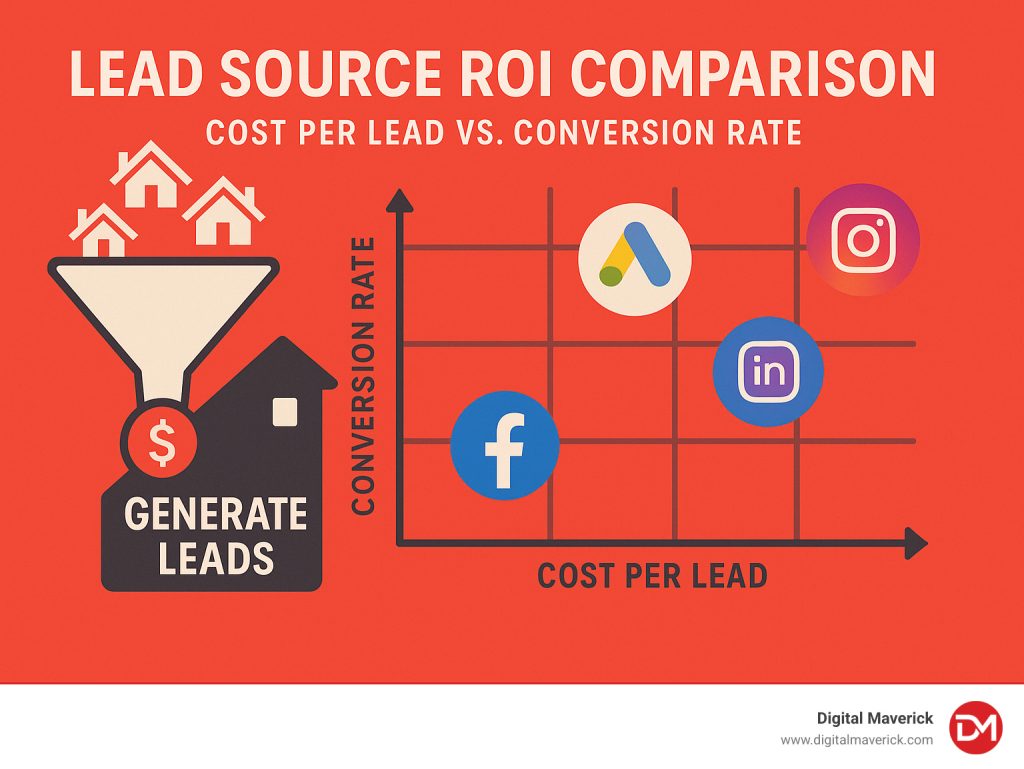
We’d love to help you optimize your real estate software implementation and build the systems needed for sustainable growth. Whether you’re looking to boost speed-to-lead, re-engage aged database contacts, or build a high-performance conversion culture, Digital Maverick provides the structure, support, and services to make it happen.

The future belongs to teams that effectively harness technology while maintaining the human touch that defines great real estate service. With the right software and systems in place, your team can thrive in any market conditions—not just survive.

More info about scalable growth systems

05.19.2025

A Comprehensive Guide to Real Estate CRM and Lead Generation

Real Estate CRM & Lead Generation | Digital Maverick

The Power of Systems: Why Real Estate CRM and Lead Generation Matter

Real estate CRM and lead generation are the backbone of any successful real estate business today. For teams looking to scale their operations and increase conversions, these systems are non-negotiable.

What is a Real Estate CRM and Lead Generation System?

ComponentFunctionBenefit
CRM (Customer Relationship Management)Centralized database to track leads, clients, and transactionsOrganizes contacts, automates follow-up, provides accountability
Lead GenerationTools and strategies to attract potential buyers and sellersCreates consistent pipeline of opportunities
IntegrationConnection between lead sources and nurturing systemsEnsures no lead falls through cracks
AutomationProgrammed follow-up sequences and alertsImproves speed-to-lead and consistent communication

More than 96% of brokers report that using a real estate CRM improves agent productivity, with many seeing an 8-10× return on investment. The right system doesn’t just organize contacts—it transforms how your team converts opportunities into closings.

The challenge isn’t usually generating leads—it’s converting them. Without proper systems, even the most promising opportunities slip away due to inconsistent follow-up, poor speed-to-lead, and lack of meaningful conversations.

I’m Preston Guyton, founder of Digital Maverick where I help real estate teams optimize powerful real estate CRM and lead generation systems that drive consistent conversions through strategic automation and accountability. After 20+ years in the industry and helping countless teams scale their operations, I’ve seen how the right systems can transform struggling teams into conversion machines.

Diagram showing the complete lead journey from generation through CRM nurturing to closing, with automation touchpoints and conversion metrics at each stage - real estate crm and lead generation infographic

Real Estate CRM and Lead Generation Fundamentals

Success in real estate boils down to something remarkably simple: keeping your pipeline healthy and flowing. Think of it like a garden – you need to consistently plant seeds (generate leads) and nurture those plants (convert through your CRM) to eventually harvest the rewards.

When your pipeline is working well, you can see exactly where every opportunity stands – from brand new leads just entering your world to serious prospects actively shopping, all the way to clients heading toward the closing table. Without this visibility? You might as well be working blindfolded.

I recently spoke with a top producer who put it perfectly: “My CRM isn’t just a tool—it’s my business’s central nervous system. I’d sooner give up my cell phone than my CRM.” That might sound extreme, but the numbers tell the story.

Industry reports indicate that real estate teams typically see an impressive 8-10× return on investment when properly implementing real estate CRM and lead generation systems. With millions of leads generated annually and clients achieving a 20% lead conversion rate, the impact on bottom lines is undeniable.

What is real estate crm and lead generation?

Real estate CRM and lead generation creates the ecosystem that powers today’s successful real estate businesses:

A CRM (Customer Relationship Management) system serves as your business’s command center – the place where all your contacts, properties, and transactions live under one roof. It’s where follow-up gets automated, tasks get assigned, and accountability becomes measurable rather than theoretical.

Industry experts define a real estate CRM as “an organizational platform to manage leads and clients, centralize data, and automate tasks to close more deals.” But in practice, it’s so much more – it’s where potential business becomes actual business.

Lead Generation encompasses all the ways you attract potential buyers and sellers into your world. This includes your digital advertising, property search websites, landing pages, referral systems, and both online and offline methods that capture prospect information.

Together, these elements create a complete sales funnel that:

  1. Captures leads from multiple sources
  2. Identifies their needs and timeframe
  3. Nurtures them with relevant, timely content
  4. Converts them into appointments and transactions
  5. Maintains relationships for future business and referrals

The most successful agents and teams understand that real estate CRM and lead generation isn’t just about collecting contact information—it’s about building trust through meaningful, consistent communication. As one client who built a $300 million business shared with me, “It’s all about having meaningful conversations that create opportunities, and opportunities that turn into transactions.”

Why every brokerage needs a unified system

The days of managing your business with spreadsheets, sticky notes and hope are long gone. Today’s competitive landscape demands a unified system that keeps everyone organized and accountable.

A unified real estate CRM and lead generation system delivers four game-changing benefits:

Organization and Efficiency means no more information silos or wondering who last spoke with a lead. When everything lives in one place, agents spend less time hunting for information and more time on dollar-productive activities. Our research shows that “A CRM helps gather and organize lead data, increases speed to lead and service, and enables targeted outreach, leading to more closed deals.”

Accountability and Transparency gives team leaders the visibility they need to monitor activity, provide meaningful coaching, and ensure leads are being properly worked. When you can measure it, you can improve it.

Mobile Access and Flexibility has become non-negotiable for today’s on-the-go agents. Modern CRMs offer robust mobile apps that let your team update information, respond to leads, and manage their pipeline from anywhere. As one user told us: “Having a system that works 24/7 with real-time notifications has been a game-changer for our response times.”

Reliability and Uptime matter tremendously when your business depends on lightning-fast lead response. Enterprise-grade platforms simply offer better reliability than cobbled-together solutions. As a broker client recently shared, “When a hot lead comes in at 9 PM on a Saturday, your CRM needs to be working perfectly. There are no second chances with lead response.”

At Digital Maverick, we’ve watched teams completely transform their businesses by implementing unified systems that connect their lead generation directly to their nurturing workflows. It is one thing to have Follow Up Boss. It is another to make it work for you with an optimized database. The payoff? Dramatically reduced lead waste and significantly higher ROI on every marketing dollar spent.

Core Features & Integrations That Boost Lead Flow

The most effective real estate CRM and lead generation systems don’t just exist as standalone tools—they create a seamless ecosystem where leads flow naturally from capture to conversion. When built correctly, these systems eliminate the friction that often causes leads to slip through the cracks.

Automated workflow dashboard showing lead capture to appointment setting - real estate crm and lead generation

Essential features checklist

I’ve worked with hundreds of real estate teams, and I can tell you firsthand—the difference between struggling and thriving often comes down to having the right CRM features in place. Here’s what you absolutely need:

Your CRM should offer robust contact management that goes beyond basic info. Think complete communication histories, relationship tracking (who referred whom), custom fields for property preferences, and smart tagging that lets you segment contacts based on their needs and timeline.

When a lead comes in, where does it go? Intelligent lead routing ensures the right agent gets the right lead at the right time. Whether you’re distributing by geography, price point, or agent specialty, automated routing prevents leads from sitting unattended. One broker told me, “When we implemented automatic round-robin distribution with accountability tracking, our response time dropped from hours to minutes.”

Without clear metrics, you’re flying blind. Comprehensive reporting and analytics show you exactly which lead sources deliver ROI, which agents convert best, and where your pipeline has bottlenecks. The teams I see winning big all have one thing in common—they obsessively track their numbers.

The real magic happens with task automation and workflows. Imagine lead behavior triggering exactly the right follow-up sequence, transaction milestones generating automatic reminders, and important dates like birthdays creating touchpoint opportunities—all without manual effort.

If your CRM isn’t mobile-optimized, it might as well not exist. Your agents need push notifications for new leads, the ability to dictate notes after a showing, and full access to documents and contact info while on the go.

Finally, real-time alerts and notifications are what separate good systems from great ones. When a lead is checking out multiple properties at 10pm, your CRM should ping the assigned agent immediately. As one client who generates around 500 leads annually shared with me: “The AI notifications that alert me when leads are ready for conversation have been the single biggest game-changer for my conversion rates.”

Integration ecosystem & APIs

The true power of your real estate CRM and lead generation system emerges when it talks seamlessly with your other tools. Think of these integrations as the connective tissue of your business.

Your email and calendar should sync automatically with your CRM. When an agent schedules a showing in Google Calendar, it should appear in the CRM without extra steps. When they email a prospect, that conversation should be captured in the contact record. This two-way synchronization eliminates the frustrating double-entry that makes agents resist using their CRM.

Phone calls are still where deals happen. The best CRMs integrate with telephony and VoIP systems to track, record, and automatically log conversations. I’ve seen teams transform their coaching by reviewing recorded calls through their CRM’s phone integration. One team leader told me, “Listening to recorded calls with new agents has cut our ramp-up time in half.”

The most flexible CRMs connect to hundreds or even thousands of other tools. Many leading platforms offer more than 250 integrations, while others boast over 1,000 connections to various lead sources and business tools. This expansive ecosystem means your CRM can adapt as your tech stack evolves.

For truly custom workflows, look for CRMs with Zapier connectivity or direct API access. This allows you to build unique automations that match your specific business processes without expensive custom development. One team I work with uses Zapier to automatically create CRM tasks when clients submit maintenance requests through their property management software—a small automation that saves hours each week.

ApproachProsConsBest For
All-in-One PlatformSeamless experience, single vendor support, consistent interfacePotentially higher cost, may sacrifice depth for breadthTeams seeking simplicity and unified reporting
Best-of-Breed IntegrationBest tools for each function, flexibility to swap componentsMore complex setup, potential integration gapsTech-savvy teams with specialized needs
Hybrid ApproachCore CRM with strategic integrations, balance of simplicity and powerRequires thoughtful planning, some manual processesMost teams looking to optimize for specific workflows

In my years working with real estate teams at Digital Maverick, I’ve found that a hybrid approach typically delivers the best results. Start with a robust core CRM, then add strategic integrations that address your specific pain points. Work with a national search portal, like ez Home Search? How about ezVerify to ensure you are not calling people on the Do Not Call List? Simply integrate it with your FUB account. This gives you the simplicity of a unified system with the specialized functionality where you need it most.

Remember—the goal isn’t to have the most complex system. It’s to have the right system that supports your team’s workflow while eliminating manual tasks that slow down your lead conversion process.

Choosing, Pricing & Scaling Your CRM

Picking the right real estate CRM and lead generation system isn’t just another tech decision—it’s choosing the foundation your business will build upon. I’ve seen many teams get this wrong, either by overreaching with complex systems they’ll never fully use or by trying to save a few dollars with basic tools they quickly outgrow.

Matching CRM size to business goals

Your CRM needs to match where you are today while supporting where you want to be tomorrow. Let’s look at what works best at different stages:

For solo agents and new licensees, simplicity is your friend. When you’re hustling to establish yourself, the last thing you need is to spend hours configuring complex software. Many new agents find success with free CRM options or platforms that offer special programs for new licensees.

I remember talking with a new agent who closed 12 deals his first year using a basic system. “I’m so glad I didn’t get talked into something complicated,” he told me. “Having a simple CRM I actually used every day was way better than a fancy system gathering dust.”

For small teams of 2-10 agents, your priorities shift toward collaboration and accountability. You need systems that help you distribute leads fairly, track who’s doing what, and share resources across the team. These mid-tier solutions give you team visibility without enterprise complexity or cost.

When you reach enterprise brokerage scale with 10+ agents, you need industrial-strength systems. Enterprise platforms provide the advanced customization, security features, and scalability that larger organizations demand. These systems allow for sophisticated team hierarchies, custom reporting, and the enterprise-grade reliability needed when dozens of agents depend on the system daily.

One broker who grew from 6 to 170 agents in just four years shared this wisdom: “Choose the system you won’t grow out of anytime soon.” That’s solid advice—switching CRMs mid-growth can be painfully disruptive.

Pricing models & hidden costs

The true cost of a real estate CRM and lead generation system often surprises teams who focus only on the advertised monthly price. Let’s pull back the curtain on what you’re really paying for:

Most CRMs follow one of four pricing approaches. Freemium models give you basic features for free, hoping you’ll upgrade later. They’re perfect for testing the waters but typically lack advanced features. This approach is why so many agents initiall heard about LionDesk back in the day – it came free with their MLS membership.

The most common approach is per-user monthly/annual pricing where you pay for each seat. This model creates predictable costs as you scale, though those per-user fees add up quickly as you grow.

Many platforms offer tiered functionality packages with different feature levels. You pay more to open up advanced features, which works well if your needs evolve gradually over time.

Some providers combine pay-per-lead + CRM services. These all-in-one solutions guarantee lead flow but typically come with higher monthly commitments.

Beyond the base subscription, watch for these hidden costs that can balloon your investment:

Onboarding and training fees sometimes reach thousands of dollars for enterprise systems. Integration costs for connecting third-party tools often require additional subscriptions. Data migration from your old system to the new one frequently incurs one-time charges.

Don’t forget operational costs like the time your team spends learning the system, ongoing administration hours, and potential add-ons for AI assistants or premium features that aren’t included in the base package.

As one broker aptly put it: “The cheapest option might not provide what you need, and the priciest option might have a dozen features you’ll never use. Focus on value, not just cost.”

At Digital Maverick, we help teams calculate the true total cost of ownership while identifying which features actually drive revenue growth—because the most expensive CRM isn’t the one with the highest price tag, but the one that sits unused while leads slip through the cracks.

The landscape of real estate CRM and lead generation is rapidly evolving, with automation and artificial intelligence changing how teams engage with prospects and manage relationships.

AI notification on smartphone showing lead engagement alert - real estate crm and lead generation

How automation lifts real estate crm and lead generation

Remember the days of manually following up with every lead? Neither do the top producers of today. Automation has become the not-so-secret weapon that allows successful teams to scale their real estate CRM and lead generation efforts without drowning in admin work or hiring an army of assistants.

Think of automation as your tireless digital assistant that never sleeps, never forgets, and never needs a coffee break. When a potential buyer views a property at 2 AM, your system can instantly send them similar listings. When someone hasn’t engaged in 30 days, a gentle check-in message goes out automatically. This consistent presence builds trust while you focus on high-value activities.

The magic happens with trigger-based outreach – communications that launch based on specific behaviors. One user told me they achieved a jaw-dropping 61% response rate by using these behavior triggers with their database of 2,500 leads. When someone’s search patterns suddenly change (perhaps looking at larger homes or different neighborhoods), the system prompts a timely check-in that feels remarkably intuitive to the prospect.

Nurture cadences keep you present throughout a prospect’s journey without requiring constant manual effort. From educational content for first-time buyers to market updates for potential sellers, these automated touchpoints maintain relationships over months or even years. The statistics are compelling – according to research on SMS statistics, text messages reach a stunning 98% open rate, with 95% of messages read within just 3 minutes. That’s engagement email marketers can only dream about!

“My CRM is like having an extra team member who works 24/7,” one broker shared. “It remembers every detail, follows up perfectly, and nudges me when a human touch is needed.”

AI-powered lead qualification has transformed how teams prioritize their time. Rather than treating all leads equally, systems can now evaluate quality and readiness based on digital body language – how often they visit your site, which properties they view repeatedly, and how they engage with your marketing. Advanced AI assistants alert agents when leads show buying signals, helping agents focus on the most promising opportunities.

Beyond client communication, workflow automation streamlines internal processes that once consumed hours of valuable time. From one-click meeting scheduling to automated task creation based on transaction milestones, these systems eliminate busywork so agents can focus on meaningful client interactions.

As one user put it: “The automation workflows have given me back 15 hours every week – that’s almost two full workdays I now spend with clients instead of paperwork.”

Emerging tech shaping tomorrow’s CRMs

The future of real estate CRM and lead generation looks increasingly intelligent, intuitive, and immersive. Several cutting-edge technologies are already reshaping what’s possible.

Machine learning and predictive analytics are taking lead management from reactive to proactive. Imagine your CRM identifying likely sellers before they even know they’re ready to list, or suggesting the perfect contact time based on when each prospect historically responds best. These aren’t science fiction – they’re capabilities being integrated into leading platforms today.

“Our system now tells us not just who to call, but when to call them and what to say,” shared one tech-forward broker. “It’s like having a crystal ball for our business.”

Conversational AI is making interactions more natural and available around the clock. Today’s advanced chatbots can qualify leads, answer common questions, and schedule appointments while you sleep. Many users report that their AI text responders are so sophisticated that “leads often can’t tell whether they’re texting with a bot or a person.” Meanwhile, voice interfaces are making it possible to update your CRM while driving between appointments – simply by talking.

While still emerging, blockchain technology promises to revolutionize transaction management with secure, immutable records and smart contracts that execute automatically when conditions are met. The potential for streamlined closings with reduced paperwork has many forward-thinking brokers excited about integration possibilities.

The property viewing experience itself is being transformed with immersive technologies that connect seamlessly with CRM systems. Virtual reality tours, augmented reality neighborhood data, and remote closing capabilities are changing how clients experience properties and complete transactions. These technologies are especially valuable for out-of-state buyers or investors who can’t easily visit properties in person.

As exciting as these innovations are, they bring new challenges around privacy and compliance. Next-generation CRMs must steer evolving regulations with improved permission management, consent tracking, and geographic-specific rule enforcement. The platforms that balance innovation with protection will ultimately win the trust of both agents and consumers.

At Digital Maverick, we help teams implement what we call “future-ready” systems – solutions that leverage today’s best automation while remaining flexible enough to adopt tomorrow’s innovations. The goal isn’t technology for technology’s sake, but rather creating more time for what truly matters: meaningful human connections that build trust and close deals.

Frequently Asked Questions & Next Steps

As you consider implementing or upgrading your real estate CRM and lead generation system, these are the questions we hear most frequently from teams looking to improve their results.

What’s the quickest way to boost lead conversion in my CRM?

Speed and consistency are your best friends when it comes to improving conversion rates. The data doesn’t lie – responding to leads within minutes rather than hours can dramatically increase your chances of making a connection.

Start by configuring your CRM to send immediate notifications when new leads arrive. The most successful teams we work with have a five-minute response standard that’s treated as non-negotiable. This immediate acknowledgment shows prospects you’re attentive and ready to help.

Next, set up thoughtful automated initial responses. A quick text or email that says “I got your inquiry and I’m preparing some information for you” buys you time while setting expectations. These shouldn’t feel robotic – write them in your natural voice.

Perhaps most importantly, develop a structured follow-up sequence that persists beyond the first day. The magic often happens between touches 8-12, when many agents have already given up. Your CRM should automatically remind you of these follow-ups and track your progress.

As one CINC client who doubled their conversion rates told us: “Speed kills in this business—speed to lead, that is. Our conversion rate doubled when we implemented a 5-minute response guarantee backed by our CRM’s notification system.”

Should I choose an all-in-one platform or integrate multiple tools?

This is the tech version of “should I buy the Swiss Army knife or individual specialized tools?” – and the answer depends on your specific situation.

All-in-one platforms shine when simplicity and consistency matter most. If your team includes members who aren’t particularly tech-savvy, having everything under one roof with a single interface and login can dramatically improve adoption. You’ll also benefit from integrated reporting that gives you a complete picture of your business without piecing together data from multiple sources.

On the flip side, integrated best-of-breed tools offer specialized capabilities that might better match your unique needs. If you have a team that’s comfortable with technology and specific requirements that no single platform fully addresses, this approach gives you more flexibility. It’s also helpful if you’ve already invested heavily in certain components that you don’t want to abandon.

At Digital Maverick, we’ve found that most teams do best with a hybrid approach – starting with a solid foundation platform and selectively adding specialized tools as specific needs emerge. This gives you the simplicity of a unified system while allowing for growth and specialization over time.

How do I keep my team accountable inside the CRM?

Accountability is where good intentions transform into actual results. Without it, even the most powerful CRM becomes an expensive digital paperweight.

The most successful teams establish clear, measurable daily activity standards – not just results metrics. For example, requiring 20 outbound calls, 5 new leads entered, and 3 appointments set daily gives agents concrete actions they can control, rather than just focusing on outcomes like closed deals.

Make these metrics visible to everyone through team dashboards. There’s something powerful about seeing your name and numbers displayed alongside your colleagues that naturally drives performance. As one BoomTown user shared: “The accountability that comes from our daily CRM metrics review has transformed our culture. What gets measured gets done.”

Create a daily rhythm around these metrics with quick morning huddles. These 15-minute meetings to celebrate wins and address challenges keep the CRM at the center of your business culture.

For teams that need stronger incentives, consider tying a portion of commission splits or bonuses to proper CRM utilization. Money talks, and when financial rewards align with desired behaviors, adoption improves dramatically.

Finally, schedule regular CRM audits to review lead follow-up, contact management, and pipeline accuracy. These check-ins prevent the database from becoming messy and ensure everyone maintains good habits.

Conclusion & How to Get Started

Implementing the right real estate CRM and lead generation system is not just about technology—it’s about creating a sustainable growth engine for your business. The most successful teams combine powerful tools with effective processes and consistent execution.

At Digital Maverick, we’ve helped countless real estate teams transform their businesses through strategic CRM implementation and lead generation optimization. Our approach focuses on eliminating lead waste, building scalable systems, and dramatically increasing ROI from existing investments.

Your Roadmap to CRM Success:

  1. Assess your current situation by auditing your existing lead sources, conversion rates, and identifying gaps in your follow-up processes
  2. Define your requirements by documenting your ideal workflow and prioritizing features based on your growth plans
  3. Select the right platform that matches your specific needs, not just the one with the flashiest features
  4. Plan for successful implementation with careful data migration and comprehensive team training
  5. Optimize and iterate by monitoring adoption and continuously refining your processes

The most sophisticated CRM is worthless without consistent usage and accountability. As we tell our clients: “The best CRM isn’t the one with the most features—it’s the one your team will actually use every day.”

Ready to transform your real estate CRM and lead generation results? Learn more about our growth systems and find how Digital Maverick can help you implement the people, training, and systems needed to turn more leads into closings.

With the right approach, your CRM will become more than just a database—it will be the command center that powers your entire business growth strategy.

05.19.2025

Time is Money—Inside Sales Time Management Strategies That Actually Work

Inside Sales Training Secrets | Digital Maverick

The Time Crisis in Inside Sales

Inside sales training is the structured development of sales professionals who sell remotely via phone, email, and digital channels rather than through face-to-face meetings. Effective training programs focus on:

  • Virtual communication skills for building rapport without in-person cues
  • Digital tool proficiency including CRM, dialers, and sales enablement platforms
  • Consultative questioning techniques to uncover needs remotely
  • Efficient time management to maximize productivity without physical territory constraints
  • Objection handling specific to virtual selling environments

Time management isn’t just a nice-to-have skill in inside sales—it’s the difference between hitting quota and falling short. According to research, it takes 8-10 touchpoints to book a meeting with a prospect, and you might need to send up to 300 cold emails to generate a single outbound lead. Without structured systems, inside sales reps can quickly become overwhelmed by activity without results.

The challenge is magnified in real estate, where leads expect immediate responses but inside sales teams often lack the training to prioritize effectively. When reps spend their days reactively jumping between tasks, important follow-ups fall through the cracks and conversion rates suffer.

I’m Preston Guyton, and as co-founder of Digital Maverick where we hire and train inside sales teams to engage real estate databases across North America, I’ve seen how proper inside sales training transforms chaotic activity into predictable revenue generation.

Inside sales training time management infographic showing comparison between reactive vs. structured approaches, highlighting key statistics on productivity gains, lead response times, and conversion rates for inside sales teams - inside sales training infographic  - inside sales training infographic

Why Time Management Is the Hidden Lever of High-Performance Inside Sales

The truth is sobering: 72% of salespeople will miss their annual quota this year. But here’s what’s interesting—it’s rarely about lacking product knowledge or communication skills. Instead, it’s about how they manage their most precious resource: time.

“The difference between top performers and everyone else isn’t just what they do—it’s when and how efficiently they do it,” explains Travis Halverson of Digital Maverick. “When we analyze struggling inside sales teams, we consistently find that time allocation, not talent, is the primary bottleneck.”

Think about the reality of today’s real estate environment. Your prospects may need 8-10 meaningful touchpoints before they’ll agree to a meeting. Want to generate just one solid outbound lead? You’re looking at sending around 300 cold emails. And if you don’t respond to a new lead within 5 minutes, your chances of qualifying them drop by a staggering 400%.

This is why lead velocity and speed-to-lead execution matter so much. When your day lacks structure, those crucial follow-ups fall through the cracks. High-potential opportunities cool off. Pipeline gaps appear. And before long, you’re not just missing targets—you’re burning out.

The Cost of a Wasted Hour

Real estate teams invest an average of $2,020 per sales rep on inside sales training. But without proper time management frameworks, much of this investment simply evaporates.

Let’s get real about what a single wasted hour actually costs an inside sales agent in real estate:

  • The basic hourly cost in salary and benefits runs $25-35
  • The opportunity cost of conversations you didn’t have: $150-300
  • The long-term impact of delayed follow-ups: $500-1,000+
  • The contribution to eventual burnout and turnover: $10,000-15,000 (what it costs to replace you)

The research backs this up. According to Wilson Learning, sales teams receiving proper training see a 43% increase in revenue performance. Add consistent manager coaching to the mix, and that performance boost jumps to an impressive 67%.

“When we installed proper time management systems through our inside sales training, we typically see a 2-3x increase in meaningful conversations per day,” notes Nikki Pais of Digital Maverick. “That translates directly to more appointments set and ultimately more closings.”

For inside sales professionals, especially in real estate where lead response time can make or break a relationship, mastering your calendar isn’t just about being organized—it’s about open uping your earning potential while preventing the exhaustion that comes from constant reactive mode. Time management isn’t just a skill; it’s the foundation that makes all your other skills actually matter.

For more insights on how training impacts sales performance, check out the 2021 State of Sales Training report.

Essential Skills Developed by Inside Sales Training

Effective inside sales training develops a specific set of time-optimization skills that maximize productivity in a virtual selling environment:

CRM Hygiene and Workflow Optimization

Think of your CRM (e.g. Follow Up Boss) as the command center for inside sales success. When we ISAs at Digital Maverick, we often see immediate productivity gains once reps master proper CRM habits.

“Poor CRM hygiene is like trying to cook in a messy kitchen—you waste time looking for ingredients instead of making the meal,” says Kurt Uhlir of ez Home Search. “When real estate teams properly train their ISAs on CRM workflow optimization, we see lead conversion rates from our portal improve by 30-40%.”

Good training teaches reps to create standardized lead tagging systems that make follow-up effortless. They learn efficient note-taking that preserves context without wasting precious minutes. Most importantly, they find how to build dashboards highlighting the day’s highest-priority actions, eliminating the “what should I do next?” paralysis that kills productivity.

Call Planning and Pre-Work

The difference between average and exceptional inside sales professionals often comes down to preparation. Through proper inside sales training, reps learn to research prospects before reaching out, making conversations instantly more relevant. They prepare objection responses in advance rather than getting caught off-guard.

This pre-work might seem time-consuming, but it actually creates massive efficiency. A well-prepared five-minute call often accomplishes more than a scattered fifteen-minute conversation.

AI Integration for Time Amplification

Modern real estate relationships demands modern tools. Today’s inside sales training should teach reps to leverage AI as a productivity multiplier.

“Our most successful clients are teaching their ISAs to use AI as a time multiplier, not a replacement,” explains Travis Halverson. “The reps who master AI prompting can save over two hours daily on non-selling tasks.”

From crafting custom AI prompts for email personalization to using AI for summarizing call recordings, these skills free up valuable time for what matters most—building human connections with prospects.

The Core Curriculum of Inside Sales Training

When we design inside sales training programs at Digital Maverick, we focus on five core areas that maximize time efficiency:

  1. Find Calls training teaches reps to quickly identify and prioritize the highest-value prospects in your database.
  2. Deal Progression frameworks help move leads through the sales process without wasted steps.
  3. Social Selling provides time-efficient methods for building relationships through digital channels.
  4. Consultative Questioning techniques help uncover needs quickly without interrogating prospects.
  5. And regular Role-Play sessions build confidence that prevents time spent hesitating or recovering from conversation missteps.

“The frameworks some people teach in inside sales training helps reps quickly identify what’s in it for the prospect,” explains Nikki Pais. “This prevents wasted time on misaligned conversations and dramatically increases conversion efficiency.”

Tailoring Inside Sales Training for Entry-Level vs. Veterans

One size definitely doesn’t fit all when it comes to time management training. For newer ISAs, we focus on fundamental time-blocking techniques and provide structured daily schedules with clear activity goals. Micro-coaching sessions help correct inefficiencies before they become habits.

Veterans need a different approach. They benefit from advanced prioritization frameworks and customized efficiency hacks for their specific workflow. Often, they need to unlearn bad habits before adopting new techniques.

“When we work with experienced inside sales teams, we often find they’ve developed bad habits that actually waste time,” notes Travis Halverson. “Sometimes veterans need to unlearn inefficient practices before they can adopt new ones.”

The best training recognizes these differences and creates personalized paths that meet each rep where they are—then takes them where they need to go.

Proven Time Management Frameworks for Inside Sales Teams

I’ve seen how the right structure can transform chaos into consistency. The best inside sales teams don’t just work hard—they work smart by implementing frameworks that eliminate the daily guesswork about what to do next.

The 4-Block Ideal Week Planner

Think of your sales week as four distinct rooms, each with its own purpose. When our clients adopt this approach through inside sales training, they stop bouncing between activities and start dominating their day:

1. Prospecting Block (40% of time)
This is your money-making time. During these hours, you’re focused solely on outbound calling, qualifying new leads, and reaching out via email and social. The magic happens when you eliminate distractions—no meetings, no admin work, just pure connection-building with potential clients.

2. Follow-Up Block (30% of time)
Here’s where relationships deepen. You’re nurturing people already in your pipeline, rekindling conversations that went quiet, and sharing valuable content that positions you as their trusted advisor. Each touchpoint moves prospects one step closer to closing.

3. Administrative Block (20% of time)
Even the best sales professionals need time to sharpen their saw. This block is for CRM updates, preparing for upcoming calls, catching up on emails, and participating in team meetings. By containing these necessary tasks, they don’t leak into your prime selling time.

4. Learning Block (10% of time)
Growth doesn’t happen by accident. Dedicate this time to improving your skills through role-play, reviewing your recorded calls, adjusting strategies based on your performance data, and learning from peers.

“The 4-Block system prevents the context switching that kills productivity,” explains Jon Cheplak, renowned real estate coach. “When our clients implement this framework through proper inside sales training, we consistently see a 30-40% increase in meaningful conversations.”

Comparison of reactive vs. proactive day for inside sales agents showing time allocation, productivity metrics, and results  - inside sales training infographic

Additional Time Management Techniques

Beyond the 4-Block system, there are several techniques we teach in our inside sales training that can boost your productivity:

The 2-Minute Rule is beautifully simple—if something takes less than two minutes, do it now instead of later. Those small tasks can pile up like dirty dishes, creating an overwhelming backlog that steals your mental energy.

The Eisenhower Matrix transforms how you prioritize leads. Instead of treating every contact equally, you categorize them: urgent and important leads get immediate attention; important but not urgent prospects get scheduled time; urgent but not important inquiries get delegated; and low-probability leads simply don’t make the cut.

Batching similar activities is like doing all your grocery shopping at once instead of making separate trips for each ingredient. Group your calls into 60-90 minute blocks, process emails in 30-45 minute sessions, and update your CRM in focused 15-30 minute sprints. Your brain will thank you for not making it constantly switch contexts.

Time Audit & Continuous Improvement

The journey to peak productivity is never really finished. The most successful inside sales professionals treat time management as an ongoing experiment:

First, they establish a baseline assessment by tracking exactly how they currently spend their time. Then they identify time drains—those activities consuming disproportionate time compared to the results they generate. Next comes implementing changes by redesigning workflows to eliminate or optimize those draining activities. After that, they measure impact by tracking key performance indicators. Finally, they refine and repeat the process, continuously adjusting based on results.

“The most successful ISAs we work with conduct monthly time audits,” says Travis Halverson. “They’re constantly looking for ways to squeeze more productivity from their day without working longer hours.”

I’ve seen agents transform their results by adopting these frameworks. One team we worked with increased their meaningful conversations by 35% in just three weeks—not by working more hours, but by working those hours more intelligently. The SWIIFT framework we teach helps reps quickly identify what matters to prospects, preventing those meandering conversations that go nowhere.

Time management isn’t just about efficiency—it’s about creating the space to build genuine connections with the people who need your help the most.

Tools & Tech That Automate the Clock

The magic of modern inside sales training isn’t just about developing skills—it’s about pairing those skills with the right technology to eliminate busywork and maximize selling time. Think of technology as your time amplifier, not your replacement.

Essential Technology for Time Optimization

When we implement new tech stacks for our clients at Digital Maverick, we focus on tools that give back hours in the day. The right technology doesn’t just save time—it creates it.

AI-Powered Email Assistance has transformed how inside sales teams handle communication. With smart templates and response suggestions based on conversation history, reps can maintain personalized outreach at scale without spending their day typing. Our research shows 86% of sales professionals report that generative AI helps them craft more effective prospect messages, giving back an average of 2+ hours daily. That’s time that can go straight into meaningful conversations.

Power Dialers and Call Sequencing eliminate the tedious parts of making calls. Instead of manually punching numbers and leaving the same voicemail dozens of times, these tools keep reps in conversation mode. One client’s team increased their daily calls by 40% simply by implementing pre-recorded voicemail drops and automatic call logging.

“The difference between a productive ISA and a frustrated one often comes down to their tools,” explains Travis Halverson of Digital Maverick. “When we equip teams with the right tech stack, we’re not just saving time—we’re eliminating the administrative burden that causes burnout.”

Meeting Scheduling Tools might seem simple, but they eliminate one of the biggest time drains in sales: the scheduling dance. By removing that back-and-forth email exchange and automating confirmations and reminders, these tools free up mental bandwidth for more important work.

Conversation Intelligence Platforms have revolutionized coaching and improvement. With automatic call recording, transcription and AI-powered insight extraction, both reps and managers can identify patterns and opportunities without spending hours reviewing calls manually.

CRM Automation serves as the central nervous system for all these tools. With triggered task creation and automated lead routing, the CRM becomes less of a data entry burden and more of a personal assistant guiding reps through their day.

“The right tech stack isn’t about replacing the human element—it’s about eliminating the busywork so your ISAs can focus on meaningful conversations,” explains Kurt Uhlir of ez Home Search. “When properly integrated with lead sources like our national portal, these tools can double or triple an agent’s productive capacity.“

Selecting the Right Stack for Real Estate Inside Sales

Real estate inside sales presents unique challenges that require specialized tools beyond generic sales tech. The key is integration—making everything work together seamlessly.

The ideal CRM for real estate inside sales should connect effortlessly with lead sources like ez Home Search, property databases, MLS systems, and transaction management platforms. When these systems talk to each other, data flows automatically instead of requiring manual transfer.

Communication tools need to support the unique needs of real estate conversations. Text messaging platforms with templates, video messaging for property walkthroughs, and automated drip campaigns for long-term nurture all play crucial roles in the real estate sales cycle.

ISA-specific scripts and templates custom to real estate conversations can dramatically reduce preparation time while improving conversation quality. Having customizable qualification questions, objection-handling frameworks, and property-specific value propositions at their fingertips allows ISAs to sound natural while staying efficient.

“At Digital Maverick, we’ve built custom tech stacks for hundreds of real estate teams,” notes Nikki Pais. “The right configuration can reduce non-selling time by up to 70%, allowing ISAs to focus almost exclusively on meaningful conversations.”

The best technology implementation doesn’t feel like technology at all—it feels like having a personal assistant who handles all the tedious parts of the job while you focus on what humans do best: building relationships and solving problems. Through our inside sales training programs, we help teams not just select the right tools, but integrate them into daily workflows that feel natural and supportive rather than complicated and burdensome.

More info about Our Offerings

Measuring, Coaching, and Reinforcing Great Time Habits

Let’s be honest—even the best inside sales training falls flat without follow-through. The magic happens when you build systems that reinforce great habits day after day, week after week.

Key Performance Indicators for Time Efficiency

I’ve seen countless teams focus on the wrong metrics and wonder why nothing changes. The secret is tracking both forward-looking and backward-looking indicators:

Those leading indicators tell you where you’re headed before you hit a wall. These include how many meaningful conversations your team has per hour, your contact-to-appointment ratio, and how quickly reps respond to new leads. I especially love tracking follow-up consistency—because that’s where most teams leave money on the table.

“The most common mistake we see is focusing exclusively on lagging indicators like appointments or closings,” explains Travis Halverson. “By the time those metrics show problems, you’ve already lost weeks or months of productivity.”

Your lagging indicators still matter—appointments set, conversion rates by source, revenue per hour—but they’re like looking in the rearview mirror. By themselves, they can’t help you change course fast enough.

The 1:1 Coaching Cadence

The data doesn’t lie: high-performing sales reps are 26% more likely to receive weekly one-to-one coaching than their peers. But not just any coaching will do.

Effective managers don’t just ask, “Did you hit your numbers?” They dig deeper with questions like:

  • “Show me how you’re organizing your calling blocks”
  • “Let’s look at your calendar—are you protecting your prospecting time?”
  • “Walk me through how you’re using the CRM to prioritize follow-ups”

The best coaching happens in real-time, right in the trenches. At Digital Maverick, we’ve found that short, focused coaching moments beat lengthy quarterly reviews every time. A 10-minute conversation immediately after an important call can cement good habits that last for months.

Gamification for Time Management

There’s something about friendly competition that brings out the best in sales teams. One of our clients turned their efficiency metrics into a weekly leaderboard, and within a month, their average response time dropped from 45 minutes to under 10.

“Gamification works because it makes the abstract concept of time management concrete and competitive,” notes Jon Cheplak. “When reps can see how their time efficiency compares to peers, it naturally drives improvement.”

The key is making the games about behaviors, not just outcomes. Rather than just celebrating the most appointments, celebrate the rep who most consistently follows the ideal week structure or who maintains the highest activity-to-result ratio.

Post-Training Reinforcement & Inside Sales Training Refreshers

Let’s face it—training decay is real. Without reinforcement, even the best inside sales training fades from memory as old habits creep back in. That’s why ongoing reinforcement matters so much.

We’ve found micro-learning works wonders—those 5-10 minute daily skill refreshers that focus on one specific technique. They’re bite-sized enough to fit into a busy schedule but powerful enough to keep skills sharp.

Peer learning communities are another secret weapon. When inside sales reps regularly share best practices and shadow top performers, good habits spread organically through the team. I’ve watched teams transform when they create a culture where everyone teaches everyone.

Manager enablement might be the most overlooked piece of the puzzle. Our research shows companies with dedicated manager training saw a 7% boost in quota attainment. Why? Because frontline leaders are the ones who either reinforce or undermine your time management principles every single day.

At Digital Maverick, we don’t just train great inside sales team and disappear. We equip our managers with observation frameworks, feedback templates, and regular calibration to ensure the training sticks and evolves as your team grows.

The bottom line? Great inside sales training isn’t an event—it’s the beginning of a process that turns good intentions into daily habits, and habits into predictable results.

Frequently Asked Questions about Inside Sales Time Management

How is inside sales time management different from outside sales?

When you step into inside sales, time takes on a completely different rhythm compared to field sales.

First off, there’s the gift of no travel time. While outside reps spend hours driving between appointments, inside sales professionals have that time available for selling—but this blessing comes with a challenge. Without those natural breaks in the day, you need to be more intentional about structuring your time.

Inside sales also typically means handling significantly more prospects and conversations each day. Your ability to prioritize effectively becomes not just important but critical to your success. You’ll need to master a broader technology stack too, with your productivity heavily dependent on how skillfully you steer your tools.

Then there’s the mental challenge of context switching—jumping between calls, emails, texts, and social media without losing effectiveness. Without the natural transitions that travel provides, you’ll need to develop strategies for maintaining focus and energy throughout your day.

What role do managers play in enforcing time discipline?

Great time management rarely survives without supportive leadership. Managers are the linchpin in creating a culture where every minute matters.

Effective sales managers start by modeling the behavior they expect, demonstrating impeccable time management in their own work. They provide regular coaching on time allocation decisions, helping reps see where their time investments are yielding returns—and where they’re not.

“The model we teach managers in our inside sales training provides a structured framework for reinforcing good time habits,” notes Nikki Pais. “Consistent coaching is the difference between temporary improvement and lasting change.”

Beyond coaching, managers excel when they focus on removing obstacles that drain productivity, whether that’s unnecessary meetings or administrative burdens. They establish clear expectations for time-based metrics and hold the team accountable to those standards.

Perhaps most importantly, great managers engage in thoughtful system design—creating workflows and processes that naturally guide reps toward efficient behavior rather than fighting against the current.

How can I calculate ROI on time-focused training?

Measuring the return on your investment in time management training isn’t just possible—it’s essential for making the case for continued development.

Start with solid baseline measurements before training begins. How many meaningful conversations is each rep having daily? What are their conversion rates at each pipeline stage? What’s the average revenue generated per hour worked? These metrics give you the “before” picture.

After training, track the same metrics to measure improvement. Look specifically at the increase in productive selling time, improvements in conversion metrics, and changes in revenue per hour worked.

To calculate the financial impact, consider:

  • Additional revenue generated through improved productivity
  • Cost savings from better efficiency
  • Reduction in expenses related to turnover (which often decreases as reps become more successful)

The ROI formula is straightforward: (Financial Benefits – Training Costs) / Training Costs × 100.

“When properly implemented, time management inside sales training typically delivers a 5-10x return within the first year,” says Travis Halverson. “The compound effect of consistent daily improvement creates dramatic results over time.”

What makes this calculation particularly powerful is that time management improvements tend to compound. A rep who saves 30 minutes daily through better habits gains back 125 hours of productive time annually—that’s over three weeks of additional selling time without working a minute longer.

Conclusion: Turning Minutes into Money

Time management isn’t just another corporate buzzword—it’s the secret weapon that transforms struggling inside sales teams into revenue machines. Through effective inside sales training focused on how reps use their time, real estate teams can dramatically boost productivity without asking anyone to work longer hours.

I’ve seen how the right approach to time management can revolutionize results. At Digital Maverick, we’ve built our entire business model around installing the people, training, and systems that turn every minute into money. Our clients consistently tell us the same thing: “We didn’t realize how much time we were wasting until you showed us a better way.”

Our comprehensive approach combines five essential elements:

First, we implement structured training that teaches time management frameworks specifically designed for inside sales environments. These aren’t generic productivity tips—they’re battle-tested systems that work in the trenches of real estate lead conversion.

Second, we focus on technology integration that automates the busywork that steals productive hours. When your tools work together seamlessly, your team spends more time having meaningful conversations and less time on administrative tasks.

Third, we install coaching systems that ensure good habits stick. As Travis Halverson often reminds our clients, “Training without coaching is just an event—coaching turns it into change.”

Fourth, we establish accountability metrics that measure what truly matters. By tracking the right activities and outcomes, we create visibility that naturally drives improvement.

Finally, we build continuous improvement into everything we do. The market evolves, technology changes, and buyer expectations shift—your time management systems must evolve too.

“The most valuable asset in real estate isn’t listings or leads—it’s time,” explains Jon Cheplak. “When agents master time management, they create capacity for growth without sacrificing quality of life.”

Whether you’re struggling with speed-to-lead response times, trying to extract more value from your existing database, or building a scalable conversion culture, proper time management training creates the foundation that makes everything else possible.

Kurt Uhlir of ez Home Search puts it perfectly: “The teams that master time management consistently outperform their competition, even when working with similar talent and lead sources. It’s the ultimate competitive advantage.”

Ready to transform your inside sales team’s productivity through effective time management training? Learn more about our growth systems and find how Digital Maverick can help you turn every minute into money—creating the business growth you want without sacrificing the life balance you need.