Real Estate Business Growth Archives - Page 4 of 4 - Digital Maverick

05.19.2025

The Definitive Guide to Real Estate Software Options

Real Estate Software Evolution | Digital Maverick

The Evolution of Real Estate Technology

Display the different types of real estate software for a residential agent - real estate software infographic

Real estate software refers to specialized digital tools and platforms designed to help real estate professionals manage properties, leads, transactions, marketing, and business operations more efficiently.

Common types of real estate software:

  • Property Management Systems – For managing rental properties and tenant relationships
  • CRM (Customer Relationship Management) – For tracking leads and client communications
  • Transaction Management – For handling contracts and closing processes
  • Marketing Automation – For generating and nurturing leads
  • Analytics Dashboards – For tracking performance metrics and ROI

The real estate industry has undergone a dramatic digital change in recent years. Where agents once relied on sticky notes, spreadsheets, and manual processes, today’s successful professionals leverage powerful software platforms that automate workflows, centralize data, and drive business growth.

As one broker quoted in our research put it: “100% of our residents are signed up for online services so we can do business in any circumstances.” This sentiment reflects how deeply technology has become embedded in modern real estate operations.

The right software doesn’t just save time—it fundamentally changes how real estate professionals work. Teams that adopt comprehensive digital solutions report significant gains in lead conversion, transaction efficiency, and overall revenue growth.

I’m Preston Guyton, with over 20 years in real estate leadership and extensive experience implementing real estate software solutions that drive growth for teams across North America through my work at Digital Maverick, where we focus on optimizing CRM usage and database management to help real estate teams close more deals.

Real estate software ecosystem showing the interconnected categories of property management, CRM, lead generation, transaction management, marketing automation, and analytics platforms with their primary functions and how they connect to create a complete digital workflow - real estate software infographic

Understanding Real Estate Software: Types and Core Capabilities

Let’s face it – today’s real estate world demands more than just hustle and handshakes. Success requires smart systems that grow alongside your business. Real estate software has come a long way from the digital rolodexes of yesterday. Now, these powerful platforms serve as the backbone for thriving teams and brokerages everywhere.

What is Real Estate Software and Why It Matters

At its heart, real estate software is any digital solution crafted specifically for the unique challenges real estate professionals face daily. These tools transform what used to be manual, paper-heavy processes into smooth digital workflows that make both your operation and your client experience significantly better.

I recently spoke with one of our clients who told me, “Knowing how close leads are to moving in has been great.” This kind of visibility – impossible without proper software – highlights exactly why these tools matter so much. They bring clarity, accountability, and structure to processes that would otherwise feel chaotic and overwhelming.

The return on investment goes far beyond just saving time (though that alone is valuable!). Our research shows some teams experience an average ROI of 600% when using comprehensive platforms that connect their lead generation to transaction management. This isn’t just working smarter – it’s fundamentally expanding what your business can achieve.

Main Categories of Real Estate Software

The real estate software world includes several key categories, each addressing specific aspects of your business:

Property Management Systems handle everything from maintenance requests to rent collection. These comprehensive solutions serve diverse property types from commercial and multifamily to single family housing, self storage, student housing, senior housing, coworking, and affordable housing.

Customer Relationship Management (CRM) solutions keep your leads, contacts, and communications organized. These platforms prevent leads from slipping through the cracks – they’re essentially the lifeblood of relationship management in today’s digital-first market.

Lead Generation Tools focus on finding fresh business opportunities. The best platforms give you access to impressive property records, deeds/sales, and mortgage information nationwide.

Marketing Automation platforms help create, distribute, and track your marketing materials across multiple channels. These often integrate seamlessly with your CRM to nurture leads through personalized communication flows.

Transaction Management solutions digitize the entire contract-to-close process, ensuring compliance while reducing errors and paperwork headaches.

Analytics Dashboards provide crucial insights into your business performance, typically pulling data from multiple systems to give you a comprehensive view of what’s working and what needs attention.

The most successful real estate professionals understand that these categories work best not as separate tools but as connected parts of a cohesive ecosystem. Many leading platforms offer “hyper-connected ecosystems” that far outperform “siloed solutions.”

When properly implemented, these tools don’t just organize your business – they transform it. They centralize your data, improve productivity, ensure compliance, improve security, and enable true scalability. Most importantly, they free you up to focus on what computers can’t do: building genuine relationships with your clients.

Key Features & Emerging Tech: AI, Automation, Mobility

The real estate software landscape is evolving at lightning speed, with game-changing technologies reshaping how the industry operates. Gone are the days when a simple contact database was enough—today’s agents need intelligent tools that work as hard as they do.

AI assistant chatbot on smartphone helping real estate agent - real estate software

AI and Machine Learning

Remember when you had to personally respond to every single lead? Those days are fading fast. AI has brought some incredible capabilities to real estate software that feel almost magical:

AI assistants now engage with new leads around the clock, having natural conversations that qualify prospects before your morning coffee. Modern AI solutions handle initial conversations so convincingly that many leads can’t tell they’re chatting with a computer.

What excites me most is how predictive analytics is changing the game. These smart systems analyze your historical data to forecast which leads are most likely to convert—almost like having a crystal ball for your business. One agent told me, “It’s like having an assistant who knows which leads deserve my immediate attention before I even look at them.”

At Digital Maverick, we’ve seen how our 24/7 AI assistant complements our human ISA team. The AI handles initial contact and basic qualification, while our human team steps in for the nuanced conversations that build real relationships. It’s the perfect partnership of technology and human touch.

Fraud detection is another area where AI shines. Modern systems can spot suspicious applications and protect property managers from potential problems—something that used to require years of experience and a skeptical eye.

Workflow Automation

If you’ve ever felt buried under repetitive tasks, real estate software automation feels like hiring a personal assistant who never sleeps:

The days of manually sending follow-up emails are over. Today’s drip campaigns intelligently nurture leads over weeks or months with personalized content. As one of our clients put it, “My system is working for me while I’m showing properties or sleeping—it’s like cloning myself.”

Task management has been revolutionized too. When a lead takes a specific action, your system automatically creates the right follow-up task and assigns it to the appropriate team member. No more sticky notes or forgotten follow-ups.

Document generation might be the biggest time-saver of all. Modern platforms automatically populate contracts and disclosures with the right information, eliminating hours of tedious paperwork. One agent told me she saved nearly 10 hours a week just from this feature alone.

I’m particularly impressed by systems that can detect specific behaviors—like when a lead views the same property multiple times—and automatically reach out with a perfectly timed text message. It’s like having a sixth sense for sales opportunities.

Mobile Accessibility

Remember when leaving the office meant leaving your business behind? Mobile-first real estate software has changed everything about how and where we work:

Today’s mobile apps put your entire business operation in your pocket. As many providers aptly describe it, you now have “your office in your pocket.” Whether you’re at a showing, grabbing lunch, or sitting on your couch, you have full access to your data and tools.

Cloud access means your information stays synchronized across all your devices. Update a contact on your phone, and it’s instantly reflected on your desktop and tablet. This seamless experience eliminates the frustration of outdated information.

The best mobile solutions even work when connectivity fails. You can capture lead details at that rural property showing with no cell service, and everything syncs automatically when you’re back in range.

I love how modern mobile platforms let agents identify new leads, run comps, and even launch marketing campaigns right from the field. This kind of mobile capability doesn’t just make work more convenient—it fundamentally expands what’s possible in a day.

At Digital Maverick, we’ve seen teams double their productivity by embracing these technologies in the right combination. The sweet spot is finding tools that automate the routine while enhancing—not replacing—the human relationships that drive this business.

More info about conversion systems

Choosing the Right Platform: Pricing, Support & Compliance

Finding your perfect real estate software match is a bit like house hunting—you need to look beyond the curb appeal and check the foundation, systems, and neighborhood too. Let’s walk through what really matters when evaluating platforms for your business.

Pricing Models and Budget Considerations

When it comes to paying for real estate software, you’ll encounter several common approaches:

Most platforms offer subscription models that grow with your team. Many providers offer individual plans starting around $69/month with team options scaling up to $499/month, while others keep things simpler with flat rates around $32/month regardless of team size.

For growing teams, tiered plans starting at around $750/month let you access more powerful features as your needs evolve. Some platforms prefer transaction-based pricing instead, where you pay based on your volume—perfect for seasonal businesses.

I’ve also seen many teams start with freemium options that offer core functionality at no cost, letting you test-drive before fully committing.

Remember though, the sticker price isn’t everything. What you’re looking for is a positive ROI considering all of the costs. As one of our clients at Digital Maverick found, “We were so focused on the monthly fee that we missed the implementation costs that ended up being twice our annual subscription.” Always factor in those hidden expenses—data migration, training time, and add-on features that might suddenly feel “essential” once you’re in the system.

The good news? Well-implemented real estate software typically pays for itself quickly. When we help teams evaluate options, we focus on expected return rather than just upfront costs. One of our partner teams saw their lead conversion jump 37% within three months of implementing a properly configured CRM—a return that made their subscription feel like a bargain.

Support team onboarding new real estate agents to software platform - real estate software

Onboarding, Training and Support

The difference between software success and frustration often comes down to implementation and support quality. Think of it like this: even the fanciest car won’t get you anywhere if nobody shows you where the ignition is.

Good vendors understand this. Quality providers can get basic systems running “as fast as one day,” while more complex deployments might take months—but either way, they guide you through the journey. The best providers offer a buffet of learning options: in-person workshops, online tutorials, on-demand videos, and detailed documentation that meets different learning styles.

Support accessibility matters tremendously. As one broker told me, “I don’t care how pretty the software is if I can’t get help when something breaks on Saturday during an open house.” Look for platforms offering multiple support channels with transparent response times. The best solutions include a “dedicated onboarding team” approach that ensures someone always knows your specific setup.

User communities can be goldmines too. Active mastermind communities with thousands of members share workarounds and best practices you’d never find on your own. One of our Digital Maverick clients found a custom workflow through their software’s community forum that saved their transaction coordinator nearly 10 hours weekly—something no official training had covered.

Remember what one satisfied user shared: “It’s not just logins in 24 hours; they prepare our entire staff for long-term success.” That’s the difference between a vendor and a partner.

Data Privacy and Compliance

In today’s digital landscape, compliance isn’t optional—it’s essential. Your real estate software needs to keep you on the right side of increasingly complex regulations.

Start by verifying the platform’s security credentials. SOC-2 compliance means they follow rigorous data protection standards, while robust encryption keeps sensitive client information safe. One team learned this lesson the hard way after a data breach exposed client financial information—a nightmare that proper security could have prevented.

Privacy regulations like GDPR, CCPA, TCPA, and DNC (do not call) affect how you can store and use client data. The best platforms build compliance tools directly into their workflows, ensuring you’re following the rules even if you don’t know all the details yourself. For property managers, look for features supporting fair housing laws and other industry-specific requirements.

Transaction platforms should maintain detailed audit trails of all activities. Quality solutions highlight their “real-time audit trails and compliance management across multiple agents,” as these records become invaluable if questions arise later.

At Digital Maverick, we’ve seen how proper compliance features save teams from costly mistakes. Our regular CRM audits help ensure that teams not only adopt best practices but maintain them consistently.

You can also add on ezVerify.ai to know who on your list is on the Do Not Call list and when they signed up to be contacted.

As one team leader shared, “The accountability metrics literally saved us from a lawsuit when we could prove exactly when disclosures were sent and acknowledged.”

Productivity enthusiasts might appreciate how compliance-friendly software aligns with research-backed frameworks like the Pomodoro Technique, helping teams stay focused while ensuring all regulatory boxes are checked during each work session.

Choosing the right real estate software is ultimately about finding the balance between features, cost, support, and compliance that works for your specific business needs. If you’re looking for guidance on making that choice, our team at Digital Maverick offers personalized services to help you steer these decisions with confidence.

Integrated Suites vs. Specialized Point Solutions

When it comes to choosing real estate software, one of the biggest decisions you’ll face is whether to go all-in with a comprehensive platform or build your tech stack piece by piece. It’s like deciding between buying a Swiss Army knife or assembling your own toolkit of specialized instruments—both approaches have their merits.
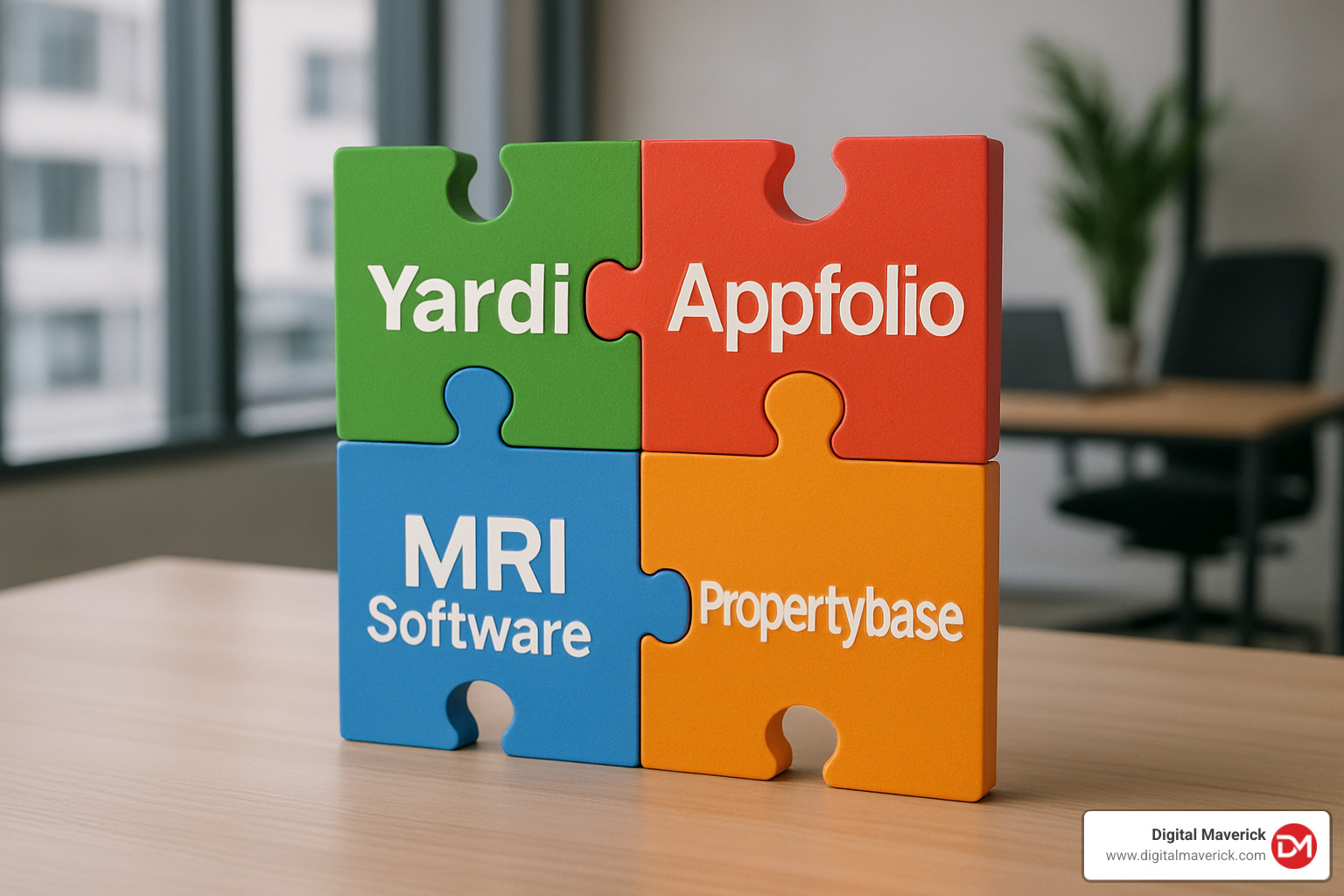
Puzzle pieces showing integrated real estate software applications - real estate software

The Case for All-in-One Platforms

Think of integrated suites as the real estate equivalent of a luxury resort—everything you need under one roof. Leading industry providers have built their reputations on this comprehensive approach.

The beauty of these platforms lies in their seamless connectivity. As many providers aptly put it, “centralizing all property management data in one platform opens up automation and AI-driven productivity gains.” When your lead generation talks directly to your CRM, which connects smoothly with your transaction management system, magic happens—data flows naturally without the headaches of making different systems play nice together.

Your team also benefits from learning just one interface rather than juggling multiple logins and designs. Many vendors emphasize this unified experience as allowing users to “reap the efficiency, security and cost rewards of a truly integrated platform.” There’s something wonderfully simple about training your team on a single system.

From a management perspective, all-in-one platforms mean one support number to call, one bill to pay, and one relationship to nurture. And when it comes to seeing the big picture, these integrated suites shine with their unified reporting capabilities. The best solutions describe their offering as “an open, hyper-connected real estate technology platform” specifically designed to eliminate those frustrating data silos that can keep you from seeing the complete story of your business.

Of course, there are trade-offs. Sometimes these platforms follow the “jack-of-all-trades, master of none” principle—offering adequate functionality across the board without necessarily excelling in every area. And once you’ve committed to an ecosystem, switching becomes more complicated and potentially expensive. There’s also the risk of becoming overly dependent on a single vendor for all your critical business functions.

The Case for Specialized Point Solutions

On the flip side, the specialized approach is like assembling an all-star team where each player brings elite skills in their particular position.

When you choose best-of-breed tools for each function, you’re prioritizing excellence in specific areas. Quality lead generation tools don’t try to be everything to everyone—instead, they focus exclusively on property data and marketing, providing access to millions of property records and specialized marketing tools that general platforms simply can’t match.

The flexibility to mix and match technologies means you can select exactly what works for your unique business model. Need the best lead generation tool but a different CRM? No problem. This approach also allows for gradual adoption—you can implement one solution at a time as your needs evolve and your budget allows.

Perhaps most importantly, using specialized solutions means you’re never completely dependent on a single technology provider. If one tool isn’t meeting your needs, you can replace it without overhauling your entire tech stack.

The challenges, however, are significant. Getting different systems to share data smoothly requires careful planning and sometimes custom integration work. Your team needs to learn and toggle between multiple interfaces, which can slow them down. When problems arise, you might find yourself caught between vendors pointing fingers at each other. And despite your best efforts, information doesn’t always synchronize perfectly across platforms, potentially leading to inconsistencies.

Finding the Right Balance

In my years working with real estate teams at Digital Maverick, I’ve found that many successful operations take a thoughtful hybrid approach. They select a robust core platform for their primary functions while strategically integrating specialized tools for specific needs where excellence is critical.

For example, a growing brokerage might use a comprehensive CRM and transaction platform while integrating specialized tools for lead generation and transaction management—getting the best of both worlds.

The key is building what we call “scalable growth systems”—technology frameworks that support what you need today while leaving room to grow tomorrow. The ideal solution balances immediate functionality with long-term flexibility, much like buying a home with “good bones” that you can improve over time.

As you evaluate your options, be honest about your team’s technical proficiency and available IT support. Look closely at the integration capabilities of your preferred platforms. And most importantly, consider your growth projections—will this solution still serve you when you’ve doubled in size?

Technology should serve your business strategy, not dictate it. The best real estate software configuration is simply the one that aligns with your specific operational model and growth objectives. At Digital Maverick, we’ve seen teams thrive with various approaches—the common factor isn’t which path they chose, but how intentionally they chose it.

Real-World Success Metrics & Best Practices

The true value of real estate software shines through when we look at what happens in the real world. It’s not just about having fancy tech—it’s about how that technology transforms everyday operations into measurable business wins.

Agent viewing performance metrics on dashboard - real estate software

Measurable Impact Stories

When I talk with real estate teams about their software journeys, the excitement in their voices is unmistakable. The numbers tell compelling stories:

Speed matters more than almost anything else in real estate. Teams using AI-powered engagement tools have slashed their lead response times dramatically. One Real Geeks user told me, “The system now identifies our hottest leads based on their website behavior and reaches out before I even know they exist!”

Conversion improvements are where the magic really happens. I recently spoke with a broker who doubled their website traffic in just four months after implementing their new platform. But the traffic wasn’t just for show—their lead-to-client conversion rate jumped right along with it.

Time savings might be the most precious benefit of all. Rex Mobile users report saving about five hours per week for each sales agent through automated prospecting. Imagine what your team could do with an extra day each month to focus on high-value activities!

At Digital Maverick, we’ve seen how the right systems can transform performance. One team we coached increased their GCI by over 30% after implementing proper lead conversion systems backed by thoughtful real estate software configuration. Another doubled their lead-to-appointment conversion rate in just 90 days by optimizing their CRM workflows and response protocols.

Implementation Best Practices

Success with real estate software isn’t accidental—it follows clear patterns that you can replicate:

Start with strategy, not features. I can’t stress this enough. The shiniest new tool won’t help if it doesn’t align with your business goals. As one wise provider puts it, “CRM selection should align with specific lead sources and team structures rather than a one-size-fits-all approach.”

User adoption makes or breaks your investment. The most powerful software becomes instantly worthless if your team avoids using it. One AppFolio client shared, “The difference wasn’t the technology—it was how thoroughly our team acceptd it after the expert coaching sessions.”

Consistent workflows create consistent results. When everyone on your team follows the same process within your software, magic happens. PropertyRadar recommends building automation that ensures you “never miss new opportunities” regardless of who’s handling the lead.

Connected systems amplify results. Your CRM talking to your transaction management platform talking to your marketing automation creates a seamless experience that clients notice. As one ClickUp user told me, “Once we connected our thousand-piece puzzle of apps, everything just flowed.”

Measure, adjust, repeat. The teams seeing the best results are obsessive about tracking their KPIs and continuously refining their processes. Soleox provides “dynamic dashboards for owners, agents, and office displays” specifically to keep everyone aligned on what’s working.

At Digital Maverick, we’ve developed what we call the “operating rhythm”—a structured daily, weekly, and monthly cadence of activities within your real estate software that ensures consistent lead nurturing. Teams following this rhythm in their CRM consistently outperform those with random, reactive approaches.

Mobile Productivity Gains

The smartphone revolution has fundamentally changed how real estate professionals leverage their software:

When you’re driving through a neighborhood and spot a potential listing opportunity, PropertyRadar’s mobile app lets you pull property details instantly and initiate contact on the spot. No more scribbling addresses to research later when the moment has passed.

Field documentation has been transformed by mobile capabilities. I recently watched an agent capture detailed property notes, photos, and even voice memos during a showing—all organized automatically in their CRM for follow-up.

Push notifications have practically eliminated the concept of “missing” an important lead. As one agent told me, “My watch buzzes within seconds of a hot lead hitting our system, and I can respond before they’ve even left our website.”

Remote transaction management might be the biggest game-changer of all. Cloud-based tools now let agents review and sign documents from their phones, dramatically accelerating closing timelines. One client shared, “I finalized a contract poolside during my family vacation—the buyers never knew I wasn’t in the office!”

These real-world examples show that successful real estate software implementation isn’t just about having the right tools—it’s about weaving those tools into your daily workflows in ways that create measurable business impact. When technology, strategy, and consistent execution come together, the results can transform your business.

Want to see how the right operating rhythm could boost your team’s performance? Learn more about Digital Maverick coaching and how we help teams make the most of their technology investments.

Frequently Asked Questions about Real Estate Software

How much does real estate software cost?

When it comes to investing in real estate software, I find my clients often want a clear picture of what to expect cost-wise. The truth is, pricing varies considerably depending on what you need and the size of your operation.

For solo agents or those just getting started, entry-level CRMs offer budget-friendly options at around $32 per month flat rate. As your needs grow, mid-range platforms scale from $69 monthly for individuals up to $499 monthly for teams.

If you’re running a larger operation with complex needs, enterprise solutions start around $750 per month and can climb into the thousands for comprehensive functionality. Specialized tools have their own pricing structures too—targeted expired and FSBO lead generation capabilities might cost around $299 monthly.

Most providers structure their pricing based on factors that directly impact value: number of users, feature access, lead volume, and for property management software, the number of properties you’re handling.

When budgeting for your real estate software, remember to look beyond the monthly subscription. Consider implementation fees, data migration costs, training expenses, and any add-on modules you might need. As one of our vendor partners puts it, “ROI often offsets costs quickly” when you implement the right solution properly.

At Digital Maverick, I’ve seen how the right software investment can transform a business—it’s not just an expense, it’s a growth catalyst when chosen wisely.

What onboarding and training should I expect?

The difference between struggling with new software and mastering it often comes down to the quality of onboarding and training you receive. Quality real estate software providers understand this and offer comprehensive support to get you up and running.

Data migration is typically the first step. Your new provider should help transfer your existing contacts, listings, and historical data into their system. The best solutions highlight their “dedicated onboarding team for secure data migration”—a critical service that prevents losing valuable information during the transition.

The best training programs offer multiple formats to accommodate different learning styles. Look for a combination of live webinars, on-demand videos, written documentation, and personalized coaching. Some teams learn best together in virtual classrooms, while others prefer self-paced tutorials they can revisit when needed.

Implementation timelines vary significantly. Basic setups can be ready “as fast as one day,” while more complex deployments might take “months” to fully implement. Be wary of any provider promising instant results without a proper implementation plan.

I love what one of our clients said about their experience: “It’s not just logins in 24 hours; they prepare our entire staff for long-term success.” That ongoing support—through regular webinars, user communities, knowledge bases, and dedicated success managers—is what transforms a software purchase into a true business partnership.

In our work at Digital Maverick, we’ve found that teams who invest in thorough training see adoption rates 3-4 times higher than those who rush through implementation. That translates directly to ROI, as software only delivers value when your team actually uses it.

How does mobile real estate software boost productivity?

The days of being chained to your desk are long gone. Today’s real estate software puts incredible power in your pocket, changing how agents work in fundamental ways.

Any-device access is the foundation of this mobility revolution. Cloud-based platforms let you seamlessly switch between your desktop, tablet, and phone without missing a beat. As many mobile solutions aptly put it, you now have “your office in your pocket.”

Push notifications have dramatically improved response times. When a hot lead comes in, you get an instant alert—whether you’re at lunch, between showings, or at your kid’s soccer game. This immediate awareness means you can respond in minutes rather than hours, often making the difference between winning and losing business.

The field capabilities of today’s mobile apps are particularly impressive. Imagine pulling up to a potential listing and instantly accessing all comparable properties in the neighborhood, or capturing high-quality photos during a showing and adding them directly to your CRM with notes. Quality mobile apps support “on-the-go lead identification, comps creation, and direct marketing campaigns” right from the field.

Even when you’re in areas with spotty service, advanced mobile apps offer offline functionality, allowing you to capture data without connectivity and syncing automatically when your connection returns.

Real estate agent using mobile software with clients - real estate software

One of our partner agents summed it up perfectly: “Knowing I can respond to leads within minutes rather than hours has completely changed my business. I’ve closed deals sitting in coffee shops that would have gone to competitors in the past.”

The productivity gains are remarkable. Mobile real estate software doesn’t just make your existing processes more convenient—it fundamentally expands what’s possible, letting you create value from anywhere at any time. In today’s competitive market, that flexibility isn’t just nice to have—it’s essential for staying ahead.

Conclusion

The landscape of real estate software continues to evolve at a rapid pace, with AI, automation, and integrated platforms reshaping how successful teams operate. But as we’ve explored throughout this guide, the right technology isn’t just about having the shiniest new tools—it’s about implementing systems that drive real, measurable results in your business.

I’ve seen it time and again: the most successful real estate professionals understand that software is meant to improve their human capabilities, not replace them. As one industry leader beautifully put it: “Technology will never replace the value of real estate agents.” Rather, great technology amplifies what you already do well, handling the routine tasks so you can focus on what truly matters—building relationships and delivering exceptional service.

At Digital Maverick, we’ve witnessed how the right operator-built systems transform struggling teams into thriving ones. Our approach combines powerful real estate software with the practical training, accountability frameworks, and ongoing support needed to turn that technology into a genuine growth engine.

After working with hundreds of teams, we’ve identified several key principles that make the difference:

Integration is absolutely essential. Whether you choose an all-in-one platform or a collection of specialized tools, your systems must talk to each other. Data silos are the enemy of efficiency.

Adoption drives ROI more than any feature set. Even the most sophisticated software becomes worthless if your team doesn’t use it consistently. The teams that invest in proper training and build accountability systems always see better results.

Mobile capabilities have moved from nice-to-have to non-negotiable. The freedom to manage your business from anywhere isn’t just convenient—it’s a competitive advantage in today’s market.

AI improves human performance rather than replacing it. The most effective teams use artificial intelligence and automation to handle routine tasks while focusing their human creativity and emotional intelligence where it matters most.

Success requires systematic approaches beyond the software itself. The teams that document their workflows and maintain consistent operating rhythms are the ones who actually deliver on the promise of their technology investments.

As you evaluate your current technology stack or consider new investments, the goal isn’t having the most features—it’s creating a system that eliminates lead waste, builds scalable growth, and consistently turns leads into conversations and conversations into closings.

We’d love to help you optimize your real estate software implementation and build the systems needed for sustainable growth. Whether you’re looking to boost speed-to-lead, re-engage aged database contacts, or build a high-performance conversion culture, Digital Maverick provides the structure, support, and services to make it happen.

The future belongs to teams that effectively harness technology while maintaining the human touch that defines great real estate service. With the right software and systems in place, your team can thrive in any market conditions—not just survive.
More info about scalable growth systems

05.19.2025

A Comprehensive Guide to Real Estate CRM and Lead Generation

Real Estate CRM & Lead Generation | Digital Maverick

The Power of Systems: Why Real Estate CRM and Lead Generation Matter

Real estate CRM and lead generation are the backbone of any successful real estate business today. For teams looking to scale their operations and increase conversions, these systems are non-negotiable.

What is a Real Estate CRM and Lead Generation System?

ComponentFunctionBenefit
CRM (Customer Relationship Management)Centralized database to track leads, clients, and transactionsOrganizes contacts, automates follow-up, provides accountability
Lead GenerationTools and strategies to attract potential buyers and sellersCreates consistent pipeline of opportunities
IntegrationConnection between lead sources and nurturing systemsEnsures no lead falls through cracks
AutomationProgrammed follow-up sequences and alertsImproves speed-to-lead and consistent communication

More than 96% of brokers report that using a real estate CRM improves agent productivity, with many seeing an 8-10× return on investment. The right system doesn’t just organize contacts—it transforms how your team converts opportunities into closings.

The challenge isn’t usually generating leads—it’s converting them. Without proper systems, even the most promising opportunities slip away due to inconsistent follow-up, poor speed-to-lead, and lack of meaningful conversations.

I’m Preston Guyton, founder of Digital Maverick where I help real estate teams optimize powerful real estate CRM and lead generation systems that drive consistent conversions through strategic automation and accountability. After 20+ years in the industry and helping countless teams scale their operations, I’ve seen how the right systems can transform struggling teams into conversion machines.

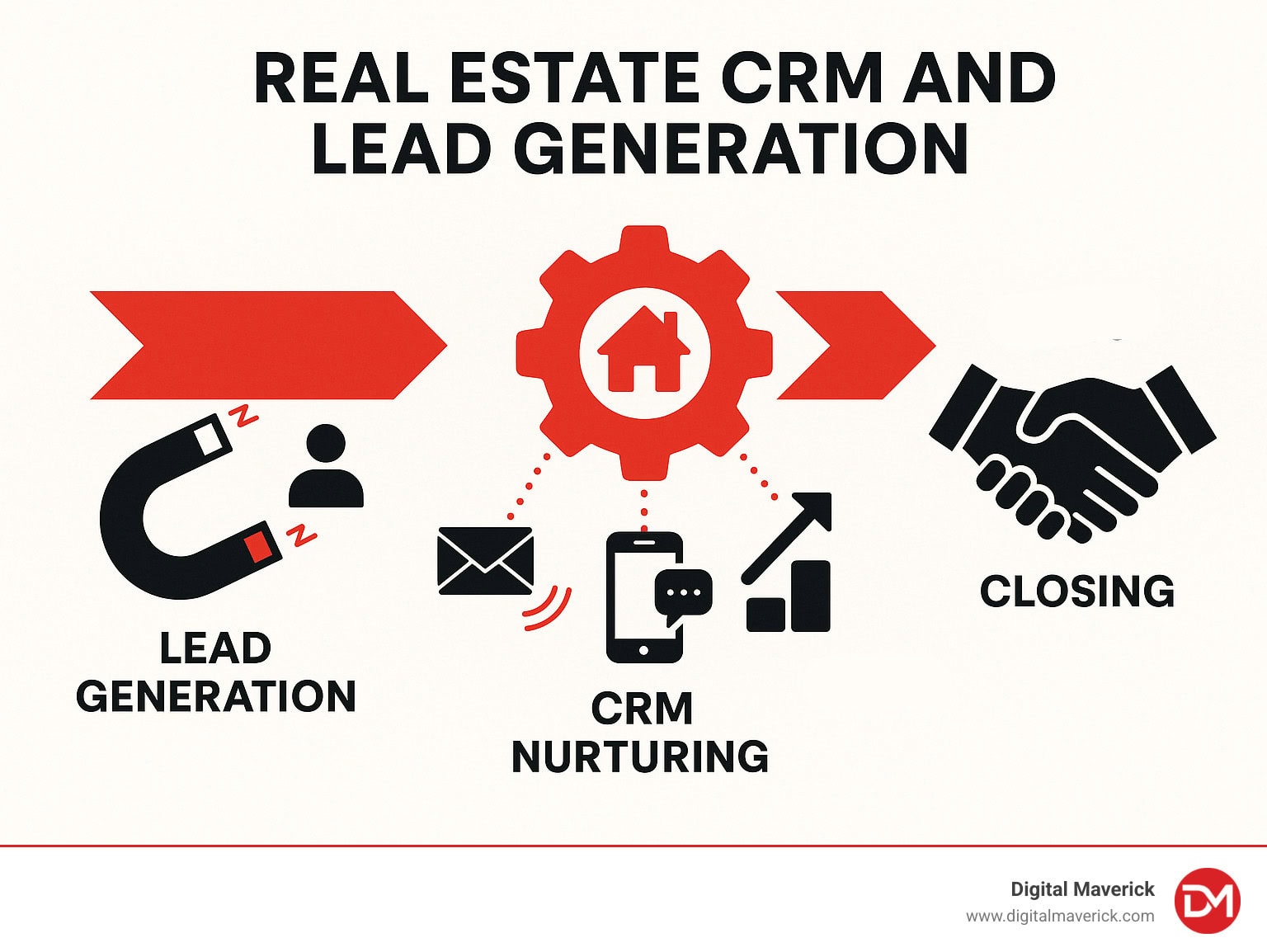
Diagram showing the complete lead journey from generation through CRM nurturing to closing, with automation touchpoints and conversion metrics at each stage - real estate crm and lead generation infographic

Real Estate CRM and Lead Generation Fundamentals

Success in real estate boils down to something remarkably simple: keeping your pipeline healthy and flowing. Think of it like a garden – you need to consistently plant seeds (generate leads) and nurture those plants (convert through your CRM) to eventually harvest the rewards.

When your pipeline is working well, you can see exactly where every opportunity stands – from brand new leads just entering your world to serious prospects actively shopping, all the way to clients heading toward the closing table. Without this visibility? You might as well be working blindfolded.

I recently spoke with a top producer who put it perfectly: “My CRM isn’t just a tool—it’s my business’s central nervous system. I’d sooner give up my cell phone than my CRM.” That might sound extreme, but the numbers tell the story.

Industry reports indicate that real estate teams typically see an impressive 8-10× return on investment when properly implementing real estate CRM and lead generation systems. With millions of leads generated annually and clients achieving a 20% lead conversion rate, the impact on bottom lines is undeniable.

What is real estate crm and lead generation?

Real estate CRM and lead generation creates the ecosystem that powers today’s successful real estate businesses:

A CRM (Customer Relationship Management) system serves as your business’s command center – the place where all your contacts, properties, and transactions live under one roof. It’s where follow-up gets automated, tasks get assigned, and accountability becomes measurable rather than theoretical.

Industry experts define a real estate CRM as “an organizational platform to manage leads and clients, centralize data, and automate tasks to close more deals.” But in practice, it’s so much more – it’s where potential business becomes actual business.

Lead Generation encompasses all the ways you attract potential buyers and sellers into your world. This includes your digital advertising, property search websites, landing pages, referral systems, and both online and offline methods that capture prospect information.

Together, these elements create a complete sales funnel that:

  1. Captures leads from multiple sources
  2. Identifies their needs and timeframe
  3. Nurtures them with relevant, timely content
  4. Converts them into appointments and transactions
  5. Maintains relationships for future business and referrals

The most successful agents and teams understand that real estate CRM and lead generation isn’t just about collecting contact information—it’s about building trust through meaningful, consistent communication. As one client who built a $300 million business shared with me, “It’s all about having meaningful conversations that create opportunities, and opportunities that turn into transactions.”

Why every brokerage needs a unified system

The days of managing your business with spreadsheets, sticky notes and hope are long gone. Today’s competitive landscape demands a unified system that keeps everyone organized and accountable.

A unified real estate CRM and lead generation system delivers four game-changing benefits:

Organization and Efficiency means no more information silos or wondering who last spoke with a lead. When everything lives in one place, agents spend less time hunting for information and more time on dollar-productive activities. Our research shows that “A CRM helps gather and organize lead data, increases speed to lead and service, and enables targeted outreach, leading to more closed deals.”

Accountability and Transparency gives team leaders the visibility they need to monitor activity, provide meaningful coaching, and ensure leads are being properly worked. When you can measure it, you can improve it.

Mobile Access and Flexibility has become non-negotiable for today’s on-the-go agents. Modern CRMs offer robust mobile apps that let your team update information, respond to leads, and manage their pipeline from anywhere. As one user told us: “Having a system that works 24/7 with real-time notifications has been a game-changer for our response times.”

Reliability and Uptime matter tremendously when your business depends on lightning-fast lead response. Enterprise-grade platforms simply offer better reliability than cobbled-together solutions. As a broker client recently shared, “When a hot lead comes in at 9 PM on a Saturday, your CRM needs to be working perfectly. There are no second chances with lead response.”

At Digital Maverick, we’ve watched teams completely transform their businesses by implementing unified systems that connect their lead generation directly to their nurturing workflows. It is one thing to have Follow Up Boss. It is another to make it work for you with an optimized database. The payoff? Dramatically reduced lead waste and significantly higher ROI on every marketing dollar spent.

Core Features & Integrations That Boost Lead Flow

The most effective real estate CRM and lead generation systems don’t just exist as standalone tools—they create a seamless ecosystem where leads flow naturally from capture to conversion. When built correctly, these systems eliminate the friction that often causes leads to slip through the cracks.

Automated workflow dashboard showing lead capture to appointment setting - real estate crm and lead generation

Essential features checklist

I’ve worked with hundreds of real estate teams, and I can tell you firsthand—the difference between struggling and thriving often comes down to having the right CRM features in place. Here’s what you absolutely need:

Your CRM should offer robust contact management that goes beyond basic info. Think complete communication histories, relationship tracking (who referred whom), custom fields for property preferences, and smart tagging that lets you segment contacts based on their needs and timeline.

When a lead comes in, where does it go? Intelligent lead routing ensures the right agent gets the right lead at the right time. Whether you’re distributing by geography, price point, or agent specialty, automated routing prevents leads from sitting unattended. One broker told me, “When we implemented automatic round-robin distribution with accountability tracking, our response time dropped from hours to minutes.”

Without clear metrics, you’re flying blind. Comprehensive reporting and analytics show you exactly which lead sources deliver ROI, which agents convert best, and where your pipeline has bottlenecks. The teams I see winning big all have one thing in common—they obsessively track their numbers.

The real magic happens with task automation and workflows. Imagine lead behavior triggering exactly the right follow-up sequence, transaction milestones generating automatic reminders, and important dates like birthdays creating touchpoint opportunities—all without manual effort.

If your CRM isn’t mobile-optimized, it might as well not exist. Your agents need push notifications for new leads, the ability to dictate notes after a showing, and full access to documents and contact info while on the go.

Finally, real-time alerts and notifications are what separate good systems from great ones. When a lead is checking out multiple properties at 10pm, your CRM should ping the assigned agent immediately. As one client who generates around 500 leads annually shared with me: “The AI notifications that alert me when leads are ready for conversation have been the single biggest game-changer for my conversion rates.”

Integration ecosystem & APIs

The true power of your real estate CRM and lead generation system emerges when it talks seamlessly with your other tools. Think of these integrations as the connective tissue of your business.

Your email and calendar should sync automatically with your CRM. When an agent schedules a showing in Google Calendar, it should appear in the CRM without extra steps. When they email a prospect, that conversation should be captured in the contact record. This two-way synchronization eliminates the frustrating double-entry that makes agents resist using their CRM.

Phone calls are still where deals happen. The best CRMs integrate with telephony and VoIP systems to track, record, and automatically log conversations. I’ve seen teams transform their coaching by reviewing recorded calls through their CRM’s phone integration. One team leader told me, “Listening to recorded calls with new agents has cut our ramp-up time in half.”

The most flexible CRMs connect to hundreds or even thousands of other tools. Many leading platforms offer more than 250 integrations, while others boast over 1,000 connections to various lead sources and business tools. This expansive ecosystem means your CRM can adapt as your tech stack evolves.

For truly custom workflows, look for CRMs with Zapier connectivity or direct API access. This allows you to build unique automations that match your specific business processes without expensive custom development. One team I work with uses Zapier to automatically create CRM tasks when clients submit maintenance requests through their property management software—a small automation that saves hours each week.

ApproachProsConsBest For
All-in-One PlatformSeamless experience, single vendor support, consistent interfacePotentially higher cost, may sacrifice depth for breadthTeams seeking simplicity and unified reporting
Best-of-Breed IntegrationBest tools for each function, flexibility to swap componentsMore complex setup, potential integration gapsTech-savvy teams with specialized needs
Hybrid ApproachCore CRM with strategic integrations, balance of simplicity and powerRequires thoughtful planning, some manual processesMost teams looking to optimize for specific workflows

In my years working with real estate teams at Digital Maverick, I’ve found that a hybrid approach typically delivers the best results. Start with a robust core CRM, then add strategic integrations that address your specific pain points. Work with a national search portal, like ez Home Search? How about ezVerify to ensure you are not calling people on the Do Not Call List? Simply integrate it with your FUB account. This gives you the simplicity of a unified system with the specialized functionality where you need it most.

Remember—the goal isn’t to have the most complex system. It’s to have the right system that supports your team’s workflow while eliminating manual tasks that slow down your lead conversion process.

Choosing, Pricing & Scaling Your CRM

Picking the right real estate CRM and lead generation system isn’t just another tech decision—it’s choosing the foundation your business will build upon. I’ve seen many teams get this wrong, either by overreaching with complex systems they’ll never fully use or by trying to save a few dollars with basic tools they quickly outgrow.

Matching CRM size to business goals

Your CRM needs to match where you are today while supporting where you want to be tomorrow. Let’s look at what works best at different stages:

For solo agents and new licensees, simplicity is your friend. When you’re hustling to establish yourself, the last thing you need is to spend hours configuring complex software. Many new agents find success with free CRM options or platforms that offer special programs for new licensees.

I remember talking with a new agent who closed 12 deals his first year using a basic system. “I’m so glad I didn’t get talked into something complicated,” he told me. “Having a simple CRM I actually used every day was way better than a fancy system gathering dust.”

For small teams of 2-10 agents, your priorities shift toward collaboration and accountability. You need systems that help you distribute leads fairly, track who’s doing what, and share resources across the team. These mid-tier solutions give you team visibility without enterprise complexity or cost.

When you reach enterprise brokerage scale with 10+ agents, you need industrial-strength systems. Enterprise platforms provide the advanced customization, security features, and scalability that larger organizations demand. These systems allow for sophisticated team hierarchies, custom reporting, and the enterprise-grade reliability needed when dozens of agents depend on the system daily.

One broker who grew from 6 to 170 agents in just four years shared this wisdom: “Choose the system you won’t grow out of anytime soon.” That’s solid advice—switching CRMs mid-growth can be painfully disruptive.

Pricing models & hidden costs

The true cost of a real estate CRM and lead generation system often surprises teams who focus only on the advertised monthly price. Let’s pull back the curtain on what you’re really paying for:

Most CRMs follow one of four pricing approaches. Freemium models give you basic features for free, hoping you’ll upgrade later. They’re perfect for testing the waters but typically lack advanced features. This approach is why so many agents initiall heard about LionDesk back in the day – it came free with their MLS membership.

The most common approach is per-user monthly/annual pricing where you pay for each seat. This model creates predictable costs as you scale, though those per-user fees add up quickly as you grow.

Many platforms offer tiered functionality packages with different feature levels. You pay more to open up advanced features, which works well if your needs evolve gradually over time.

Some providers combine pay-per-lead + CRM services. These all-in-one solutions guarantee lead flow but typically come with higher monthly commitments.

Beyond the base subscription, watch for these hidden costs that can balloon your investment:

Onboarding and training fees sometimes reach thousands of dollars for enterprise systems. Integration costs for connecting third-party tools often require additional subscriptions. Data migration from your old system to the new one frequently incurs one-time charges.

Don’t forget operational costs like the time your team spends learning the system, ongoing administration hours, and potential add-ons for AI assistants or premium features that aren’t included in the base package.

As one broker aptly put it: “The cheapest option might not provide what you need, and the priciest option might have a dozen features you’ll never use. Focus on value, not just cost.”

At Digital Maverick, we help teams calculate the true total cost of ownership while identifying which features actually drive revenue growth—because the most expensive CRM isn’t the one with the highest price tag, but the one that sits unused while leads slip through the cracks.

The landscape of real estate CRM and lead generation is rapidly evolving, with automation and artificial intelligence changing how teams engage with prospects and manage relationships.

AI notification on smartphone showing lead engagement alert - real estate crm and lead generation

How automation lifts real estate crm and lead generation

Remember the days of manually following up with every lead? Neither do the top producers of today. Automation has become the not-so-secret weapon that allows successful teams to scale their real estate CRM and lead generation efforts without drowning in admin work or hiring an army of assistants.

Think of automation as your tireless digital assistant that never sleeps, never forgets, and never needs a coffee break. When a potential buyer views a property at 2 AM, your system can instantly send them similar listings. When someone hasn’t engaged in 30 days, a gentle check-in message goes out automatically. This consistent presence builds trust while you focus on high-value activities.

The magic happens with trigger-based outreach – communications that launch based on specific behaviors. One user told me they achieved a jaw-dropping 61% response rate by using these behavior triggers with their database of 2,500 leads. When someone’s search patterns suddenly change (perhaps looking at larger homes or different neighborhoods), the system prompts a timely check-in that feels remarkably intuitive to the prospect.

Nurture cadences keep you present throughout a prospect’s journey without requiring constant manual effort. From educational content for first-time buyers to market updates for potential sellers, these automated touchpoints maintain relationships over months or even years. The statistics are compelling – according to research on SMS statistics, text messages reach a stunning 98% open rate, with 95% of messages read within just 3 minutes. That’s engagement email marketers can only dream about!

“My CRM is like having an extra team member who works 24/7,” one broker shared. “It remembers every detail, follows up perfectly, and nudges me when a human touch is needed.”

AI-powered lead qualification has transformed how teams prioritize their time. Rather than treating all leads equally, systems can now evaluate quality and readiness based on digital body language – how often they visit your site, which properties they view repeatedly, and how they engage with your marketing. Advanced AI assistants alert agents when leads show buying signals, helping agents focus on the most promising opportunities.

Beyond client communication, workflow automation streamlines internal processes that once consumed hours of valuable time. From one-click meeting scheduling to automated task creation based on transaction milestones, these systems eliminate busywork so agents can focus on meaningful client interactions.

As one user put it: “The automation workflows have given me back 15 hours every week – that’s almost two full workdays I now spend with clients instead of paperwork.”

Emerging tech shaping tomorrow’s CRMs

The future of real estate CRM and lead generation looks increasingly intelligent, intuitive, and immersive. Several cutting-edge technologies are already reshaping what’s possible.

Machine learning and predictive analytics are taking lead management from reactive to proactive. Imagine your CRM identifying likely sellers before they even know they’re ready to list, or suggesting the perfect contact time based on when each prospect historically responds best. These aren’t science fiction – they’re capabilities being integrated into leading platforms today.

“Our system now tells us not just who to call, but when to call them and what to say,” shared one tech-forward broker. “It’s like having a crystal ball for our business.”

Conversational AI is making interactions more natural and available around the clock. Today’s advanced chatbots can qualify leads, answer common questions, and schedule appointments while you sleep. Many users report that their AI text responders are so sophisticated that “leads often can’t tell whether they’re texting with a bot or a person.” Meanwhile, voice interfaces are making it possible to update your CRM while driving between appointments – simply by talking.

While still emerging, blockchain technology promises to revolutionize transaction management with secure, immutable records and smart contracts that execute automatically when conditions are met. The potential for streamlined closings with reduced paperwork has many forward-thinking brokers excited about integration possibilities.

The property viewing experience itself is being transformed with immersive technologies that connect seamlessly with CRM systems. Virtual reality tours, augmented reality neighborhood data, and remote closing capabilities are changing how clients experience properties and complete transactions. These technologies are especially valuable for out-of-state buyers or investors who can’t easily visit properties in person.

As exciting as these innovations are, they bring new challenges around privacy and compliance. Next-generation CRMs must steer evolving regulations with improved permission management, consent tracking, and geographic-specific rule enforcement. The platforms that balance innovation with protection will ultimately win the trust of both agents and consumers.

At Digital Maverick, we help teams implement what we call “future-ready” systems – solutions that leverage today’s best automation while remaining flexible enough to adopt tomorrow’s innovations. The goal isn’t technology for technology’s sake, but rather creating more time for what truly matters: meaningful human connections that build trust and close deals.

Frequently Asked Questions & Next Steps

As you consider implementing or upgrading your real estate CRM and lead generation system, these are the questions we hear most frequently from teams looking to improve their results.

What’s the quickest way to boost lead conversion in my CRM?

Speed and consistency are your best friends when it comes to improving conversion rates. The data doesn’t lie – responding to leads within minutes rather than hours can dramatically increase your chances of making a connection.

Start by configuring your CRM to send immediate notifications when new leads arrive. The most successful teams we work with have a five-minute response standard that’s treated as non-negotiable. This immediate acknowledgment shows prospects you’re attentive and ready to help.

Next, set up thoughtful automated initial responses. A quick text or email that says “I got your inquiry and I’m preparing some information for you” buys you time while setting expectations. These shouldn’t feel robotic – write them in your natural voice.

Perhaps most importantly, develop a structured follow-up sequence that persists beyond the first day. The magic often happens between touches 8-12, when many agents have already given up. Your CRM should automatically remind you of these follow-ups and track your progress.

As one CINC client who doubled their conversion rates told us: “Speed kills in this business—speed to lead, that is. Our conversion rate doubled when we implemented a 5-minute response guarantee backed by our CRM’s notification system.”

Should I choose an all-in-one platform or integrate multiple tools?

This is the tech version of “should I buy the Swiss Army knife or individual specialized tools?” – and the answer depends on your specific situation.

All-in-one platforms shine when simplicity and consistency matter most. If your team includes members who aren’t particularly tech-savvy, having everything under one roof with a single interface and login can dramatically improve adoption. You’ll also benefit from integrated reporting that gives you a complete picture of your business without piecing together data from multiple sources.

On the flip side, integrated best-of-breed tools offer specialized capabilities that might better match your unique needs. If you have a team that’s comfortable with technology and specific requirements that no single platform fully addresses, this approach gives you more flexibility. It’s also helpful if you’ve already invested heavily in certain components that you don’t want to abandon.

At Digital Maverick, we’ve found that most teams do best with a hybrid approach – starting with a solid foundation platform and selectively adding specialized tools as specific needs emerge. This gives you the simplicity of a unified system while allowing for growth and specialization over time.

How do I keep my team accountable inside the CRM?

Accountability is where good intentions transform into actual results. Without it, even the most powerful CRM becomes an expensive digital paperweight.

The most successful teams establish clear, measurable daily activity standards – not just results metrics. For example, requiring 20 outbound calls, 5 new leads entered, and 3 appointments set daily gives agents concrete actions they can control, rather than just focusing on outcomes like closed deals.

Make these metrics visible to everyone through team dashboards. There’s something powerful about seeing your name and numbers displayed alongside your colleagues that naturally drives performance. As one BoomTown user shared: “The accountability that comes from our daily CRM metrics review has transformed our culture. What gets measured gets done.”

Create a daily rhythm around these metrics with quick morning huddles. These 15-minute meetings to celebrate wins and address challenges keep the CRM at the center of your business culture.

For teams that need stronger incentives, consider tying a portion of commission splits or bonuses to proper CRM utilization. Money talks, and when financial rewards align with desired behaviors, adoption improves dramatically.

Finally, schedule regular CRM audits to review lead follow-up, contact management, and pipeline accuracy. These check-ins prevent the database from becoming messy and ensure everyone maintains good habits.

Conclusion & How to Get Started

Implementing the right real estate CRM and lead generation system is not just about technology—it’s about creating a sustainable growth engine for your business. The most successful teams combine powerful tools with effective processes and consistent execution.

At Digital Maverick, we’ve helped countless real estate teams transform their businesses through strategic CRM implementation and lead generation optimization. Our approach focuses on eliminating lead waste, building scalable systems, and dramatically increasing ROI from existing investments.

Your Roadmap to CRM Success:

  1. Assess your current situation by auditing your existing lead sources, conversion rates, and identifying gaps in your follow-up processes
  2. Define your requirements by documenting your ideal workflow and prioritizing features based on your growth plans
  3. Select the right platform that matches your specific needs, not just the one with the flashiest features
  4. Plan for successful implementation with careful data migration and comprehensive team training
  5. Optimize and iterate by monitoring adoption and continuously refining your processes

The most sophisticated CRM is worthless without consistent usage and accountability. As we tell our clients: “The best CRM isn’t the one with the most features—it’s the one your team will actually use every day.”

Ready to transform your real estate CRM and lead generation results? Learn more about our growth systems and find how Digital Maverick can help you implement the people, training, and systems needed to turn more leads into closings.

With the right approach, your CRM will become more than just a database—it will be the command center that powers your entire business growth strategy.

05.19.2025

Time is Money—Inside Sales Time Management Strategies That Actually Work

Inside Sales Training Secrets | Digital Maverick

The Time Crisis in Inside Sales

Inside sales training is the structured development of sales professionals who sell remotely via phone, email, and digital channels rather than through face-to-face meetings. Effective training programs focus on:

  • Virtual communication skills for building rapport without in-person cues
  • Digital tool proficiency including CRM, dialers, and sales enablement platforms
  • Consultative questioning techniques to uncover needs remotely
  • Efficient time management to maximize productivity without physical territory constraints
  • Objection handling specific to virtual selling environments

Time management isn’t just a nice-to-have skill in inside sales—it’s the difference between hitting quota and falling short. According to research, it takes 8-10 touchpoints to book a meeting with a prospect, and you might need to send up to 300 cold emails to generate a single outbound lead. Without structured systems, inside sales reps can quickly become overwhelmed by activity without results.

The challenge is magnified in real estate, where leads expect immediate responses but inside sales teams often lack the training to prioritize effectively. When reps spend their days reactively jumping between tasks, important follow-ups fall through the cracks and conversion rates suffer.

I’m Preston Guyton, and as co-founder of Digital Maverick where we hire and train inside sales teams to engage real estate databases across North America, I’ve seen how proper inside sales training transforms chaotic activity into predictable revenue generation.

Inside sales training time management infographic showing comparison between reactive vs. structured approaches, highlighting key statistics on productivity gains, lead response times, and conversion rates for inside sales teams - inside sales training infographic  - inside sales training infographic

Why Time Management Is the Hidden Lever of High-Performance Inside Sales

The truth is sobering: 72% of salespeople will miss their annual quota this year. But here’s what’s interesting—it’s rarely about lacking product knowledge or communication skills. Instead, it’s about how they manage their most precious resource: time.

“The difference between top performers and everyone else isn’t just what they do—it’s when and how efficiently they do it,” explains Travis Halverson of Digital Maverick. “When we analyze struggling inside sales teams, we consistently find that time allocation, not talent, is the primary bottleneck.”

Think about the reality of today’s real estate environment. Your prospects may need 8-10 meaningful touchpoints before they’ll agree to a meeting. Want to generate just one solid outbound lead? You’re looking at sending around 300 cold emails. And if you don’t respond to a new lead within 5 minutes, your chances of qualifying them drop by a staggering 400%.

This is why lead velocity and speed-to-lead execution matter so much. When your day lacks structure, those crucial follow-ups fall through the cracks. High-potential opportunities cool off. Pipeline gaps appear. And before long, you’re not just missing targets—you’re burning out.

The Cost of a Wasted Hour

Real estate teams invest an average of $2,020 per sales rep on inside sales training. But without proper time management frameworks, much of this investment simply evaporates.

Let’s get real about what a single wasted hour actually costs an inside sales agent in real estate:

  • The basic hourly cost in salary and benefits runs $25-35
  • The opportunity cost of conversations you didn’t have: $150-300
  • The long-term impact of delayed follow-ups: $500-1,000+
  • The contribution to eventual burnout and turnover: $10,000-15,000 (what it costs to replace you)

The research backs this up. According to Wilson Learning, sales teams receiving proper training see a 43% increase in revenue performance. Add consistent manager coaching to the mix, and that performance boost jumps to an impressive 67%.

“When we installed proper time management systems through our inside sales training, we typically see a 2-3x increase in meaningful conversations per day,” notes Nikki Pais of Digital Maverick. “That translates directly to more appointments set and ultimately more closings.”

For inside sales professionals, especially in real estate where lead response time can make or break a relationship, mastering your calendar isn’t just about being organized—it’s about open uping your earning potential while preventing the exhaustion that comes from constant reactive mode. Time management isn’t just a skill; it’s the foundation that makes all your other skills actually matter.

For more insights on how training impacts sales performance, check out the 2021 State of Sales Training report.

Essential Skills Developed by Inside Sales Training

Effective inside sales training develops a specific set of time-optimization skills that maximize productivity in a virtual selling environment:

CRM Hygiene and Workflow Optimization

Think of your CRM (e.g. Follow Up Boss) as the command center for inside sales success. When we ISAs at Digital Maverick, we often see immediate productivity gains once reps master proper CRM habits.

“Poor CRM hygiene is like trying to cook in a messy kitchen—you waste time looking for ingredients instead of making the meal,” says Kurt Uhlir of ez Home Search. “When real estate teams properly train their ISAs on CRM workflow optimization, we see lead conversion rates from our portal improve by 30-40%.”

Good training teaches reps to create standardized lead tagging systems that make follow-up effortless. They learn efficient note-taking that preserves context without wasting precious minutes. Most importantly, they find how to build dashboards highlighting the day’s highest-priority actions, eliminating the “what should I do next?” paralysis that kills productivity.

Call Planning and Pre-Work

The difference between average and exceptional inside sales professionals often comes down to preparation. Through proper inside sales training, reps learn to research prospects before reaching out, making conversations instantly more relevant. They prepare objection responses in advance rather than getting caught off-guard.

This pre-work might seem time-consuming, but it actually creates massive efficiency. A well-prepared five-minute call often accomplishes more than a scattered fifteen-minute conversation.

AI Integration for Time Amplification

Modern real estate relationships demands modern tools. Today’s inside sales training should teach reps to leverage AI as a productivity multiplier.

“Our most successful clients are teaching their ISAs to use AI as a time multiplier, not a replacement,” explains Travis Halverson. “The reps who master AI prompting can save over two hours daily on non-selling tasks.”

From crafting custom AI prompts for email personalization to using AI for summarizing call recordings, these skills free up valuable time for what matters most—building human connections with prospects.

The Core Curriculum of Inside Sales Training

When we design inside sales training programs at Digital Maverick, we focus on five core areas that maximize time efficiency:

  1. Find Calls training teaches reps to quickly identify and prioritize the highest-value prospects in your database.
  2. Deal Progression frameworks help move leads through the sales process without wasted steps.
  3. Social Selling provides time-efficient methods for building relationships through digital channels.
  4. Consultative Questioning techniques help uncover needs quickly without interrogating prospects.
  5. And regular Role-Play sessions build confidence that prevents time spent hesitating or recovering from conversation missteps.

“The frameworks some people teach in inside sales training helps reps quickly identify what’s in it for the prospect,” explains Nikki Pais. “This prevents wasted time on misaligned conversations and dramatically increases conversion efficiency.”

Tailoring Inside Sales Training for Entry-Level vs. Veterans

One size definitely doesn’t fit all when it comes to time management training. For newer ISAs, we focus on fundamental time-blocking techniques and provide structured daily schedules with clear activity goals. Micro-coaching sessions help correct inefficiencies before they become habits.

Veterans need a different approach. They benefit from advanced prioritization frameworks and customized efficiency hacks for their specific workflow. Often, they need to unlearn bad habits before adopting new techniques.

“When we work with experienced inside sales teams, we often find they’ve developed bad habits that actually waste time,” notes Travis Halverson. “Sometimes veterans need to unlearn inefficient practices before they can adopt new ones.”

The best training recognizes these differences and creates personalized paths that meet each rep where they are—then takes them where they need to go.

Proven Time Management Frameworks for Inside Sales Teams

I’ve seen how the right structure can transform chaos into consistency. The best inside sales teams don’t just work hard—they work smart by implementing frameworks that eliminate the daily guesswork about what to do next.

The 4-Block Ideal Week Planner

Think of your sales week as four distinct rooms, each with its own purpose. When our clients adopt this approach through inside sales training, they stop bouncing between activities and start dominating their day:

1. Prospecting Block (40% of time)
This is your money-making time. During these hours, you’re focused solely on outbound calling, qualifying new leads, and reaching out via email and social. The magic happens when you eliminate distractions—no meetings, no admin work, just pure connection-building with potential clients.

2. Follow-Up Block (30% of time)
Here’s where relationships deepen. You’re nurturing people already in your pipeline, rekindling conversations that went quiet, and sharing valuable content that positions you as their trusted advisor. Each touchpoint moves prospects one step closer to closing.

3. Administrative Block (20% of time)
Even the best sales professionals need time to sharpen their saw. This block is for CRM updates, preparing for upcoming calls, catching up on emails, and participating in team meetings. By containing these necessary tasks, they don’t leak into your prime selling time.

4. Learning Block (10% of time)
Growth doesn’t happen by accident. Dedicate this time to improving your skills through role-play, reviewing your recorded calls, adjusting strategies based on your performance data, and learning from peers.

“The 4-Block system prevents the context switching that kills productivity,” explains Jon Cheplak, renowned real estate coach. “When our clients implement this framework through proper inside sales training, we consistently see a 30-40% increase in meaningful conversations.”

Comparison of reactive vs. proactive day for inside sales agents showing time allocation, productivity metrics, and results  - inside sales training infographic

Additional Time Management Techniques

Beyond the 4-Block system, there are several techniques we teach in our inside sales training that can boost your productivity:

The 2-Minute Rule is beautifully simple—if something takes less than two minutes, do it now instead of later. Those small tasks can pile up like dirty dishes, creating an overwhelming backlog that steals your mental energy.

The Eisenhower Matrix transforms how you prioritize leads. Instead of treating every contact equally, you categorize them: urgent and important leads get immediate attention; important but not urgent prospects get scheduled time; urgent but not important inquiries get delegated; and low-probability leads simply don’t make the cut.

Batching similar activities is like doing all your grocery shopping at once instead of making separate trips for each ingredient. Group your calls into 60-90 minute blocks, process emails in 30-45 minute sessions, and update your CRM in focused 15-30 minute sprints. Your brain will thank you for not making it constantly switch contexts.

Time Audit & Continuous Improvement

The journey to peak productivity is never really finished. The most successful inside sales professionals treat time management as an ongoing experiment:

First, they establish a baseline assessment by tracking exactly how they currently spend their time. Then they identify time drains—those activities consuming disproportionate time compared to the results they generate. Next comes implementing changes by redesigning workflows to eliminate or optimize those draining activities. After that, they measure impact by tracking key performance indicators. Finally, they refine and repeat the process, continuously adjusting based on results.

“The most successful ISAs we work with conduct monthly time audits,” says Travis Halverson. “They’re constantly looking for ways to squeeze more productivity from their day without working longer hours.”

I’ve seen agents transform their results by adopting these frameworks. One team we worked with increased their meaningful conversations by 35% in just three weeks—not by working more hours, but by working those hours more intelligently. The SWIIFT framework we teach helps reps quickly identify what matters to prospects, preventing those meandering conversations that go nowhere.

Time management isn’t just about efficiency—it’s about creating the space to build genuine connections with the people who need your help the most.

Tools & Tech That Automate the Clock

The magic of modern inside sales training isn’t just about developing skills—it’s about pairing those skills with the right technology to eliminate busywork and maximize selling time. Think of technology as your time amplifier, not your replacement.

Essential Technology for Time Optimization

When we implement new tech stacks for our clients at Digital Maverick, we focus on tools that give back hours in the day. The right technology doesn’t just save time—it creates it.

AI-Powered Email Assistance has transformed how inside sales teams handle communication. With smart templates and response suggestions based on conversation history, reps can maintain personalized outreach at scale without spending their day typing. Our research shows 86% of sales professionals report that generative AI helps them craft more effective prospect messages, giving back an average of 2+ hours daily. That’s time that can go straight into meaningful conversations.

Power Dialers and Call Sequencing eliminate the tedious parts of making calls. Instead of manually punching numbers and leaving the same voicemail dozens of times, these tools keep reps in conversation mode. One client’s team increased their daily calls by 40% simply by implementing pre-recorded voicemail drops and automatic call logging.

“The difference between a productive ISA and a frustrated one often comes down to their tools,” explains Travis Halverson of Digital Maverick. “When we equip teams with the right tech stack, we’re not just saving time—we’re eliminating the administrative burden that causes burnout.”

Meeting Scheduling Tools might seem simple, but they eliminate one of the biggest time drains in sales: the scheduling dance. By removing that back-and-forth email exchange and automating confirmations and reminders, these tools free up mental bandwidth for more important work.

Conversation Intelligence Platforms have revolutionized coaching and improvement. With automatic call recording, transcription and AI-powered insight extraction, both reps and managers can identify patterns and opportunities without spending hours reviewing calls manually.

CRM Automation serves as the central nervous system for all these tools. With triggered task creation and automated lead routing, the CRM becomes less of a data entry burden and more of a personal assistant guiding reps through their day.

“The right tech stack isn’t about replacing the human element—it’s about eliminating the busywork so your ISAs can focus on meaningful conversations,” explains Kurt Uhlir of ez Home Search. “When properly integrated with lead sources like our national portal, these tools can double or triple an agent’s productive capacity.“

Selecting the Right Stack for Real Estate Inside Sales

Real estate inside sales presents unique challenges that require specialized tools beyond generic sales tech. The key is integration—making everything work together seamlessly.

The ideal CRM for real estate inside sales should connect effortlessly with lead sources like ez Home Search, property databases, MLS systems, and transaction management platforms. When these systems talk to each other, data flows automatically instead of requiring manual transfer.

Communication tools need to support the unique needs of real estate conversations. Text messaging platforms with templates, video messaging for property walkthroughs, and automated drip campaigns for long-term nurture all play crucial roles in the real estate sales cycle.

ISA-specific scripts and templates custom to real estate conversations can dramatically reduce preparation time while improving conversation quality. Having customizable qualification questions, objection-handling frameworks, and property-specific value propositions at their fingertips allows ISAs to sound natural while staying efficient.

“At Digital Maverick, we’ve built custom tech stacks for hundreds of real estate teams,” notes Nikki Pais. “The right configuration can reduce non-selling time by up to 70%, allowing ISAs to focus almost exclusively on meaningful conversations.”

The best technology implementation doesn’t feel like technology at all—it feels like having a personal assistant who handles all the tedious parts of the job while you focus on what humans do best: building relationships and solving problems. Through our inside sales training programs, we help teams not just select the right tools, but integrate them into daily workflows that feel natural and supportive rather than complicated and burdensome.

More info about Our Offerings

Measuring, Coaching, and Reinforcing Great Time Habits

Let’s be honest—even the best inside sales training falls flat without follow-through. The magic happens when you build systems that reinforce great habits day after day, week after week.

Key Performance Indicators for Time Efficiency

I’ve seen countless teams focus on the wrong metrics and wonder why nothing changes. The secret is tracking both forward-looking and backward-looking indicators:

Those leading indicators tell you where you’re headed before you hit a wall. These include how many meaningful conversations your team has per hour, your contact-to-appointment ratio, and how quickly reps respond to new leads. I especially love tracking follow-up consistency—because that’s where most teams leave money on the table.

“The most common mistake we see is focusing exclusively on lagging indicators like appointments or closings,” explains Travis Halverson. “By the time those metrics show problems, you’ve already lost weeks or months of productivity.”

Your lagging indicators still matter—appointments set, conversion rates by source, revenue per hour—but they’re like looking in the rearview mirror. By themselves, they can’t help you change course fast enough.

The 1:1 Coaching Cadence

The data doesn’t lie: high-performing sales reps are 26% more likely to receive weekly one-to-one coaching than their peers. But not just any coaching will do.

Effective managers don’t just ask, “Did you hit your numbers?” They dig deeper with questions like:

  • “Show me how you’re organizing your calling blocks”
  • “Let’s look at your calendar—are you protecting your prospecting time?”
  • “Walk me through how you’re using the CRM to prioritize follow-ups”

The best coaching happens in real-time, right in the trenches. At Digital Maverick, we’ve found that short, focused coaching moments beat lengthy quarterly reviews every time. A 10-minute conversation immediately after an important call can cement good habits that last for months.

Gamification for Time Management

There’s something about friendly competition that brings out the best in sales teams. One of our clients turned their efficiency metrics into a weekly leaderboard, and within a month, their average response time dropped from 45 minutes to under 10.

“Gamification works because it makes the abstract concept of time management concrete and competitive,” notes Jon Cheplak. “When reps can see how their time efficiency compares to peers, it naturally drives improvement.”

The key is making the games about behaviors, not just outcomes. Rather than just celebrating the most appointments, celebrate the rep who most consistently follows the ideal week structure or who maintains the highest activity-to-result ratio.

Post-Training Reinforcement & Inside Sales Training Refreshers

Let’s face it—training decay is real. Without reinforcement, even the best inside sales training fades from memory as old habits creep back in. That’s why ongoing reinforcement matters so much.

We’ve found micro-learning works wonders—those 5-10 minute daily skill refreshers that focus on one specific technique. They’re bite-sized enough to fit into a busy schedule but powerful enough to keep skills sharp.

Peer learning communities are another secret weapon. When inside sales reps regularly share best practices and shadow top performers, good habits spread organically through the team. I’ve watched teams transform when they create a culture where everyone teaches everyone.

Manager enablement might be the most overlooked piece of the puzzle. Our research shows companies with dedicated manager training saw a 7% boost in quota attainment. Why? Because frontline leaders are the ones who either reinforce or undermine your time management principles every single day.

At Digital Maverick, we don’t just train great inside sales team and disappear. We equip our managers with observation frameworks, feedback templates, and regular calibration to ensure the training sticks and evolves as your team grows.

The bottom line? Great inside sales training isn’t an event—it’s the beginning of a process that turns good intentions into daily habits, and habits into predictable results.

Frequently Asked Questions about Inside Sales Time Management

How is inside sales time management different from outside sales?

When you step into inside sales, time takes on a completely different rhythm compared to field sales.

First off, there’s the gift of no travel time. While outside reps spend hours driving between appointments, inside sales professionals have that time available for selling—but this blessing comes with a challenge. Without those natural breaks in the day, you need to be more intentional about structuring your time.

Inside sales also typically means handling significantly more prospects and conversations each day. Your ability to prioritize effectively becomes not just important but critical to your success. You’ll need to master a broader technology stack too, with your productivity heavily dependent on how skillfully you steer your tools.

Then there’s the mental challenge of context switching—jumping between calls, emails, texts, and social media without losing effectiveness. Without the natural transitions that travel provides, you’ll need to develop strategies for maintaining focus and energy throughout your day.

What role do managers play in enforcing time discipline?

Great time management rarely survives without supportive leadership. Managers are the linchpin in creating a culture where every minute matters.

Effective sales managers start by modeling the behavior they expect, demonstrating impeccable time management in their own work. They provide regular coaching on time allocation decisions, helping reps see where their time investments are yielding returns—and where they’re not.

“The model we teach managers in our inside sales training provides a structured framework for reinforcing good time habits,” notes Nikki Pais. “Consistent coaching is the difference between temporary improvement and lasting change.”

Beyond coaching, managers excel when they focus on removing obstacles that drain productivity, whether that’s unnecessary meetings or administrative burdens. They establish clear expectations for time-based metrics and hold the team accountable to those standards.

Perhaps most importantly, great managers engage in thoughtful system design—creating workflows and processes that naturally guide reps toward efficient behavior rather than fighting against the current.

How can I calculate ROI on time-focused training?

Measuring the return on your investment in time management training isn’t just possible—it’s essential for making the case for continued development.

Start with solid baseline measurements before training begins. How many meaningful conversations is each rep having daily? What are their conversion rates at each pipeline stage? What’s the average revenue generated per hour worked? These metrics give you the “before” picture.

After training, track the same metrics to measure improvement. Look specifically at the increase in productive selling time, improvements in conversion metrics, and changes in revenue per hour worked.

To calculate the financial impact, consider:

  • Additional revenue generated through improved productivity
  • Cost savings from better efficiency
  • Reduction in expenses related to turnover (which often decreases as reps become more successful)

The ROI formula is straightforward: (Financial Benefits – Training Costs) / Training Costs × 100.

“When properly implemented, time management inside sales training typically delivers a 5-10x return within the first year,” says Travis Halverson. “The compound effect of consistent daily improvement creates dramatic results over time.”

What makes this calculation particularly powerful is that time management improvements tend to compound. A rep who saves 30 minutes daily through better habits gains back 125 hours of productive time annually—that’s over three weeks of additional selling time without working a minute longer.

Conclusion: Turning Minutes into Money

Time management isn’t just another corporate buzzword—it’s the secret weapon that transforms struggling inside sales teams into revenue machines. Through effective inside sales training focused on how reps use their time, real estate teams can dramatically boost productivity without asking anyone to work longer hours.

I’ve seen how the right approach to time management can revolutionize results. At Digital Maverick, we’ve built our entire business model around installing the people, training, and systems that turn every minute into money. Our clients consistently tell us the same thing: “We didn’t realize how much time we were wasting until you showed us a better way.”

Our comprehensive approach combines five essential elements:

First, we implement structured training that teaches time management frameworks specifically designed for inside sales environments. These aren’t generic productivity tips—they’re battle-tested systems that work in the trenches of real estate lead conversion.

Second, we focus on technology integration that automates the busywork that steals productive hours. When your tools work together seamlessly, your team spends more time having meaningful conversations and less time on administrative tasks.

Third, we install coaching systems that ensure good habits stick. As Travis Halverson often reminds our clients, “Training without coaching is just an event—coaching turns it into change.”

Fourth, we establish accountability metrics that measure what truly matters. By tracking the right activities and outcomes, we create visibility that naturally drives improvement.

Finally, we build continuous improvement into everything we do. The market evolves, technology changes, and buyer expectations shift—your time management systems must evolve too.

“The most valuable asset in real estate isn’t listings or leads—it’s time,” explains Jon Cheplak. “When agents master time management, they create capacity for growth without sacrificing quality of life.”

Whether you’re struggling with speed-to-lead response times, trying to extract more value from your existing database, or building a scalable conversion culture, proper time management training creates the foundation that makes everything else possible.

Kurt Uhlir of ez Home Search puts it perfectly: “The teams that master time management consistently outperform their competition, even when working with similar talent and lead sources. It’s the ultimate competitive advantage.”

Ready to transform your inside sales team’s productivity through effective time management training? Learn more about our growth systems and find how Digital Maverick can help you turn every minute into money—creating the business growth you want without sacrificing the life balance you need.

08.24.2022

Digital Maverick

It’s critical that we meet you where you are NOW, at the intersection of your Single Most Greatest obstruction to growth and our specific solution that will break you through. This is why we do not offer a cookie-cutter program – it’s more like an (un)program – that is specific to you.