Real Estate Business Growth Archives - Page 4 of 4 - Digital Maverick

05.19.2025

How to Generate Leads in Real Estate the Right Way

Generate Leads Real Estate Strategies | Digital Maverick

Why Lead Generation is the Lifeblood of Your Real Estate Business

Generate leads real estate agents need to thrive starts with understanding the most effective strategies. Here’s a quick overview of the top methods:

  1. Sphere of Influence: Contact friends, family, and past clients regularly
  2. Online Presence: Optimize your website and Google Business Profile
  3. Content Marketing: Create valuable neighborhood guides and market reports
  4. Social Media: Post consistently with video content (gets 403% more inquiries)
  5. Open Houses: Collect visitor information and follow up systematically
  6. Geographic Farming: Target specific neighborhoods with consistent marketing
  7. For Sale By Owners (FSBOs): Approach with market insights, not sales pitches
  8. Community Involvement: Host local events and partner with businesses

Without a steady flow of leads, your real estate business can’t survive—much less thrive. The National Association of REALTORS® reports that 3 out of 4 homeowners choose the first agent they talk to when deciding to list their home. This statistic alone highlights why having a consistent lead generation strategy is crucial for sustainable success.

Lead generation in real estate isn’t just about finding new clients; it’s about building relationships that convert to revenue. While many agents scramble for the next shiny tool or platform, the most successful professionals understand that lead generation requires a balanced approach of both digital and traditional methods, all supported by systematic follow-up.

Think of lead generation as the engine that powers your business. Without regular maintenance and fuel, even the most expensive car won’t take you anywhere.

I’m Preston Guyton, founder of Digital Maverick, where I’ve spent over 20 years helping real estate teams generate high-quality leads and optimize their conversion systems to close more deals. My experience in generate leads real estate strategies spans from traditional methods to cutting-edge AI applications that identify high-probability sellers.

Modern real estate lead generation funnel showing multiple channels feeding into qualification, nurturing, and conversion stages with average conversion rates at each step - generate leads real estate infographic

The Foundations of Real Estate Lead Generation

Behind every successful real estate business lies a strong foundation of lead generation principles. It’s not just about collecting phone numbers and email addresses—it’s about building meaningful connections that transform strangers into clients who trust you with their biggest investments.

What is lead generation & why it matters

At its core, generate leads real estate is about attracting potential clients and nurturing them until they’re ready to work with you. Think of it as planting seeds that, with proper care, grow into closed transactions.

NAR research reveals something fascinating: most buyers and sellers find their agent through personal connections—friends, neighbors, or relatives who recommend someone they trust. This insight confirms what the most successful agents already know: relationships drive this business, even in our digital-first world.

One of our Digital Maverick clients, Christina, shared her experience: “I closed 12 additional deals in my first year simply by focusing on building genuine relationships rather than chasing transactions. When I shifted from ‘selling homes’ to ‘helping people,’ everything changed—my lead generation became natural and effective.”

The math behind successful lead generation is eye-opening. With typical conversion rates between 0.4% and 1.2%, you need a substantial pipeline flowing consistently. For example, if your goal is 24 transactions annually with a 2% conversion rate, you’ll need approximately 1,200 leads in your funnel. This isn’t to discourage you—it’s to emphasize why consistent lead generation activities must become part of your daily routine.

You need to focus your efforts on:

  1. Generating new leads of active and non-active buyers. Segment them, add them to different action plans, and do the work to follow up.
  2. Connecting with your existing database. This requires managing your database, tagging clients, taking notes, calling or having your ISA call, and looking for ways to serve them where they are in the process.

High production agents know that not 80% to 95% of their database is not actively buying and selling right now. They know this because they have systems in place and workflows to identify each of their contacts individually so that they can be there to serve them when they are ready to buy and sell.

Key pillars of a winning system

Your generate leads real estate system stands firmly on three essential pillars:

Consistent Prospecting Habit transforms average agents into top producers. Jeff Glover’s story proves this—he sold 30 homes at age 19 simply by door-knocking with well-rehearsed scripts. His secret wasn’t extraordinary talent but extraordinary consistency. Block time every morning for lead generation activities before the day’s distractions take over.

Systematic Follow-Up separates the professionals from the amateurs. Research shows 80% of sales require five follow-up contacts, yet most agents give up after just two attempts. Your follow-up system should include multiple touchpoints across different channels—phone calls, personalized emails, text messages, and social media engagement—all scheduled at strategic intervals.

CRM Hygiene and Management turns your database into a gold mine. Regular cleaning, smart tagging, and thoughtful segmentation ensure you’re delivering the right message to the right people at precisely the right time. Your CRM isn’t just a digital address book—it’s the command center of your entire business.

As Jon Cheplak explains, “The difference between struggling agents and top producers isn’t talent—it’s systems. Top producers have systematized their lead generation to the point where it runs almost on autopilot.”

We’ve observed this at Digital Maverick. Agents who commit to even 30 minutes of focused lead generation each morning see their pipelines grow exponentially compared to those who prospect sporadically. The science is clear: consumer trust develops through consistency, and consistency comes from having reliable systems in place.

Digital Presence & SEO: Your 24/7 Lead Magnet

Your online presence is often the first impression potential clients have of you. A strategic digital footprint works around the clock to generate leads real estate professionals can convert into clients.

“Your clients are vetting you online, whether you know it or not. They look for your profiles, your reviews, and increasingly what ChatGPT, Perplexity, or other answer engines say about you”, says Kurt Uhlir, Chief Marketing Officer at ez Home Search.

How optimized websites generate leads real estate around the clock

Your website should be more than a digital business card—it should be a lead-generating machine. Here’s what makes the difference:

  • Speed and Mobile Optimization: 53% of visitors abandon sites that take longer than 3 seconds to load, and 96% of people use the internet in their home search, primarily on mobile devices.

  • Clear Calls to Action (CTAs): Every page should guide visitors toward a specific action, whether that’s scheduling a consultation, downloading a neighborhood guide, or signing up for market updates.

  • IDX Integration: Allowing visitors to search listings directly on your site keeps them engaged and provides valuable data on their preferences. If you’re site does not provide a search experience they will actually use, they will go to a website that will, and then another agent will be calling them.

  • Google Business Profile Optimization: This free tool is often overlooked, yet it’s crucial for local visibility. Complete profiles with reviews, posts, and accurate information rank higher in local searches.

Jason, a north Georgia-based agent, shared: “After optimizing my website with targeted landing pages for each neighborhood I serve, my lead generation increased by 37% in just two months. The best part? These leads converted at nearly twice the rate of my paid leads because they found me through specific local searches.”

Content & lead magnets that generate leads real estate seekers crave

Content marketing isn’t just about blogging—it’s about creating valuable resources that address specific pain points in the home buying or selling process. Effective lead magnets include:

  • Neighborhood Guides: Detailed information about local schools, amenities, and market trends
  • Home Valuation Tools: Instant estimates that capture seller information
  • First-Time Homebuyer Guides: Step-by-step resources for navigating the purchase process
  • Investment Property Calculators: Tools that help investors analyze potential returns

These resources should be gated behind simple forms that collect contact information. The optimal form length is 3-5 fields—enough to gather necessary information without creating friction.

“We implemented a series of neighborhood-specific landing pages with downloadable market reports,” explains Jay Valento. “Each report requires an email to access, and we’ve built an automated drip campaign that nurtures these leads with relevant content. From this system alone, we’ve generated 45 transactions in the past year.”

Content creation doesn’t have to be overwhelming. Start with one high-quality piece per month, focusing on evergreen topics that will remain relevant. Over time, this library of content becomes a powerful lead generation asset that works 24/7.

Social Media & Video Marketing

Social media isn’t just a trendy option anymore—it’s become essential for real estate pros who want to generate leads real estate consumers actually respond to. The difference between agents who struggle and those who thrive on these platforms comes down to strategy, not just showing up.

Generate leads real estate with engaging social content

The numbers tell the story: NAR reports that 90% of REALTORS are on Facebook, and more than half generate more leads through social media than through traditional channels like the MLS or their CRM. That’s powerful stuff when you think about it.

Creating content that actually works doesn’t have to be complicated. Think of your social strategy as being built on five simple pillars: informative posts that educate your audience, entertaining content that makes them smile, inspirational stories that touch hearts, educational pieces that build your authority, and yes, some promotional content that showcases your listings.

“I honestly thought social media was just a time-waster until I committed to doing it right,” shares JJ, who works with Digital Maverick. “Now about a third of my business comes directly from Facebook and Instagram—especially from my videos highlighting local businesses. People remember me as ‘that agent who featured my favorite coffee shop.'”

Consistency matters more than perfection. The algorithms reward regular posting, so using scheduling tools like Hootsuite helps you batch-create content when you’re feeling creative and distribute it when your audience is most active. For real estate, Instagram tends to perform best on Saturdays between noon and 9 pm—when people are dreaming about their next home.

Smart agents are also leveraging messenger chatbots to capture leads even while they’re sleeping or showing properties. These automated tools can answer common questions, gather contact information, and even begin the qualification process before you’ve had your morning coffee.

Community engagement isn’t just a nice bonus—it’s essential. By actively participating in local Facebook groups and offering helpful advice (without the sales pitch), you position yourself as the neighborhood expert long before someone needs to buy or sell.

Leveraging video to get 403% more inquiries

If there’s one statistic that should convince you to accept video, it’s this: listings with video receive 403% more inquiries than those without. That’s not a typo—four hundred and three percent! Video simply communicates in ways that photos and text cannot.

You don’t need fancy equipment or professional editing skills. Today’s smartphones capture incredible quality, and authenticity often outperforms polished production. What matters is showing up consistently with content that adds value.

Property walkthroughs are the obvious starting point, but don’t stop there. Neighborhood tours showing local parks, schools, and restaurants help buyers envision their lifestyle. Client testimonials build trust through social proof. Quick market updates position you as knowledgeable and current. Even behind-the-scenes glimpses of your day build the personal connection that leads to business.

One Digital Maverick client found remarkable success with a simple approach: recording a 2-minute market update video each week, then repurposing it across platforms. The full version went on YouTube, short clips on Instagram and Facebook, and key points in an email newsletter. This efficient strategy generated 27 direct inquiries in just the first month.

Different platforms have different sweet spots for video content. YouTube rewards longer, information-rich content with searchable titles. Instagram prefers vertical, quick-hitting 30-60 second clips with engaging captions. Facebook videos perform best at 1-3 minutes with attention-grabbing openings. And LinkedIn’s audience responds to professional, data-driven insights that appeal to investors or luxury clients.

The beauty of video is that it humanizes you in a way no other medium can. In a business built on relationships, letting people see your personality, expertise, and genuine care for your community creates connections that convert to clients—often at that impressive 403% higher rate than your competitors who are still relying solely on listing photos.

Database & Referral Mining

One of the most overlooked sources of leads is often sitting right in your CRM: past clients, sphere of influence, and people you’ve already met. Mining your database effectively can be the most cost-efficient way to generate leads real estate professionals often neglect.

How to tap your database to generate leads real estate already waiting

Your existing database is gold—these contacts already know you, which significantly increases conversion probability. Think of your CRM not as a digital filing cabinet but as a treasure chest waiting to be opened.

Most agents are sitting on a goldmine without realizing it. Your past clients and contacts aren’t just names in a system—they’re relationships with potential. By segmenting your database into categories like past clients, sphere of influence, and various temperature leads (hot, warm, cold), you can craft messages that resonate with each group’s specific needs.

“We analyzed our database and found that 68% of our past clients had never been contacted after closing,” admits Michael, a team leader working with Digital Maverick. “After implementing a systematic follow-up program, we generated 14 referrals and 8 repeat clients in just three months—business that was literally waiting for us to reach out.”

The magic happens when you maintain regular touchpoints—aim for at least 33 meaningful contacts per year. These aren’t just generic newsletters, but personalized connections that matter: birthday cards, home purchase anniversaries, neighborhood updates, and seasonal check-ins. Each touch reinforces your relationship and keeps you top-of-mind when real estate needs arise.

Cold leads deserve special attention too. Many agents write them off, but with the right reactivation campaign, these contacts can warm up quickly. A simple “I was thinking about you” message with a relevant market insight can rekindle conversations that lead to listings.

We help teams audit their databases quarterly, ensuring no opportunities slip through the cracks. Our 24/7 AI assistant can even scan databases for engagement patterns and highlight contacts showing seller signals based on online behavior and life events—catching life changes that suggest a move might be imminent.

Scripts & communication techniques that convert

The way you reach out to your database contacts can make or break your conversion efforts. It’s not just what you say, but how quickly you say it that matters.

Speed-to-lead is perhaps the most underrated factor in lead conversion. When someone raises their hand by filling out a form or asking a question, the clock starts ticking. Research shows that contacting a lead within 5 minutes increases conversion by 900% compared to waiting 30 minutes. That’s not a typo—900%. Our ISA teams are trained to pounce on new leads within minutes, capturing interest while it’s still hot.

Text messaging has become the communication channel of choice for busy professionals. According to Gallup research, text messages enjoy a staggering 98% open rate (compared to email’s modest 20%), with 95% of texts read within three minutes of receipt. A simple, personalized text can open doors that emails and voicemails cannot.

When crafting your messages, use confidence phrases that subtly guide the conversation forward. Instead of saying “If we meet,” say “When we meet.” Rather than “I hope I can help,” try “Let me show you how I can help.” These small shifts in language assume the next step, making it more likely to happen.

Here’s a sample script that works wonders for reengaging a cold database contact:

“Hi [Name], it’s [Your Name] with [Your Brokerage]. I was reviewing the market trends in [Their Neighborhood] and noticed some interesting shifts that might impact your home’s value. How are you feeling about the recent changes in our local market?”

This approach offers value first, shows you’re thinking about them specifically, and opens the door to a non-threatening conversation.

Your database isn’t just a list; it’s a community of people who already know your name. Nurture these relationships with purpose, and they’ll become your most reliable source of business for years to come.

Community & Offline Prospecting

While digital strategies are essential, face-to-face interactions still create some of the strongest connections. Community involvement and traditional prospecting remain powerful ways to generate leads real estate professionals can reliably convert.

Building hyper-local authority

Becoming the recognized expert in specific neighborhoods or market segments creates a steady stream of inbound leads that practically walk through your door.

Geographic farming has proven incredibly effective for many of our clients. Instead of spreading yourself thin across an entire city, focus on a defined area through consistent marketing touches. One Digital Maverick client chose to concentrate exclusively on a 400-home subdivision. By sending monthly market updates and hosting quarterly community events like summer barbecues and holiday gatherings, they’ve captured an impressive 23% market share in that neighborhood.

Cause marketing creates both business opportunities and personal fulfillment. When you align your business with meaningful causes, you build goodwill while opening doors to new networks. JJ Devore found her passion after 9/11 by joining a first-responder home-buying program. She now donates part of every commission to this cause, which has not only generated leads but also given her work deeper purpose.

“I got HUD-certified and now host monthly first-time buyer seminars at our local library,” shares another client. “It’s incredibly rewarding to help people understand the buying process, and each session typically results in 2-3 serious buyers who already trust me as their guide.”

Community events create natural opportunities for connection without the awkwardness of direct selling. Ronnie tried something practical that resonated with homeowners: “We hosted a ‘Shred Day’ where neighbors could bring sensitive documents for secure disposal. It cost us $400 for the shredding service, but we collected 37 contacts and converted 3 into listings within two months.” The ROI speaks for itself.

Other community event ideas that have worked well include outdoor movie nights in local parks, trunk-or-treat Halloween gatherings, pet adoption fairs partnered with local shelters, and neighborhood-wide yard sales that bring communities together.

Classic tactics that still generate leads real estate pros overlook

In our rush to accept digital innovation, many agents have abandoned traditional methods that still deliver exceptional results.

Open houses, when done right, can be lead-generation goldmines rather than boring Sunday afternoon obligations. Go beyond the standard cheese plate by creating memorable experiences. One agent hosts themed open houses based on the home’s era or architecture. Another partners with local vendors to create mini-experiences throughout the home. The goal is creating an event people actually want to attend—and tell their friends about.

For Sale By Owner (FSBO) outreach requires finesse, not pressure. These sellers have already identified themselves as motivated, but they’re often wary of agents. Instead of pushing for a listing appointment, offer genuine market insights and establish yourself as a resource. Jeff Glover’s remarkable story of selling 30 homes at age 19 began with a simple FSBO door-knocking strategy and well-rehearsed scripts that focused on helping rather than selling.

Expired listings represent perfect opportunities to demonstrate how your approach differs from what didn’t work before. Rather than criticizing the previous agent, focus on specific strategies you’d implement differently. One Digital Maverick client created a “Second Chance” program specifically for expired listings, with specialized marketing materials highlighting why homes don’t sell and how her approach addresses those issues.

Circle prospecting around your successes creates awareness and often uncovers hidden selling intentions. When you list or sell a home, the neighbors are naturally curious. One of our clients sends “Just Listed” postcards to 100 homes surrounding each new listing, consistently generating 1-2 additional listings per campaign. The key is following up with a personal visit or call rather than just relying on the mailer.

Corporate relocation partnerships can deliver a steady stream of qualified leads. Meeting with HR departments at major local employers can establish you as their go-to resource for relocating employees. One agent secured an exclusive arrangement with a hospital, receiving 3-5 referrals monthly—leads that arrive already trusting her expertise because of the corporate endorsement.

We help teams balance these traditional tactics with modern approaches, creating integrated campaigns that leverage both online and offline touchpoints. The most successful agents aren’t choosing between digital and traditional—they’re thoughtfully combining both for maximum impact.

It’s not that anyone lead channel is good or bad. Success coming from having an action plan in intentionally investing the work – day in and day out.

Smart Tech, AI & Paid Lead Sources

Technology has transformed how we generate leads real estate professionals can leverage for growth. From artificial intelligence to predictive analytics, these tools can identify likely sellers before they even list.

AI tools that generate leads real estate teams love

Artificial intelligence isn’t just a buzzword anymore—it’s becoming a trusted partner for savvy agents looking to stay ahead of the curve. Think of AI as your tireless assistant, working around the clock to spot opportunities you might miss.

Predictive analytics has become particularly powerful in our industry. These sophisticated AI algorithms analyze hundreds of data points about homeowners—everything from life events to online behavior—to identify who’s most likely to sell soon. As one leading provider explains, “We leverage over 250 points of data on homeowners to process our predictive algorithm. This helps identify who is most likely to list their home for sale in the next 12 months with up to 70% accuracy.” That’s like having a crystal ball for your business!

Our 24/7 conversational AI assistant engages with website visitors at all hours, answering questions and qualifying leads while you sleep or spend time with family. One of our clients recently shared, “Our AI assistant generated 14 qualified appointments in the first month—9 of which we wouldn’t have captured otherwise because they came in after business hours.”

Behavior triggers have also revolutionized how we nurture leads. Modern CRMs can alert you when a prospect shows buying signals—maybe they’ve viewed the same property listing three times in a week or suddenly started searching in a higher price range. These digital nudges help you reach out at exactly the right moment.

“The difference between struggling with lead follow-up and mastering it isn’t working harder—it’s working smarter with the right technology,” notes our own Travis Halverson. “Our systems identify not just who to contact, but exactly when and how to reach out for maximum effectiveness.”

While organic methods build sustainable pipelines, sometimes you need to prime the pump with paid lead sources. The key is using them strategically, not desperately.

Zillow Premier Agent connects you with buyers actively searching listings. It’s powerful but comes at a premium—expect to invest $30-$60 per lead in smaller markets and $1,000+ monthly in competitive metro areas. It works best for agents with rock-solid follow-up systems who can convert these high-intent leads. Although with their changes to a % and change in lead quality, more agents are looking at other portals that better align with their business goals.

Google Ads let you target specific keywords and locations, but the landscape is competitive. With an average $2.37 per click and real estate conversion rates hovering around 2.47%, you’ll need to optimize continuously. They shine when you’re targeting niche markets with specific search terms like “waterfront homes in Charleston” or “golf course properties in Phoenix.”

Facebook & Instagram Ads offer incredible targeting options at a lower entry point—averaging $2.44 per lead with proper setup. These leads might be earlier in their journey, but they’re perfect for nurturing campaigns. One of our clients uses Facebook ads to promote neighborhood guides, capturing contact information from people who might be 3-6 months from making a move.

“We’ve found the sweet spot is allocating 60% of marketing budget to organic methods and 40% to paid channels,” shares our lead generation specialist. “This creates a balanced approach where paid leads provide immediate opportunities while organic methods build long-term sustainability.”

When considering paid leads, don’t just look at the sticker price. Calculate what each lead is potentially worth based on your average commission, conversion rate, and target ROI. For instance, if your average commission is $9,000 and you convert 2% of leads, each lead could be worth about $180.

At Digital Maverick, we help teams implement tracking systems that measure the true ROI of each lead source. This data-driven approach typically helps our clients reduce their cost per acquisition by 30-40% after proper optimization. We’re not just spending money on leads—we’re investing it wisely.
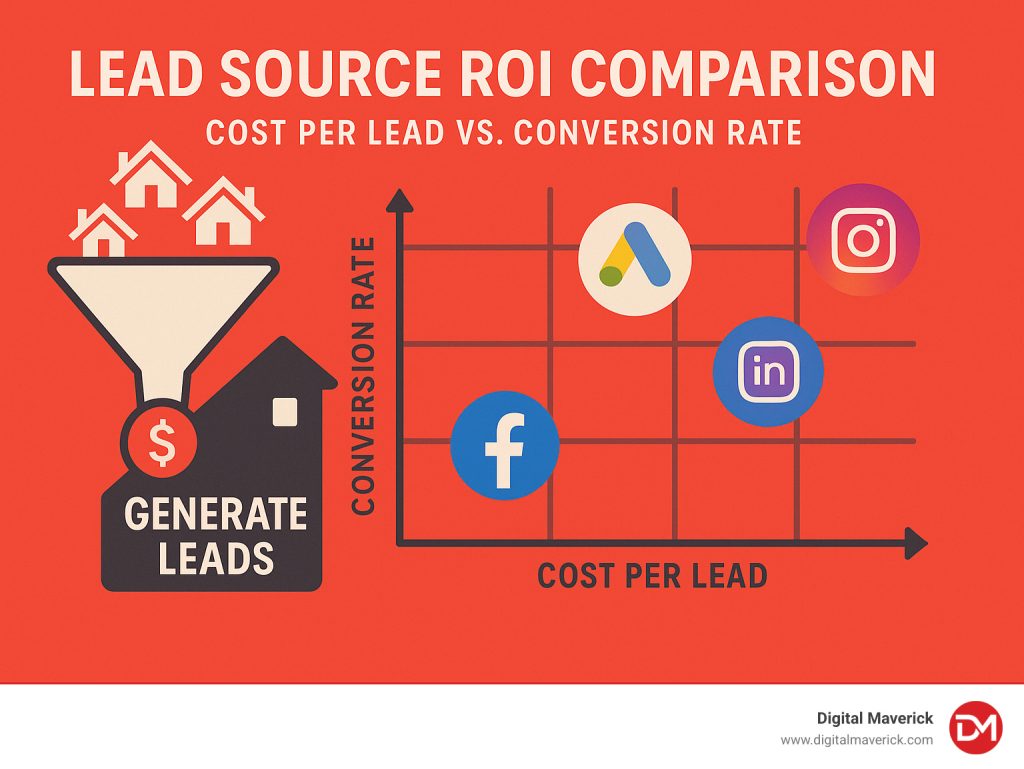
An infographic showing lead source ROI comparison with a funnel labeled "Generate Leads Real Estate" and a graph comparing cost per lead to conversion rate for Facebook, Google, LinkedIn, and Instagram. Digital Maverick logo at bottom right.

Frequently Asked Questions about Real Estate Lead Generation

How many leads do I need each month?

This is one of the most common questions I hear from agents, and the answer isn’t one-size-fits-all. Your ideal lead volume depends on three key factors:

Your conversion rate is the foundation of this calculation. Most agents convert between 0.4% and 1.2% of leads to closed deals. If you’re new to the business, start with a conservative estimate of 0.5% while you build your skills and systems.

Your income goal provides the target to work backward from. Let’s say you want to earn $100,000 annually with an average commission of $5,000 per transaction. That means you need 20 closed deals each year to hit your number.

The quality of your follow-up system dramatically impacts results. I’ve seen Digital Maverick clients double their conversion rates after implementing structured follow-up frameworks that nurture leads properly.

When you put these factors together, the math becomes clear. For a new agent targeting 20 transactions at a 0.5% conversion rate, you’d need about 4,000 annual leads—roughly 333 per month. That might sound overwhelming, but quality trumps quantity every time.

As one top-producing Digital Maverick client who closes 75+ transactions yearly told me: “I’d rather have 50 highly qualified leads than 500 cold contacts. Our focus on lead quality has allowed us to maintain a 3.2% conversion rate—well above industry average.”

Should new agents buy leads or focus on free methods?

I recommend new agents take a balanced approach that builds skills while testing paid channels:

Start by mastering free methods that build your foundation. Growing your sphere of influence, optimizing your online presence, and leveraging open houses costs nothing but time and creates sustainable momentum.

While doing this, allocate a small budget—perhaps $300-500 monthly—to test paid channels strategically. This helps you identify which platforms align best with your market, personality, and working style before making bigger investments.

Most importantly, invest in follow-up systems before scaling lead volume. A handful of well-nurtured leads will outperform hundreds of neglected ones every time.

One of my favorite success stories comes from a Digital Maverick client now in her third year: “When I started, I focused entirely on free methods for the first six months. This forced me to master the fundamentals of lead conversion before investing in paid acquisition. Now that I convert at 2.8%, my paid lead campaigns are highly profitable.”

Even “free” methods require an investment of time. I’ve found that consistency with 2-3 strategies executed regularly beats trying to do everything at once but doing it poorly.

What’s the fastest way to generate listing leads?

When agents need listing leads quickly, I point them toward these high-yield strategies:

Expired Listings offer immediate opportunity since these sellers are already motivated and have demonstrated willingness to work with an agent. They’ve raised their hand—they just need the right partner.

FSBO Outreach works best when you approach with market data and insights rather than a sales pitch. Approximately 90% of FSBOs eventually list with an agent, and the ones who appreciate your expertise (not your pressure) will remember you when they’re ready.

Geographic Farming with Predictive Analytics lets you target neighborhoods strategically. Focus on areas with high turnover rates and use AI tools to identify likely sellers before they even know they’re ready to move.

Strategic Open Houses in neighborhoods with aging demographics or high equity levels can uncover hidden sellers. Focus on meeting the neighbors, not just potential buyers for that specific property.

Sphere Activation remains powerful when done systematically. Contact everyone you know with a specific request for referrals, especially targeting those connected to typical seller demographics.

A Digital Maverick team leader shared this gem with me: “We implemented a ‘Coming Soon’ strategy that’s been incredibly effective. We secure the listing, place a ‘Coming Soon’ sign, and immediately contact neighbors. This typically generates 1-2 additional listing appointments per property.”

For teams looking to scale quickly, Digital Maverick’s ISA services provide immediate lead qualification and follow-up support, allowing agents to focus exclusively on high-probability appointments while the foundation gets built.

Conclusion

Generating real estate leads consistently isn’t about finding one magical tactic—it’s about building systems that work together across multiple channels. The agents who thrive don’t just chase the newest shiny object; they create balanced lead generation ecosystems that blend digital strategies, traditional methods, and smart technology.

We’ve seen how the right systems transform struggling teams into market leaders. We equip real estate professionals with scalable growth frameworks that combine expert conversion services, hands-on coaching, and operational rhythms that produce predictable results.

“Most agents don’t have a lead generation problem—they have a lead conversion problem,” explains our founder Jon Cheplak. “We’ve helped teams double their production without spending an extra dollar on marketing simply by implementing the right follow-up systems and accountability structures.”

Think about it: what good are hundreds of leads if they’re sitting neglected in your CRM? Our approach focuses on the critical moment when a lead becomes a conversation—and the process that turns that conversation into a closing.

The secret isn’t working harder; it’s working smarter. Our clients find that with the right operational rhythm, they can achieve more meaningful conversations each day while actually spending less time chasing dead-end prospects.

Whether you’re struggling with slow response times, a database full of untouched contacts, or a team that needs accountability, having the right partner makes all the difference. Our ISA team has become the go-to solution for ambitious real estate professionals across the U.S., providing the structure and support that turns potential into profit.

Generate leads real estate success isn’t a one-time event but an ongoing process requiring consistency, adaptation, and measurement. The strategies we’ve outlined in this guide provide a roadmap, but the magic happens when you implement them with discipline and continually refine your approach based on results.

Ready to transform your lead generation and conversion systems? Visit Digital Maverick to find how our team can help you eliminate lead waste, build scalable systems, and dramatically increase your GCI through proven frameworks built by operators—not vendors.

We partner with agents who are serious about growth and ready to install the people, training, and systems needed to create sustainable success. Because at the end of the day, real estate isn’t just about properties—it’s about the relationships that build your business for years to come.

05.19.2025

7 Amazing Resources for Seller Leads for REALTORS

Seller Leads for Realtors | Digital Maverick

Finding Quality Seller Leads for Today’s Market

For real estate agents seeking growth, seller leads for REALTORS are the lifeblood of a sustainable business. Here’s a quick overview of the most effective seller lead sources in 2024:

  1. Home Valuation Landing Pages – Convert curious homeowners with instant CMAs
  2. Geographic Farming with Predictive Analytics – Target neighborhoods with high turnover rates
  3. Pre-Foreclosure & Distressed Property Data – 30-40% of these homeowners list within 12 months
  4. Expired & FSBO Listings – Ready-to-convert sellers with immediate intent
  5. Sphere of Influence & Referral Systems – Leverage your existing network for warm leads

Finding quality seller leads for REALTORS isn’t just about volume—it’s about intent, timing, and conversion. While only about 5% of homeowners are thinking of selling at any given time, 70% choose the first agent they meet. This makes speed-to-lead and consistent follow-up crucial elements of any successful lead generation strategy.

The challenge most agents face isn’t getting leads—it’s converting them. Many REALTORS struggle with inconsistent follow-up processes, overwhelmed databases, and missed opportunities. The difference between average and top-producing agents often comes down to systems and execution, not just lead volume.

I’m Preston Guyton, founder of Digital Maverick and a real estate leader with over 20 years of experience helping teams generate and convert seller leads for REALTORS through proven systems and inside sales support. My expertise comes from building multiple successful real estate businesses focused on lead generation and conversion.

Infographic showing the 7 best sources for seller leads in real estate with conversion rates, typical costs, and key follow-up strategies for each source type - seller leads for realtors infographic

Resource #1: Geographic Farming & Smart Data

Remember the old days when agents would blanket a neighborhood with flyers and hope for the best? Those days are long gone. Today’s seller leads for REALTORS come from a perfect blend of traditional neighborhood expertise and cutting-edge data analytics.

Geographic farming has evolved from a shotgun approach to precision targeting that identifies likely sellers before they even know they’re ready to list.

Building a Seller Leads Farm That Feeds You Year-Round

Finding the right neighborhood to farm is like choosing the perfect garden plot. You need the right conditions for growth.

The ideal farm area has 300-500 homes – enough to provide consistent opportunities without stretching your resources too thin. Look for neighborhoods with at least a 6-8% annual turnover rate, which means new listings appear regularly throughout the year. And while you’re at it, avoid areas where one agent already dominates the market.

I recently spoke with Walker, a Texas agent who transformed his business through smart farming: “I picked a neighborhood with steady turnover and became the neighborhood expert by sending just-sold postcards after every transaction. Before long, neighbors started calling me before they even thought about listing with someone else.”

The most successful farming strategies create a consistent presence. Monthly market updates showing recent sales keep homeowners informed about their equity growth. Quarterly neighborhood events help you connect face-to-face with potential sellers. “Just Listed” and “Just Sold” announcements demonstrate your success and expertise. And personal touches like holiday cards or seasonal gifts ensure you stay top-of-mind when listing decisions happen.

Tech That Makes Seller Farming Smarter

This isn’t your grandmother’s farming strategy. Today’s tools use sophisticated predictive analytics to identify likely sellers before they even call an agent.

Modern analytics platforms analyze over 250 data points about homeowners to create heat maps showing properties most likely to hit the market. Research suggests they can predict over 70% of listings 6-12 months before they appear on the MLS.

Even with minimal information, modern tools can work wonders. One user told me: “I receive 20 guaranteed seller leads per zip code monthly, with 30-40% listing within 12 months.” These platforms can take address-only leads and enrich them with phone numbers, email addresses, and other contact details.

The best agents are combining these smart tools with traditional farming techniques to create a powerful listing generation system that includes:

  • Predictive heat maps highlighting homes most likely to sell soon
  • MLS data overlays that reveal off-market opportunities
  • Automated direct mail campaigns triggered by life events like work anniversaries or children reaching college age
  • Address enrichment that turns basic property information into actionable contact data

The combination of traditional farming with modern analytics gives you the best of both worlds – the personal touch that builds trust and the precision targeting that puts you in front of the right homeowners at exactly the right time.

Resource #2: AI-Powered Predictive Analytics Platforms

Remember when finding seller leads meant endless cold calls and door knocking? Those days are quickly becoming history. Today’s AI-powered platforms are like having a time machine for your real estate business—showing you who’s likely to sell months before they even decide to list.

Spotting Listings 6–12 Months Out

The magic of AI lies in its ability to connect dots that humans simply can’t see across hundreds of data points. These platforms identify subtle patterns that signal a homeowner might be ready for a change:

Life changes often trigger moves—marriage certificates filed at the county, kids heading off to college, or retirement paperwork submitted. AI systems spot these transitions and flag them as potential selling signals.

Ownership tenure is another powerful predictor. Most homeowners tend to make a move after 5-7 years in a property—right when they’ve built enough equity to comfortably upgrade.

“I reached out to a couple the AI system had flagged as likely sellers,” shares JD, a Dallas-based agent. “When I called, the wife actually laughed and said, ‘That’s spooky—we were literally discussing listing our home last night.’ I signed them two days later.”

The platforms don’t just look at public records either. They analyze online behavior like home searches and mortgage-calculator visits, plus financial indicators such as equity position and whether the owner’s mortgage rate sits significantly higher than current market rates.

As a representative from a leading predictive-analytics firm explains, “Our algorithm identifies over 70% of listings before they ever hit the market. We’re essentially giving agents tomorrow’s newspaper today.”

Budget & ROI Snapshot

Like any powerful tool, predictive-analytics platforms require investment, but the returns can be substantial:

Most services price their data by zip-code exclusivity, ranging from roughly $200-$1,000 monthly depending on the market’s value and competition. Premium packages at the higher end may include dedicated success coaching, while entry-level options around $199 per month often guarantee a minimum number of new leads in each territory.

The real value comes in the conversion lift. While traditional cold prospecting might convert at 1-2%, agents using these AI-powered platforms consistently report 2-5% conversion rates on initial outreach, climbing to 8-15% with proper nurturing systems.

Chris, a California agent who acceptd predictive analytics, puts it simply: “Working these leads is the most profitable thing I do each day. My ROI is about 7:1 compared to other lead sources, plus I’m building a reputation as the agent who somehow always knows when people are ready to move.”

When calculating your potential return, remember to factor in not just the commission from immediate conversions, but also the time saved from more targeted prospecting and the long-term value of each new client relationship.

Resource #3: Home Valuation Landing Pages

There’s something irresistible about homeowners wanting to know their property’s value. It’s like when someone takes a personality quiz—we’re all curious about what we’ve got! That’s why home-valuation landing pages continue to be gold mines for generating seller leads for REALTORS in today’s market.

Crafting a High-Converting Page

I’ve seen hundreds of these pages, and the ones that consistently deliver leads share some common elements that just work.

A compelling headline makes all the difference—something straightforward like “What’s Your Home Worth in Today’s Market?” instantly connects with a homeowner’s curiosity. Keep your form fields minimal (name, email, phone, address) because every additional field reduces conversion rates by about 4%.

Trust signals matter enormously. Think about it—would you give your contact info to a random agent? Probably not. But add some recent sales numbers, client testimonials, and your credentials, and suddenly you’re a trusted advisor rather than a stranger.

One of our clients calls these pages “the simplest, most cost-effective way I’ve found to generate seller leads,” noting that their budget now sits under $60 per month after an initial free-trial period.

Don’t forget mobile optimization! Over 60% of homeowners are grabbing their phones when that “I wonder what my home is worth” thought strikes. If your page loads slowly or looks wonky on mobile, you’re losing more than half your potential leads.

The magic happens when you drive the right traffic to these pages. Facebook and Instagram ads targeting homeowners by age, location and interests work beautifully. Google PPC campaigns can capture those actively searching valuation terms, while regular emails to your database keep your existing contacts engaged.

Follow-Up That Wins the Appointment

Here’s where most agents drop the ball. Industry research shows that adding text messaging to your follow-up can boost conversions by over 100%—yet many agents still rely solely on email.

The golden rule? Speed-to-lead. When someone requests a home valuation, they’re in a curious mindset right now. Five minutes later, they’re back to watching Netflix and your opportunity is fading.

My most successful clients use a simple but powerful sequence:

  1. Send an immediate automated response thanking them and setting expectations
  2. Call within 5 minutes (yes, minutes!)
  3. If they don’t answer, follow up with a friendly text: “Hi Sarah, I just sent your home-valuation report. What’s causing you to think about what the property is worth?”
  4. Email valuable content about market trends and neighborhood sales
  5. Keep in touch with monthly automated valuation updates showing their equity growth

“I was skeptical about these leads at first,” one agent told me, “but after implementing this follow-up system, I doubled my business in just three months. The monthly check-ins with updated values keep me top-of-mind when they’re ready to sell.”

Resource #4: Distressed & Pre-Foreclosure Data Feeds

Working with homeowners facing financial challenges can be one of the most rewarding—and reliable—sources of seller leads for REALTORS. The numbers tell the story: many data providers report that 30-40% of homeowners in pre-foreclosure end up listing their homes within a year. These aren’t just leads; they’re people who genuinely need your expertise.

Working with Sensitive Situations

When I talk with agents who excel in this space, they all emphasize the same thing: this work is about helping people first, getting listings second.

Walker, a successful agent from Texas, shared his personal approach with me: “I leveraged probate and divorce leads for listings by leading with empathy. These homeowners need solutions, not sales pitches.”

This mindset shift makes all the difference. Instead of approaching these calls as a transaction opportunity, think of yourself as a problem-solver bringing options to someone in a tough spot. When you reach out:

Lead with genuine concern for their situation. A simple “I specialize in helping homeowners explore all their options” opens more doors than pushing for a listing.

Become their educator, not their salesperson. Many distressed homeowners don’t understand all their alternatives to foreclosure, from loan modifications to short sales.

Bring value beyond the listing by connecting them with attorney referrals or financial-counseling resources. This builds immediate trust.

Help them visualize the timeline ahead. Most homeowners in distress feel overwhelmed by uncertainty—your clarity about the process becomes invaluable.

“Having resources and solutions ready made me different from agents who just wanted the listing,” shared Rick, a Texas agent who built his business on distressed-property leads. “People can tell when you genuinely want to help.”

Compliance Essentials

The sensitive nature of distressed-property leads means paying extra attention to legal requirements. Reputable data providers actively scrub their information against the DNC List before distribution.

Beyond the basics, you’ll need to stay on top of:

DNC compliance by verifying all numbers against the national registry before making calls

FCC regulations regarding autodialers and pre-recorded messages, which have specific requirements

Clear opt-out processes to respect and document when someone asks not to be contacted again

Fair Housing laws that prohibit discriminatory language or targeting in your outreach

The agents who find long-term success with distressed seller leads for REALTORS build a support network around their business. This typically includes relationships with foreclosure-defense attorneys, financial advisors who understand debt restructuring, cash buyers who can close quickly, and contractors willing to help with pre-listing repairs.

This holistic approach transforms what could be seen as “ambulance chasing” into a genuine service—helping homeowners steer one of the most challenging times in their lives while creating listing opportunities that might otherwise end up as foreclosures.

Resource #5: Expired & FSBO Prospecting Toolkits

When it comes to finding motivated seller leads for REALTORS, expired listings and For Sale By Owner (FSBO) properties are like finding gold. These homeowners have already made the decision to sell—they just haven’t connected with the right agent yet.

Scripts That Re-List the Property

Converting these leads comes down to having confident, solution-focused conversations that address what went wrong the first time around.

With expired listings, it’s all about showing what you’ll do differently. A well-known real-estate coach advises agents to “position yourself as the knowledge broker for expired listings that other agents couldn’t sell. Show them specifically what you’ll do differently.”

When I call expired listings, I’ve found success with questions like, “I noticed your home didn’t sell—what do you think was the main reason?” This opens the door for me to share three specific strategies I’d implement differently. Then I simply ask, “Would it be worth 15 minutes to show you my unique marketing plan?”

For FSBO properties, empathy goes a long way. I start with “How’s the selling process going so far?” and genuinely listen to their challenges. Then I might share, “On average, homes sold by agents sell for 17% more than FSBOs. Would you like to know why?” This approach respects their decision while offering valuable insight.

The key is positioning yourself as a problem-solver, not just another agent looking for a listing.

Multichannel Attack Plan

The magic happens when you coordinate your approach across multiple channels. The most successful agents don’t just make one call and move on—they create a consistent presence that’s hard to ignore.

Modern power-dialer solutions (starting around $60/month) have transformed how agents work these leads. Users praise these systems as “the quickest, cleanest, easiest, most affordable way to start a business,” noting that they combine lead sourcing with built-in marketing tools and have helped secure millions of listings industry-wide.

A winning strategy typically includes phone calls through the dialer, pre-recorded voicemail drops for when no one answers, brief text follow-ups that have higher read rates than emails, personalized direct mail outlining your value proposition, and even in-person door knocking with professional materials to leave behind.

Timing matters tremendously. Contact expired listings the very same day they expire, when emotions are still fresh. For FSBOs, a gentle check-in every 7-10 days works well, especially as you track their days on market. That 30-45 day mark is often when FSBO frustration peaks—the perfect moment for your follow-up.

What sets top agents apart is their commitment to creating value-added content specifically addressing common FSBO and expired-listing challenges. Instead of just asking for the listing, they become a resource—sharing market insights, pricing strategies, and marketing approaches that the homeowner hasn’t considered yet.

With the right tools, scripts, and persistent follow-up system, expired and FSBO prospects can become your most reliable source of seller leads for REALTORS in any market.

Resource #6: Your Sphere & Referral Systems

You might be overlooking your most valuable goldmine of seller leads for REALTORS—your existing contacts. According to NAR research, nearly two-thirds of sellers find their agent through a referral or work with someone they’ve used before. That’s not just a statistic—it’s an opportunity waiting to be tapped.

Automating Repeat & Referral Business

I’ve seen countless agents chase new leads while neglecting the warm relationships already in their database. The truth is, consistent communication turns past clients into future listings.

“Your existing lead database is your #1 source for real estate leads,” many industry coaches remind agents. And they’re absolutely right.

The magic happens when you create touchpoints that feel personal but don’t require daily manual effort:

Those birthday texts that arrive right on time? They matter. The monthly neighborhood updates showing how property values are climbing? They plant seeds. Those quarterly check-ins saying “Did you know your home has appreciated 12% since you bought it?” They start conversations about selling.

Jenny, an agent from Oklahoma, shared something that stuck with me: “When the market shifted, I stopped chasing cold leads and focused on nurturing my database first. The results were immediate and didn’t cost me a fortune.”

Modern CRM systems make this approach scalable. Many platforms now offer “engagement co-pilots” that handle the heavy lifting of nurturing campaigns while alerting you when it’s time for that personal phone call that makes all the difference.

Turning Buyers into Sellers

Every buyer in your database is a future seller—if you stay connected throughout their homeownership journey. This is why we talk about focusing on database management. That is the critical piece that most agents miss, and I want you to be successful.

Smart agents track life milestones that trigger moves: growing families, job changes, retirement plans. They alert clients when they hit equity milestones that make moving up possible. They cultivate relationships with first-time buyers who might become real-estate investors with the right guidance.

“We want to earn your business every single month,” as one leading platform puts it. This mindset transforms one-time transactions into lifetime relationships.

The most effective database mining involves thoughtful segmentation. Who are the natural connectors in your sphere that know everyone in town? Which past clients live in neighborhoods with high turnover? Who’s approaching that seven-year itch when many homeowners start thinking about their next move?

When you host that educational event on “When is the right time to sell?” or “Investment properties 101,” you’re not just providing value—you’re surfacing seller leads for REALTORS who might have been sitting in your database all along.

The beauty of sphere marketing is that it compounds over time. Each year you nurture these relationships, your referral business grows exponentially—creating a sustainable source of listings that doesn’t disappear when market conditions change.

Resource #7: Done-for-You Seller Lead Marketplaces

If you’d rather focus on what you do best—converting leads and closing deals—then done-for-you seller leads for REALTORS might be your perfect match. These turnkey solutions deliver a steady stream of potential sellers right to your inbox, letting you skip the generation hassle and jump straight to relationship-building.

Vetting a Vendor the Right Way

I’ve seen too many agents burn through their marketing budgets on low-quality leads. When shopping for a lead provider, ask these crucial questions:

“How exactly do you qualify these leads?” You want to understand their vetting process—are they just collecting names, or truly identifying seller intent?

Look for guarantees on lead volume or quality, and be sure that leads are delivered exclusively to you rather than shared with multiple agents.

Contract flexibility matters too. Can you test the waters without signing your life away? The best vendors offer short-term options to prove their value before you commit long-term.

Don’t overlook practical details like CRM integration. A seamless flow of leads into your existing systems can save hours of manual data entry and prevent opportunities from slipping through the cracks.

Calculating True ROI

When evaluating lead services, looking beyond the sticker price reveals the true value:

Lead cost vs. GCI isn’t just simple math. If you’re paying $500 monthly for leads that generate one $9,000 commission, that’s an 18x return—not bad at all.

The time savings factor is often overlooked. What could you accomplish with the hours you’d normally spend on lead generation? More client meetings? Family time? Self-care?

Consider the lifetime value of each client relationship. That seller might buy their next home with you, refer friends, or become an investor client down the road.

Some platforms now offer performance-based pricing models—only charging when you close a deal—while others stick with predictable monthly fees, giving you budget certainty regardless of market fluctuations.

As one delighted agent shared, “I have been able to connect with more sellers than ever before using home-valuation leads. It takes the pain of managing ads off my plate.” That relief is sometimes worth as much as the leads themselves!

At Digital Maverick, we help teams analyze conversion metrics at every stage and across different channels—from lead to listing appointment to closed deal. We’ve found that seemingly small improvements in conversion rates can dramatically impact your bottom line. After all, increasing your lead-to-listing conversion from 3% to 5% means 66% more business from the same lead volume.

The right lead marketplace isn’t just about quantity—it’s about finding the quality and support that matches your conversion strengths. When those elements align, your listing pipeline can transform from a trickle to a steady flow.

Frequently Asked Questions about Seller Leads for REALTORS

What are seller leads for REALTORS?

When we talk about seller leads for REALTORS, we’re referring to potential home sellers who’ve shown some interest in listing their property. These leads exist on a spectrum—from the highly motivated expired-listing owner who’s ready to try again, to the curious homeowner who just wants to know what their property might be worth in today’s market.

The quality of these leads really comes down to a few key factors. Timeline is a big one—is this someone looking to sell next month or just testing the waters for next year? Motivation matters too—a job relocation creates more urgency than someone casually considering downsizing. Property condition and equity position also play crucial roles in determining how quickly and smoothly a potential listing might progress.

As one of our data enrichment partners puts it: “We deliver full lead records with complete contact info; quality depends on the conversation and empathy shown by agents.” This highlights an important truth—even the best lead is only as good as the agent’s ability to connect and build trust.

How do seller leads for REALTORS differ from buyer leads?

There’s a world of difference between seller and buyer leads, which is why many successful agents eventually specialize in one or the other.

Seller leads for REALTORS typically offer higher overall value since they often convert to both a listing and a subsequent purchase. They’re also much rarer—only about 5% of homeowners are seriously considering selling at any given time, compared to the much larger pool of potential buyers.

I’ve noticed that seller motivation tends to be driven more by life changes (marriage, divorce, job changes, empty nest) rather than market conditions. This creates more predictable timelines and often more committed clients once they decide to move forward.

Industry data shows that seller leads convert at roughly six times the rate of buyer leads. This dramatically higher conversion rate justifies the typically higher acquisition cost for quality seller leads. When you’re working with sellers, you’re often dealing with fewer “tire-kickers” and more serious decision-makers.

What’s the fastest way to nurture seller leads into listings?

In my experience working with thousands of agents, the most effective nurturing strategy combines speed, value, and genuine persistence.

Speed-to-lead is absolutely critical—contact new leads within 5 minutes whenever possible. The data is shocking: conversion potential drops by 80% after just the first hour. This is why many of our Digital Maverick clients implement 24/7 response systems.

Beyond that initial contact, success comes from a thoughtful multi-channel approach. A phone call creates connection, texts provide convenience, emails deliver detailed information, and occasional direct mail stands out in our digital world.

What you communicate matters just as much as how. Seller leads for REALTORS respond best to value-driven content—neighborhood-specific market insights, detailed CMA information, and equity analysis that helps them make informed decisions.

Research shows that texting in the sales process with a qualified lead can increase conversions by over 100%, highlighting the importance of meeting potential clients where they are most comfortable communicating.

The most successful nurturing sequence I’ve seen looks something like this: immediate response within minutes, follow-up with value-add content within 24 hours, weekly check-ins with relevant market updates for the first month, then monthly valuation updates and personalized check-ins thereafter. This consistent, value-first approach builds trust over time and positions you as the obvious choice when they’re ready to list.

Conclusion

Finding quality seller leads for REALTORS is just the first chapter of your success story. What truly separates thriving agents from struggling ones isn’t just lead volume—it’s having reliable systems to nurture, convert, and close those opportunities consistently.

At Digital Maverick, we’ve walked in your shoes. We understand the frustration of watching promising leads slip through the cracks or feeling overwhelmed by follow-up tasks. That’s why we’ve built our business around equipping real estate teams with growth systems that actually work in the real world.

Our approach isn’t about quick fixes or flashy marketing gimmicks. We focus on eliminating lead waste while creating predictable growth through proven frameworks. When you partner with us, you’re not just getting another vendor—you’re gaining a team that’s committed to your success.

What makes the Digital Maverick advantage so powerful? It starts with clear daily reporting and accountability metrics that keep everyone focused on what matters. Our tactical playbooks provide step-by-step guidance for turning conversations into closings, while our real-time coaching helps agents overcome objections and close more deals.

Perhaps most valuable is our full-service conversion support. From that critical first touch to the final signature at closing, we ensure no opportunity gets overlooked. The result? Higher ROI from your existing database, more efficient ad spend, and CRM investments that finally deliver on their promise.

As the real estate market continues its evolution, the agents who will thrive won’t be the ones with the biggest advertising budgets—they’ll be the ones with systematic approaches to generating and converting seller leads for REALTORS. By implementing the resources outlined in this guide and partnering with experts who truly understand the conversion process, you can build a sustainable business focused on listings.

The journey from lead to listing doesn’t have to be complicated, but it does require intention and consistency. With the right partner by your side, you can transform your approach to seller leads and watch your business grow in ways you never thought possible.

Ready to take the next step? Let’s talk about how Digital Maverick can help you implement these strategies with proven systems and support. Your future sellers are out there—let’s help you find them.

More info about our growth systems

05.19.2025

Beginner’s Guide to Finding Home Buyer Leads

Master Home Buyer Leads | Digital Maverick

Mastering Home Buyer Leads: The Foundation of Real Estate Success

Home buyer leads are potential clients actively searching for a property to purchase. They form the lifeblood of any successful real estate business and require strategic acquisition and nurturing to convert into closed transactions.

Quick Guide to Home Buyer Leads
1. Definition: Potential clients actively looking to purchase property
2. Types: Online (portals, social media, IDX websites) and offline (open houses, referrals, networking)
3. Average Cost: $30-$300+ per lead depending on quality and exclusivity
4. Conversion Rate: Typically 0.4% to 1.2% from lead to closed transaction
5. Best Practices: Respond within 5 minutes, use multi-channel follow-up, implement consistent nurturing

Maintaining a healthy pipeline of buyer leads isn’t just helpful—it’s essential for sustainable growth.

Yes, you may want seller leads, and you should. Just remember that most buyers are also sellers, and in the majority of cases, people start looking for their next property (and searching for infotainment purposes more frequently) before they decide to discuss listings. By identifying these buying signals, you’ll gain more buyer and more seller leads.

Whether you’re a solo agent looking to establish yourself or a team leader aiming to scale, your ability to consistently generate and convert home buyer leads will determine your success.

The challenge? Most real estate professionals struggle with inconsistent lead generation, poor follow-up systems, and inefficient conversion strategies. This guide will help you overcome these problems with proven tactics that work in today’s market.

I’m Preston Guyton, co-founder of Digital Maverick where I’ve spent over 20 years helping real estate teams implement effective home buyer lead generation and conversion systems that significantly increase closed transactions and GCI. My experience has shown that the difference between struggling and thriving teams isn’t just about getting more leads—it’s about having the right systems to maximize every opportunity.

Comprehensive home buyer lead generation funnel showing online and offline sources, qualification process, nurture sequences, and conversion points with average metrics at each stage - home buyer leads infographic  - home buyer leads infographic

Why this guide matters

According to the National Association of REALTORS®, about 32% of real estate professionals generate business through third-party lead providers. Yet many agents fail to create sustainable businesses because they don’t understand the complete lead lifecycle—from generation to nurturing to conversion.

This guide provides a comprehensive roadmap for establishing a consistent flow of qualified home buyer leads, whether you’re just starting out or looking to scale your existing operation. We’ll cover everything from defining what makes a quality lead to implementing systems that convert those leads into closed transactions.

What Are Home Buyer Leads & Why They’re Essential

Home buyer leads are potential clients who have shown interest in purchasing property, and the majority of time, they will also be listing a property. These aren’t just names in your database—they’re real people at different stages of their homebuying journey, from those just starting to browse listings online to serious prospects who are actively touring homes and securing financing.

Think of these leads as the seeds of your future commissions. Without consistently planting and nurturing them, your business will inevitably experience those dreaded feast-or-famine cycles that keep many agents up at night.

As one of our top-producing partners puts it: “Think of lead generation like farming, not hunting. If you only plant seeds at harvest time, you’ll always have dry spells.” This mindset shift—from reactive to proactive—is often what separates sustainable businesses from struggling ones.

The conversion math tells a compelling story about why home buyer leads matter so much:

  • With an average commission of $9,000
  • And a typical conversion rate of 1% (industry average ranges from 0.4-1.2%)
  • Each lead in your pipeline represents approximately $90 in potential revenue

This simple calculation reveals something powerful: even small improvements in either generation or conversion can dramatically impact your income. Boost your conversion from 1% to 2%? You’ve effectively doubled your business without spending an extra dollar on marketing.

Understanding the buyer journey helps you meet prospects where they are:

  1. Awareness: The moment someone realizes they might want to buy a home
  2. Consideration: Their research phase—exploring neighborhoods, price points, and financing options
  3. Decision: The active phase of touring homes and submitting offers
  4. Post-Purchase: Moving in and potentially becoming your advocate through referrals

Each stage requires different approaches, messaging, and nurturing strategies to move leads forward. According to NAR data, approximately 32% of real estate professionals rely on third-party lead providers to fill their pipelines, yet many struggle to convert these opportunities due to poor understanding of this journey.

Research on word-of-mouth marketing shows that referrals remain the highest-converting lead source, with prospects being 4x more likely to buy when referred by someone they trust. This underscores why nurturing every lead—even those not ready to buy immediately—creates long-term value beyond the immediate transaction.

The quality of your home buyer leads matters as much as quantity. A smaller pool of highly-engaged prospects will always outperform a massive database of unqualified contacts. As we’ll explore in later sections, distinguishing between different lead types and tailoring your approach accordingly is crucial for maximizing your return on investment.

Primary Categories of Home Buyer Leads

Not all home buyer leads are created equal. Understanding the different categories will help you allocate your resources effectively and set appropriate expectations for conversion rates.

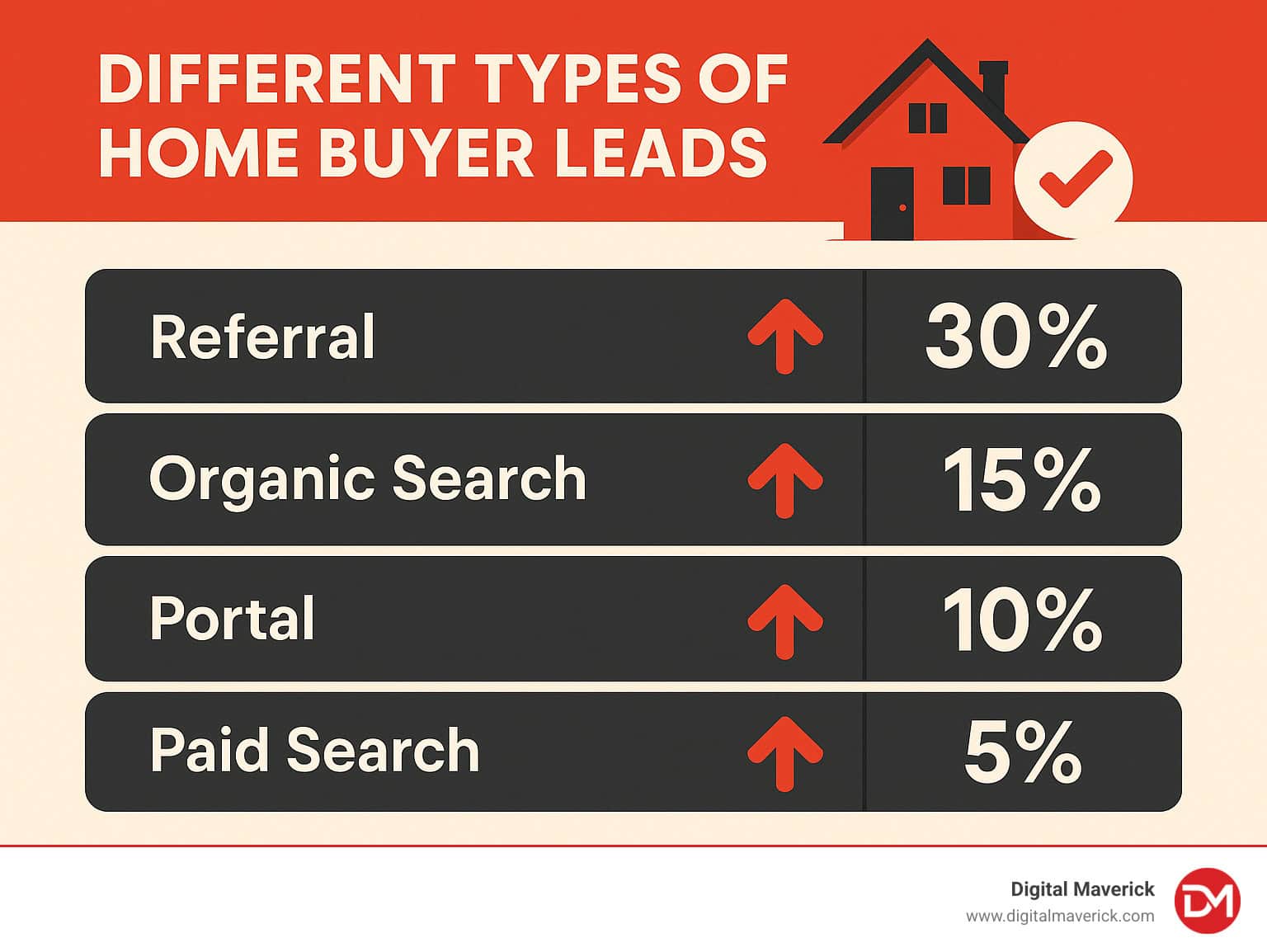
Different types of home buyer leads with their typical conversion rates  - home buyer leads infographic  - home buyer leads infographic

When I first started generating leads, I was shocked by how differently they performed based on their source. Think of your lead sources like different types of fishing spots—some yield trophy catches while others provide a steady stream of smaller fish. Both have their place in a well-rounded strategy.

The real estate world typically divides leads into several key categories: paid versus organic, online versus offline, exclusive versus shared, and warm versus cold. Each has distinct characteristics that affect not just cost, but also how you should approach nurturing them.

Paid leads typically require immediate investment but can deliver quicker results, while organic leads build more slowly but often convert at higher rates. Similarly, exclusive leads might cost more upfront but won’t be shopped to multiple agents, unlike shared leads which may come at a lower price point but face more competition.

Understanding lead intent is crucial too. A lead who’s just starting their research journey needs very different nurturing than someone who’s mortgage-approved and ready to tour homes this weekend.

Online Home Buyer Leads

The digital revolution has transformed how we find clients, with online leads now representing the fastest-growing segment in real estate lead generation.

Search PPC (Pay-Per-Click) Leads capture active buyers right when they’re searching for properties. When someone types “homes for sale in Austin” or “best neighborhoods for families in Portland,” your ads can appear at the perfect moment. CINC’s platform, which starts around $900 monthly for solo agents, can be particularly effective for capturing this high-intent traffic.

Social Media Leads work differently—they often catch people earlier in their journey. Facebook, Instagram, and TikTok allow you to target based on life events (like marriage or new jobs) that often trigger moves. I’ve seen agents have great success with carousel ads showcasing local neighborhoods or video tours. Market Leader’s Network Boost reaches about 10 million consumers monthly through these channels, generating approximately 1 million leads yearly.

IDX Website Leads come from your own digital home base. When optimized correctly, your website becomes a 24/7 lead generation machine. The magic happens when you pair property search capabilities with smart lead capture tools like saved search alerts or neighborhood guides. One agent I coached saw a 300% increase in leads after adding a simple “What’s My Home Worth?” widget from ez Home Search.

Real Estate Portal Leads bring volume but at a price. These major platforms attract millions of active shoppers monthly, making them valuable sources despite their higher costs—typically $20-$60 per lead in smaller markets and $1,000+ monthly in major metros. The key is having systems ready to quickly engage these leads before they contact other agents.

Chatbot & AI-Generated Leads represent the cutting edge of lead generation. Modern AI tools like Offrs’ RAIA can engage website visitors around the clock, qualifying prospects through natural conversations before they ever speak with you. One team I worked with increased their lead-to-appointment ratio by 40% after implementing AI chat on their site.

Offline Home Buyer Leads

Despite our digital world, traditional methods still deliver exceptional results when executed with creativity and consistency.

Open Houses remain powerful lead generators when you approach them strategically. As one of my coaching clients likes to say, “Most open houses feature a cheese plate, a few nosy neighbors, and a bored agent.” Make yours memorable! Try themed events like “Sunset Showcase” with wine and cheese, or neighborhood walking tours that start at your listing. The agents who treat open houses as marketing events rather than chores consistently outperform their peers.

Networking & Referrals still form the backbone of sustainable real estate businesses. Research on word-of-mouth marketing confirms what successful agents already know—personal recommendations drive the highest-converting leads. Developing a strong sphere of influence creates a referral engine that grows more powerful over time, especially when you consistently provide value between transactions.

Direct Mail has made a surprising comeback in recent years. In a world of digital overwhelm, a well-designed physical mailer can cut through the noise. The most successful campaigns target specific neighborhoods or demographics and include clear calls to action that bridge to digital follow-up.

Community Events position you as a local expert while naturally generating leads. I’ve seen agents host first-time homebuyer workshops, neighborhood block parties, and even outdoor movie nights at listed properties. These experiences create meaningful connections that digital advertising simply can’t match.

The most successful agents don’t rely on just one category—they build a diverse lead portfolio that balances immediate results with long-term sustainability. Like a smart investor, they spread their resources across different lead types to maximize returns while minimizing risk.

10 High-ROI Tactics to Generate Home Buyer Leads in 2024

Ready to fill your pipeline with qualified home buyer leads? Let’s explore strategies that actually work in today’s market—not just theory, but tactics real agents are using to grow their businesses right now.

1. Build a Local SEO Engine

The beauty of search engine optimization is that it keeps working for you long after you’ve put in the effort—like planting a tree that bears fruit year after year.

Your local SEO strategy should focus on being the neighborhood expert buyers turn to first. Create detailed content hubs about specific communities, with insider information on schools, parks, restaurants, and market trends that generic websites simply don’t have.

“The key to local SEO is thinking like a buyer,” explains Trevor, a former agent who now coaches top producers. “What specific questions are they asking about neighborhoods, school districts, or commute times? Answer those questions comprehensively, and Google will reward you.”

Don’t forget to optimize your Google Business Profile with consistent, accurate contact information. When someone searches “real estate agent near me,” you want your name popping up with glowing reviews attached.

2. Launch Targeted Social Campaigns

Social media isn’t just for sharing listing photos anymore—it’s a sophisticated targeting machine that can put you in front of people right when they’re thinking about buying.

Meta ads (Facebook and Instagram) can target people experiencing major life changes—like marriage, new jobs, or growing families—all signals someone might be house-hunting soon. Our research shows these life-event triggers convert at significantly higher rates than generic demographics.

Consider partnering with local micro-influencers who already have the trust of your target audience. These collaborations feel more authentic than traditional advertising and can generate warm leads who already feel connected to you. According to our data, brands working with micro-influencers see sales increases up to 18%, and 63% of younger consumers trust influencer recommendations more than brand messages.

Short-form video content on platforms like Instagram Reels or TikTok can showcase your personality while delivering valuable market insights. One agent I know gained 15 new buyer clients after her “10 Hidden Gems in Portland Under $400K” video went locally viral.

3. Master Paid Lead Platforms

Paid lead platforms offer something invaluable: predictability. When your business needs a steady flow of prospects, these services can deliver—though quality varies dramatically.

Before investing, understand what you’re really paying for. Exclusive leads typically convert 3-5 times better than shared leads, but they’ll cost you more upfront. A basic lead might cost $30, while a qualified, exclusive lead could run $300+.

“The key is understanding your conversion metrics,” says Joe Rosen, an agent who built his business using paid lead platforms. “If you know your close rate and average commission, you can calculate exactly how much you can afford to pay per lead and still be profitable.”

For example, premium lead services offer guaranteed exclusive leads starting at $139 plus $25 per lead, with some programs delivering approximately 25+ leads for $399/month, depending on your market competitiveness.

4. Deploy AI & Automation

AI tools aren’t replacing agents—they’re supercharging the ones who accept them. The right automation can help you nurture 10x more leads without working longer hours.

Imagine having a system that scores every lead based on their behavior, automatically prioritizing the hot prospects ready to make moves. Or AI-crafted email templates that sound like you wrote them personally, but scale across hundreds of contacts.

At Digital Maverick, we’ve seen agents boost their reply rates to over 50% using smart, AI-driven nurture sequences—dramatically outperforming traditional “check-in” emails that feel generic and forgettable.

The real magic happens when your website can analyze user behavior and respond accordingly. When someone views multiple properties in the same neighborhood or price range, that’s a buying signal your system should catch, triggering personalized outreach that acknowledges their specific interests.

5. Host Memorable In-Person Experiences

Face-to-face experiences stand out more than ever. The standard open house with a plate of cookies won’t cut it anymore—you need to create memorable moments that get people talking.

I’ve seen agents transform ordinary showings into events that buyers actually look forward to attending. Think themed open houses like “Coastal Living Night” for waterfront properties, complete with a local chef preparing seafood bites, or “Design Your Dream Space” workshops where potential buyers can visualize themselves in the home.

One particularly creative agent in a beach community organized “underwater virtual showcases” for waterfront properties, creating an immersive experience that not only attracted serious buyers but also local media attention—giving her free publicity that generated even more home buyer leads.

Community workshops on topics like “Navigating the Mortgage Process” or “First-Time Homebuyer Secrets” position you as a helpful expert rather than just another salesperson, building trust before buyers are even ready to tour homes.

6. Combine Sphere & Referral Marketing

Your existing relationships remain your most valuable asset. People who know, like, and trust you are not only more likely to work with you themselves but also to send others your way.

The key is staying top-of-mind without being annoying. Regular, value-added touchpoints through personalized emails, social media engagement, and occasional direct mail keep you connected. But the real magic happens with micro-events—small, intimate gatherings like coffee meetups or dinner parties that strengthen relationships in ways digital communication simply can’t.

“Where do Realtors get most of their leads? Effective agents blend paid platforms with traditional methods like networking, referrals, open houses, and free social-media tactics,” our research confirms.

For new agents especially, simply letting your social circles know you’re in real estate can jumpstart your business. Join clubs, sports teams, volunteer organizations—anywhere you can authentically connect with potential clients while contributing to your community.

7. Leverage Data & Predictive Tools

Today’s data tools can help you identify potential buyers before they even list themselves as “in the market”—giving you a massive competitive advantage.

Geo-farming has evolved beyond just sending postcards to the same neighborhood repeatedly. Now you can use predictive analytics to target areas with high turnover probability or households showing “move likely” signals based on factors like property tenure, life events, and online behavior.

Quality predictive analytics services aggregate data from over 25 sources to achieve 72% accuracy in predicting homeowners likely to move within 18 months. Similarly, advanced AI has developed models that can predict inherited property sales with 40% precision within a 50-mile radius—identifying potential sellers (and thus, creating opportunities for your buyers) before traditional methods would catch them.

8. Optimize for Compliance & Privacy

As lead generation becomes more sophisticated, staying compliant with privacy regulations isn’t just about avoiding fines—it’s about building trust with potential clients.

Every call, text, and email you send needs to comply with regulations like the TCPA (Telephone Consumer Protection Act) and CAN-SPAM Act. Make sure you’re regularly scrubbing your contact lists against the DNC (Do Not Call) registry, and that all your lead capture forms have clear, explicit opt-in mechanisms.

Quality lead management tools automatically handle compliance issues by scrubbing phone numbers against the Do Not Call list, giving you peace of mind while cold calling expired or FSBO leads that might connect you with potential buyers.

9. Track ROI & Conversion Metrics

Without tracking your results, you’re essentially flying blind. The most successful agents know exactly which lead sources deliver value and which are draining their budget.

Focus on these critical metrics:

  • Cost Per Lead (CPL): What you’re paying to acquire each prospect
  • Cost Per Acquisition (CPA): Your all-in cost to acquire a closed client
  • Speed-to-Lead: How quickly you’re responding to inquiries (aim for under 5 minutes)
  • Pipeline Velocity: How efficiently leads move through your sales process

“You should calculate your monthly ROI—if your lead spend leads to enough closed transactions, paid leads can be worthwhile,” our research confirms. This calculation should include not just the direct cost of the leads but also the time and resources required to nurture and convert them.

10. Tailor Strategy: New Agents vs Teams

Your lead generation approach should match your experience level and team structure. What works for a solo new agent won’t necessarily work for an established team with dedicated roles.

For new agents, start with low-cost methods that leverage your existing relationships and build your conversion skills. Focus on becoming the go-to expert in a specific neighborhood or niche where you can outshine even established agents through deeper local knowledge.

For teams, implement specialized roles for lead generation, nurturing, and closing. Invest in more sophisticated technology and analytics that can distribute leads efficiently and track performance across team members. Consider comprehensive end-to-end solutions starting at $899/month for solo agents or $1,299/month for teams.

The best strategy combines multiple approaches, creating a diverse lead pipeline that can weather market changes and algorithm updates. As one of our coaching clients puts it: “The agents who survive any market are the ones who never rely on just one source of home buyer leads.”

Following Up, Nurturing & Converting Leads

Getting home buyer leads is just the beginning. The real magic happens when you nurture those connections and turn them into happy homeowners – and commission checks.

Conversion workflow showing the progression from initial lead capture through nurturing stages to closed transaction - home buyer leads infographic

If there’s one thing I’ve learned after years in this business, it’s that speed matters. A lot. Responding to a new lead within 5 minutes makes you 9 times more likely to convert them than waiting half an hour. Think about it – when someone’s excited about buying a home, they want answers now, not tomorrow.

At Digital Maverick, we’ve seen incredible results with a multi-channel approach. We immediately send a friendly text acknowledgment, follow up with a phone call within those crucial first 5 minutes, email helpful resources, send a personal video text (people love seeing a real face!), and use retargeting ads to stay on their radar. This wraparound strategy keeps leads engaged and prevents them from wandering off to other agents.

Assessing Lead Quality

Let’s be honest – not every lead deserves the same amount of your precious time. Learning to quickly spot the difference between tire-kickers and serious buyers will save you countless hours and frustration.

When evaluating lead quality, pay attention to their digital body language. Are they opening your emails? Clicking links? Revisiting your website multiple times? These engagement signals speak volumes. Also consider practical factors like their pre-approval status, timeline (are they looking to move next month or next year?), and their core motivation for moving.

I recommend using a simple A/B/C grading system to keep things organized:

A Leads are your hot prospects – ready to buy within 30 days, pre-approved, and actively engaging with your content. These deserve your immediate and consistent attention.

B Leads have a 1-3 month timeline, are working on financing, and show moderate engagement. Keep them warm with regular value-added touchpoints.

C Leads are looking 3+ months out with uncertain financing and minimal engagement. Don’t ignore them, but put them on a longer-term nurturing plan.

This simple classification helps you prioritize your efforts where they’ll have the biggest impact while making sure no lead falls through the cracks.

Best Practices for Conversion

Converting home buyer leads into clients isn’t about luck – it’s about having a system and sticking to it religiously.

For new leads, implement what I call the “10-day blitz” – an intensive follow-up sequence that starts with multiple touchpoints on day one (call, text, email), followed by value-add content on day two (perhaps a neighborhood guide or market report), another check-in call on day three, and alternating touchpoints through day ten. This approach demonstrates your professionalism and persistence without crossing into annoying territory.

For longer-term nurturing, develop a consistent rhythm. Start with 3-5 touches in the first week, then taper to 1-2 weekly touchpoints for the next few weeks. By months 2-3, weekly value-add content keeps you top of mind, and beyond that, bi-weekly or monthly check-ins maintain the connection until they’re ready to move forward.

Video texting has been a game-changer for many of our clients. In a world of faceless digital communication, a quick 30-second video introducing yourself creates an instant personal connection. Property highlight videos and neighborhood tours add tremendous value and showcase your local expertise.

And don’t forget to master those common objection handlers. When a lead says “I’m just looking right now,” respond with warmth: “Perfect! Most of my clients start by just looking. What specifically are you hoping to find?” This acknowledges their position while gently moving the conversation forward.

As Trevor, who sold 150 homes during his transition from agent to coach, wisely notes: “Conversion isn’t about pressure—it’s about consistency and adding value at every touchpoint. The agents who win are the ones who stay in the game longer than their competition.”

Integrating Tech Stack

A thoughtfully connected technology ecosystem can transform your lead management from chaotic to clockwork.

Start with seamless CRM synchronization. Every lead source should feed directly into your CRM without requiring manual data entry. This eliminates dangerous delays and human error while ensuring leads are automatically routed to the right team member based on territory or expertise.

Next, leverage marketing automation to keep conversations flowing. Set up behavior-triggered email sequences that respond to specific actions (like viewing a particular property multiple times), automated text message follow-ups that feel personal but don’t require your constant attention, and smart reminders that prompt you when it’s time for a personal touchpoint.

Finally, implement reporting dashboards that give you real-time visibility into what’s working and what isn’t. Track your key performance indicators, monitor conversion rates by lead source, and quickly identify bottlenecks in your sales process.

At Digital Maverick, we help teams build tech stacks that eliminate lead waste and maximize conversion. But we don’t just set it and forget it – we conduct regular CRM audits and establish accountability metrics to ensure the system continues working as intended. Because the best technology in the world only works when it’s properly maintained and actually used.

More info about growth systems

Frequently Asked Questions about Home Buyer Leads

What’s the average cost of purchasing home buyer leads?

Let’s talk money—because this is probably what you’re most curious about! The cost of home buyer leads varies dramatically depending on quality, whether they’re exclusively yours, and your local market conditions.

At the lower end, basic shared leads might cost you $30-$50 each. These are typically less qualified prospects who might be shopping around with multiple agents. Moving up the quality ladder, mid-tier leads typically run $50-$150 each, while premium exclusive leads with serious buyers can cost anywhere from $150 to over $300 per lead.

If you’re looking at specific platforms, here’s what you might expect to pay:

Premium lead services charge around $20-$60 per lead in smaller markets but can easily run $1,000+ monthly in major metropolitan areas. Some providers start at $189 monthly plus $30-$50 per lead, while others have a different model at $899 monthly for solo agents with leads included. Some services offer buyer leads for approximately $12 each.

Remember though—the raw cost per lead isn’t nearly as important as what you do with those leads. A $200 lead that converts at 5% delivers way more value than a $20 lead with a 0.1% conversion rate. It’s all about the return, not just the investment!

Are exclusive home buyer leads worth the premium?

In a word: usually! Exclusive home buyer leads typically convert at 3-5 times the rate of shared leads, which often justifies their higher price tag.

Think about it from the buyer’s perspective—when they submit their information and suddenly get bombarded by five different agents all claiming to be the neighborhood expert, it creates a terrible first impression. With exclusive leads, you’re not competing in a race to the bottom with other agents desperately trying to win the same prospect.

The benefits of exclusivity include building trust more easily (since the buyer isn’t juggling multiple agent relationships), having proper time to nurture the lead, and creating a more professional experience overall.

Quality lead providers guarantee specific numbers of exclusive leads monthly that won’t be shared with competitors. Similarly, some premium programs in selected areas ensure only one agent works each buyer lead.

That said, exclusivity doesn’t automatically mean quality. I’ve seen expensive exclusive leads that went nowhere, and shared leads that turned into million-dollar transactions. Always evaluate based on engagement signals, motivation factors, and timeline—regardless of whether you’re the only agent in their inbox.

How can I measure the true ROI of my lead-generation efforts?

This is where many agents struggle—knowing whether their lead gen is actually paying off. Calculating your true return on investment means tracking several interconnected metrics.

First, you need to understand your total investment, which includes the obvious direct costs like platform fees and advertising spend. But don’t forget the hidden costs—the hours you spend nurturing leads, the technology tools you pay for, and even the opportunity cost of what else you could have done with that time and money.

On the return side, track your closed transaction volume, commission revenue, and—this is important—the referral business generated from those leads over time. A lead that becomes a client who refers three friends is vastly more valuable than one who simply buys a home and disappears.

The key performance indicators worth monitoring include your cost per lead, cost per appointment, cost per closed transaction, and the lifetime value of the clients you acquire. At Digital Maverick, we build clear daily reporting and accountability metrics into every plan so our clients can make data-driven decisions about scaling what works and cutting what doesn’t.

Here’s a simplified ROI calculation to get you started: If you spend $5,000 on leads in a month and close two transactions with an average commission of $9,000 each, your gross return is $18,000 on a $5,000 investment—that’s a 360% ROI before accounting for your time and operational costs.

The best agents I know review these numbers monthly and adjust their strategy accordingly. They don’t just blindly spend on leads—they invest in systems that maximize the return on every dollar and minute they put into their business.

Conclusion

Generating and converting home buyer leads is both an art and a science. The most successful real estate professionals combine strategic systems with authentic relationship-building to create sustainable businesses.

At Digital Maverick, we’ve seen how implementing the right lead generation and conversion systems can transform real estate businesses. Our clients benefit from:

  • Eliminating lead waste through proper tracking and follow-up
  • Building scalable systems that support sustainable growth
  • Generating more high-quality leads through targeted strategies
  • Increasing GCI without proportionally increasing workload
  • Open uping higher ROI from existing database, ad spend, and CRM investments

What sets our approach apart is that we’re built by experienced operators who have scaled real estate businesses—not marketing agencies. We provide full-service conversion support, from ISAs to coaching to CRM automation, all backed by clear daily reporting and accountability metrics.

The journey from lead to client isn’t always straightforward, but with the right systems and support, you can create a predictable pipeline that delivers consistent results.

Whether you’re just starting out or looking to scale your existing business, success with home buyer leads comes down to three fundamental principles:

  1. Consistency: Implement daily lead generation activities rather than sporadic efforts
  2. Quality: Focus on leads with genuine motivation and capability to purchase
  3. Systems: Build repeatable processes that don’t depend on individual heroics

By applying the strategies outlined in this guide and continuously refining your approach based on results, you’ll be well on your way to mastering the art and science of home buyer leads.

For more information about how Digital Maverick can help you implement scalable growth systems that turn leads into conversations—and conversations into closings—visit our offerings page.

08.24.2022

Digital Maverick

It’s critical that we meet you where you are NOW, at the intersection of your Single Most Greatest obstruction to growth and our specific solution that will break you through. This is why we do not offer a cookie-cutter program – it’s more like an (un)program – that is specific to you.